
How Do You Maintain a Human Touch in Outreach When Using an AI Sales Assistant?
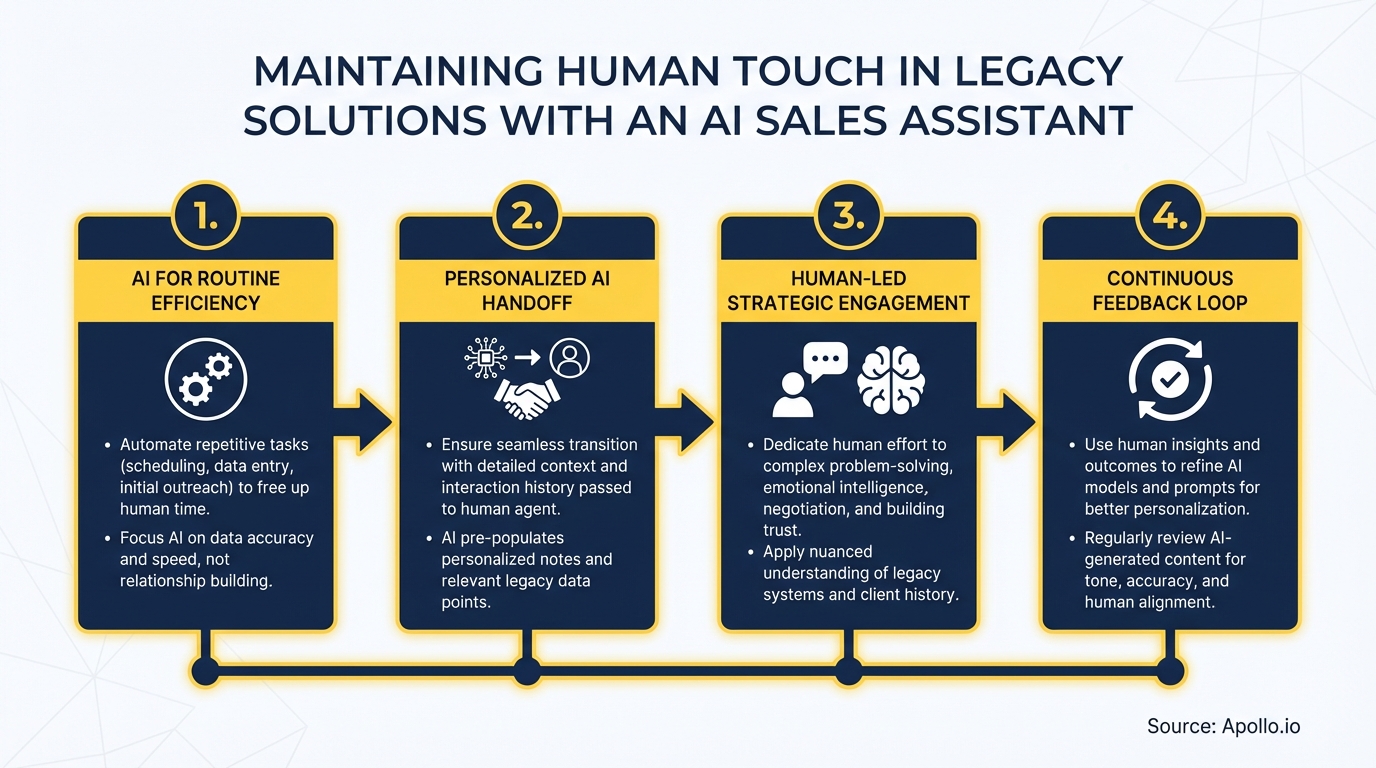
Maintaining a human touch when using an AI sales assistant means designing deliberate review steps where reps add judgment, empathy, and context before messages reach prospects. AI handles the research, drafting, and sequencing. Humans own the voice, the timing, and the moments that matter. Tools like Apollo's AI Sales Assistant are built around this principle: automate the busywork, but keep the rep in control of what gets sent and when.
The stakes are real. According to Gartner, by 2030, 75% of B2B buyers will prefer sales experiences that prioritize human interaction over AI. That doesn't mean abandoning AI. It means knowing exactly where to step in. Check out how to use sales automation the right way for the foundational framework.

Let Apollo Find Your Next Buyer
Tired of burning hours verifying contact info that goes nowhere? Apollo surfaces accurate, ready-to-engage prospects so your reps spend time selling, not searching. Over 600K companies have already made the switch.
Start Free with Apollo →Key Takeaways
- Human touch in AI-assisted outreach is about when and how reps intervene, not whether they use AI at all.
- AI should own research, drafting, and sequencing. Reps should own tone, judgment, and high-stakes moments.
- Authenticity signals like named reps, direct phone numbers, and real calendar links build trust that generic personalization cannot.
- SDRs and AEs need a clear escalation architecture: defined handoff points where humans take over from automated sequences.
- Grounding AI outputs in your specific ICP and value proposition prevents the generic "AI sameness" that buyers now easily detect.
Why Does Human Touch Still Matter in AI-Assisted Outreach?
Human touch matters because buyers can now detect generic AI outreach instantly, and they respond to it accordingly. Research from Chameleon Sales found that 76% of B2B decision-makers still prefer to interact with a real person during the buying process. As AI-generated volume increases, authentic human presence becomes a competitive differentiator, not a fallback.
The challenge is not choosing between AI and human effort. It's designing a workflow where both play their correct role.
AI excels at scale, speed, and consistency. Humans excel at diagnosis, empathy, and navigating ambiguity.
Outreach that blends both outperforms either extreme.
What Is the Right Division of Labor Between AI and Reps?
The right division is: AI handles research, drafting, and sequencing; reps handle review, editing, and high-trust moments. This is not about limiting AI.
It's about routing work to whoever does it best.
| Task | AI Role | Human Role |
|---|---|---|
| Account research | Pulls firmographics, signals, news | Adds strategic context and POV |
| First-touch email | Drafts personalized message | Reviews tone, edits opener, approves send |
| Follow-up sequences | Builds multi-step cadence | Checks relevance before each step |
| Meeting prep | Summarizes company priorities and past objections | Prepares tailored questions and stories |
| Discovery call | Records, transcribes, surfaces insights | Leads conversation, reads the room |
| Post-meeting follow-up | Auto-drafts summary and next steps | Personalizes before sending |
Apollo's Outbound Copilot supports manual approval gates before adding new prospects to sequences, giving reps full control over who enters and when. Learn how AI sales tools actually close more deals when humans stay in the loop.
Turn Funnel Gaps Into Closed Deals
Tired of watching marketing leads stall before they ever reach your pipeline? Apollo surfaces in-market buyers with real intent signals so your team reaches the right prospect at right moment. Join nearly 100K paying customers hitting quota with confidence.
Schedule a Demo →How Do SDRs and AEs Add Authenticity to AI-Generated Messages?
SDRs and AEs add authenticity by injecting specific, non-obvious details that AI cannot generate from public data alone: a genuine opinion, a shared industry experience, a reference to something the prospect said publicly, or a candid observation about their market position.
- Named rep identity: Every message should include the rep's name, direct number, and a real calendar link. Buyers notice generic scheduling links with no personal identity attached.
- Original point of view: Add one sentence that reflects the rep's actual perspective, not a rephrased product benefit. Example: "I noticed your team recently expanded into enterprise accounts, which usually means the qualification criteria changes fast."
- Specific reference: Cite something real and recent about the prospect's company, not just their job title and industry. Apollo's AI Research surfaces job changes, funding events, and tech stack signals that reps can reference naturally.
- Conversational edit: Read the AI draft aloud. If it sounds like a press release, rewrite the opener. One sentence in your natural voice resets the entire tone.
For AEs managing complex deals, enterprise outreach requires even more deliberate personalization at each stage. Tory Kindlick, Head of Revenue Ops at RapidSOS, captured the balance well: "Work that would've taken me hours was done before I even got off the train" — referring to using Apollo's AI Assistant to research and segment accounts, then steering the outputs herself.
Struggling to find the right prospects to personalize for? Search Apollo's 230M+ contacts with 65+ filters to build a list worth personalizing.

How Do You Build an Escalation Architecture for Human Handoffs?
An escalation architecture defines exactly which moments require a human to take over from an automated sequence, and how that handoff happens without friction. Without it, buyers who reply get delayed responses or fall into continued automation, which destroys trust fast.
- Trigger-based handoffs: Any reply, meeting booking, or out-of-office response should immediately pause the sequence and notify the rep. No prospect who has responded should receive another automated message.
- Named owner on every account: Every sequence should display a named rep with a direct phone number. Buyers who want to escalate need a real person, not a routing form.
- SLA for response: Set a maximum response window for rep follow-up after a trigger fires. This is especially critical for inbound signals like intent data that indicate active buying behavior.
- High-stakes step review: Pricing discussions, procurement requests, and objection handling should always route to a human. Apollo's pre-meeting insights help reps arrive prepared for these conversations without scrambling.
Spending too much time managing sequences manually? Apollo's multi-channel sales engagement platform lets you automate the cadence while keeping human review gates at every critical step.
How Do You Ground AI Outputs in Your Actual ICP and Voice?
You ground AI outputs by configuring the AI's context before it generates anything. Generic AI outputs happen when the system has no information about your buyer, product, or differentiation.
Specific outputs require specific inputs.
Apollo's AI Content Center lets teams configure their company name, customer pain points, value proposition, call-to-action, and product differentiators.
Apollo can auto-populate this from your website URL.
Every AI output then draws from this context, which means emails, call scripts, and follow-ups reflect your actual positioning rather than generic B2B templates.
An ON24 study found that 84% of marketers believe AI makes personalization more attainable. The key word is "attainable" — AI creates the conditions for personalization at scale, but the rep's configured context and final review determine whether it actually lands. Matt Tumbiolo, Enterprise BDR at Smartling, described the result: "Apollo's AI Assistant makes building targeted prospecting lists effortless. I can give it very specific prompts, and it stays within those parameters to deliver accurate, high-quality results."
For teams building a sales tech stack that scales revenue, grounding AI in ICP context is what separates consolidation wins from tech sprawl. As Predictable Revenue put it: "We reduced the complexity of three tools into one."
How Do You Measure Whether Your Outreach Still Feels Human?
You measure human-touch quality through reply rate, positive reply rate, and meeting conversion from first touch. These metrics reflect whether prospects are engaging as if a real person reached out, not just whether emails were delivered.
- Reply rate by sequence step: A drop at step one often signals the opener sounds automated. A rep edit to the first line usually recovers it.
- Positive reply rate: Separates engagement from objections. Track this by segment to see where human review is having the most impact.
- Meeting show rate: AI-booked meetings with no human context in the confirmation often have lower show rates. A personalized confirmation note from the rep changes this.
- A/B test human edits vs. raw AI output: Run the same sequence with and without rep edits on the opener. The delta shows exactly how much the human layer is contributing.
For broader sales analytics that drive revenue growth, track these metrics at the rep level to coach on where human judgment is being applied well and where it's being skipped.

The Bottom Line: AI Scales the Work, Humans Own the Outcome
Maintaining a human touch in AI-assisted outreach is not about limiting what your AI assistant does. It's about being deliberate with where human judgment, voice, and accountability are required.
AI handles the volume, research, and sequencing. Reps handle the moments that build trust: the edited opener, the timely reply, the prepared discovery call, the named owner who actually picks up the phone.
Data from Salesforce shows that 83% of sales teams using AI saw revenue growth in the past year, compared to 66% of teams not using AI. The teams winning are not the ones using AI most aggressively. They're the ones who've built the clearest human-in-the-loop process around it.
Apollo's AI Sales Assistant is designed for exactly this: AI that handles end-to-end GTM workflows while keeping reps in control of every send, every handoff, and every conversation that matters. Learn more in the AI Assistant usage guide, or start a free trial and see how the hybrid approach works in your own pipeline.
Prove Pipeline ROI With Apollo
ROI pressure killing your tool budget approval? Apollo delivers measurable pipeline impact — fast. Leadium 3x'd annual revenue after making the switch. Start free today.
Start Free with Apollo →Don't miss these
Sales
Inbound vs Outbound Marketing: Which Strategy Wins?
Sales
What Is a Sales Funnel? The Non-Linear Revenue Framework for 2026
Sales
What Is a Go-to-Market Strategy? The 2026 GTM Playbook
See Apollo in action
We'd love to show how Apollo can help you sell better.
By submitting this form, you will receive information, tips, and promotions from Apollo. To learn more, see our Privacy Statement.
4.7/5 based on 9,690 reviews
