
How to Hire and Onboard a GTM Engineer at a Series B or C Company
The GTM Engineer title crossed 3,000 open roles in January 2026, according to RevEngine. Series B and C founders are scrambling to hire them. Most are making the same mistake: they're treating this hire like an ops admin instead of a revenue strategist. The result is a slow, expensive ramp and a frustrated builder who quits in six months.
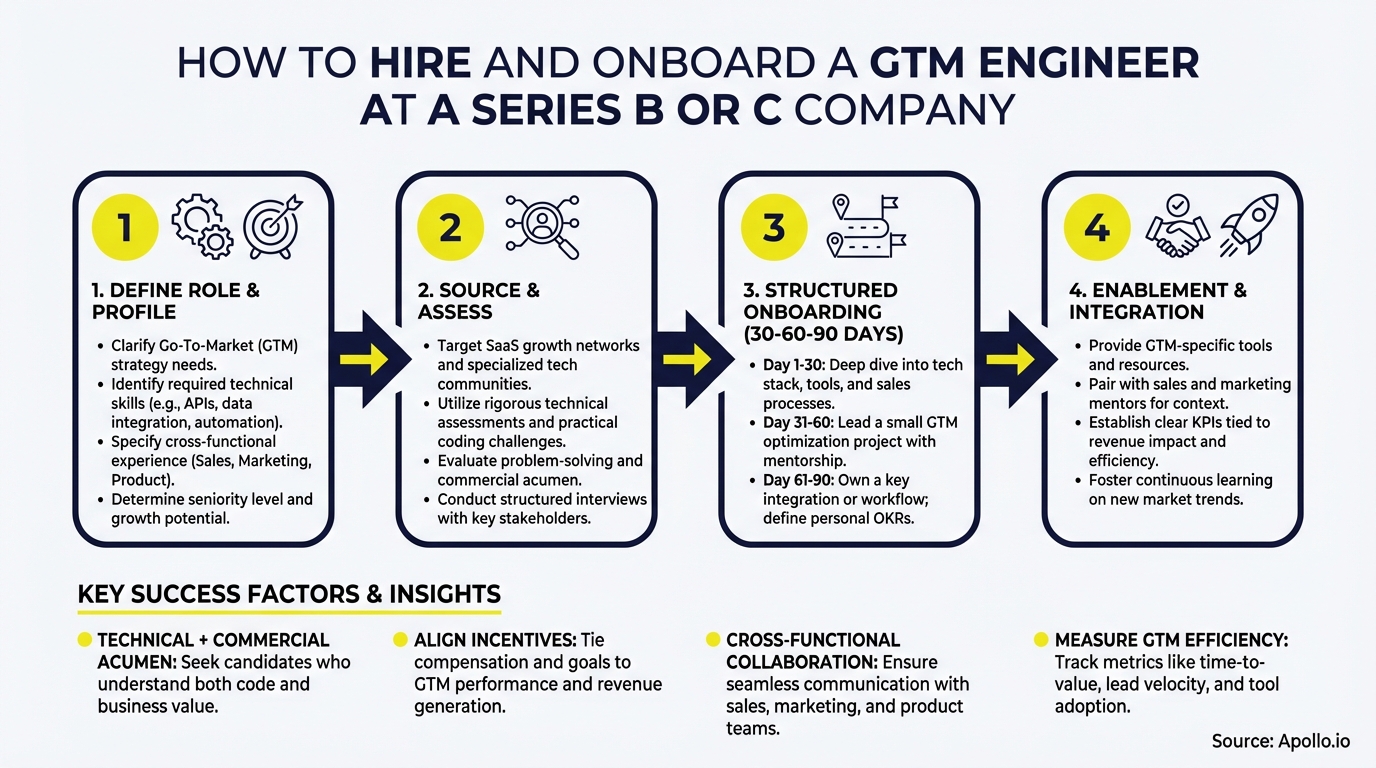
This guide covers exactly how to hire and onboard a GTM Engineer at a Series B or C company, from writing the job description to the 30/60/90-day plan that produces measurable pipeline outcomes. For a deeper look at structured engagement models, see the GTM Engineering (GTME) Program.

Apollo Turns Research Hours Into Pipeline
Tired of your reps burning half their day verifying contact info instead of selling? Apollo delivers 230M+ accurate contacts instantly, so your team spends time closing — not digging. Start building pipeline today.
Start Free with Apollo →Key Takeaways
- GTM Engineers are revenue strategists, not tool administrators. Hire and onboard accordingly.
- Job postings for the role grew 200% year-over-year in 2025, making talent competition intense and comp expectations high.
- The best onboarding plans give the hire a system-build mandate in the first 90 days, not a backlog of cleanup tasks.
- Posting as "RevOps / Sales Ops" often attracts a wider and stronger applicant pool than posting "GTM Engineer" alone.
- Cross-functional alignment from day one, not month three, is the single biggest predictor of a successful ramp.
What Does a GTM Engineer Actually Do at a Series B or C Company?
A GTM Engineer builds and operates the revenue system that connects targeting, scoring, outreach, and attribution into one compounding motion. As M Accelerator notes, "this position bridges marketing and sales through automation, data integration, and tech optimization to drive revenue growth."
At Series B/C specifically, the GTM Engineer's mandate is system design, not system maintenance. They should own:
- Total Addressable Market (TAM) unification and ICP qualification
- Account scoring models that encode actual priorities (fit, intent, timing, engagement)
- AI-assisted messaging workflows and outbound sequence architecture
- Data orchestration between CRM, enrichment sources, and intent signals
- Reporting that tracks which signals produce pipeline, not just which campaigns ran
What they are not: a HubSpot admin, a list puller, or a sequence template writer.
The Frankenstack approach, where a GTME's primary value is duct-taping 14 tools together, creates fragility.
The best GTM Engineers collapse workflows, not expand them.
How Do You Write a GTM Engineer Job Description That Attracts the Right Candidates?
Write the job description around outcomes, not tools. Candidates who are purely tool-oriented will self-select in; revenue strategists will self-select out if the JD reads like a software admin posting.
Practical hiring tip: Communities report fewer applicants to "GTM Engineer" titles compared to established titles. Consider posting as "RevOps / Sales Ops Engineer" or "Revenue Systems Engineer" to widen the funnel, then screen for GTM Engineering capabilities in the interview loop.
Key JD elements for Series B/C:
- Outcomes, not tasks: "Build a self-optimizing scoring model" beats "manage HubSpot workflows"
- AI workflow ownership: Account research automation, enrichment governance, CRM writeback
- Cross-functional scope: Works across Sales, Marketing, and RevOps, not siloed in one function
- Build mandate: Greenfield system design, not backlog maintenance
According to Product Studio, job postings for "GTM Engineer" grew 200% year-over-year in 2025, which means compensation expectations have moved accordingly. Market compensation for the role now sits at a median of $127,500 per year, per GTM Engineer Club. Budget accordingly.
What Should the GTM Engineer Interview Loop Look Like?
The GTM Engineer interview should include a live-build exercise, not just a case study presentation. You want to see how they think about system design, not how well they can prepare a deck.
| Interview Stage | What to Assess | Signal to Look For |
|---|---|---|
| Screen (30 min) | GTM systems thinking | Can they describe a revenue system they built, not just operated? |
| Technical (60 min) | Automation depth, data modeling | Ask them to design a scoring model for your ICP on the spot |
| Live Build (90 min) | Execution speed, prioritization | Give them your CRM data and a pipeline goal. What do they build first? |
| Cross-Functional (45 min) | Stakeholder management | How do they handle conflicting priorities between Sales and Marketing? |
For RevOps leaders evaluating candidates: ask about AI workflow governance specifically. The best candidates will have opinions on prompt versioning, data QA, and how to catch AI errors before they reach prospects. For a fuller picture of the skills that matter, see what structured onboarding looks like for technical GTM hires.

What Does a 30/60/90-Day GTM Engineer Onboarding Plan Look Like?
A GTM Engineer's 30/60/90-day plan should deliver a working revenue system by day 90, not just a strategy document. The most common onboarding failure is assigning cleanup tasks in the first 30 days instead of a build mandate.
Spending hours building your GTM system from scratch? See how Apollo's go-to-market platform accelerates the build.
| Phase | Primary Focus | Deliverable | Success Metric |
|---|---|---|---|
| Days 1-30 | Audit + TAM build | Documented current state, complete ICP-qualified TAM list | TAM size confirmed, data gaps identified |
| Days 31-60 | Scoring + messaging architecture | Live scoring model, persona-specific messaging variants | Top 10% of TAM ranked and prioritized for reps |
| Days 61-90 | Workflows + launch | Automated enrichment, sequences live, dashboards running | SDRs operating from system-surfaced priority queues |
Cross-functional alignment must start in week one, not after the system is built. The GTME needs access to CRM data, Marketing's inbound signal data, and Sales leadership's ICP criteria before they can build anything useful.
Gartner reports that sales organizations collaborating on enablement content across functions are 2.4 times more likely to achieve strong commercial growth.
Turn Funnel Guesswork Into Pipeline Wins
Tired of watching marketing leads stall before they ever reach your pipeline? Apollo surfaces high-intent prospects and keeps your funnel moving with real-time signals. Over 600K companies use Apollo to forecast with confidence.
Start Free with Apollo →How Do RevOps Leaders Set GTM Engineers Up for Success?
RevOps leaders are the most important internal partner for a new GTM Engineer. The GTME builds the system; RevOps maintains and tunes it after launch.
For RevOps teams supporting this hire, the handoff checklist should include:
- CRM access and field documentation (what data exists, what's reliable)
- Current sequence and campaign library (what's been tried, what worked)
- Intent data and enrichment sources currently in use
- Inbound lead flow and scoring rules (if any exist)
- Defined SLAs between Marketing and Sales for lead handoffs
The GTME should own the scoring model and workflow architecture. RevOps owns data hygiene, CRM governance, and monthly tuning cycles. These are complementary functions, not competing ones. For a deeper look at how RevOps and GTM Engineering divide responsibilities, see what revenue operations actually drives.
Want your GTM Engineer building on clean, verified data from day one? Start with Apollo's 230M+ verified business contacts so your new hire spends their first 30 days building systems, not cleaning lists.
What Platform Should a GTM Engineer Build On?
The GTM tech stack decision is one of the first choices a new GTM Engineer will face. The instinct to stitch together specialized tools for each function (data, scoring, sequencing, reporting) creates compounding fragility.
Every API connection is a future failure point. Every tool is a separate contract, a separate login, a separate support queue.
The GTME methodology is built around consolidating these workflows into one connected system. TAM building, scoring, messaging, sequences, and reporting all run in one place. SDRs using this approach spend less time on research and data entry and more time on conversations that produce pipeline. "Having everything in one system was a game changer" (Cyera).
For GTM Engineers evaluating platforms, the key question is not "does this tool have this feature" but "how many tools will I need to maintain to get a single account from 'identified' to 'sequenced'?" Fewer handoffs means fewer failures. For more on how sales automation should actually work, the principle is the same: elegant systems outperform elaborate ones.

Start Building Your GTM System in 2026
Hiring a GTM Engineer is a significant investment. The median market compensation, the ramp time required, and the cross-functional coordination needed all compound quickly.
Get the hire right, give them a build mandate from day one, and connect them to a platform that doesn't require API babysitting.
The endgame is agentic GTM: a system where scoring, research, messaging, and prioritization run continuously, with SDRs and AEs spending their time on judgment and conversations, not data entry. That's the standard worth building toward.
Apollo brings prospecting, scoring, sequencing, and reporting into one platform, so your GTM Engineer ships a working system instead of a workflow diagram. Start free with Apollo and give your new hire the foundation they need to build fast.
Prove Pipeline ROI From Day One
ROI pressure killing your tool budget? Apollo delivers measurable pipeline impact fast — teams like Leadium 3x'd annual revenue. See your first wins before your next budget review.
Start Free with Apollo →Don't miss these
Sales
Inbound vs Outbound Marketing: Which Strategy Wins?
Sales
What Is a Sales Funnel? The Non-Linear Revenue Framework for 2026
Sales
What Is a Go-to-Market Strategy? The 2026 GTM Playbook
See Apollo in action
We'd love to show how Apollo can help you sell better.
By submitting this form, you will receive information, tips, and promotions from Apollo. To learn more, see our Privacy Statement.
4.7/5 based on 9,690 reviews
