
How to Find and Maintain Verified Business Email Addresses in 2026
Most sales teams treat verified business email addresses as a one-time checkbox. Find the email, add it to a sequence, send.
But in 2026, that approach is actively costing you pipeline. Mailbox providers now enforce strict authentication requirements, contact data decays faster than ever, and a single high-bounce campaign can damage your sender reputation for months.
This guide reframes verification as an ongoing data governance program—covering what "verified" actually means today, how fast data decays, the real cost of unverified contacts, and how to build a cadence that keeps your outreach reaching inboxes.
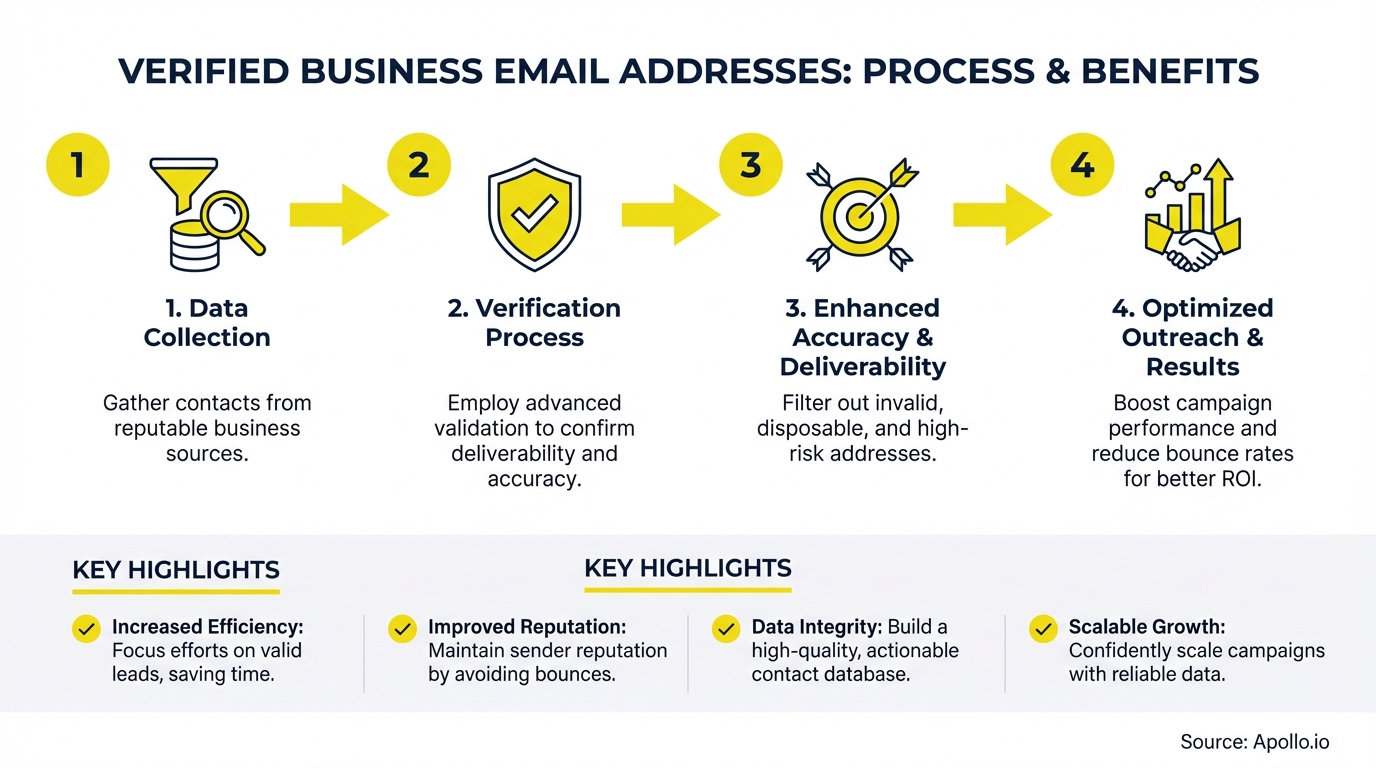

Accurate Data, More Deals Closed
Tired of burning hours verifying emails that bounce and numbers that don't connect? Apollo delivers 96% email accuracy so your team reaches real buyers faster. Join 550K+ companies turning verified contacts into pipeline.
Start Free with Apollo →Key Takeaways
- "Verified" now means more than a valid mailbox—it requires domain authentication alignment (SPF, DKIM, DMARC) to survive modern provider filters.
- According to ZeroBounce, at least 23% of an email list degrades annually—making re-verification a recurring necessity, not a one-time task.
- Poor data quality has measurable financial consequences at scale, making list hygiene a revenue-protection investment.
- Delivery rate and inbox placement are different metrics—most senders conflate them, which masks serious deliverability problems.
- A structured verification cadence, tied to trigger events like role changes or domain migrations, is the most reliable way to protect sender reputation.
What "Verified" Actually Means: A Four-Level Taxonomy
A verified business email address is not simply one that "exists." Genuine verification spans four distinct levels, each adding a layer of confidence and deliverability protection.
| Verification Level | What It Checks | Risk If Skipped |
|---|---|---|
| Syntax Validation | Correct format (user@domain.tld), no illegal characters | Hard bounces from malformed addresses |
| Domain/MX Check | Domain exists and has active mail exchange records | Sending to dead domains; damages IP reputation |
| Mailbox Responsiveness | SMTP handshake confirms the specific mailbox accepts mail | Hard bounces even on valid domains |
| Authentication Alignment | Sender domain has SPF, DKIM, and DMARC configured correctly | Rejection or spam placement under Microsoft/Google enforcement rules |
Two edge cases require special handling. Catch-all addresses accept all mail at a domain regardless of whether the specific mailbox exists—they pass SMTP checks but carry higher bounce risk. Role-based addresses (info@, support@, sales@) are often shared inboxes managed by multiple people or automated systems; they rarely convert and frequently generate spam complaints. Both categories should be segmented and treated with caution in outbound sequences.
Since May 5, 2025, Microsoft has enforced SPF, DKIM, and DMARC requirements for bulk senders—meaning authentication alignment is now a hard prerequisite, not a best practice. "Verified" without authentication coverage is increasingly incomplete.
How Fast Does Business Email Data Decay?
B2B contact data degrades faster than most revenue teams account for. ZeroBounce's 2025 data shows at least 23% of an email list degrades annually. But decay isn't uniform—it spikes around trigger events.
Research from RevenueBase found that in November 2024, business email addresses experienced a 3.6% decay rate in a single month—significantly higher than the traditional 1.5–2.0% monthly churn baseline. This kind of volatility is typically driven by end-of-year restructuring, layoffs, and role changes.
The practical implication: a list built six months ago could have material inaccuracies even if it was clean when sourced. A cadence-driven approach is the only reliable fix.
Recommended Verification Cadence by Segment
| Segment | Recommended Refresh Interval | Key Trigger Events |
|---|---|---|
| Active outbound sequences | Every 60–90 days | Before each new campaign send |
| CRM contacts (not recently touched) | Quarterly | Job change alerts, funding rounds, M&A |
| Imported or purchased lists | Before first use, then quarterly | Any bulk import event |
| High-value target accounts | Monthly or on trigger | New hire announcements, domain changes, org restructures |
Trigger-based refreshes matter as much as scheduled ones. When a target company announces layoffs, closes a funding round, or migrates its email domain, contact records across your entire account should be flagged for re-verification immediately.
Tired of manually chasing data freshness? Apollo's continuous data enrichment automatically refreshes contact and account records so your team always works from current information.
"Apollo enriches everything we have: contacts, leads, accounts... And we don't really have to touch it, it just works."

Delivery Rate vs. Inbox Placement: Why the Distinction Matters
This is one of the most consequential misunderstandings in B2B outreach. Mailjet's 2025 survey found that only 12% of senders correctly understood that "delivery rate" measures emails accepted and delivered to any folder—including spam—not necessarily the inbox.
You can have a 99% delivery rate and still have a third of your emails going directly to spam. Inbox placement is the metric that actually correlates with replies, pipeline, and revenue.
The inbox placement picture has deteriorated sharply for Microsoft environments. According to The Digital Bloom's 2025 benchmarks, Office365 inbox placement dropped 26.73 percentage points (from 77.43% to 50.70%) and Outlook/Hotmail fell 22.56 percentage points (from 49.33% to 26.77%) in Q1 2025 compared to Q1 2024. For B2B teams targeting enterprise buyers—most of whom use Microsoft email infrastructure—this is a material pipeline risk.
Verified business email addresses protect inbox placement in two ways: they prevent hard bounces that damage sender reputation, and they ensure you're only sending to active mailboxes that are more likely to engage rather than mark as spam.
For a deeper dive on keeping your emails out of spam folders, see Apollo's guide to email deliverability: reach inboxes, dodge spam filters and bulk email best practices.
Turn Funnel Guesswork Into Pipeline Wins
Pipeline forecasting a guessing game because leads stall before they ever become opportunities? Apollo surfaces in-market buyers with precision so your funnel actually converts. Join 550K+ companies building predictable pipeline.
Start Free with Apollo →The Real Cost of Unverified Email Data
Unverified contacts aren't just an efficiency problem—they're a financial one. When bounces accumulate, sender reputation degrades, open rates fall across your entire domain, and the effective cost per qualified conversation rises sharply. Email marketing's ROI potential is substantial: SalesO reports averages ranging from $36 to $42 returned for every $1 invested. Bounces and spam placements from unverified lists erode that return directly.
The cost compounds across the revenue team. SDRs waste time on contacts that will never receive their messages.
Marketing campaigns show inflated send counts but deflated actual reach. RevOps spends cycles cleaning data reactively rather than building pipeline proactively.
A governance-first approach—where verification is a standing workflow rather than a pre-campaign scramble—converts a reactive cost center into a systematic competitive advantage. See also: how to verify email addresses for B2B sales for a step-by-step process.
Authentication, Compliance, and Sender Reputation
In 2026, verification and authentication are inseparable. Here's what your sending infrastructure needs to have in place before scale outreach makes sense:
- SPF (Sender Policy Framework): Declares which mail servers are authorized to send on behalf of your domain. Missing or misconfigured SPF causes rejections at providers enforcing bulk-sender rules.
- DKIM (DomainKeys Identified Mail): Cryptographically signs outgoing messages, confirming they haven't been tampered with in transit.
- DMARC (Domain-based Message Authentication, Reporting & Conformance): Tells receiving servers what to do when SPF or DKIM checks fail (quarantine or reject). A DMARC policy at
p=rejectalso prevents domain spoofing in phishing attacks. - One-click unsubscribe: Required by Google and Yahoo for bulk senders. Complaints above threshold (many experts recommend staying under 0.1%) trigger deliverability penalties.
Authentication protects your domain reputation. List verification protects your IP reputation. Both are required for sustainable outbound at scale. If you're building or auditing your email infrastructure, Apollo's guide to improving email deliverability in 5 steps covers the practical setup checklist.
How to Find Verified Business Email Addresses: Methods That Work in 2026
There are several reliable approaches to sourcing verified business email addresses, depending on your scale and workflow.
- B2B sales intelligence platforms: Purpose-built databases that maintain and verify contact records at scale. Apollo's database covers 224M people across 30M+ companies, with business email addresses searchable by title, industry, or company—with 96% email accuracy.
- Email finder tools: Useful for targeted lookups when you know the name and company. Apollo's email finder cross-references multiple data signals to surface the most current address.
- CRM enrichment: Continuously appending and refreshing contact records already in your CRM, so your team works from current data without manual research.
- Real-time verification at point of capture: Validating emails the moment they enter your system (via form fills, manual entry, or imports) before they ever reach a sequence.
The most effective programs combine a verified source at the top of the funnel with continuous enrichment downstream. Sourcing and maintaining verified contacts in one unified workspace eliminates the gaps that appear when data travels between disconnected tools.
"We benchmarked ZoomInfo versus Apollo, Clearbit, Lusha, and Seamless, and ultimately Apollo won on all fronts, especially in enrichment. Higher quality than ZoomInfo, greater breadth than Clearbit."
Struggling to find qualified contacts with accurate data? Search Apollo's 224M+ verified contacts with 65+ filters to build precise prospecting lists instantly.

Verification Governance Checklist
Use this checklist to assess and improve your current verification program:
- All outbound lists pass syntax, MX, and SMTP checks before campaign launch
- Catch-all and role-based addresses are segmented and excluded from primary sequences
- CRM contacts are re-verified on a documented schedule (quarterly minimum)
- Trigger alerts are configured for job changes, domain migrations, and org announcements
- SPF, DKIM, and DMARC are configured and monitored for all sending domains
- One-click unsubscribe is implemented and complaint rates are monitored below 0.1%
- Hard bounce rates are tracked per campaign; any campaign exceeding threshold triggers list audit
- Imported or purchased lists are verified before first use
For guidance on writing outreach that converts once your list is clean, see how to write sales emails that get responses and the best cold email subject lines to boost open rates.
Conclusion: Treat Verified Emails as a Data Governance Program
A verified business email address is only as valuable as its freshness. The teams winning in 2026 aren't those with the biggest lists—they're the ones whose lists are cleanest, best authenticated, and continuously maintained.
Verification is not a pre-campaign task; it's an ongoing program that protects sender reputation, improves inbox placement, and makes every outreach dollar work harder.
Apollo gives B2B GTM teams a unified workspace to find, verify, enrich, and engage contacts—without stitching together multiple tools. From sourcing verified contacts to automating sequences with deliverability safeguards built in, it's the infrastructure modern outbound requires.
Start Your Free Trial and build your next campaign on verified data from day one.
Prove Pipeline ROI Before Next Quarter
ROI pressure killing your tool budget before it even starts? Apollo delivers measurable pipeline impact fast — Leadium 3x'd their annual revenue after switching. Start your free trial and show leadership wins, not promises.
Start Your Free Trial →Don't miss these
Sales
Inbound vs Outbound Marketing: Which Strategy Wins?
Sales
What Is a Sales Funnel? The Non-Linear Revenue Framework for 2026
Sales
What Is a Go-to-Market Strategy? The 2026 GTM Playbook
See Apollo in action
We'd love to show how Apollo can help you sell better.
By submitting this form, you will receive information, tips, and promotions from Apollo. To learn more, see our Privacy Statement.
4.7/5 based on 9,690 reviews
