
How to Evaluate GTM Automation Platforms on Flexibility, Integrations, and Total Cost (2026)
Most GTM platform evaluations stall on feature checklists. The real decision hinges on three factors that don't appear in any demo: how flexible the platform is when your process changes, how deeply it connects to your existing stack, and what it actually costs to run over 12 months. Getting these wrong is expensive. Getting them right is the difference between a platform that accelerates revenue and one that creates a second job for your RevOps team. This guide gives you a practical framework for evaluating sales automation platforms on the criteria that matter most.

Apollo Turns Hours of Research Into Minutes
Tired of your reps burning half their day verifying contact info instead of selling? Apollo delivers 230M+ accurate contacts instantly, so your team spends time closing — not searching. Start building real pipeline today.
Start Free with Apollo →Key Takeaways
- Integration depth is the top evaluation criterion: 90% of buyers prioritize a vendor's ability to connect with their existing systems before anything else.
- Total cost of ownership goes well beyond the license fee. Admin overhead, integration maintenance, and data pipeline costs are often the largest line items.
- Pricing models are shifting from seats to hybrid consumption, making usage forecasting a required part of any GTM platform evaluation in 2026.
- AI governance (audit trails, permissioning, write-back controls) is now a required evaluation criterion, not a nice-to-have.
- All-in-one platforms that consolidate prospecting, engagement, and data reduce integration overhead and total cost simultaneously.
Why Do Traditional Feature Checklists Fail GTM Platform Evaluations?
Feature checklists fail because they measure what a platform can do on day one, not how it behaves when your ICP shifts, your team doubles, or your CRM schema changes.
According to The Insight Collective, 90% of buyers prioritize a vendor's ability to integrate with their existing systems and applications, yet most RFP templates still lead with surface-level feature counts.
The compounding problem: stacks keep growing. More tools mean more sync points, more failure modes, and more RevOps hours spent on maintenance rather than pipeline.
The evaluation framework needs to start with integration depth, flexibility under change, and total cost of operation, not feature parity.
How Do You Score a GTM Platform on Flexibility?
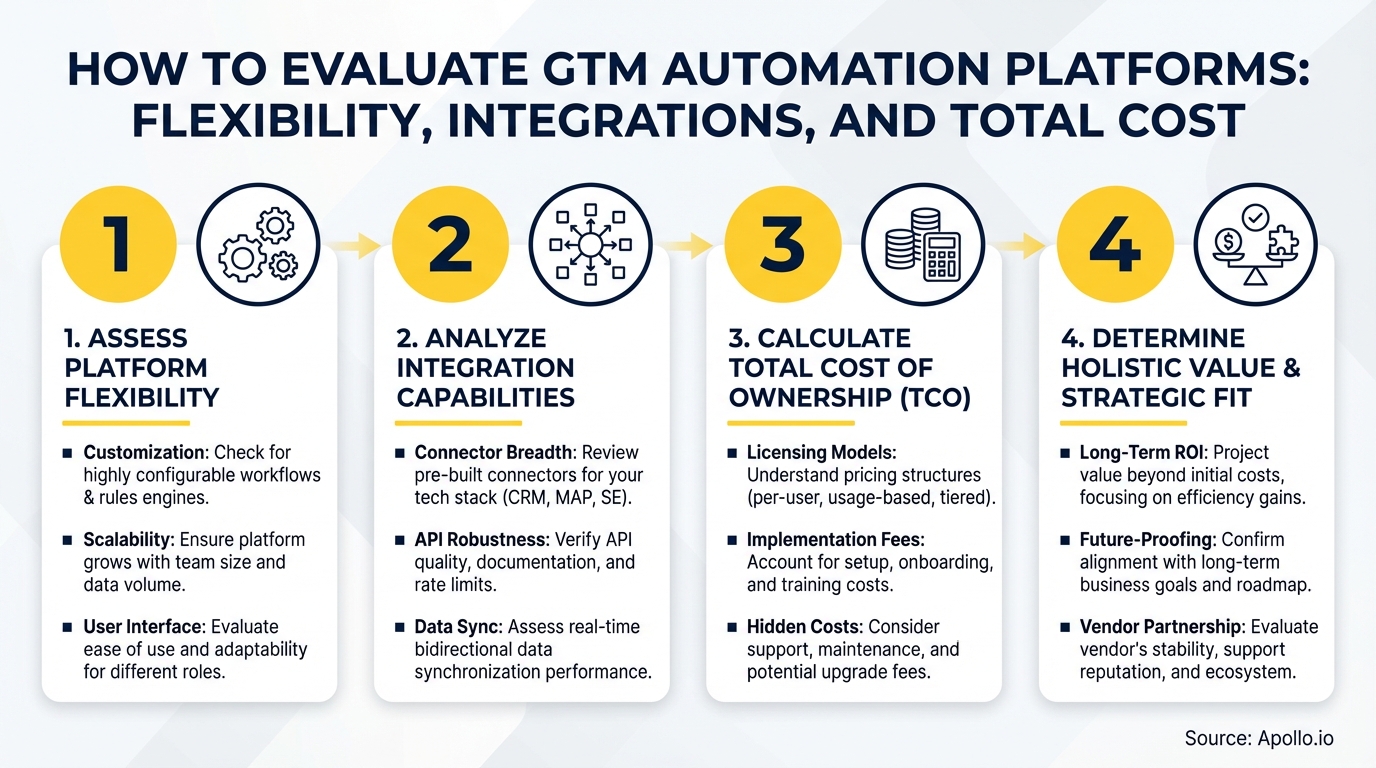
Flexibility means the platform adapts to your processes without requiring engineering work or professional services. Evaluate it across three dimensions: workflow customization, data model extensibility, and modular adoption.
As noted by Unify GTM, "customization for unique processes" is a key evaluation criterion for GTM platforms. Modern platforms should support a flexible, adaptable workflow builder and workflow automation that RevOps can configure without engineering tickets.
| Flexibility Dimension | What to Test | Red Flag |
|---|---|---|
| Workflow customization | Can RevOps build and modify sequences without dev? | Requires professional services for changes |
| Data model extensibility | Can you add custom fields, objects, and filters? | Fixed schema with no custom properties |
| Modular adoption | Can you start with one module and expand? | All-or-nothing onboarding |
| AI configurability | Can you control AI inputs, outputs, and guardrails? | Black-box AI with no audit or override |
For RevOps leaders, the critical question is: how quickly can the team change a workflow without opening a support ticket? Platforms that require vendor involvement for routine changes create a hidden labor cost that compounds over time.
How Do You Evaluate GTM Platform Integrations Beyond the Connector List?
Integration quality is not measured by the number of connectors. It is measured by connector reliability, sync depth, observability, and how quickly workflows can be modified without engineering involvement.
Despite the push for integration, Infuse reports that 42% of GTM teams cite data quality and technology gaps as barriers to executing their marketing strategies effectively. A long connector list does not solve a shallow sync problem.
Key integration criteria to score during evaluation:
- Bidirectional sync: Does data flow both ways between the GTM platform and your CRM? Learn more about how data sync improves B2B sales and marketing ROI.
- Native CRM connectors: Are HubSpot and Salesforce native integrations or third-party middleware? See how Apollo connects directly with HubSpot and Salesforce.
- API access: Does the platform expose a full REST API for custom integrations and reverse ETL patterns?
- Observability: Can RevOps monitor sync status, error rates, and data freshness without contacting support?
- Ecosystem breadth: It is suggested that platforms should be able to centralize data across the 15 to 20 tools commonly used by B2B organizations.
Spending hours untangling broken data syncs? Apollo's CRM automation keeps your contact and account data clean and synchronized automatically.

What Does Total Cost of Ownership Actually Include for GTM Platforms?
Total cost of ownership for a GTM automation platform includes four cost categories that most buyers undercount: license fees, integration labor, admin overhead, and data/AI consumption overages.
Pricing is shifting from seat-based to hybrid consumption models for data and AI features, making usage forecasting a required part of the evaluation. Buyers must now model consumption scenarios and overage policies, not just the base subscription rate.
| Cost Category | What to Measure |
|---|---|
| License fee | Per seat or per usage; annual vs. monthly billing |
| Integration labor | RevOps hours to build, maintain, and monitor connectors |
| Admin overhead | Hours spent on data hygiene, deduplication, and governance |
| Consumption overages | Credit burn rates for data lookups, AI actions, and enrichment |
| Tool consolidation savings | Platforms replaced or reduced by adopting this solution |
The last row matters as much as the first. Teams that replace multiple point solutions with a unified platform reduce both integration overhead and license spend simultaneously. As the team at Predictable Revenue put it: "We reduced the complexity of three tools into one." Census reported a similar outcome: "We cut our costs in half."
Data from Revenue Memo indicates that marketing automation delivers an average return of $5.44 for every dollar spent over the first three years, with 76% of businesses achieving positive ROI within the first year. The platforms that deliver the top end of that range are those with lower total operating costs, not necessarily lower license fees.
Turn Funnel Chaos Into Predictable Revenue
Pipeline forecasting a guessing game because leads stall before they ever become opportunities? Apollo surfaces in-market buyers at the right moment, so your pipeline reflects reality — not wishful thinking. Nearly 100K paying customers trust Apollo to fill the funnel with leads that actually convert.
Schedule a Demo →What AI Governance Criteria Should RevOps Leaders Include in Platform Evaluations?
AI governance criteria belong in every GTM platform evaluation in 2026 because AI features that write back to your CRM or send outbound on your behalf need auditability, not just capability. RevOps leaders should require vendors to demonstrate permissioning controls, audit trails, and safe write-back boundaries before signing.
Minimum AI governance requirements to evaluate:
- Audit trails: Every AI-generated action (email sent, record updated, sequence enrolled) must be logged with timestamp and user attribution.
- Permissioning: Admins must control which users and roles can trigger AI actions and which systems AI can write back to.
- Data provenance: Where does the AI pull its inputs? Can you trace a recommendation back to its source data?
- Override controls: Can a human review and cancel an AI action before it executes?
For SDRs and AEs using AI-powered sales automation, governance matters because it determines whether leadership can trust AI-generated activity data in their pipeline forecasts. Teams that skip this evaluation step often discover the gap after a compliance review or a batch of unintended emails.
How Do RevOps Teams Use a Maturity Framework to Evaluate Automation Fit?
RevOps teams use an automation maturity framework to match platform complexity to their actual operational stage, avoiding over-investment in capabilities they cannot yet use. Most teams are not at full automation: research from Ascend2's State of Marketing Automation found only 9% of organizations report a fully automated customer journey.
Match your evaluation criteria to your current maturity stage:
- Stage 1 (Manual): Prioritize ease of setup, pre-built sequences, and native CRM sync. Complexity is a cost, not a benefit.
- Stage 2 (Partial automation): Prioritize workflow flexibility, trigger-based enrollment, and data enrichment. Focus on building an automated lead generation system before layering AI.
- Stage 3 (Orchestrated): Prioritize API depth, AI governance, composable architecture, and advanced routing for enterprise teams.
Founders building their first outbound motion need different platform criteria than RevOps leaders managing a 50-rep team. Buying for Stage 3 when you operate at Stage 1 inflates TCO without improving outcomes.
How Does Apollo Consolidate GTM Automation into One Platform?
Apollo consolidates prospecting, data enrichment, multi-channel engagement, revenue operations, and AI automation into a single platform, eliminating the integration overhead that drives up TCO for teams running separate tools for each function.
Apollo's transparent, published pricing makes TCO modeling straightforward. Per Apollo's official pricing page:
| Plan | Price (Annual Billing) | Credits/User/Year |
|---|---|---|
| Free | $0 | 900 (75/month) |
| Basic | $49/user/month | 30,000 |
| Professional | $79/user/month | 48,000 |
| Organization | $119/user/month (min 3 users) | 72,000 |
Annual billing saves 20% compared to monthly. The Organization tier includes advanced routing, admin governance controls, and security features suited to enterprise GTM teams.
Struggling to justify GTM platform spend to finance? See how Apollo's unified pipeline tools replace multiple point solutions and reduce total stack cost.

What Is the Final GTM Platform Evaluation Checklist for 2026?
Use this checklist before signing any GTM automation platform contract. Each item maps to flexibility, integration quality, or total cost of ownership.
Flexibility:
- Can RevOps modify workflows without engineering or professional services?
- Does the platform support custom fields, objects, and segmentation filters?
- Can you adopt one module now and expand later without re-contracting?
Integrations:
- Are CRM connectors native or middleware-dependent?
- Is there full bidirectional sync with observable error monitoring?
- Does the vendor expose a complete REST API for custom workflows?
Total Cost:
- Have you modeled consumption scenarios including data and AI credit overages?
- Have you counted integration labor and admin overhead in your TCO model?
- Which point solutions does this platform replace, and what is the net cost?
AI Governance:
- Are all AI actions logged with attribution and timestamp?
- Can admins set permissioning boundaries on AI write-backs?
- Is there a human review step before AI actions execute at scale?
Teams that complete this checklist before a demo are significantly better positioned to negotiate pricing, set contractual SLAs, and avoid the integration surprises that inflate first-year TCO. For teams looking to reduce stack complexity while improving pipeline outcomes, Apollo's AI sales automation platform is built to pass every item on this list.
Ready to evaluate a platform that scores high on flexibility, integration depth, and transparent pricing? Start a free trial with Apollo and test it against your own checklist.
Prove Pipeline ROI With Apollo
Budget approval stuck on unclear metrics? Apollo delivers measurable pipeline impact from day one — so you can justify every dollar spent. Leadium 3x'd their annual revenue. You're next.
Start Free with Apollo →Don't miss these
Sales
Inbound vs Outbound Marketing: Which Strategy Wins?
Sales
What Is a Sales Funnel? The Non-Linear Revenue Framework for 2026
Sales
What Is a Go-to-Market Strategy? The 2026 GTM Playbook
See Apollo in action
We'd love to show how Apollo can help you sell better.
By submitting this form, you will receive information, tips, and promotions from Apollo. To learn more, see our Privacy Statement.
4.7/5 based on 9,690 reviews
