How Do I Evaluate AI Sales Assistant Vendors Before Buying in 2026?
Evaluating AI sales assistant vendors before buying means assessing them across five dimensions: workflow integration, data governance, output accuracy, total cost of ownership, and adoption readiness. The market has matured fast. According to Cirrus Insight, 56% of sales professionals use AI daily, and those users are twice as likely to exceed their sales targets. The question is no longer whether to buy, but which vendor actually fits your GTM motion.
Tools like Apollo's AI Sales Assistant are built end-to-end into the sales workflow, covering account research, prospect list building, sequence creation, and outreach from a single platform. That integration model is exactly what to benchmark other vendors against. Before you sign anything, use this framework to cut through the demos and identify the right fit for your team.

Get Verified Contacts, Skip the Hunt
Tired of burning hours tracking down emails that bounce and numbers that go nowhere? Apollo delivers 97% accurate contact data so your reps spend time selling, not searching. Join 600K+ companies building pipeline that actually converts.
Start Free with Apollo →Key Takeaways
- Vendor evaluation in 2026 is an execution problem, not a novelty problem. Focus on workflow fit and measurable outcomes.
- Data governance and transparency are now core buying criteria, not just IT checklists. Ask where your data is processed and whether it is used to improve the vendor's models.
- Tool consolidation reduces rep overwhelm. Weight native CRM integration and all-in-one coverage heavily in your scorecard.
- Run a structured pilot against quota outcomes, not just satisfaction surveys, before committing.
- Total cost of ownership includes licenses, governance tooling, onboarding, and ongoing monitoring. Price-per-seat is only the starting point.
What Are the Core Criteria for Evaluating AI Sales Assistant Vendors?
The core criteria are: workflow nativeness, data governance, output accuracy, integration depth, and adoption simplicity. Generic AI features are now table stakes.
What separates vendors is whether the AI is embedded in the rep's actual workflow or bolted on as a separate tool that creates more context-switching.
Use this scorecard when comparing vendors:
| Criterion | What to Ask | Why It Matters |
|---|---|---|
| Workflow Integration | Is AI embedded in prospecting, sequencing, and reporting, or is it a separate chat window? | Fragmented tools increase rep overhead and reduce adoption |
| Data Governance | Where is data processed? Is your data used to improve vendor models? | EU AI Act enforcement begins August 2, 2026. Contracts must reflect documentation and transparency obligations. |
| Output Accuracy | Can the vendor run a sandbox test against your CRM data? | Demos are optimized. Real accuracy only shows in your pipeline context. |
| Native Integration | Does it connect natively to your CRM and email, or via third-party connectors? | Native integrations reduce latency, data gaps, and maintenance overhead |
| Adoption Simplicity | Can a non-technical rep use it on day one without prompt engineering? | Complexity kills adoption. Conversational interfaces lower the learning curve. |
| Total Cost of Ownership | What is the all-in cost: licenses, governance tooling, onboarding, and monitoring? | Per-seat pricing often understates actual spend when compliance and rollout costs are included |
How Should RevOps Leaders Structure the Vendor Evaluation Process?
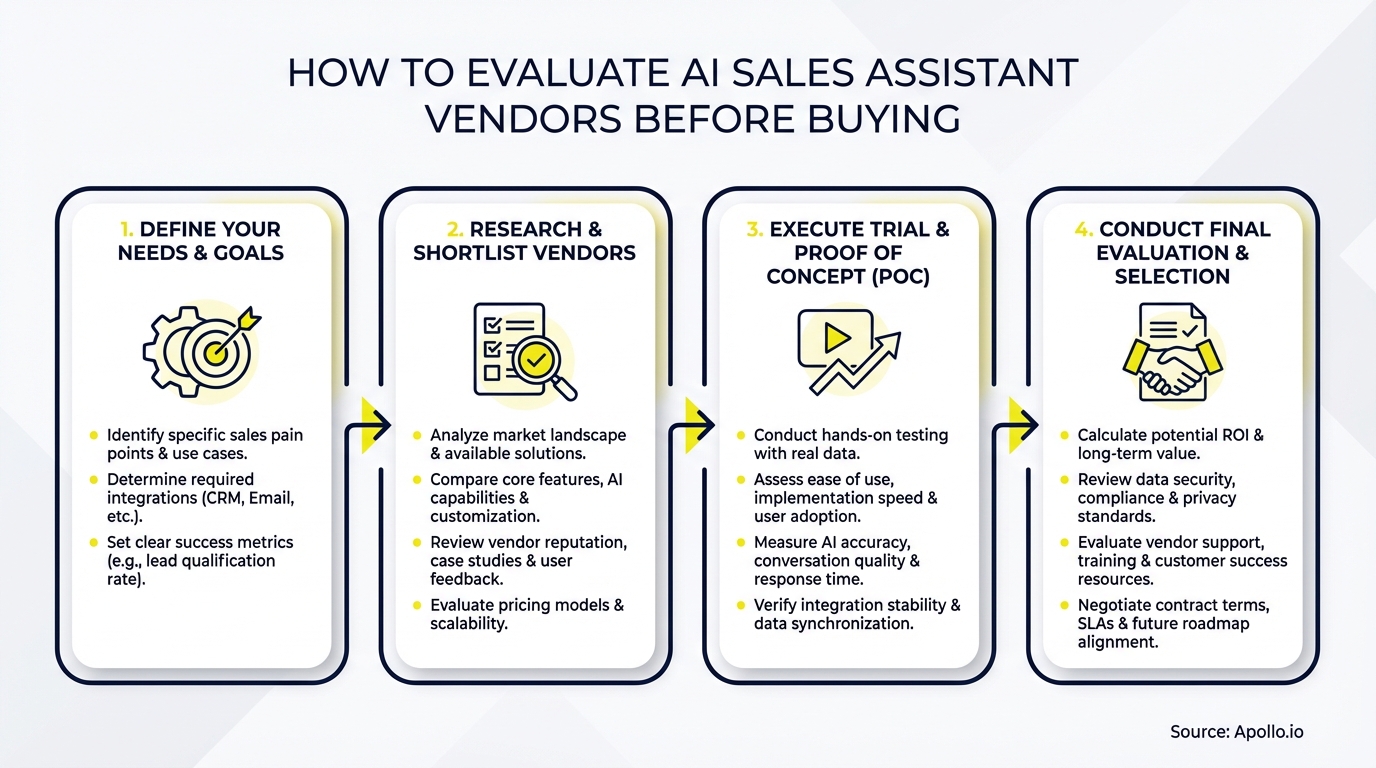
RevOps leaders should structure AI vendor evaluation in four stages: requirements mapping, security and governance review, accuracy bake-off, and pilot design. Skipping any stage exposes the team to adoption failure or compliance risk after contract signature.
Research from Optif.ai shows that 89% of revenue organizations used AI-powered tools as of 2025, up from 34% in 2023. The competitive gap now lies in how well those tools are implemented, not whether they exist. That makes the evaluation process itself a strategic advantage.
Stage 1: Requirements Mapping. Define which GTM workflows need AI support: prospecting, sequencing, research, meeting prep, or conversation intelligence. Map required integrations (CRM, calendar, email) and identify which teams will use the tool.
Stage 2: Security and Governance Review. Ask vendors for SOC 2 Type II reports, data residency documentation, sub-processor lists, and their position on using customer data to improve their models.
Apollo, for example, does not allow customer data to be used to train external AI models and maintains SOC 2 and ISO 27001 certifications. Verify that any vendor you shortlist can provide equivalent documentation.
Stage 3: Accuracy Bake-Off. Avoid evaluating AI solely on demos. Ask vendors to run their tool against a sample of your actual CRM accounts. Measure output relevance, hallucination rate on factual claims, and multi-turn reliability. This is the clearest signal of real-world fit.
Stage 4: Pilot Design. Structure a time-boxed pilot with a treatment group using the AI tool and a control group without it. Measure quota attainment, meetings booked, and sequence reply rates across both groups. Tie the pilot outcome directly to contract renewal criteria.
Struggling to evaluate pipeline impact across tools? Sales analytics frameworks can help RevOps teams build the measurement infrastructure before a pilot begins.
What Data Governance Questions Should You Ask Every Vendor?
Every AI sales assistant vendor should answer six data governance questions before you reach contract stage. With the EU AI Act's transparency obligations taking effect in August 2026, governance documentation is shifting from a security team checkbox to a procurement requirement for any vendor operating in global markets.
- Where are prompts and outputs processed? Confirm data residency regions and whether in-country processing options exist for regulated markets.
- Is customer data used to improve vendor AI models? Require a written statement. This is a non-negotiable for most enterprise procurement teams.
- What is the prompt and response retention policy? Ask how long conversation data is stored and who can access it.
- Who are the sub-processors? AI tools often route data through multiple third-party model providers. Get the full list.
- What are the incident response SLAs? Ask how quickly the vendor notifies customers of a data incident and what remediation steps are contractually committed.
- Can you audit AI-generated outputs? Confirm whether the platform maintains audit logs of AI-generated actions, especially if the tool can execute actions in your CRM.
For teams building or updating their sales tech stack, governance answers should be captured in a standardized vendor disclosure document before pricing discussions begin.

How Do SDRs and AEs Know If an AI Assistant Will Actually Help Them Hit Quota?
SDRs and AEs should look for AI assistants that reduce research time, ground messaging in real account context, and eliminate manual steps between insight and action. The proxy for quota impact is not the demo: it is whether the tool reduces the gap between knowing what to do and doing it.
Data from Rev Empire shows that over 80% of sales teams using AI report increased revenue, compared to 66% of those without it. That gap widens when AI is embedded in workflow rather than operating as a side tool.
For SDRs, the key indicators of a high-impact AI assistant are:
- Can it build a targeted prospect list from a natural language prompt without manual filter configuration?
- Does it generate personalized first-touch emails grounded in real account signals (funding, job changes, tech stack), not generic templates?
- Does it suggest the next best action automatically, or does the rep still have to navigate across multiple screens to act on an insight?
For AEs, the relevant capabilities are pre-meeting research summaries, AI-generated conversation insights from recorded calls, and automated follow-up drafting. Apollo's pre-meeting research feature, for example, surfaces company priorities, decision-maker context, and past objections before each call, so AEs walk in prepared without manual research.
"Apollo's AI Assistant makes building targeted prospecting lists effortless. I can give it very specific prompts, and it stays within those parameters to deliver accurate, high-quality results." — Matt Tumbiolo, Enterprise BDR, Smartling
Spending too much time on manual outreach? Automate your multi-channel sequences with Apollo's sales engagement platform and let AI handle the heavy lifting.
Turn Funnel Gaps Into Pipeline With Apollo
Pipeline forecasting a guessing game because quality leads never make it past the top? Apollo surfaces in-market buyers and moves them toward opportunity — before your forecast falls apart. Nearly 100K paying customers trust Apollo to build pipeline that converts.
Schedule a Demo →How Do You Evaluate Tool Consolidation vs. Point Solutions?
Evaluate tool consolidation by mapping every workflow the AI assistant will touch and checking whether the vendor covers it natively or requires integrations with other paid tools. Point solutions add per-workflow cost, integration maintenance, and context fragmentation.
A 2024 Gartner survey found that 50% of sellers were overwhelmed by the amount of technology needed. Adding another point solution to an already fragmented stack typically worsens adoption rather than improving it.
When evaluating consolidation potential, score vendors on whether they natively cover:
- Prospect data and contact enrichment
- Multi-channel sequence execution (email, phone, social)
- AI-powered research and account intelligence
- Meeting scheduling and conversation intelligence
- Pipeline tracking and deal management
- Workflow automation and lead scoring
A platform that covers all six natively reduces tool sprawl, lowers total cost, and gives RevOps a single source of truth. Customers who have consolidated onto Apollo's platform describe it in terms like "Having everything in one system was a game changer" (Cyera) and "We cut our costs in half" (Census). See how Predictable Revenue reduced tech stack costs by 50% by consolidating on Apollo.
For a deeper look at building a scalable, consolidated stack, the sales automation guide covers how to sequence tool adoption without creating new integration debt.
What Does a Good AI Sales Assistant Pilot Look Like?
A good AI sales assistant pilot runs for 30 to 60 days, uses a matched control group, and measures quota-relevant outcomes rather than satisfaction scores. Pilots that only measure NPS or "time saved" rarely produce the evidence needed to justify a multi-seat purchase.
Structure the pilot with these parameters:
- Treatment group: Reps with full access to the AI assistant across prospecting, sequencing, and research
- Control group: Reps using current tools without the AI assistant
- Primary metrics: Meetings booked per rep, sequence reply rates, pipeline generated, quota attainment
- Secondary metrics: Time from lead to first touch, number of manual steps per sequence, CRM data completeness
- Governance check: Confirm vendor audit logs are active and data handling matches the governance documentation provided during evaluation
At the end of the pilot, compare the delta between groups on primary metrics. Tie the renewal or expansion decision explicitly to the pilot results. This approach protects the budget owner and gives the vendor clear performance accountability. For frameworks on measuring sales outcomes, return on sales benchmarks provide a baseline for contextualizing pilot results against industry norms.

Ready to See What an AI Sales Assistant Should Actually Do?
Evaluating AI sales assistant vendors before buying comes down to one question: does this tool reduce the gap between insight and action for your reps, or does it create more steps? The best vendors embed AI natively across prospecting, research, sequencing, and pipeline management.
They provide transparent governance documentation, support structured pilots, and show measurable quota impact, not just demo polish.
Apollo's AI Sales Assistant covers the full GTM motion from a single platform, with SOC 2 and ISO 27001 certifications, customer data privacy protections, and a track record across nearly 100K paying customers. See how it works against your own ICP and pipeline.
Curious how AI can help you find and prioritize the right accounts? Explore Apollo's AI-powered pipeline builder and see what your outbound motion looks like when AI handles the research and prioritization.
Prove Pipeline ROI With Apollo
ROI pressure killing your tool budget approval? Apollo delivers measurable pipeline impact — 46% more meetings with AI Research Agent. Nearly 100K paying customers justified the investment. Start yours free.
Start Free with Apollo →Don't miss these
Sales
Inbound vs Outbound Marketing: Which Strategy Wins?
Sales
What Is a Sales Funnel? The Non-Linear Revenue Framework for 2026
Sales
What Is a Go-to-Market Strategy? The 2026 GTM Playbook
See Apollo in action
We'd love to show how Apollo can help you sell better.
By submitting this form, you will receive information, tips, and promotions from Apollo. To learn more, see our Privacy Statement.
4.7/5 based on 9,690 reviews
