
How to Define the Right Human-to-AI Handoff Point in an Outbound Prospecting Workflow
Most outbound teams aren't failing because they adopted AI. They're failing because they never decided where AI stops and the human begins. The debate has shifted from "AI vs. SDRs" to a more practical question: where exactly does the approval gate belong in your workflow? Getting this right is the difference between AI that accelerates pipeline and AI that creates noise. Tools like Apollo's AI Sales Assistant are built to handle research, list building, and sequence drafting end-to-end — but even the best AI needs a human in the loop at the right moments to convert activity into revenue.
For a deeper foundation on outbound prospecting strategy, start there before wiring in AI handoffs.

Research Less, Close More With Apollo
Tired of burning hours on manual lead research while your pipeline stalls? Apollo surfaces verified contacts instantly, so your team spends time selling — not searching. Join 600K+ companies building predictable pipeline.
Start Free with Apollo →Key Takeaways
- The handoff point is an approval gate, not a full handover: AI drafts, researches, and sequences — humans approve, personalize the final layer, and own exceptions.
- Sales professionals who use AI daily are twice as likely to exceed their targets, but workflow design determines whether that advantage materializes.
- Signal-triggered moments (a reply, pricing page visit, or job change) are the clearest escalation triggers from AI to human.
- Data silos and tool sprawl are the leading blockers of effective AI handoffs — consolidation is a prerequisite, not an afterthought.
- Measuring handoff quality requires specific metrics: escalation rate, AI draft acceptance rate, reply quality, and meeting rate by sequence type.
What Is a Human-to-AI Handoff Point in Outbound Prospecting?
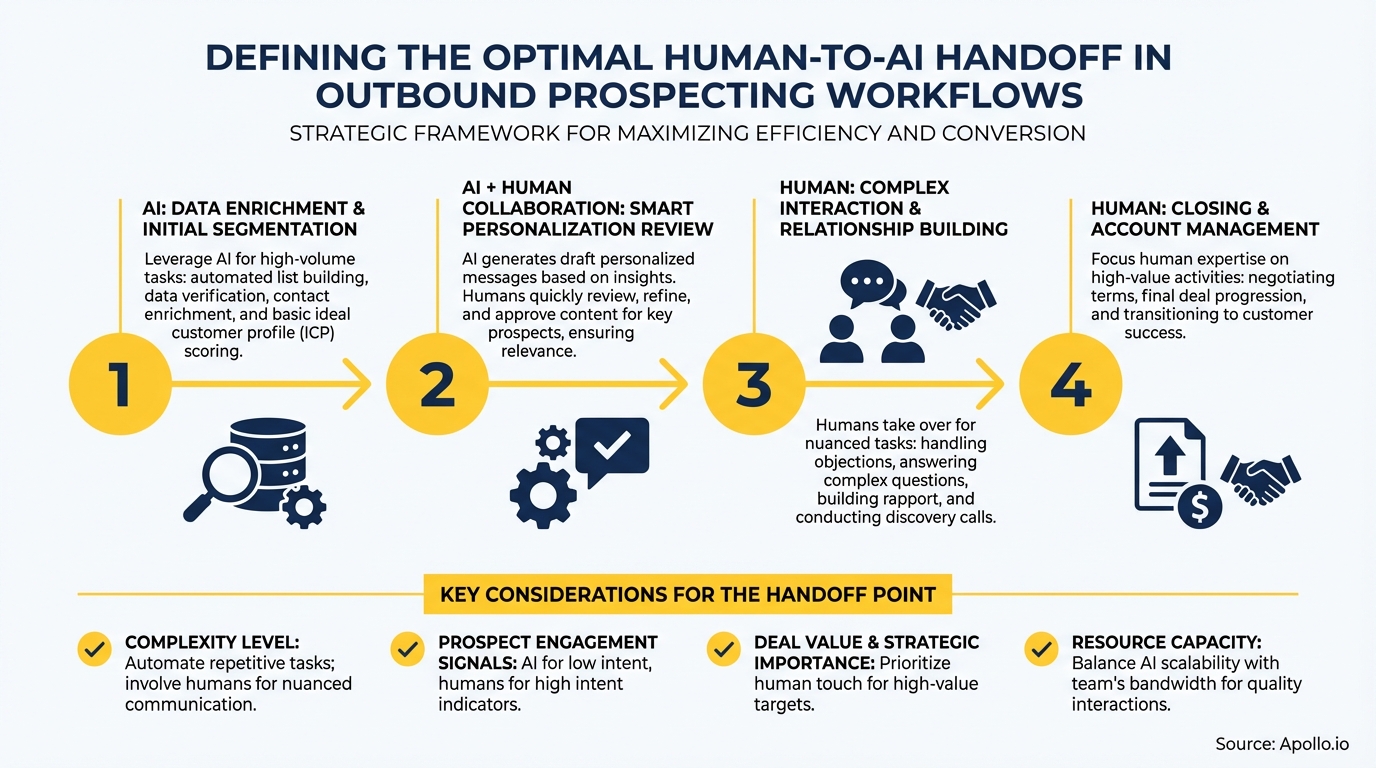
A human-to-AI handoff point is the defined moment in an outbound workflow where control transfers between an AI system and a human rep — or vice versa. These are not one-time events.
A mature workflow contains multiple handoff gates across the prospecting lifecycle: list building, research, drafting, sending, and follow-up.
The modern framing is: AI handles volume and speed; humans handle judgment and relationship. As noted in research from SuperRep.ai, this hybrid approach is often considered optimal, where AI handles high-volume tasks and humans focus on complex conversations. The practical implication: every stage of your sales automation workflow needs an explicit rule for who owns it.
How Do You Map Handoff Points Across the Outbound Workflow?
Handoff points map to the natural stages of outbound prospecting, each with a clear escalation trigger.
| Outbound Stage | AI Owns | Human Escalation Trigger |
|---|---|---|
| ICP & List Building | Filter application, lookalike matching, scoring | Strategic account or executive-level contact |
| Research & Enrichment | Account summaries, tech stack, intent signals | High-value account requiring custom insight |
| Sequence Drafting | Multi-step email + call + social sequences | Regulated industry, sensitive claim, or C-suite recipient |
| Send Approval | Scheduling and delivery automation | Low confidence score, compliance flag, or manual QA batch |
| Prospect Engagement | Monitoring replies, click signals, intent data | Any positive reply, meeting link click, or pricing page visit |
| Follow-Up | Draft post-meeting summaries and next-step emails | Multi-stakeholder deal, objection handling, negotiation |
Use intent data signals to automate the escalation trigger at the engagement stage — this is where AI monitoring creates the most leverage.
Turn Funnel Guesswork Into Real Pipeline
Tired of watching marketing leads stall before they ever reach sales? Apollo surfaces in-market buyers with verified contact data so your team acts on real signals, not gut feel. 600K+ companies forecast with confidence.
Start Free with Apollo →How Do SDRs and AEs Apply Handoff Rules in Practice?
SDRs benefit most from AI handling prospecting volume so they can focus time on live conversations. A practical SDR handoff model: AI builds the list, scores accounts, and drafts the first three sequence touches.
The SDR reviews the draft before send (the approval gate), then takes full ownership the moment a prospect replies.
For Account Executives managing later-stage pipeline, the handoff is different. AI prepares pre-meeting research summaries and auto-drafts follow-up emails after calls. The AE reviews, edits for nuance, and sends. This mirrors what Apollo's pre-meeting research and AI follow-up email tools are built to support. Research from WJARR found that human-AI collaborative approaches achieved 41.8% higher decision accuracy and 36.2% higher transaction efficiency compared to either human-only or AI-only models in deal management.
Struggling to find the right accounts for your SDRs to work? Search Apollo's 230M+ contacts with 65+ filters and let AI scoring surface the best-fit accounts automatically.
What Governance Rules Should You Set for AI Outbound Content?
Governance defines what AI is allowed to do autonomously versus what requires human review before execution. Without it, handoffs become inconsistent and QA breaks down at scale.
A minimum viable governance framework for outbound GenAI covers four areas:
- Content rules: What claims AI can make, what must be human-verified (pricing, case study references, regulatory language)
- Data access rules: Which contact fields AI can use to personalize, and which require manual confirmation
- Send authority: Which sequence types auto-send vs. require rep approval before delivery
- Escalation rules: Defined triggers that route a prospect or message to a human (reply received, account tier, compliance flag)
Apollo's AI Content Center lets teams configure value propositions, pain points, and CTAs that ground all AI-generated outputs — reducing governance gaps at the message level. The Outbound Copilot also supports manual or automatic approval modes before prospects are added to sequences, giving RevOps teams a native control point.

What Data and Tech Stack Conditions Enable Reliable Handoffs?
Reliable handoffs require clean data and a unified system. Fragmented tools create gaps where context is lost between AI actions and human review. According to monday.com, organizations with mature AI implementations have already realized 22% efficiency gains and expect 28% within two years — but that maturity requires integrated data, not siloed tools.
The practical checklist before scaling AI handoffs:
- Verified contact data: AI drafting personalized emails against stale data produces errors that undermine trust. Email verification should run before any sequence launches.
- Unified platform: When prospecting, sequencing, and CRM sync live in separate tools, handoff context breaks. Apollo consolidates prospecting, engagement, and enrichment in one workspace — as Cyera noted, "Having everything in one system was a game changer."
- ICP scoring embedded in the workflow: AI scores should surface inside the rep's prospecting view, not in a separate dashboard. Apollo's Scores assign ICP ratings (Excellent, Good, Fair, Not a Fit) directly in search results.
Spending too much time managing disconnected tools? See how Apollo's AI automation consolidates your outbound tech stack into one platform where handoffs happen without context loss.
What Metrics Measure Handoff Quality in Outbound Prospecting?
Handoff quality connects directly to revenue outcomes. Track these metrics by sequence type and account tier to identify where the AI-to-human transition is working or breaking down.
| Metric | What It Measures | Warning Signal |
|---|---|---|
| AI Draft Acceptance Rate | % of AI-drafted messages sent without major edits | Below 60% signals poor content grounding |
| Escalation Rate | % of prospects routed to human review | Too high = AI over-flagging; too low = missing exceptions |
| Reply Rate by Sequence Type | AI-drafted vs. human-edited message performance | Gap between AI and human reply rates indicates personalization deficit |
| Meeting Rate Post-Handoff | Meetings booked after human takes over a prospect | Low rate = handoff timing is too late or too early |
| QA Pass Rate | % of AI content passing compliance/accuracy review | Declining rate = governance rules need tightening |
Build your outbound sequences with these metrics in mind from the start — not as a post-launch audit.
How Do You Get Started Defining Your First Handoff Point?
Start with a single, high-volume workflow stage rather than trying to govern the entire outbound motion at once. The most practical first handoff to define: sequence send approval. Configure AI to draft, set a rep review window, and auto-send only if approved within 24 hours. This creates a human-in-the-loop control point without adding friction to the full workflow.
From there, layer in escalation triggers at the engagement stage (any reply routes to human), then add governance rules for content and data access as your team's confidence grows. The Apollo AI Assistant supports this approach natively — reps can build, review, and approve sequences through a single conversational interface without switching tools. As Erik Fernando Nieto, BDR at JumpCloud, noted: "Apollo's AI Assistant filters and cleans prospect data for me, so I can find the right people faster and run better searches. It saves me about an hour per prospecting session."
For a full playbook on selling with AI, including workflow design and rep enablement, Apollo's guide covers the end-to-end approach.

Start Building Smarter Outbound Handoffs with Apollo
Defining the right human-to-AI handoff point is not a one-time decision — it's an ongoing operating model. The teams that get it right assign AI to volume and speed, keep humans at judgment and relationship moments, and measure the gap between the two continuously.
Apollo's unified platform makes this practical: AI handles prospecting, research, and sequence drafting in one workspace, while reps retain approval authority at every key gate.
Start Free with Apollo and build your first AI-assisted outbound workflow with human-in-the-loop controls built in from day one.
Prove Pipeline ROI From Day One
Budget approval stuck on unclear metrics? Apollo delivers measurable pipeline impact fast — 46% more meetings with AI, real results your CFO can't argue with. Start free today.
Start Free with Apollo →Don't miss these
Sales
Inbound vs Outbound Marketing: Which Strategy Wins?
Sales
What Is a Sales Funnel? The Non-Linear Revenue Framework for 2026
Sales
What Is a Go-to-Market Strategy? The 2026 GTM Playbook
See Apollo in action
We'd love to show how Apollo can help you sell better.
By submitting this form, you will receive information, tips, and promotions from Apollo. To learn more, see our Privacy Statement.
4.7/5 based on 9,690 reviews
