
How to Compare B2B Data Providers on Accuracy, Coverage, and Refresh Rates
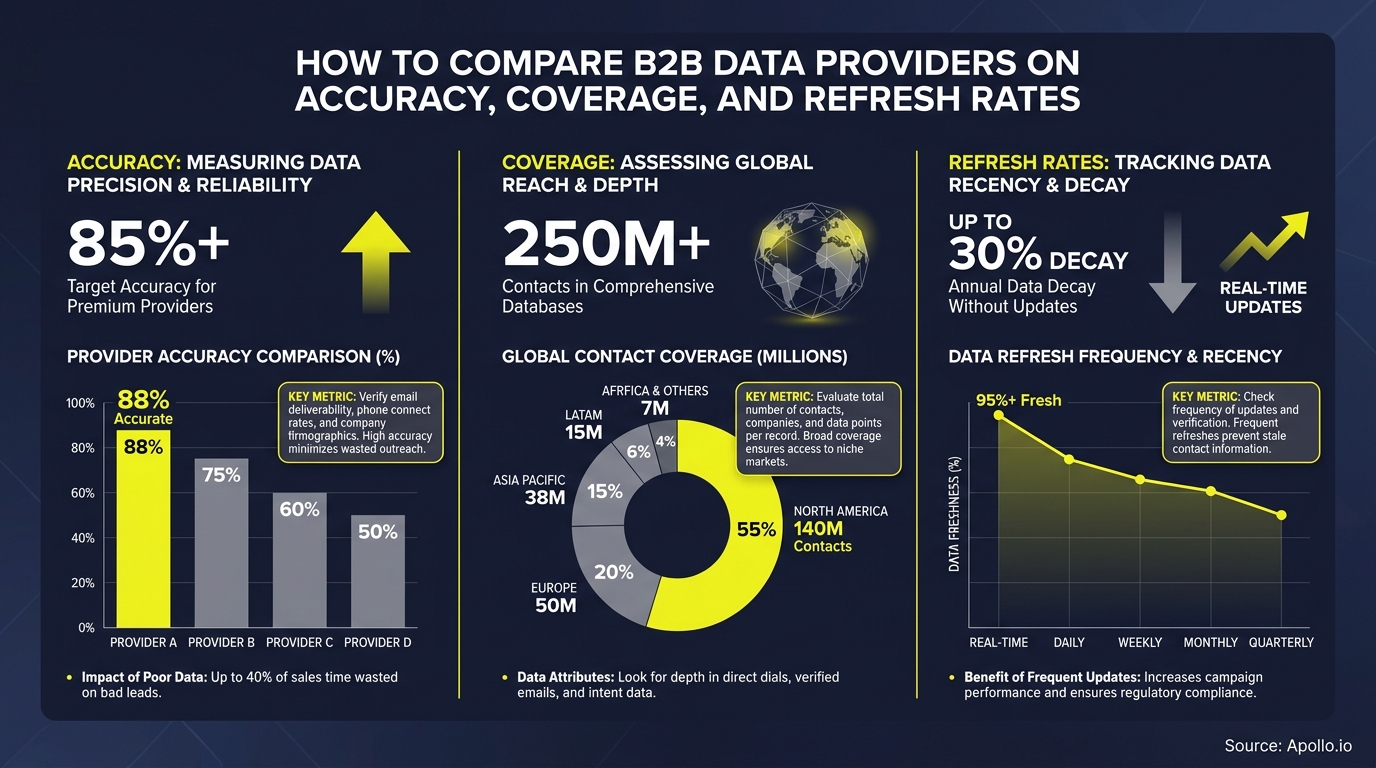
Most B2B data provider comparisons fail before they start. Vendors quote database size. Buyers trust the number. Then bounce rates spike, SDRs chase dead contacts, and pipeline stalls. The real question is never "which provider has the most records?" It's "which provider is most accurate for my ICP, right now?"
This framework gives RevOps leaders, SDRs, and marketing teams a repeatable, evidence-based process to compare B2B data providers on accuracy, coverage, and refresh rates — before signing a contract. For deeper context on why enriched data drives revenue outcomes, see how contact data enrichment drives ROI.

Verify Less. Connect More. Close Faster.
Tired of burning hours hunting down emails that bounce and numbers that go nowhere? Apollo delivers verified business contacts so your team spends time selling, not searching. Nearly 100K paying customers already made the switch.
Start Free with Apollo →Key Takeaways
- Vendor claims about database size are unreliable proxies for quality — run an ICP-specific pilot before committing.
- B2B contact data decays at 2.1% per month, meaning refresh cadence is as important as initial accuracy.
- "Coverage" has three layers that matter: records found, records verified, and records compliant to use.
- SDRs and RevOps teams should use deliverability outcomes (bounce rate, connect rate) as their primary accuracy benchmark.
- Governance, data lineage, and dispute resolution processes belong on every vendor scorecard — especially if AI is in your stack.
Why Is Comparing B2B Data Providers So Difficult?
Comparing B2B data providers is difficult because vendors control which benchmarks they publish, and those benchmarks rarely reflect your specific ICP. As noted by DealSignal, basic counts of accounts or contacts often fail to reflect the freshness or relevance of those records for your use case.
The data quality problem is severe across the industry. According to Demand Gen Report, a 2025 study found that around 75% of respondents estimate at least 10% of their lead data is inaccurate, outdated, or non-compliant — directly affecting pipeline. For teams building a reliable marketing database, this gap makes independent testing essential.
How Do I Run a Bake-Off to Test Data Provider Accuracy?
A bake-off is a structured head-to-head pilot where you submit the same ICP sample to multiple providers under identical conditions and measure real outcomes.
Here's a practical 2-week protocol:
- Sample size: 500–1,000 contacts, stratified by your top ICP segments (industry, seniority, region)
- Fields tested: Business email, direct phone, job title, company HQ, and employee count
- Verification step: Run all outputs through the same third-party email verifier before sending
- Outreach conditions: Same sequence, same sender domain, same time window across all providers
- Success metrics: Bounce rate, invalid rate, connect rate (phone), and match rate per field
Set a hard threshold before you start: many RevOps teams now require a bounce rate below 3% as a minimum bar for any provider. Bounce rate is the most honest proxy for both accuracy and refresh effectiveness.
Struggling to find qualified leads that actually convert? Search Apollo's 230M+ verified contacts with 65+ filters and run your own pilot with clean data from day one.

What Are the Three Layers of B2B Data Coverage?
Coverage is not a single number — it has three distinct layers, and conflating them leads to bad vendor decisions.
| Coverage Layer | What It Means | How to Measure It |
|---|---|---|
| Found | Provider returns a record for your ICP contact | Match rate against your sample list |
| Verified | Record passes email/phone verification | Invalid rate after third-party verification |
| Compliant-to-use | Record includes source, lawful basis, and opt-out status | Governance disclosure audit during RFP |
A provider can claim 300M records but deliver thin compliant-to-use coverage for EU contacts or niche verticals. Per Mindforce Research, evaluating industry-specific data depth is a critical part of any coverage assessment. Ask each vendor for match rate breakdowns by your target geo, seniority tier, and industry — not aggregate totals.
Turn Funnel Guesswork Into Real Pipeline
Tired of watching marketing leads stall before they ever reach your pipeline? Apollo surfaces high-intent prospects and puts your team in front of real buyers first. Nearly 100K paying customers stopped guessing and started closing.
Start Free with Apollo →How Does Data Refresh Rate Affect Pipeline and Deliverability?
Refresh rate determines how quickly a provider re-verifies records after contact data changes — and the decay clock never stops. Research from Cleanlist puts the B2B contact data decay rate at 2.1% per month, or 22.5% annually. For high-velocity SDR teams, that means roughly one in five records becomes unreliable within a year without active re-verification.
Field-level decay varies significantly. Use this as a baseline for your SLA negotiations:
| Field | Decay Risk | Recommended Re-verification Cadence |
|---|---|---|
| Business email | High (job changes, domain changes) | Monthly for active sequences |
| Direct phone | Medium-High | Quarterly |
| Job title | High | Monthly for ICP accounts |
| Company HQ / size | Low-Medium | Semi-annually |
Ask vendors: "What is your re-verification cadence by field type, and can you provide SLA commitments in writing?" Vague answers like "continuous" or "real-time" without documented methodology should be red flags. For teams already managing enrichment workflows, Apollo's data enrichment and cleansing capabilities automate re-verification to keep CRM records current.
How Do RevOps Leaders Build a Vendor Scorecard for Data Quality?
RevOps leaders should build a weighted scorecard that turns subjective vendor claims into comparable numbers. This makes procurement auditable and defensible to leadership.
Core scorecard dimensions:
- Accuracy (30%): Pilot bounce rate, invalid email rate, phone connect rate
- Coverage (25%): ICP match rate by segment (industry + geo + seniority)
- Refresh cadence (20%): Documented re-verification SLA per field type
- Governance and lineage (15%): Source disclosure, last-verified date metadata, opt-out handling
- Dispute resolution (10%): Time-to-correct SLA, escalation path, audit trail
Include governance explicitly. Compliance documentation is now part of data quality scoring — buyers are asking for data source, collection date, lawful basis, and last verification date as standard RFP requirements.
This protects outbound programs and is essential for AI-powered scoring and routing workflows.
Tired of stitching together multiple data tools with inconsistent quality? Start free with Apollo's verified B2B contact data and enrichment platform — one workspace instead of three.
What RFP Questions Should SDRs and RevOps Teams Ask Data Providers?
SDRs and RevOps teams should use these questions in every data provider RFP to separate documented claims from marketing language.
- "What is your email accuracy rate for [our ICP: e.g., VP-level contacts at US SaaS companies with 50–500 employees]?" (Require a sample, not a global stat.)
- "What is your re-verification cadence for business email and job title fields?"
- "Can you provide last-verified-date metadata at the record level?"
- "What is your SLA for correcting an inaccurate record once reported?"
- "What is the source of your contact data, and how do you document lawful basis?"
- "What is your match rate for our sample list? Can we run a paid pilot before committing?"
A provider unwilling to answer these questions in writing is signaling risk. For teams building a scalable data enrichment strategy, these RFP answers form the foundation of your vendor governance framework.
How Does Apollo Help B2B Teams Compare and Validate Data Quality?
Apollo gives B2B GTM teams a unified platform to prospect, enrich, and engage — without stitching together separate data, engagement, and verification tools. Apollo's database covers 230M+ people and 30M+ companies, with 97% email accuracy and 65+ filters for ICP-specific prospecting.
For teams evaluating providers, Apollo offers a free tier to run your own pilot against your ICP before any contract commitment. Teams like Cyera have found that "having everything in one system was a game changer" — consolidating data, enrichment, and outreach into one workspace instead of managing multiple vendor relationships with inconsistent quality standards.
Apollo's data enrichment tools also support ongoing CRM re-verification — so your records stay accurate beyond the initial import. Explore Apollo's full data enrichment tool suite to see how teams are driving revenue with cleaner data in 2026.

How Do You Choose the Right B2B Data Provider in 2026?
Choose the provider that performs best on your ICP in a controlled pilot — not the one with the biggest database claim or the smoothest sales deck. The evaluation framework is straightforward: define your ICP sample, test identical fields under identical conditions, measure deliverability outcomes, and score vendors on a weighted rubric that includes governance and refresh SLAs.
The cost of skipping this process is real. Poor data quality hinders accurate forecasting for 39% of sales professionals, per Martal. Meanwhile, data quality issues are a major factor in the failure or underperformance of 60% of AI projects, according to Taboola — making rigorous provider evaluation a prerequisite for any AI-powered GTM motion.
Apollo makes it easy to start with verified data and scale with confidence. Request a Demo to see how Apollo's accuracy, coverage, and enrichment capabilities hold up against your ICP — on your terms.
Apollo Proves ROI Before Day 30
Budget approval stuck on unclear pipeline metrics? Apollo delivers measurable wins fast — 4x more meetings, +10% win rates, +50% YoY growth. Nearly 100K paying customers justified the spend. You will too.
Start Free with Apollo →Don't miss these
Sales
Inbound vs Outbound Marketing: Which Strategy Wins?
Sales
What Is a Sales Funnel? The Non-Linear Revenue Framework for 2026
Sales
What Is a Go-to-Market Strategy? The 2026 GTM Playbook
See Apollo in action
We'd love to show how Apollo can help you sell better.
By submitting this form, you will receive information, tips, and promotions from Apollo. To learn more, see our Privacy Statement.
4.7/5 based on 9,690 reviews
