
How Do Enterprise Teams Govern and Monitor AI SDR Activity in 2026?
AI SDRs have moved from pilot projects to production systems — and that shift changes everything about oversight. According to MarketBetter.ai, 89% of revenue organizations now use AI in some form, yet governance frameworks have not kept pace. Without structured controls, AI-generated outreach creates brand risk, compliance exposure, and pipeline quality issues that compound quietly until something breaks. Understanding how SDR programs operate is the foundation for building governance that actually works. Tools like Apollo's AI Sales Assistant address this by embedding guardrails, approval workflows, and audit-ready activity logs directly into the outbound motion — so governance is part of the platform, not bolted on afterward.

Research Less, Pipeline More With Apollo
Tired of your reps burning hours verifying contact info instead of selling? Apollo delivers accurate business contacts instantly, so your team spends time closing—not chasing. Join 600K+ companies building predictable pipeline.
Start Free with Apollo →Key Takeaways
- AI SDR adoption is accelerating faster than governance maturity, creating measurable compliance and brand risk for enterprise teams.
- Effective AI SDR governance requires defined KPIs, a cross-functional RACI, and tool inventory controls to eliminate shadow AI in SDR workflows.
- RevOps leaders should anchor monitoring programs to recognized standards like the NIST AI Risk Management Framework for auditable, scalable controls.
- Immutable audit logs and role-based access controls are now table-stakes features enterprises should require from any AI outreach vendor.
- Governance built into a unified platform reduces tool sprawl and makes compliance evidence far easier to produce.
Why Is AI SDR Governance a Priority in 2026?
AI SDR governance is a priority because autonomous outreach systems now operate at a scale and speed that exceeds human review capacity. Salestools.io reports that 22% of sales teams have fully replaced their human SDR function with AI as of early 2026, with another 55% running AI-augmented workflows. At that penetration level, ungoverned AI touches thousands of prospects daily — any systematic error in targeting, messaging, or consent handling multiplies at scale.
The FCC's one-to-one consent rule, effective January 27, 2026, added a direct legal obligation: AI-assisted outreach must capture, record, and retain consent evidence. That requirement alone forces enterprises to instrument their AI SDR programs with monitoring, suppression lists, and audit trails.
This isn't optional compliance overhead — it's a prerequisite for running AI outbound legally.
Struggling to scale outbound without losing control? See how Apollo's AI sales automation keeps governance built into every workflow.
What KPIs Should RevOps Use to Monitor AI SDR Activity?
RevOps leaders should monitor AI SDR activity using a core set of KPIs that cover output quality, compliance signals, and pipeline contribution. Tracking these metrics weekly creates an early-warning system before issues reach deal-stage impact.
| KPI | What It Measures | Alert Threshold |
|---|---|---|
| AI-generated touch volume | Emails, calls, tasks sent by AI per period | Spike >30% week-over-week |
| Opt-out / unsubscribe rate | Prospect rejection of AI outreach | >2% per sequence |
| Spam complaint rate | Deliverability and brand risk | >0.1% of sends |
| Approval override rate | Reps bypassing review gates | Any upward trend |
| Meeting-booked rate (AI vs. human) | AI output quality vs. baseline | Drop >15% from baseline |
| Policy violation flags | Suppression list breaches, consent gaps | Zero tolerance |
Review cadence should be weekly for operational KPIs and monthly for trend analysis. Connect these metrics to your revenue operations reporting framework so leadership has visibility without requiring manual data pulls.
Turn Funnel Chaos Into Predictable Pipeline
Tired of watching marketing leads stall before they ever reach your pipeline? Apollo surfaces high-intent prospects so your team works opportunities that actually close. Nearly 100K paying customers stopped guessing and started growing.
Start Free with Apollo →How Should RevOps and Sales Ops Build a Cross-Functional Governance Model?
A cross-functional governance model for AI SDRs assigns clear ownership across RevOps, Sales Ops, Legal, Security, and the SDR team itself using a RACI structure. Fragmented ownership is the primary cause of governance failure — when everyone assumes someone else is responsible, no one acts.
| Activity | Responsible | Accountable | Consulted | Informed |
|---|---|---|---|---|
| Prompt / sequence approval | Sales Ops | RevOps | Legal, SDR Manager | Marketing |
| Tool inventory & approval | RevOps | Security | Legal | SDR Team |
| KPI monitoring & alerts | RevOps | VP Sales | Sales Ops | Finance |
| Incident response | Security | Legal | RevOps, SDR Manager | Executive team |
| Compliance evidence retention | Legal | CTO / CISO | RevOps | Audit |
Release management for prompts and sequences deserves the same discipline as software releases: versioning, staged rollouts, and rollback plans.
SDR Managers should not deploy new AI messaging templates to the full team without a review gate.
This mirrors the governance approach described in responsible sales automation practices.
How Do Enterprise Teams Eliminate Shadow AI in SDR Programs?
Enterprise teams eliminate shadow AI by conducting a formal tool inventory, establishing an approved-vendor list, and enforcing policy through access controls rather than just written guidelines. The Signal identifies rules of engagement as a primary challenge for AI SDR programs, particularly around integration with existing GTM systems — a problem that worsens when reps use unapproved tools that don't connect to the CRM or suppression infrastructure.
- Inventory step: Survey all tools SDRs use for prospecting, messaging, and research. Include browser extensions and personal accounts.
- Approval gate: Require a Security + Legal review before any AI tool accesses prospect data or sends communications on behalf of the company.
- Technical enforcement: Block unapproved AI services at the network or SSO level. Policy documents alone don't stop adoption.
- Amnesty period: Give reps 30 days to declare unapproved tools before enforcement begins. This surfaces real usage without punishment.
The goal is a consolidated, auditable tech stack. As Cyera found after consolidating their tools: "Having everything in one system was a game changer." Fewer approved tools means fewer attack surfaces and cleaner audit trails.

What Observability and Access Controls Do AI SDR Agents Require?
AI SDR agents require immutable activity logs, role-based access controls (RBAC), and drift monitoring to remain auditable at enterprise scale. These aren't nice-to-have features — they are the evidence layer that supports compliance investigations, customer disputes, and board-level AI oversight disclosures.
Key observability requirements:
- Audit logs: Record every action the AI took: who prompted it, what it sent, which data it accessed, and the outcome. Logs must be tamper-resistant.
- RBAC: Limit which roles can approve sequences, modify ICP filters, or disable suppression lists. SDRs should not have admin-level access to AI configuration.
- Drift detection: Alert when AI output quality (reply rates, opt-out rates) deviates from baseline, indicating model behavior changes or data quality issues.
- Data access boundaries: Prevent AI from accessing confidential pricing, unreleased product info, or non-public company data when generating outbound messages.
This observability framework maps directly to the NIST AI-600-1 Generative AI Profile (released July 2024), which specifies logging, testing, and incident response as core controls for generative AI systems. SDR programs operating at enterprise scale are now, effectively, regulated production systems. Learn how Apollo's Outbound Copilot surfaces credit cost transparency and approval controls before each automated run — a practical implementation of observability baked into the workflow.
Need a unified platform where AI outreach, approvals, and audit trails live in one place? Explore Apollo's sales engagement platform with built-in governance controls.
What Is the AI SDR Governance Maturity Roadmap?
AI SDR governance matures through three stages: Reactive, Structured, and Optimized. Most enterprises are currently in the Reactive stage — monitoring after problems occur rather than preventing them.
| Stage | Characteristics | Key Actions |
|---|---|---|
| Reactive | No formal program, incident-driven fixes | Conduct tool inventory, assign RACI ownership |
| Structured | KPI tracking, approval workflows, RBAC in place | Implement weekly monitoring cadence, suppression controls |
| Optimized | Continuous monitoring, drift alerts, audit-ready evidence | Align to NIST AI RMF, run quarterly governance reviews |
Most teams can move from Reactive to Structured in 60-90 days by completing the tool inventory, deploying the RACI, and activating KPI dashboards. The enterprise sales solutions that support this progression are those with native governance controls, not those requiring separate monitoring overlays.

How Should Enterprise Teams Start Governing AI SDR Activity Today?
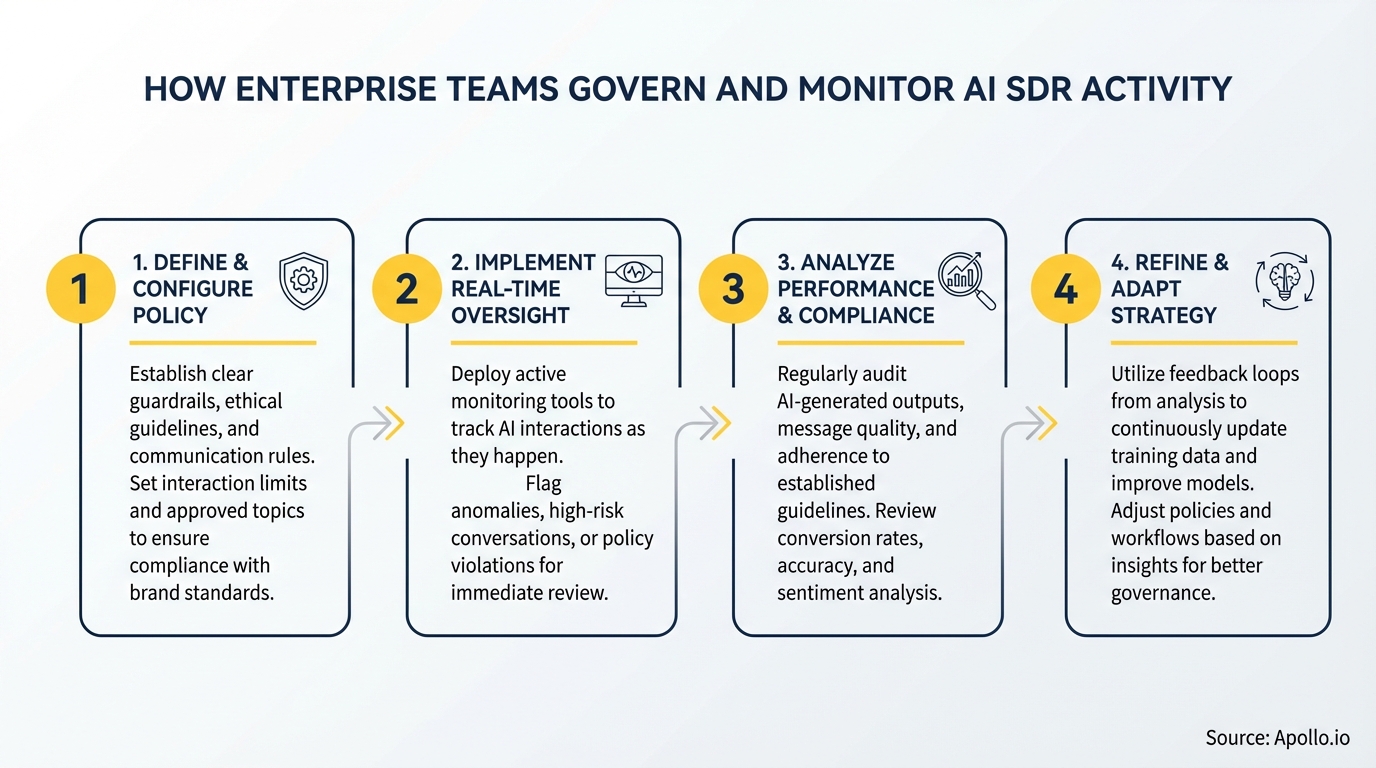
Enterprise teams should start with three immediate actions: complete a tool inventory, assign a governance owner, and activate KPI monitoring on existing AI SDR outputs. These three steps move a program from invisible risk to visible, manageable activity in days — not quarters.
The broader context is clear: AI SDR adoption has outrun governance maturity across most organizations, and the regulatory and compliance environment in 2026 has removed the option to defer action. The teams that build governance infrastructure now will scale AI outbound without the brand, legal, and pipeline quality risks that are already surfacing elsewhere.
Apollo's platform is built for this moment. With the AI Assistant, AI Content Center, approval workflows, and SOC2/ISO 27001-backed data protections, Apollo consolidates the AI SDR capability and the governance layer into one workspace. As Tory Kindlick, Head of Revenue Ops at RapidSOS, put it: "Work that would've taken me hours was done before I even got off the train." That efficiency only scales safely when governance is embedded — not added later. Explore how Apollo can power your governed sales tech stack, or schedule a demo to see the platform in action.
Prove Pipeline ROI Before Next QBR
ROI pressure killing your tool budget? Apollo delivers measurable pipeline impact from day one — so you walk into every budget conversation with numbers, not guesses. Nearly 100K paying customers already have the proof.
Start Free with Apollo →Don't miss these
Sales
Inbound vs Outbound Marketing: Which Strategy Wins?
Sales
What Is a Sales Funnel? The Non-Linear Revenue Framework for 2026
Sales
What Is a Go-to-Market Strategy? The 2026 GTM Playbook
See Apollo in action
We'd love to show how Apollo can help you sell better.
By submitting this form, you will receive information, tips, and promotions from Apollo. To learn more, see our Privacy Statement.
4.7/5 based on 9,690 reviews
