
Inbound Marketing Lead Generation: The 2026 Framework for B2B Pipeline
Inbound marketing lead generation is the practice of attracting qualified buyers through content, SEO, and owned channels, then converting that interest into pipeline. It works because buyers arrive with intent already formed.
But the game has shifted significantly: AI assistants now intercept early research, budgets face tighter scrutiny, and buyers are largely pre-committed to a vendor before your first form-fill.
The teams winning at inbound in 2026 aren't just publishing more content. They're building buyer preference before first contact, measuring pipeline quality instead of MQL volume, and structuring content so AI answer engines can extract and surface it.
This guide gives you the updated framework.

Get Pipeline-Ready Leads With Apollo
Tired of chasing low-quality leads that never convert? Apollo's 224M-contact database with 96% email accuracy puts your ICP in front of you — fast. Join 550K+ companies generating predictable pipeline.
Start Free with Apollo →Key Takeaways
- According to MarketingLTB, 61% of marketers consider inbound their primary marketing approach, yet generating traffic and leads remains their top challenge.
- Inbound lead generation is shifting from MQL volume to pipeline quality metrics: cost-per-opportunity, MQL-to-SQL conversion, and win-rate impact.
- AI assistants are now part of the B2B buying process, which means your content must be structured for extraction, not just ranked for clicks.
- First-party data capture (email lists, webinars, communities) is becoming the core infrastructure for inbound-to-revenue workflows.
- Combining inbound content with outbound follow-up on the same platform significantly compresses time-to-meeting.
What Is Inbound Marketing Lead Generation?
Inbound marketing lead generation uses content, search visibility, and owned channels to attract buyers who are already researching solutions. Unlike outbound, you don't interrupt.
You position your brand where buyers look, answer their questions with authority, and create conversion points that capture their information in exchange for value.
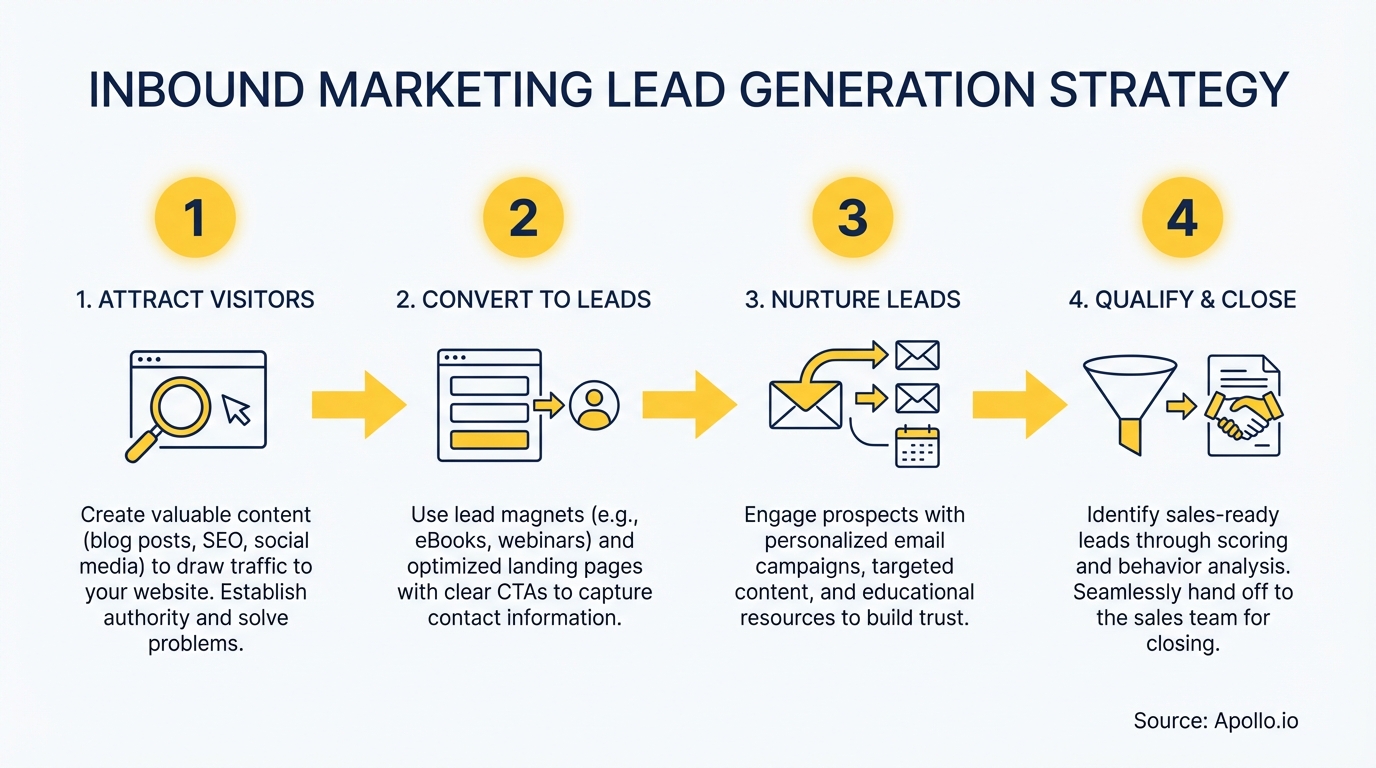
It is not simply publishing blog posts and waiting. Effective inbound lead generation requires deliberate funnel architecture: content mapped to buyer stages, conversion assets that earn information exchange, and a follow-up workflow that acts on intent signals quickly. For a broader view of how inbound fits into your overall strategy, see Demand Generation vs Lead Generation: What's the Difference?
Why Inbound Lead Generation Is Harder (and More Important) in 2026
Three forces are reshaping inbound effectiveness right now:
- AI answer interception: Search engine volume is shifting as AI summaries answer queries directly, reducing click-through to content. Teams now need to optimize for AI extractability, not just keyword rankings.
- Pre-shaped buyer decisions: Research shows the majority of B2B buyers already have a preferred vendor before they ever contact a vendor directly. This means your content must build preference, not just awareness.
- Measurement credibility gaps: Many B2B marketing leaders report they don't trust their own marketing measurement data, which stalls investment in inbound programs precisely when ROI proof is most needed.
Despite these pressures, Huble reports that content marketing generates over three times as many leads as outbound marketing and costs significantly less. The ROI case is strong. The execution gap is where most teams lose.

The 4-Part Inbound Lead Generation Framework
1. Preference Formation: Win Before the First Contact
Most inbound strategies focus on the moment someone fills out a form. The real leverage is in the months before that.
Buyers who encounter your brand repeatedly during their research phase are far more likely to convert when they finally reach out.
Tactics for building pre-contact preference:
- Category entry point content: Create content that answers the earliest questions buyers ask when a problem first surfaces, not just comparison or product-focused content.
- Original benchmarks and data: Proprietary research creates credibility signals AI cannot replicate. Publish surveys, customer data analyses, or industry benchmarks under your brand.
- Credibility-first TOFU: Executive POV content, thought leadership, and social distribution on professional networks where B2B buyers research during the discovery phase.
- Consistent distribution: A Google/NRG B2B Buyer Journey study found 59% of US B2B buyers used social media during the research stage. Distribute inbound content across social channels, not just SEO.
2. Content Assets by Funnel Stage
Map your content to the specific questions buyers ask at each stage. Thin coverage at any stage creates preference gaps that competitors fill.
| Stage | Buyer Need | Best Content Assets | Conversion Goal |
|---|---|---|---|
| TOFU | Problem framing, education | Blog posts, social content, short videos, benchmarks | Brand recall, newsletter sign-up |
| MOFU | Solution evaluation, proof | Guides, webinars, comparison pages, case studies | Form fill, demo request, content download |
| BOFU | Vendor validation, risk reduction | ROI calculators, free trials, live demos, customer stories | Meeting booked, trial started |
According to Sword and the Script, gated content consumption was up 14% in 2023 compared to 2022, and 77% since 2019. MOFU and BOFU gated assets remain effective conversion tools when the content genuinely earns the exchange.
For detailed channel-specific tactics, the guide on Lead Generation: Attract, Engage, and Convert B2B Prospects covers conversion architecture in depth.
3. Measurement and Attribution: Stop Reporting Leads, Start Reporting Signal
MQL volume is a vanity metric when disconnected from pipeline outcomes. The modern inbound measurement framework tracks quality signals across the full funnel.
KPIs that matter to sales leaders:
- MQL-to-SQL conversion rate by content source
- Cost-per-opportunity (not cost-per-lead)
- Pipeline contribution by channel
- Time from first inbound touch to meeting booked
- Win-rate for inbound-sourced vs. other pipeline
Attribution approaches: Last-click attribution misses most of the buyer journey. Supplement with self-reported attribution (ask prospects how they found you), deal-level journey analysis, and first-touch tracking for awareness content. "Dark social" channels (peer communities, private sharing, newsletters) contribute meaningful influence that never appears in your analytics without explicit capture mechanisms.
"Apollo helps us turn data into action... we are living and breathing inside the tool."
4. First-Party Data Architecture: Own Your Inbound Audience
Third-party cookies and persistent identifiers are degrading as tracking infrastructure. B2B inbound programs built on owned data outperform those reliant on paid retargeting as identity signals weaken.
Build first-party data capture into every inbound asset:
- Email list growth: Newsletter subscriptions from TOFU content create a direct-contact audience you own regardless of algorithm changes.
- Webinars and events: High-intent registration captures first-party data alongside demonstrated interest signals.
- Community building: Peer communities create ongoing engagement data and warm audiences for new content launches.
- Progressive profiling: Collect data incrementally across multiple content interactions rather than demanding full forms on first visit.
- Data enrichment on capture: When a prospect fills out a form, enriching their record with firmographic and technographic data immediately enables faster qualification and more relevant follow-up.
Need to enrich and act on inbound leads faster? Apollo's data enrichment instantly fills firmographic gaps on every inbound record, so your team can qualify and route without manual research.
Turn Weak Leads Into Real Pipeline
Tired of marketing leads that never become real opportunities? Apollo surfaces in-market buyers with verified contact data so your team reaches the right prospects at right moment. Join 550K+ companies building predictable pipeline.
Start Free with Apollo →How to Convert Inbound Interest into Booked Meetings
Generating inbound leads is only half the equation. The conversion from lead to meeting is where most programs leak pipeline.
Replace Static Forms with Conversational Qualification
The "Contact Us → wait 48 hours" model kills conversion rates. Conversational qualification routes and personalizes the experience in real time, dramatically improving speed-to-lead and show rates. Apollo's meeting scheduling tools let inbound leads book directly with the right rep without manual routing delays.
Speed to Lead Is a Pipeline Variable
Inbound leads decay rapidly. The faster a qualified rep follows up after a form fill or content download, the higher the conversion rate.
Automated workflows that trigger immediate follow-up sequences on inbound actions compress the gap between intent signal and conversation.
"The moment we select someone in our database, they're instantly added to a sequence and we can take action right away. We're effective and efficient with our outreach."
For lead nurturing sequences that keep inbound leads engaged between touchpoints, see 6 Proven Prospect Nurturing Strategies to Convert Hesitant Leads.
AI-Ready Content: Structure for Answer Engine Visibility
AI assistants are now a primary discovery channel for B2B buyers. Content that isn't structured for extraction is invisible to these systems.
This is the new inbound battleground: not just ranking for keywords, but appearing in AI-generated answers.
Principles for AI-extractable inbound content:
- Lead every section with a declarative statement that answers the question directly. AI systems extract the clearest, most specific answer available.
- Use structured formats: Tables, numbered lists, and clearly labeled sections are more extractable than dense paragraphs.
- Include evidence: Specific statistics with citations signal credibility to both AI systems and the buyers they serve. Vague claims are deprioritized.
- Write self-contained sections: Each H2 should fully answer one question without requiring context from other sections.
- Avoid filler: AI summarizers prioritize density. Every sentence should contribute a specific, verifiable claim or actionable instruction.
This approach also strengthens traditional SEO. Content optimized for AI extraction tends to rank better for featured snippets and zero-click answers as well.
Common Inbound Lead Generation Mistakes to Avoid
| Mistake | Why It Hurts | Fix |
|---|---|---|
| Optimizing for MQL volume only | Volume without quality creates sales friction and wastes follow-up capacity | Track cost-per-opportunity and MQL-to-SQL rate by source |
| TOFU-heavy content without MOFU/BOFU | Attracts awareness but doesn't capture buyers in decision mode | Map content to all three funnel stages with clear conversion paths |
| Slow lead follow-up | Intent signals decay within hours; delayed follow-up loses deals to faster competitors | Automate immediate follow-up sequences triggered by inbound actions |
| Single-channel distribution | SEO alone misses buyers researching via social, communities, and AI tools | Distribute across professional social networks, newsletters, and communities |
| No first-party data capture | Traffic without owned audience means starting from zero when algorithms change | Build email lists, webinar audiences, and community memberships from every content asset |
For more on building a complete automated lead generation system that handles both inbound and outbound, Apollo's guide walks through the full architecture.

Start Converting Inbound Interest into Pipeline
Inbound marketing lead generation in 2026 requires more than a content calendar. It requires a system: content that builds buyer preference early, measurement that connects to revenue, first-party data infrastructure, and fast follow-up that turns intent signals into conversations.
Apollo brings inbound lead qualification, data enrichment, engagement sequences, and meeting booking into one unified platform, so your team acts on every inbound signal without switching tools or losing context.
Start Your Free Trial and see how Apollo turns inbound leads into pipeline faster.
Prove Pipeline ROI With Apollo
ROI pressure killing your next budget approval? Apollo delivers measurable pipeline impact fast — so you walk into every review with numbers that stick. Leadium 3x'd their revenue. You're next.
Start Free with Apollo →Don't miss these
Sales
Inbound vs Outbound Marketing: Which Strategy Wins?
Sales
What Is a Sales Funnel? The Non-Linear Revenue Framework for 2026
Sales
What Is a Go-to-Market Strategy? The 2026 GTM Playbook
See Apollo in action
We'd love to show how Apollo can help you sell better.
By submitting this form, you will receive information, tips, and promotions from Apollo. To learn more, see our Privacy Statement.
4.7/5 based on 9,690 reviews
