What Is High Ticket Sales? The 2026 Buyer-First Closing Playbook
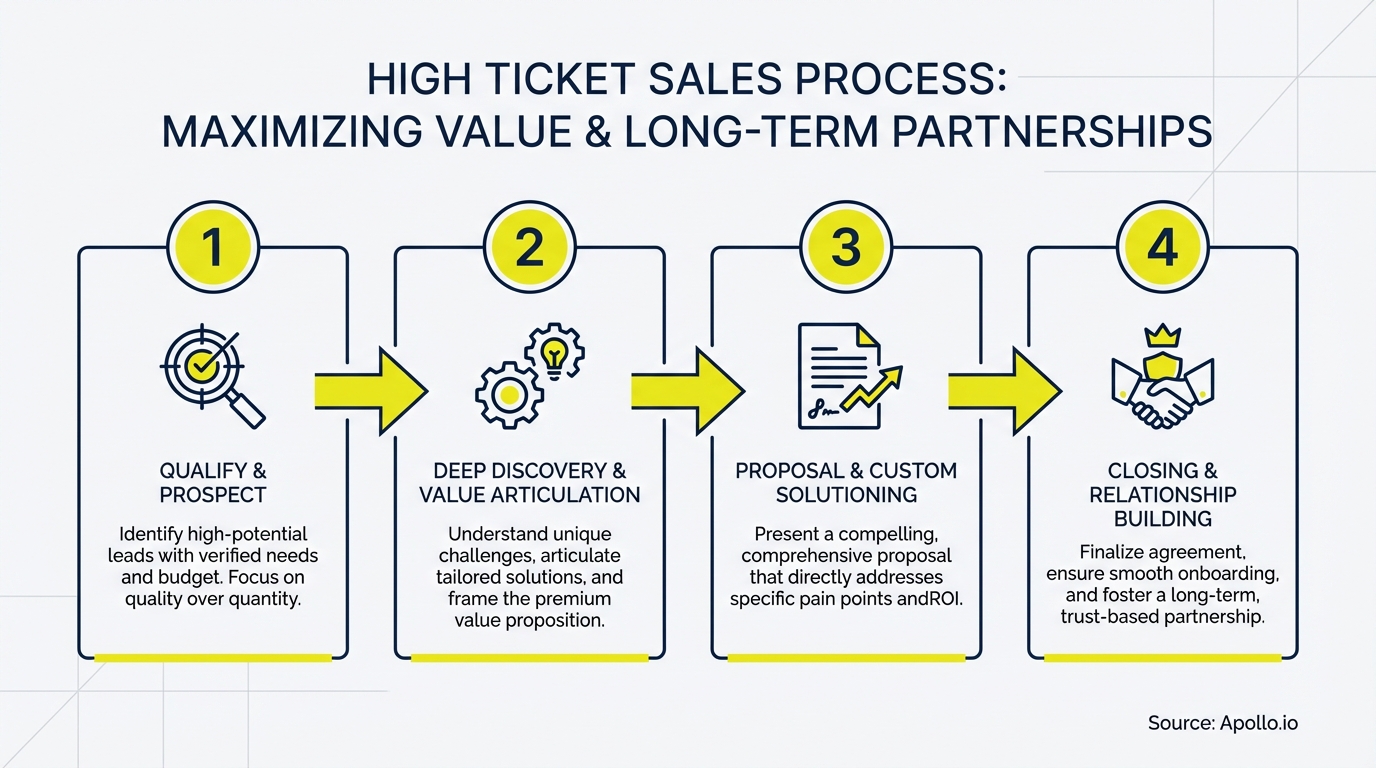
High ticket sales refers to selling premium-priced products or services, typically $5,000 and above, where the buying decision involves multiple stakeholders, extended timelines, and significant risk assessment. In 2026, the rules have fundamentally changed: buyers are doing more research independently, budgets are tighter, and reps who rely solely on relationship-based selling are losing ground to those who build a complete buyer enablement system.
The shift is structural. According to InformatechTarget, over two-thirds of buyers involved in big-ticket transactions are now Millennials and Gen Z, a generation that expects self-serve research experiences before ever speaking to a rep. Winning high ticket deals today means building the content and tools that close deals before you even get on a call.

Apollo Turns Research Hours Into Revenue
Tired of spending hours hunting for contacts that bounce anyway? Apollo delivers verified business emails and phones so your reps sell instead of search. Join 550K+ companies building pipeline faster.
Start Free with Apollo →Key Takeaways
- High ticket sales involves premium deals ($5,000+) with longer cycles, multiple decision-makers, and higher scrutiny on ROI.
- Modern high-ticket buyers complete most of their evaluation independently, making self-serve content and buyer enablement assets critical.
- ROI-first selling, authority-building, and structured objection handling are the core strategies that separate top closers.
- AI and automation tools dramatically reduce administrative overhead so reps can focus time on high-value conversations.
- Apollo's unified platform supports every stage of the high ticket sales cycle, from prospecting to pipeline management.
What Makes High Ticket Sales Different from Standard B2B Selling?
High ticket sales is not just standard B2B selling at a higher price point. The entire process, from discovery to close, operates differently.
Deals require executive buy-in, procurement review, security assessments, and multi-stakeholder consensus. A single misstep in the evaluation phase can kill a deal that took months to build.
| Dimension | Standard B2B Sales | High Ticket Sales |
|---|---|---|
| Deal Size | $500–$4,999 | $5,000–$500,000+ |
| Sales Cycle | Days to weeks | Weeks to months |
| Decision Makers | 1–2 | 3–10+ (buying committee) |
| Content Needed | Product pages, demos | ROI models, TCO calculators, security packs, implementation guides |
| Primary Risk | Feature mismatch | Budget justification, implementation risk, stakeholder misalignment |
For a deeper dive into the enterprise end of high ticket deals, see this guide on enterprise sales strategies and executive access.
Why Rep-Free Buyer Enablement Is Now Non-Negotiable
The most important shift in high ticket sales is happening before reps ever enter the conversation. Research consistently shows that B2B buyers spend the vast majority of their purchase journey evaluating independently.
By the time a prospect books a call, they have already formed strong opinions, often with your competitor's content shaping their view.
According to Kondo's B2B Sales Benchmarks, 80% of B2B sales interactions between suppliers and buyers are projected to occur in digital channels by 2025. If your digital presence consists only of a demo request form, you are invisible for most of the buying journey.
The fix is a structured self-serve asset stack. Every high-ticket deal should be supported by:
- ROI calculators and TCO models: Let buyers build the business case themselves, in their own numbers.
- Implementation playbooks: Remove fear of complexity by showing the onboarding path step by step.
- Security and compliance documentation: Procurement teams need this before any deal can advance.
- Executive summary briefs: Asynchronous materials that champions can share internally without you present.
- Case studies with measurable outcomes: Industry-specific proof, not generic testimonials.
"Now we know exactly what we want to say and who we want to say it to. It's just a matter of going into Apollo and making it happen."
The ROI-First Selling Framework for High Ticket Deals
High ticket buyers are not buying features. They are buying outcomes they can justify to a CFO or board.
ROI-first selling means leading every conversation with quantified business impact, not product capabilities. The rep's job is to help the buyer articulate the cost of inaction and the value of change.
A practical ROI-first framework follows four steps:
- Diagnose the current state cost: What is the problem costing the buyer in time, revenue, or risk right now?
- Quantify the improvement: What measurable outcome does your solution deliver, and over what timeframe?
- Map to business objectives: Connect the outcome to a goal the executive sponsor already owns (revenue growth, cost reduction, risk mitigation).
- Build the internal business case: Provide the champion with a pre-formatted ROI summary they can present upward without your help.
Reps who master this framework win more often because they remove the friction of internal justification, the step where most high-ticket deals stall. For tactical pitch execution, see these proven sales pitch techniques that close more deals.
Struggling to identify which prospects are actually worth the investment of a full ROI conversation? Search Apollo's database of 224M+ contacts with 65+ filters to find buyers who match your exact ICP before you spend a minute on outreach.

How to Handle High Ticket Sales Objections
Objections in high-ticket deals are usually not about price. They are about risk. Understanding the real objection underneath the stated one is what separates closers from order-takers.
| Stated Objection | Real Concern | Response Strategy |
|---|---|---|
| "It's too expensive." | Can't justify ROI internally | Build a co-created ROI model with the champion |
| "We need to evaluate other options." | Not confident you're the best fit | Provide a differentiated comparison guide; offer a structured POC |
| "Now isn't the right time." | No internal urgency or budget cycle issue | Quantify the cost of delay; align to an upcoming initiative or event |
| "We need legal/security review." | Procurement bottleneck | Proactively provide security pack, DPA, and compliance documentation |
| "Our team won't adopt it." | Implementation risk | Share customer implementation timelines and onboarding success data |
Risk reversal is equally important. Structured pilots, phased contracts, success-based milestones, and strong onboarding guarantees all reduce perceived risk and accelerate decision-making. For more on managing complex B2B sales cycles, including buying committee dynamics, see Apollo's full B2B sales guide.
Turn Funnel Gaps Into Pipeline Gold
Leads not converting to opportunities. Apollo surfaces in-market buyers with the right signals at right moment — so your team pursues prospects ready to buy, not just available. 550K+ companies trust Apollo to close the gap.
Schedule a Demo →The Technology Stack That Powers High Ticket Sales
High ticket sales is operationally demanding. Reps managing 6-figure deals cannot afford to spend the majority of their time on administrative tasks. According to Landbase, sales representatives spend only 28–34% of their time on actual selling activities, with the rest consumed by administrative tasks and non-revenue-generating work.
The right tech stack eliminates that drag. For high-ticket teams, the essential categories are:
- Prospecting and data intelligence: Identify and verify decision-makers across the buying committee.
- Sales engagement: Multi-channel outreach sequences with personalization at scale.
- Deal management: Track multi-stakeholder deals, next steps, and pipeline health in one place.
- Conversation intelligence: Capture call insights and coaching signals automatically.
- AI automation: Reduce research and admin time so reps focus on selling.
"The thing that made me most excited as somebody who's been in sales development a long time was Apollo's integration between sales data and sales engagement and the magic that you can make happen when those two are together on the same platform."
Apollo consolidates all of these capabilities into a single unified platform. Instead of stitching together a data tool, an engagement tool, a dialer, and a CRM, high-ticket teams can run their entire workflow in one workspace. Manage every deal stage with Apollo's deal management tools, purpose-built for complex multi-stakeholder pipelines.
For guidance on building a tech stack that scales with deal complexity, see this playbook on how to build a sales tech stack that scales revenue.
How AI Is Reshaping High Ticket Sales in 2026
AI has moved from a nice-to-have to a structural advantage in high-ticket selling. The teams using it effectively are not replacing reps; they are removing everything that slows reps down. Research from In-Flow shows that sales reps save up to 5 hours per week on administrative tasks and lead qualification by implementing AI-powered sales tools, time that can be reinvested directly into high-value prospect conversations.
Practical AI applications for high-ticket deals include:
- Automated account research and stakeholder mapping before first contact
- AI-generated personalized outreach at scale, tailored to each prospect's role and business context
- Call transcription and deal intelligence to surface risks and next steps automatically
- Predictive lead scoring to prioritize the accounts most likely to close at high value
For a full breakdown of which tools deliver the highest impact, see Apollo's guide to AI sales tools that actually close more deals.
Key Metrics to Measure High Ticket Sales Performance
Measuring the right metrics keeps high-ticket pipelines honest. Vanity metrics like activity volume tell you nothing about deal health. Focus on these instead:
| Metric | What It Measures | Why It Matters |
|---|---|---|
| Average Deal Size | Revenue per closed deal | Tracks upmarket movement over time |
| Sales Cycle Length | Days from first touch to close | Identifies where deals stall |
| Win Rate by Stage | Conversion between pipeline stages | Pinpoints the weakest step in the process |
| Multi-Stakeholder Engagement Rate | Number of contacts engaged per account | Predicts deal resilience and close probability |
| Pipeline Coverage Ratio | Pipeline value vs. quota | Signals whether enough qualified deals exist to hit targets |
Analytics that connect outreach activity to pipeline outcomes are essential for high-ticket teams. Apollo's sales analytics capabilities give revenue leaders visibility into what's working at every stage of the deal cycle.
How to Get Started with High Ticket Sales
If you are transitioning from transactional selling to high-ticket deals, three fundamentals have to be in place before you scale.
- Define your ICP with precision. High-ticket deals cannot be won with broad targeting. Identify the specific company size, industry, tech environment, and trigger events that predict your best buyers.
- Build your self-serve asset stack. Create the ROI tools, case studies, and implementation guides that let buyers evaluate you independently. This content does the selling when you are not in the room.
- Establish a repeatable qualification framework. Not every large-logo prospect is a real high-ticket opportunity. Use a structured framework (budget, authority, need, timeline) to protect your team's time and focus energy where it converts.
For a comprehensive foundation, Apollo's guide on what high-ticket sales are and how to close them walks through every stage of the process in detail.

Conclusion: Build the System, Win the Deal
High ticket sales in 2026 rewards teams who build systems, not just reps who rely on relationships. The buyers are more informed, more independent, and more skeptical than ever.
Winning means meeting them with the right content at the right stage, leading every conversation with ROI, and using technology to eliminate the operational drag that keeps reps out of their most important deals.
Apollo gives high-ticket sales teams a unified platform to prospect smarter, engage more effectively, and manage complex deals without stitching together five separate tools. Start free with Apollo and see how the world's leading GTM teams are closing bigger deals, faster.
Prove Pipeline ROI Before the Next QBR
Budget approval stuck on unclear metrics? Apollo surfaces measurable pipeline impact so you walk into every review with proof, not promises. Leadium 3x'd revenue — see what Apollo does for yours.
Start Free with Apollo →Don't miss these
Sales
Inbound vs Outbound Marketing: Which Strategy Wins?
Sales
What Is a Sales Funnel? The Non-Linear Revenue Framework for 2026
Sales
What Is a Go-to-Market Strategy? The 2026 GTM Playbook
See Apollo in action
We'd love to show how Apollo can help you sell better.
By submitting this form, you will receive information, tips, and promotions from Apollo. To learn more, see our Privacy Statement.
4.7/5 based on 9,690 reviews
