
GTM Tech Stack: Build a Revenue Engine Without the Tool Chaos
Your go-to-market tech stack is either your competitive advantage or your operational nightmare. The difference comes down to one question: are you building a revenue engine or duct-taping a Frankenstack?
According to Zylo, organizations averaged 305 apps in their SaaS portfolios in 2024, with the number of software solutions projected to reach over 15,000 tools by 2025 alone. Yet most revenue teams struggle to extract value from the tools they already own.
This guide explores how to design a GTM tech stack that drives measurable outcomes under real-world constraints: flat budgets, privacy regulations, and the shift toward AI-powered workflows. The role of the GTM Engineer has emerged specifically to solve this problem—building systems that execute strategy at velocity without integration overhead.

Apollo Eliminates Hours Of Daily Prospecting
Tired of reps spending 4+ hours daily hunting for contact info? Apollo delivers 224M verified contacts instantly. Join 550K+ companies who replaced manual research with automated prospecting.
Start Free with Apollo →Key Takeaways
- GTM tech stacks are shifting from multi-tool Frankenstacks to unified platforms with agentic workflows
- Budget constraints demand measurable ROI from every tool—consolidation beats proliferation
- Privacy regulations require first-party data strategies and new measurement architectures
- The best GTM stacks prioritize execution velocity and data quality over feature breadth
- RevOps professionals using unified stacks are significantly more likely to exceed revenue goals
What Is A GTM Tech Stack?
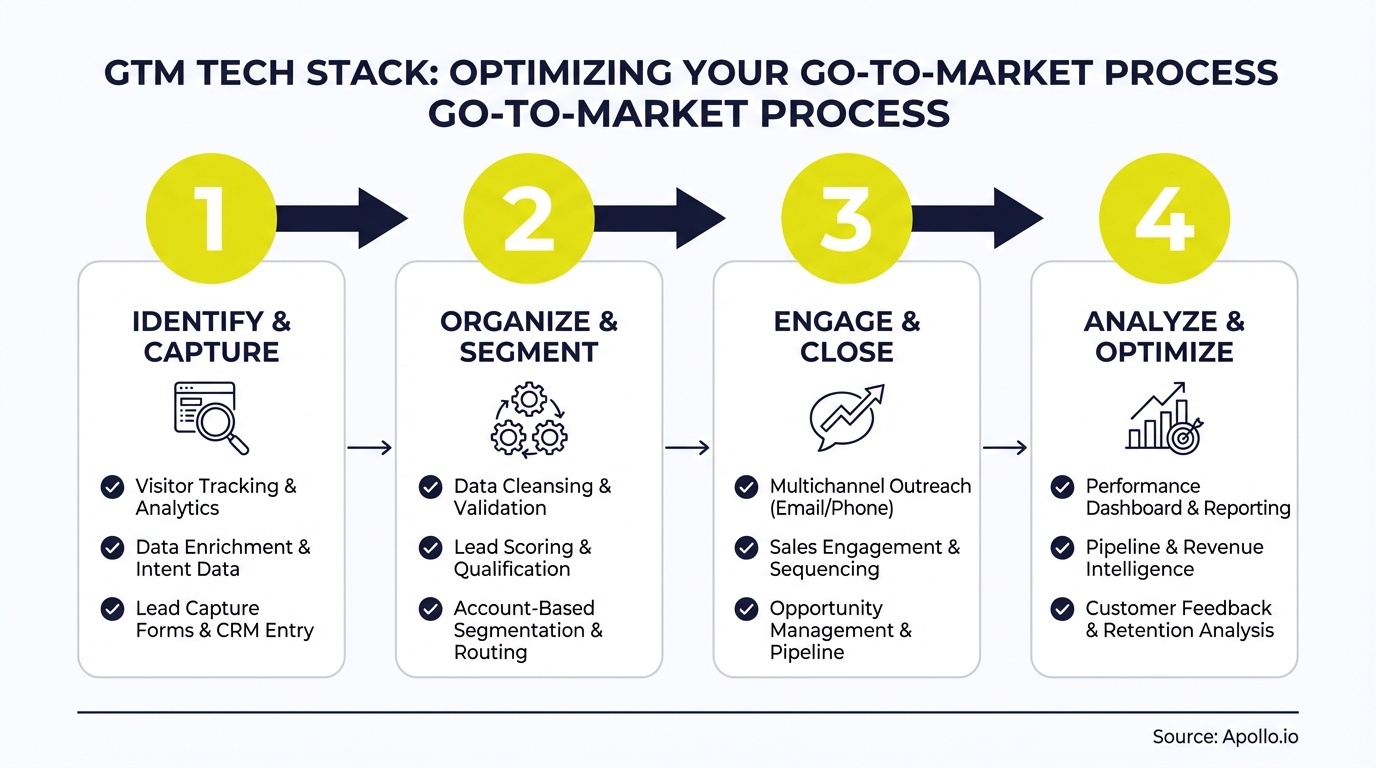
A GTM tech stack is the collection of software platforms and tools that revenue teams use to identify, engage, convert, and retain customers. It spans prospecting, outreach, pipeline management, and customer success—connecting data, workflows, and people across the entire revenue lifecycle.
The GTM tech stack differs from a traditional sales stack or martech stack by emphasizing cross-functional alignment. It's not just marketing tools or sales tools—it's the unified infrastructure that RevOps, sales, marketing, and customer success teams use to execute a coordinated go-to-market strategy.
Research from Deloitte found that B2B organizations using RevOps were 1.4 times as likely to exceed their 2023 revenue goals by 10% or more, compared to those not using RevOps. The tech stack is the operational backbone that makes that alignment possible.
Why Do Revenue Teams Need A Unified GTM Tech Stack?
Fragmented tools create fragmented execution. When prospecting happens in one platform, engagement in another, and reporting in a third, strategy gets lost in translation between systems.
The problem compounds when leadership sets a targeting strategy but every rep interprets it differently because they're pulling from different lists, using different sequences, and measuring success with different metrics. Nothing scales.
Nothing compounds.
According to a 2024 report, marketing leaders are only using 33% of their available technology capabilities, yet 75% face budget cuts to marketing technology. This utilization gap signals a fundamental mismatch between stack complexity and team capacity.
Data from G2's 2023 Software Buyer Behavior Report revealed that buyers prefer to work with fewer vendors (78%) and use a single solution instead of multiple tools (84%). Your tech stack should reflect this same consolidation principle.
What Are The Core Components Of A Modern GTM Tech Stack?
A minimum viable GTM tech stack includes five essential layers, each serving a specific function in the revenue engine. These categories represent capabilities, not necessarily individual tools—the goal is to minimize vendor count while maximizing coverage.
| Stack Layer | Primary Function | Key Capabilities |
|---|---|---|
| Data & Intelligence | Identify and enrich target accounts | Contact database, firmographic filters, technographic signals, intent data |
| Engagement & Outreach | Execute multi-channel sequences | Email sequences, calling workflows, social outreach, task automation |
| Pipeline Management | Track opportunities to close | Deal stages, forecasting, activity tracking, win/loss analysis |
| Analytics & Attribution | Measure what drives revenue | Conversion metrics, channel attribution, signal correlation, ROI tracking |
| Workflow Automation | Orchestrate data and actions | Data routing, scoring updates, CRM sync, trigger-based workflows |
The software segment dominated the revenue operations market with over 66.0% share in 2024, according to Grand View Research. This consolidation reflects a shift from point solutions to integrated platforms.
How Should RevOps Teams Prioritize Stack Investments Under Budget Constraints?
Budget pressure has forced GTM leaders to defend every dollar. Start with tools that directly impact pipeline velocity and data quality—these deliver measurable ROI within a single quarter.
Prioritize platforms that consolidate multiple capabilities over best-of-breed point solutions. A unified prospecting and engagement platform eliminates data handoffs, reduces training overhead, and cuts subscription costs compared to stitching together separate tools for contact data, email sequences, and calling workflows.
Tired of juggling multiple prospecting tools? Search Apollo's 224M+ contacts with 65+ filters and execute sequences from the same platform.
The global revenue operations software market was valued at $3.7 billion in 2023 and is projected to reach $15.9 billion by 2033, growing at a Compound Annual Growth Rate (CAGR) of 15.4% from 2024 to 2033, according to Allied Market Research. This growth trajectory reflects increasing demand for unified GTM platforms.
Turn Lead Guesswork Into Pipeline Confidence
Running out of qualified leads while competitors fill their pipeline. Apollo delivers 224M verified contacts with 96% accuracy. Join 550K+ companies who replaced lead struggles with predictable revenue.
Start Free with Apollo →
What Is The Role Of AI And Agentic Workflows In The GTM Stack?
AI has moved from experimental feature to operational requirement. Agentic workflows—where AI handles research, drafting, and execution with human oversight—are becoming a first-class layer in modern GTM stacks.
Recent acquisitions signal this shift. Salesforce's acquisition of Qualified in December 2025 added agentic AI for inbound pipeline conversion directly into their GTM platform.
The 6sense launch of AI Email Agents in August 2025 demonstrated how agents can handle drafting, sending, follow-ups, and reply routing autonomously.
The endgame isn't AI as a feature—it's Agentic GTM, where most prospecting, enrichment, and outreach runs autonomously with strategic human oversight. The winning GTM stack architectures prioritize data readiness and agent governance as much as traditional features.
Apollo's perspective is that the best GTM Engineer isn't a tool sommelier stitching together 14 disparate tools—they're a revenue strategist who deploys elegant strategy at high velocity. That's why Apollo's GTM Engineering (GTME) Program focuses on collapsing the typical Frankenstack into one unified workflow, helping teams move from strategy to execution without integration overhead.
How Do Privacy Regulations Impact GTM Stack Architecture?
Privacy regulations have fundamentally changed how GTM stacks collect, store, and activate data. Signal loss from cookie deprecation and privacy legislation means traditional attribution models no longer work.
The shift demands first-party data strategies. Revenue teams need infrastructure to capture intent signals from owned channels—website behavior, content engagement, product usage—and route that intelligence into scoring, segmentation, and personalization workflows.
Clean rooms are emerging as standard measurement architecture for privacy-safe attribution. These environments allow teams to measure campaign lift and prove ROI without exposing individual-level data, satisfying both compliance requirements and CFO accountability demands.
Reverse ETL has become critical plumbing in modern GTM stacks. The Fivetran acquisition of Census in May 2025 operationalized the "warehouse as source of truth" model, pushing modeled data back into CRM, marketing automation, and engagement platforms for real-time segmentation and AI personalization.
What Does Stack Consolidation Look Like In Practice?
Stack consolidation doesn't mean settling for fewer capabilities—it means choosing platforms that cover multiple functions within a single workflow. The goal is to eliminate handoffs, reduce data drift, and simplify team training.
Consider prospecting and engagement as a single motion, not separate tools. When contact discovery, enrichment, sequencing, and conversation intelligence exist in one platform, reps spend more time selling and less time context-switching between applications.
According to an October 2025 report, CRM platforms achieve 87.5% adoption, and marketing automation platforms reach 82.3% penetration in B2B martech stacks. These core platforms should serve as integration hubs, not just data silos.
Spending hours on manual outreach? Automate your sequences with Apollo and execute multi-channel cadences from one workspace.
How Can GTM Engineers Build Adoption And Governance Into The Stack?
Technology adoption determines ROI more than feature breadth. The best GTM stack fails if your team doesn't use it correctly—or at all.
GTM Engineers should build adoption into the system design itself. This means configuring workflows that match how reps actually work, not forcing teams to adapt to rigid tool logic.
Pre-built templates, default sequences, and automated data enrichment reduce the learning curve and accelerate time-to-value.
Governance frameworks prevent stack sprawl. Establish clear kill criteria for underutilized tools: if a platform isn't used by at least 60% of the intended audience within 90 days, sunset it.
Track adoption metrics monthly and tie stack decisions to measurable outcomes like pipeline velocity and conversion rates.
According to a November 2024 report, 56.59% of RevOps professionals agreed that Annual Recurring Revenue (ARR) or Monthly Recurring Revenue (MRR) is the most useful metric for engaging executive leaders. Your GTM stack should be instrumented to report on these metrics directly.
What Are The Most Common GTM Stack Mistakes To Avoid?
The biggest mistake is optimizing for feature coverage instead of execution velocity. Teams chase the "perfect" stack with best-of-breed tools for every micro-function, then spend 40% of their time managing integrations instead of selling.
Another critical error: building the stack before defining the strategy. Your GTM playbook should determine your stack architecture, not the other way around.
If you can't articulate your targeting strategy, qualification criteria, and conversion milestones, adding more tools won't fix the problem.
Data debt kills AI initiatives before they start. Disconnected systems, duplicate records, and undefined lifecycle stages make it impossible for AI agents to act intelligently.
Clean data and unified taxonomy are prerequisites for agentic workflows.
Over half (59.8%) of organizations have only had a revenue operations function for one to two years, as of a November 2023 report. This relative immaturity means many teams are still learning what actually drives stack ROI versus what sounds impressive in vendor demos.
How Should Teams Evaluate New Tools For The GTM Stack?
Start with the problem, not the product. Define the specific workflow bottleneck or data gap you're solving, then evaluate whether a new tool is the right solution or if better configuration of existing platforms would suffice.
Prioritize platforms with native integrations to your CRM and data warehouse. API-dependent connections introduce fragility and maintenance overhead.
The best tools sync bidirectionally in real-time without custom middleware.
Test for actual adoption, not just feature completeness. Run a 30-day pilot with a small team segment before committing to an annual contract.
Measure daily active usage, workflow completion rates, and impact on target metrics like meetings booked or pipeline created.
Consolidation is a competitive advantage. Platforms that replace multiple point solutions reduce training complexity, subscription costs, and integration maintenance. The GTM engineer job description increasingly emphasizes the ability to architect unified systems over managing tool sprawl.
What Does The Future Of The GTM Tech Stack Look Like?
The GTM tech stack is evolving toward three defining characteristics: agentic execution, warehouse-first architecture, and privacy-native measurement.
Agentic execution means AI agents handle routine tasks autonomously—prospecting, enrichment, outreach, and qualification—with humans focusing on strategic decisions and relationship-building. This requires stacks built for agent governance, not just human workflows.
Warehouse-first architecture treats the data warehouse as the single source of truth, with operational tools like CRM and marketing automation serving as execution interfaces. Reverse ETL becomes standard plumbing, pushing modeled data to downstream systems for activation.
Privacy-native measurement replaces cookie-based attribution with first-party data, clean rooms, and marketing mix modeling. GTM stacks will need built-in compliance controls and privacy-safe collaboration capabilities to operate effectively under evolving regulations.
The role outlined in how to become a gtm engineer increasingly focuses on architecting these modern stack paradigms, not just configuring legacy tools.
Turn ROI Questions Into Instant Approvals
Budget approval stuck on unclear metrics? Apollo delivers measurable pipeline impact from day one—96% email accuracy drives real conversations. Built-In increased win rates 10% and ACV 10% using Apollo's proven ROI.
Start Free with Apollo →Ready to consolidate your GTM tech stack into one powerful platform? Start Your Free Trial with Apollo's all-in-one solution and experience how unified prospecting, engagement, and analytics accelerate your revenue engine without the integration chaos.
Don't miss these
Sales
Inbound vs Outbound Marketing: Which Strategy Wins?
Sales
What Is a Sales Funnel? The Non-Linear Revenue Framework for 2026
Sales
What Is a Go-to-Market Strategy? The 2026 GTM Playbook
See Apollo in action
We'd love to show how Apollo can help you sell better.
By submitting this form, you will receive information, tips, and promotions from Apollo. To learn more, see our Privacy Statement.
4.7/5 based on 9,690 reviews
