
GTM Engineer: The Revenue Strategist Building Modern Go-to-Market Systems
Sales teams are drowning in tools, data, and disconnected workflows. The average seller uses 8 different tools to close a single deal, spending just 28% of their week actually selling.
Enter the GTM Engineer—a hybrid role combining revenue strategy, technical automation, and data engineering to transform how companies acquire and retain customers. This isn't about duct-taping tools together; it's about architecting systems that turn strategy into execution at scale.
According to Bloomberry, GTM Engineering jobs saw an increase of 205% year-over-year in 2025 compared to 2024, indicating explosive demand. The role exists at the intersection of sales operations, marketing automation, and data engineering—solving the measurable quota risk that tool fragmentation creates.
This guide covers what GTM Engineers actually do, how they drive ROI, and why companies are building entire teams around this discipline in 2026.

Apollo Eliminates Hours Of Daily Research
Tired of reps spending 4+ hours daily hunting for contact info? Apollo delivers 224M verified contacts instantly. Join 550K+ companies who transformed wasted research time into selling time.
Start Free with Apollo →Key Takeaways
- GTM Engineers are revenue strategists who build automated systems that connect data, tools, and workflows across the entire customer journey
- The role emerged because sellers spend 72% of their time on non-selling work, and poor data quality costs organizations an average of $12.9M annually
- Industry salaries for GTM Engineers typically range from $132k to $241k, with demand growing 205% year-over-year
- The best GTM Engineers focus on consolidating tech stacks and governance—not stitching together more tools
- Agentic AI is shifting the role from workflow builder to autonomous system operator, requiring new governance and observability practices
What Is A GTM Engineer?
A GTM Engineer is a technical operator who designs, builds, and maintains the systems that power a company's go-to-market motion. They sit at the intersection of sales strategy, marketing automation, and data engineering.
Unlike traditional sales operations or marketing ops roles that maintain existing tools, GTM Engineers architect new workflows, build custom integrations, and create data pipelines that didn't exist before. Tabula describes them as professionals who combine skills from sales strategists, tech tinkerers, and data gurus.
The role emerged because B2B buying shifted to digital self-serve channels—even at deal sizes exceeding $1M. Companies needed someone who could "productize" the buying journey the same way engineers build software products.
GTM Engineers translate executive strategy into automated execution. When leadership decides to target a new vertical or test a product-led growth motion, the GTM Engineer builds the infrastructure that makes it happen.
Why Do Companies Need GTM Engineers?
The business case for GTM Engineering is anchored in three measurable problems that directly impact quota attainment and revenue velocity.
First, sellers are time-poor. Salesforce research found that sales reps spend just 28% of their week actually selling, with 72% consumed by research, data entry, and administrative tasks that automation can eliminate.
Second, tool fragmentation creates quota risk. Salesforce's 2026 State of Sales data shows that 42% of sellers feel overwhelmed by too many tools, and overwhelmed sellers are 45% less likely to hit quota.
Third, data quality is a revenue leak. Gartner estimates that poor data quality costs organizations an average of $12.9M per year through missed opportunities, wasted outreach, and incorrect targeting.
GTM Engineers solve these problems by building unified systems that automate research, consolidate workflows, and maintain data integrity across the entire revenue stack. Need help building a systematic GTM approach? The right framework eliminates these friction points.
What Does A GTM Engineer Actually Do?
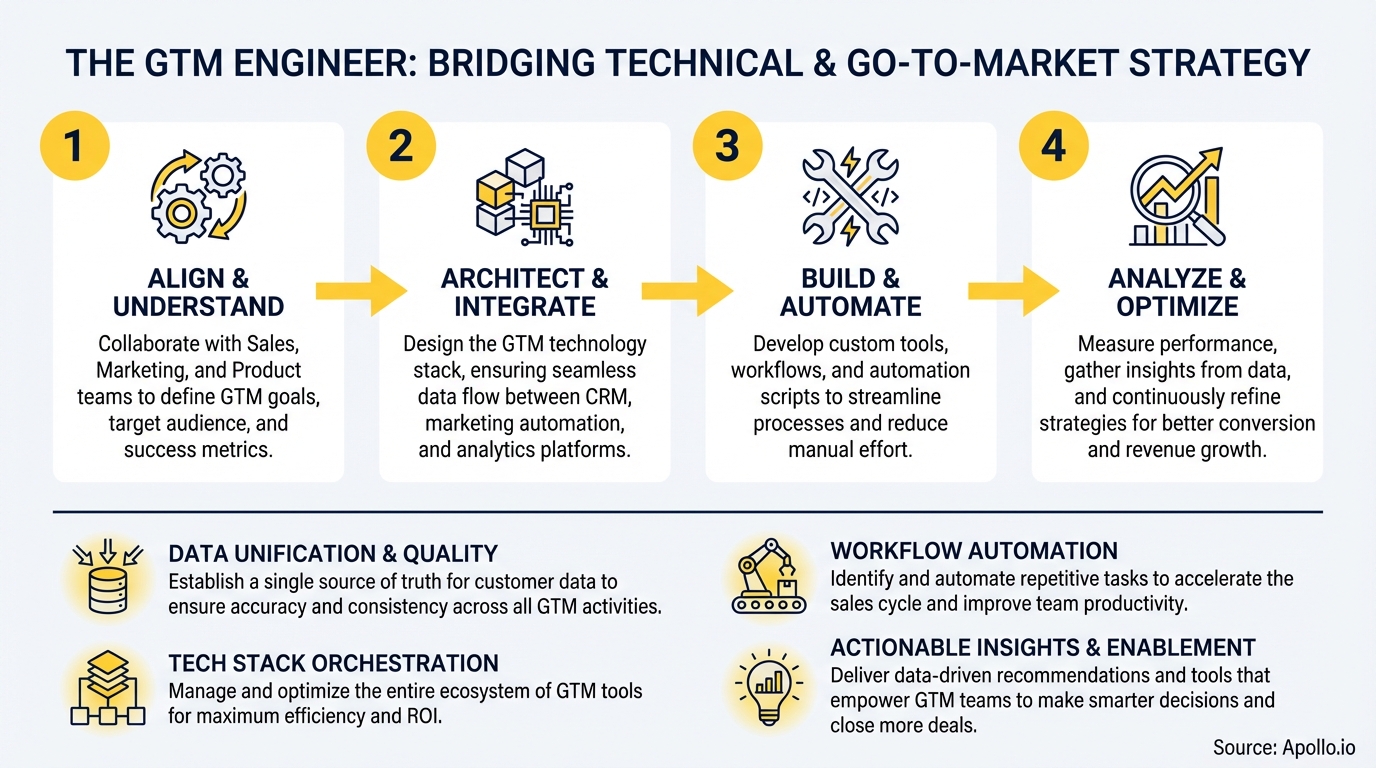
The core responsibilities of a GTM Engineer fall into five key areas: data orchestration, workflow automation, system integration, experimentation governance, and performance measurement.
Data orchestration means building pipelines that unify first-party CRM data, second-party enrichment providers, and third-party intent signals into a single scoring and prioritization system. This isn't just connecting APIs—it's defining data contracts, transformation logic, and refresh cadences.
Workflow automation involves designing multi-step sequences that combine AI research, human review, and automated outreach. For example, a GTM Engineer might build a system that identifies high-intent accounts, researches each one using AI, flags the top 10% for human personalization, and automatically sequences the rest.
System integration requires maintaining connections between CRM, marketing automation, sales engagement, data enrichment, and analytics platforms. The goal isn't to add more tools—it's to create a consolidated workflow that reduces the number of systems sellers touch daily.
Experimentation governance means establishing frameworks for testing new channels, messaging, or targeting criteria. GTM Engineers define success metrics, set up A/B test infrastructure, and build dashboards that surface statistically significant results.
Performance measurement involves instrumenting every touchpoint—email opens, website visits, content downloads, meeting bookings—and building attribution models that connect activities to pipeline and closed revenue.
How Is GTM Engineering Different From RevOps?
GTM Engineers and Revenue Operations teams serve complementary but distinct functions. Understanding where these roles diverge helps companies structure their teams correctly.
RevOps focuses on maintaining existing systems, reporting on performance, and ensuring process compliance across sales, marketing, and customer success. They're the operators who keep the machine running smoothly.
GTM Engineers build new systems and workflows that didn't exist before. They're the architects who design and construct the machine itself, then hand it off to RevOps for ongoing maintenance.
Research from JohnnyGrow shows that Gartner predicts 75% of the highest-growth companies will adopt a RevOps model by the end of 2025. This creates direct demand for builder/operator roles—often titled GTM Engineer—that can construct the systems RevOps will manage.
In practice, GTM Engineers spend most of their time writing SQL queries, building API integrations, configuring automation platforms, and designing scoring models. RevOps spends most of their time generating reports, running team meetings, managing tool licenses, and enforcing data hygiene standards.
The best teams have both: GTM Engineers who build the infrastructure, and RevOps professionals who maintain it and extract insights from it.

What Skills Do GTM Engineers Need?
The skill requirements for GTM Engineers blend technical capabilities with strategic revenue knowledge. This isn't a pure engineering role, nor is it traditional sales operations.
Technical skills include SQL for querying databases, Python or JavaScript for custom integrations, API literacy for connecting systems, and familiarity with no-code automation platforms like Zapier, Make, or n8n.
Data skills encompass data modeling, ETL pipeline design, data quality frameworks, and basic statistical analysis for measuring experiment outcomes. GTM Engineers need to understand how data flows through systems and where quality breaks down.
GTM strategy knowledge means understanding buyer journeys, lead scoring methodologies, attribution models, and channel performance analysis. You can't build effective systems without knowing how sales and marketing teams actually operate.
Tool expertise varies by company, but most GTM Engineers work with CRM platforms (Salesforce, HubSpot), sales engagement tools, data enrichment services, and marketing automation systems. The goal is deep understanding of one stack—not surface knowledge of 20 tools.
A 2025 analysis from The Digital Bloom highlights that the rise of the "technical GTM hire" indicates a need for professionals who can combine traditional GTM expertise with technical skills to build custom data workflows and automate manual processes.
Communication skills are critical—GTM Engineers translate technical complexity into business value for executives, and translate business requirements into technical specifications for implementation. Struggling with scattered tools? Consolidate your data foundation with Apollo's 224M+ verified contacts.
What Are The Career Paths For GTM Engineers?
GTM Engineering offers multiple career trajectories depending on whether you lean technical, strategic, or managerial. Compensation growth follows these paths accordingly.
The technical track progresses from GTM Engineer to Senior GTM Engineer to Principal GTM Engineer or GTM Architect. These roles focus on increasingly complex system design, custom integrations, and technical mentorship.
The strategic track moves from GTM Engineer to GTM Strategy Lead to Director of GTM or VP of Revenue Operations. These roles shift focus from building systems to defining strategy, managing budgets, and aligning GTM initiatives with company objectives.
The specialized track includes roles like GTM Data Engineer, GTM Automation Engineer, or GTM AI Engineer. These positions go deep on specific technical domains—data pipelines, workflow automation, or AI implementation.
Data from GTM Engineer Club shows that most job aggregators show a range of $132,000–$241,000 for experienced GTM Engineers. Senior and principal roles command premiums well above that range.
The fastest-growing track in 2026 is the AI specialization. Multiple sources indicate that agentic AI is moving GTM Engineering from "workflow builder" to "autonomous workflow operator"—raising demand for engineers who can govern, QA, and optimize AI-driven systems. Curious about breaking into this field? The barrier to entry is lower than you think.
How Do GTM Engineers Drive Measurable ROI?
The ROI case for GTM Engineering is quantifiable through three primary levers: time savings, tool consolidation, and data quality improvement.
Time savings manifest when automation eliminates manual research and data entry. If a 10-person sales team spends 20 hours per week on non-selling tasks, and automation reclaims 50% of that time, you've created 100 hours of new selling capacity weekly.
Tool consolidation reduces both direct costs and operational overhead. Companies running separate point solutions for data enrichment, sales engagement, conversation intelligence, and meeting scheduling often spend significantly more than they would on a unified platform—plus the hidden cost of maintaining integrations.
Data quality improvement translates to pipeline efficiency. Gartner's $12.9M annual cost estimate for poor data quality comes from wasted outreach to wrong contacts, missed opportunities due to incomplete records, and incorrect territory assignments.
For teams looking to operationalize this discipline systematically, Apollo's GTM Engineering (GTME) Program offers a 12-week engagement where a dedicated Go-to-Market Engineer builds a complete system around your strategy. The program's seven-pillar framework—Build TAM List, Score & Prioritize, Define Personas, Create Messaging, Build Sequences, Optimize Signals, and Scale Playbooks—creates measurable infrastructure rather than scattered automations.
| ROI Driver | Measurement Metric | Implementation Timeline |
|---|---|---|
| Selling Time Recovery | Hours per week redirected from research to conversations | 4-8 weeks |
| Tool Cost Reduction | Annual savings from eliminated subscriptions | 8-12 weeks |
| Data Quality Improvement | Reduction in bounce rates and wrong-contact touches | 4-6 weeks |
| Pipeline Velocity Increase | Days reduced in average sales cycle length | 12-16 weeks |
Turn Weak Leads Into Pipeline With Apollo
Running out of qualified prospects while your funnel dries up. Apollo delivers 224M verified contacts matched to your ICP. Built-In increased win rates 10% with Apollo's scoring.
Start Free with Apollo →What Is The Future Of GTM Engineering?
Three major shifts are reshaping the GTM Engineer role in 2026: the move toward agentic AI, the consolidation of tech stacks, and the formalization of the discipline through dedicated training programs and conferences.
Agentic AI means autonomous systems that execute multi-step workflows without human intervention—prioritizing accounts, researching contacts, generating messaging, and even booking meetings. This shifts the GTM Engineer's job from building workflows to governing autonomous agents.
Governance requirements include defining data contracts for AI inputs, establishing quality thresholds for AI outputs, building escalation paths for edge cases, and implementing compliance guardrails for brand safety and regulatory requirements.
Stack consolidation pressure is intensifying. Companies recognize they can't sustain 8+ tools per rep indefinitely.
The trend is toward unified platforms that handle prospecting, engagement, enrichment, and analytics in one system—reducing the integration burden GTM Engineers must maintain.
Apollo's perspective is that the best GTM Engineer isn't a tool sommelier stitching together 14 disparate tools—they're a revenue strategist who deploys elegant strategy at high velocity through consolidated platforms.
The discipline is formalizing rapidly. A dedicated GTM Engineering Summit is scheduled for September 22, 2026 in San Francisco.
Tool-specific training programs are emerging, and companies are building entire teams around the function rather than treating it as a one-off hire.
Data from GrauntX reveals that between November 2024 and October 2025, GTM roles experienced explosive growth of +453% on average across AI-implementing companies. This signals that AI adoption is accelerating demand for GTM infrastructure—not replacing it.
What Does A Modern GTM Tech Stack Look Like?
The architecture of a modern GTM tech stack is shifting from "best-of-breed integration nightmare" to "consolidated platform with surgical point solutions." Understanding how to structure your GTM technology determines whether your GTM Engineer spends time building or duct-taping.
The foundation layer includes a CRM (system of record), a data platform (enrichment and verification), and a sales engagement platform (sequences and multi-channel outreach). These three must be deeply integrated or, ideally, unified in a single platform.
The intelligence layer adds conversation intelligence, intent data, and website visitor tracking. These tools surface buying signals that feed into prioritization and targeting systems.
The automation layer includes workflow orchestration (Make, n8n, Zapier), AI research tools, and custom scripts or APIs for specialized tasks. This is where GTM Engineers spend most of their building time.
The observability layer encompasses analytics platforms, dashboards, and experimentation frameworks. Without instrumentation and measurement, you're automating in the dark.
The key principle: consolidate wherever possible, integrate intentionally where you can't. Every additional tool creates maintenance overhead, data synchronization challenges, and potential points of failure. Need a unified foundation? Apollo's sales engagement platform combines prospecting, enrichment, and multi-channel outreach in one system.
What Are The Biggest Challenges GTM Engineers Face?
GTM Engineers encounter three persistent challenges: data quality degradation, tool sprawl governance, and stakeholder alignment on prioritization.
Data quality degrades continuously. Contacts change jobs, companies get acquired, phone numbers disconnect, and emails bounce.
Building systems that automatically refresh and verify data—rather than one-time enrichment—is critical but technically complex.
Tool sprawl governance becomes a problem when every team wants their own point solution. GTM Engineers must balance legitimate tool requests against the operational overhead of maintaining yet another integration.
This requires strong stakeholder management and clear decision frameworks.
Stakeholder alignment on prioritization is challenging because sales, marketing, and customer success often have competing definitions of what "high-priority" means. GTM Engineers must translate these perspectives into unified scoring models that everyone trusts.
The solution to all three challenges is the same: establish clear governance frameworks, document decision criteria, and build systems with observability from day one. When stakeholders can see exactly how the system works and why it makes the decisions it does, trust and alignment follow.
How Do You Hire A GTM Engineer?
Hiring a GTM Engineer requires evaluating technical ability, strategic thinking, and cultural fit—often through unconventional interview methods.
Technical assessment should include a take-home project that mirrors real work: "Here's a messy dataset, a business objective, and access to our tools. Build something that solves the problem." This reveals SQL skills, automation thinking, and problem-solving approach.
Strategic evaluation means asking candidates to audit your current GTM motion and propose a prioritized backlog of improvements. Can they identify the highest-leverage opportunities?
Do they think in terms of business outcomes rather than technical features?
Cultural fit assessment focuses on collaboration style. GTM Engineers must work across sales, marketing, RevOps, and engineering teams.
Look for candidates who can translate technical concepts into business language and vice versa.
Reference checks should specifically probe: "Did this person build systems that scaled, or one-off solutions that broke?" and "How did they handle disagreements about technical direction?"
The hiring market is competitive. With 205% year-over-year growth in GTM Engineer postings and demand concentrated in high-growth companies, expect to compete on compensation, autonomy, and technical challenge.
What Are Common GTM Engineer Projects?
GTM Engineer projects typically fall into five categories: account scoring systems, automated research workflows, self-serve buying infrastructure, marketplace enablement, and experimentation frameworks.
Account scoring systems unify signals from intent data, firmographic fit, engagement history, and product usage into a single prioritization score. This involves data modeling, weight calibration, and continuous optimization based on conversion outcomes.
Automated research workflows use AI to gather company information, identify relevant contacts, and draft personalized messaging—then route high-priority accounts to humans for review before sending. This balances automation velocity with personalization quality.
Self-serve buying infrastructure includes pricing calculators, ROI estimators, product configuration tools, and automated provisioning systems. These projects "productize" the buying journey for customers who prefer digital self-service.
Marketplace enablement involves catalog governance, data synchronization, SLA routing, and analytics integration for companies selling through third-party marketplaces. This is increasingly important as McKinsey data shows 48% of B2B winners sell on industry marketplaces.
Experimentation frameworks establish test-and-learn infrastructure for new channels, messaging, or targeting approaches. This includes A/B test configuration, statistical significance calculation, and automated reporting.
| Project Type | Primary Benefit | Typical Duration |
|---|---|---|
| Account Scoring System | Prioritize highest-value opportunities | 6-8 weeks |
| Automated Research Workflow | Reclaim seller time for conversations | 4-6 weeks |
| Self-Serve Buying Infrastructure | Accelerate deal velocity for low-touch segments | 12-16 weeks |
| Marketplace Enablement | Capture incremental channel revenue | 8-12 weeks |
| Experimentation Framework | Systematic improvement through testing | 4-6 weeks |
How Is AI Changing GTM Engineering?
AI is fundamentally transforming what GTM Engineers build and how they spend their time. The shift from rule-based automation to intelligent agents creates both opportunity and complexity.
Pre-AI GTM engineering focused on connecting tools and building if/then workflows. Post-AI GTM engineering focuses on prompt engineering, data pipeline quality, and governance frameworks for autonomous systems.
The technical work is shifting from "configure Zapier triggers" to "design prompt chains that maintain context across multi-step research tasks." This requires understanding language model capabilities, limitations, and failure modes. Exploring how AI amplifies GTM capabilities? The role is evolving faster than most realize.
Governance becomes critical when AI systems operate autonomously. GTM Engineers must define quality thresholds (what accuracy rate is acceptable?), escalation paths (when should a human intervene?), and compliance guardrails (what can AI never say or do?).
The endgame is Agentic GTM—systems that identify opportunities, research accounts, generate messaging, execute outreach, and book meetings without human intervention. GTM Engineers become the architects and governors of these autonomous systems rather than the operators of manual workflows.
This doesn't eliminate the role—it elevates it. The companies that win are those with GTM Engineers who can build reliable, scalable, compliant AI systems faster than competitors can stitch together point solutions.
What Should You Build First As A GTM Engineer?
Prioritization is the most important skill for new GTM Engineers. With infinite possible projects and finite time, choosing the right first build determines whether you create momentum or frustration.
Start with data foundation projects that improve the quality of your system of record. If your CRM is full of bad data, every downstream automation will fail.
Build enrichment workflows that automatically verify and update contact information.
Move to time-saving automation that eliminates the highest-volume manual tasks. If your reps spend 10 hours per week researching accounts, build an AI research workflow that reduces that to 2 hours.
Measure the time savings and communicate the impact.
Then tackle prioritization systems that help teams focus on the right opportunities. A scoring model that ranks your entire market by likelihood to buy creates immediate strategic value and generates data for future optimization.
Save the complex integrations and experimental channels for later. Build credibility through quick wins that demonstrably save time or improve data quality before tackling ambitious multi-quarter projects.

The framework: highest impact, lowest complexity first. As you deliver wins
Prove ROI Fast With Apollo's Built-In Analytics
Budget approval stuck on unclear metrics? Apollo tracks every touchpoint from prospect to close, showing exact pipeline contribution. Built-In increased win rates 10% with Apollo's scoring.
Start Free with Apollo →Don't miss these
Sales
Inbound vs Outbound Marketing: Which Strategy Wins?
Sales
What Is a Sales Funnel? The Non-Linear Revenue Framework for 2026
Sales
What Is a Go-to-Market Strategy? The 2026 GTM Playbook
See Apollo in action
We'd love to show how Apollo can help you sell better.
By submitting this form, you will receive information, tips, and promotions from Apollo. To learn more, see our Privacy Statement.
4.7/5 based on 9,690 reviews
