InsightsSalesHow to Find Phone Numbers for Free: The Relevance-First Framework for 2026
How to Find Phone Numbers for Free: The Relevance-First Framework for 2026
February 19, 2026
Written by The Apollo Team
How to Find Phone Numbers for Free: The Relevance-First Framework for 2026
Searching for a phone number for free in 2026? Whether you're prospecting, recruiting, or verifying contact details, free methods exist—but they come with critical limitations.
This guide covers legitimate free approaches, their real-world constraints, and when data quality and compliance require a professional platform.
The landscape has shifted. B2B buyers now actively resist irrelevant outreach, and contact data decays faster than most teams realize. According to Landbase, some studies show this decay can be as high as 70.3% per year. The cost of bad data isn't just wasted time—it's lost revenue and damaged trust.
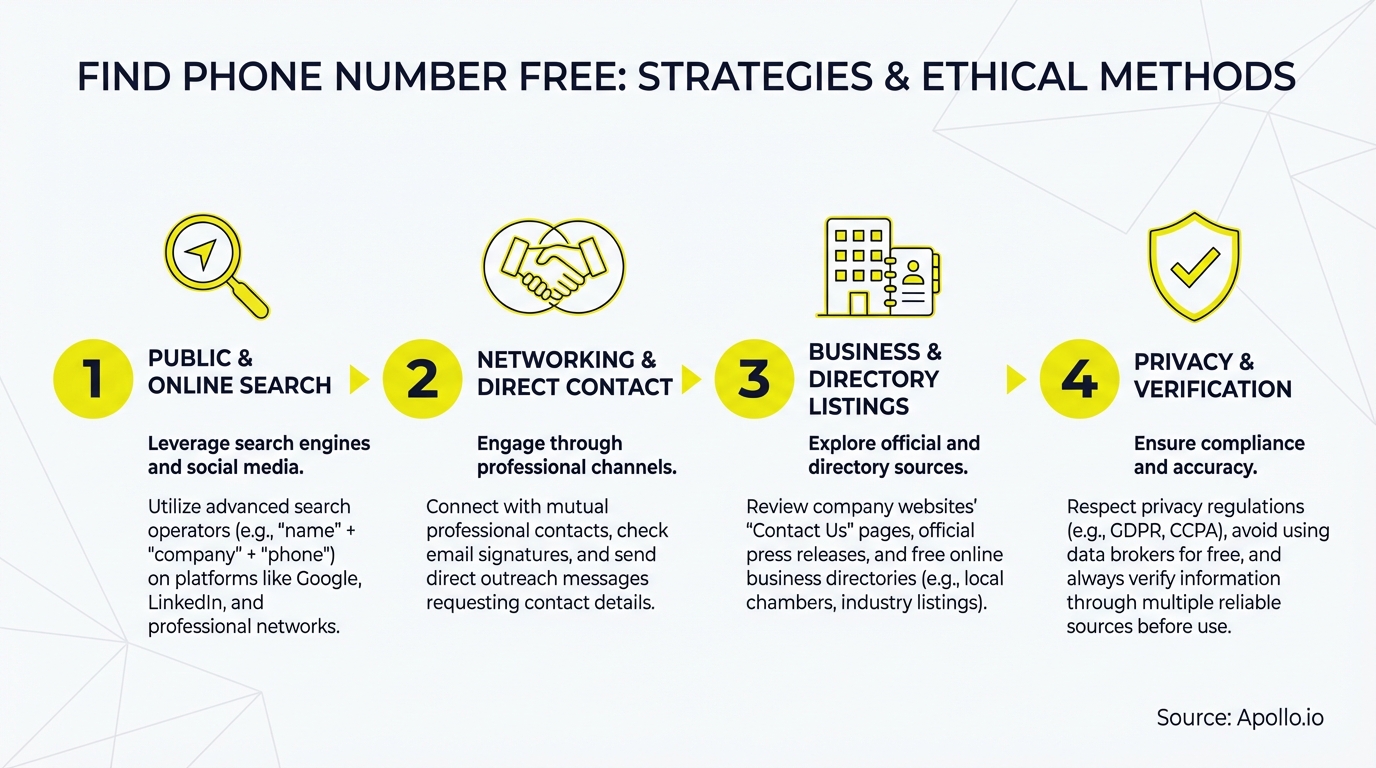
An infographic illustrates four ethical steps for finding phone numbers, including online search and networking.
LEAD RESEARCH TIME WASTE
Find Verified Contacts In Seconds With Apollo
Tired of spending hours hunting for accurate contact info? Apollo delivers 224M+ verified contacts with 96% email accuracy. Join 550K+ companies who eliminated manual research.
Free phone lookup methods exist but suffer from outdated data, opt-outs, and limited scale
B2B contact data can decay as high as 70.3% annually, making verification critical
Professional platforms like Apollo provide verified contacts, compliance safeguards, and enrichment at scale
Relevance-first prospecting—ICP filtering before lookup—prevents wasted outreach and buyer resistance
Data freshness workflows (QA sampling, verification cadences) are non-negotiable for business-critical outreach
10 Free Methods to Find Phone Numbers (and Their Real Limitations)
Free lookup methods can work for one-off personal searches. For business prospecting, their constraints quickly become deal-breakers.
Common Free Lookup Approaches
Method
How It Works
Limitation
Google Search
Use quotes and site operators to search names + contact keywords
Time-intensive; results often outdated or incomplete
Social Media Profiles
Check bios and About sections on professional networks
Most users don't list phone numbers publicly
People Directories
Free tiers on Whitepages, TruePeopleSearch, FastPeopleSearch
Opt-outs common; full details behind paywalls
Company Websites
Browse team pages, staff directories, association listings
Only works for publicly listed roles; not scalable
Mutual Connections
Ask shared contacts or use online communities
Requires existing network; slow for cold outreach
Reverse Lookups
Enter a number into Google, Truecaller, or messaging apps
Verification only; doesn't help find new contacts
Email First
Find their email and request a call
Adds friction; many prospects ignore email requests
Library Phonebooks
Local directories for older or listed numbers
Extremely outdated; B2B contacts rarely included
Web Archives
Use Wayback Machine to find previously listed info
Historical data only; no guarantee of current validity
Mobile Apps
Apps like Truecaller and CallApp offer free ID features
Limited free searches; accuracy varies widely
"Apollo enriches everything we have: contacts, leads, accounts... And we don't really have to touch it, it just works."
Why Free Lookups Fail for Business Prospecting
Free methods break down when you need scale, accuracy, and compliance. Here's what teams encounter:
Data Decay Is Real and Fast. Research from Inoopa found that in a typical 500-record calling campaign with 10% bad data, approximately 200 calls (requiring 4 attempts per dead record) are wasted, amounting to over 16 hours of lost productivity and more than $800 in financial costs per campaign. That's just one campaign.
Manual Processes Don't Scale. Searching Google, scraping websites, and verifying numbers one-by-one consumes hours that could be spent on actual conversations. Sales teams at growing companies need hundreds or thousands of verified contacts—not ten.
Compliance Risks Are Rising. Free scraped data often lacks provenance and consent documentation. With privacy regulations tightening globally, using unverified contact sources exposes your organization to legal and reputational risk.
Relevance Gaps Hurt Performance. Free lookups give you a number—not context. Without firmographics, intent signals, or ICP alignment, you're dialing blindly. And buyers notice: they actively avoid suppliers who send irrelevant outreach.
Struggling with unreliable pipeline visibility? Apollo delivers real-time deal intelligence and buyer intent signals that make forecasting predictable. Built-In increased win rates 10% with Apollo's scoring.
The Relevance-First Framework: ICP Filtering Before Lookup
The biggest mistake in phone prospecting isn't the lookup method—it's looking up the wrong contacts. Before you search for any phone number, define who matters.
Step 1: Define Your Ideal Customer Profile (ICP)
Document firmographics (industry, company size, location), technographics (tools they use), and behavioral signals (funding, hiring, intent). This prevents wasted outreach and aligns your prospecting with buyer needs.
Step 2: Apply Intent Signals
Prioritize contacts showing buying signals: recent funding, job changes, content engagement, or technology stack changes. Intent-driven prospecting converts at measurably higher rates than spray-and-pray tactics.
Step 3: Verify Consent and Compliance
Before dialing, confirm your list is compliant with Do Not Call registries, privacy regulations, and consent requirements. Professional platforms handle this automatically; free lookups do not.
Data Freshness Workflows: How to Keep Contact Data Current
Even verified data decays. High-performing teams build ongoing verification into their workflows.
Establish a Verification Cadence
Set quarterly QA sampling on active lists. Test a random 5% of contacts each quarter and measure accuracy. If decay exceeds 10%, trigger a full list refresh.
Use Waterfall Enrichment
Waterfall enrichment queries multiple data sources in sequence until a verified match is found. This ensures you get the freshest, most accurate contact details without manual lookups. Explore Apollo's Waterfall Enrichment for automated, multi-source verification.
Track Changes and Audit Trails
Maintain change logs for contact updates. Document when numbers were verified, by whom, and through which source. This creates accountability and helps identify patterns in data quality issues.
"We benchmarked ZoomInfo versus Apollo, Clearbit, Lusha, and Seamless, and ultimately Apollo won on all fronts, especially in enrichment. Higher quality than ZoomInfo, greater breadth than Clearbit."
Woman shows data on a tablet to a smiling man in a modern office.
When to Use a Professional Platform Like Apollo
Free methods work for casual, one-off searches. Professional platforms become essential when you need:
Scale: Hundreds or thousands of contacts, not ten
Accuracy: Verified, current data with measurable quality standards
Enrichment: Firmographics, intent signals, and behavioral data beyond just phone numbers
Compliance: Built-in safeguards for privacy regulations and Do Not Call lists
Integration: CRM-ready data that syncs with your sales stack
Efficiency: Automated workflows that eliminate manual lookup and verification
Apollo consolidates prospecting, enrichment, and engagement in one workspace. Sales teams save time, reduce tool costs, and connect with the right contacts faster. See how contact data enrichment drives measurable ROI.
Compliance and Trust: Aligning Outreach With Buyer Expectations
B2B buyers expect consistency between your website messaging and sales outreach. Gaps in that alignment damage trust and reduce conversion rates.
Do Not Call (DNC) and TSR Basics
Even B2B prospecting is subject to consumer protection rules in many jurisdictions. Maintain an internal DNC list, honor opt-out requests immediately, and document consent for every contact.
Call Labeling and Identification
Use caller ID that clearly identifies your company. Unlabeled or spoofed numbers trigger spam filters and erode trust before the conversation even starts.
Messaging Consistency
Ensure your outreach scripts align with website messaging. If your site emphasizes a specific value proposition, your reps should lead with that same message.
Inconsistencies confuse buyers and undermine credibility.
Continuously refresh contact details and firmographics
Analytics
Revenue operations dashboard
Measure data quality, outreach performance, and pipeline impact
Apollo unifies these functions in one workspace, eliminating the need for separate tools and reducing admin overhead. Discover Apollo's full GTM toolkit.
How to Protect Your Own Phone Number
If you're searching for contact info, others are searching for yours. Here's how to control your exposure:
Search Your Number: Google your phone number to see where it appears publicly
Opt Out of Directories: Submit removal requests to Whitepages, Spokeo, and other people-finder sites
Use VoIP for Public-Facing Communication: Google Voice or similar services keep your real number private
Limit Web Form Sharing: Don't enter your real number on forms unless absolutely necessary
Conclusion: Choose Relevance, Accuracy, and Scale
You can find a phone number for free—but free methods don't scale, don't verify, and don't provide the context you need for effective outreach. For business-critical prospecting, professional platforms deliver verified contacts, compliance safeguards, and enrichment that drives real pipeline.
Apollo gives you 224M+ verified contacts, 96% email accuracy, and the tools to prospect, engage, and close faster. Build trust, stay compliant, and connect with the right buyers.
Budget approval stuck on unclear metrics? Apollo delivers measurable pipeline impact from day one—track time saved, meetings booked, and deals closed. Built-In increased win rates 10% and ACV 10% with Apollo's signals.