
What Is Enterprise Marketing Automation? ROI, Implementation, and 2026 Best Practices
Enterprise marketing automation (EMA) is the use of software and AI to orchestrate, execute, and measure marketing workflows at scale across complex organizations. It goes far beyond scheduling emails: modern EMA connects data, content, lead scoring, sales handoffs, and revenue reporting into a unified operating system for revenue growth.
The business case is accelerating fast. According to Cazoomi, approximately 76% of businesses utilized some form of marketing automation technology in 2024. And Salesgenie reports that around 80% of companies using marketing automation report an increase in leads, with 77% reporting higher conversion rates.

Research Less, Pipeline More With Apollo
Tired of burning hours on manual lead research while your pipeline stalls? Apollo surfaces verified contacts instantly so your team spends time selling, not searching. Join 550K+ companies building predictable pipeline.
Start Free with Apollo →Key Takeaways
- Enterprise marketing automation unifies prospecting, engagement, lifecycle nurture, and revenue reporting in one workflow layer.
- AI-powered automation is now the standard: 76%+ of businesses use it, and GenAI is shifting from pilots to operational cost justification.
- The biggest ROI gains come from automating lead management, content workflows, and the marketing-to-sales handoff.
- Governance, data quality, and integration architecture are now core buying criteria, not afterthoughts.
- Budget-constrained teams should prioritize automating email nurture, lead scoring, and outbound sequences first.
What Is Enterprise Marketing Automation (and What It Is Not)?
EMA is: A system that automates repeatable marketing workflows, personalizes outreach at scale, scores and routes leads, and ties marketing activity to revenue outcomes. It spans inbound nurture, outbound sequences, account-based programs, and post-sale lifecycle marketing.
EMA is not: A single email tool, a CRM, or a one-time campaign builder. It is not just "batch and blast" email. And it is not a replacement for strategy: automation executes your playbook; it does not write it.
The market reflects this growing importance. Dataopedia reports the global marketing automation market was valued at approximately $6.65 billion in 2024 and is projected to grow to around $15.58 billion by 2030.
How Does Enterprise Marketing Automation Work?
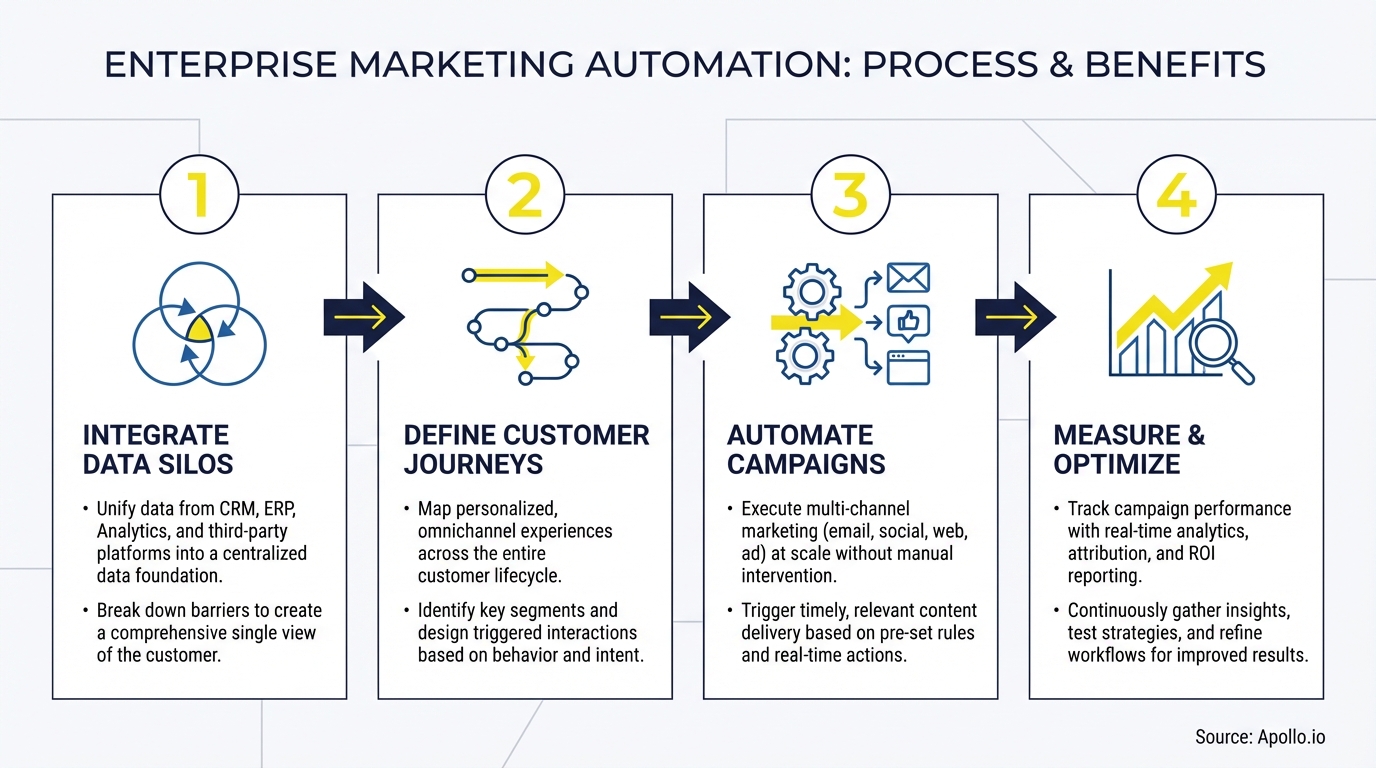
EMA platforms connect four core workflow layers that operate in a continuous loop:
| Layer | Function | Key Outputs |
|---|---|---|
| Data & Enrichment | Unifies CRM, intent, and firmographic data into a clean contact/account record | Verified contacts, enriched accounts, segmented lists |
| Audience & Segmentation | Applies scoring models and filters to identify ICP-fit audiences | Prioritized lead queues, buying group maps |
| Engagement & Orchestration | Executes multi-channel sequences: email, phone, social outreach | Personalized touchpoints, automated follow-ups, drip programs |
| Handoff & Measurement | Routes sales-ready leads, syncs to CRM, tracks pipeline attribution | MQL-to-SQL conversion, revenue attribution, closed-loop reporting |
The most important shift in 2025-2026 is the move toward agentic automation: AI agents that handle operational tasks like routing, buying-group signal summarization, and next-best-action recommendations, tightening the marketing-to-sales handoff without manual intervention.
Struggling to feed your automation engine with quality leads? Search Apollo's 224M+ verified contacts with 65+ filters to build precise audience segments instantly.
Core Features of Enterprise Marketing Automation Platforms
- Lead scoring and routing: Behavioral and firmographic signals that rank and direct leads to the right rep or sequence
- Multi-channel sequence automation: Coordinated email, phone, and social outreach with conditional logic and personalization
- AI-assisted content generation: Draft personalization at scale, tailored based on account context and input signals
- Account-based program orchestration: Buying-group engagement tracking and account-level scoring
- CRM and data sync: Bidirectional integration to keep contact records accurate across systems
- Analytics and attribution: Pipeline influence, campaign ROI, and revenue contribution reporting
- Governance controls: Consent management, data retention policies, audit logs, and role-based access
Learn how lifecycle marketing strategies integrate with automation to keep buyers engaged across every stage.
How to Build an ROI Framework for Enterprise Marketing Automation
The CFO question is always the same: "What does this buy us?" Here is a practical framework for building a defensible business case.
Step 1: Identify Your Baseline Costs
Quantify the current cost of manual processes: hours spent on list building, manual follow-up, content production, and reporting. Calculate the loaded cost per rep hour and multiply by volume.
Step 2: Apply Benchmark Uplift Ranges
Use verified benchmarks as conservative targets:
| Metric | Benchmark Finding | Source |
|---|---|---|
| Lead volume increase | 50% more qualified leads for automation adopters | Sales Odyssey |
| Revenue impact | At least 10% revenue increase within 6-9 months for automated lead management | Graph8 |
| Lead increase + conversion | 80% report more leads; 77% report higher conversion rates | Salesgenie |
Step 3: Prioritize Workflows by ROI Potential
Budget-constrained teams should automate in this order:
- Email nurture sequences (highest volume, lowest complexity, fastest to deploy)
- Lead scoring and routing (directly reduces sales cycle time and improves rep efficiency)
- Outbound prospecting sequences (scales pipeline without adding headcount)
- Content production workflows (GenAI integration reduces production costs at scale)
- Attribution and reporting (enables budget reallocation to highest-performing channels)
"We reduced the complexity of three tools into one. We're getting higher reply rates, open rates are doubled, meetings are up, and speed to booking a meeting is cut in half."
Explore how Apollo Workflows automates prospecting and outreach sequences so your team focuses on selling, not manual task management.

Governance and Data Quality: The Foundation EMA Teams Skip
Poor data quality is the single most common reason enterprise automation programs underperform. Personalization only works when the underlying contact and account data is accurate and current.
In 2025-2026, governance has moved from checkbox compliance to core buying criteria. Identity system migrations, API changes, and consent regulation requirements mean enterprise buyers now evaluate auditability, operational resilience, and data stewardship architecture when selecting automation platforms.
Data Governance Checklist for EMA
- Assign a named data steward for each core system (CRM, MAP, enrichment layer)
- Define data retention and suppression policies before launch, not after
- Establish a data sync cadence: how often contact records refresh and what triggers updates
- Audit list segmentation logic quarterly to prevent audience decay
- Document API integrations and build for resilience, not just current-state connectivity
- Implement role-based access controls and audit logs for all automation workflows
See how data sync improves B2B sales and marketing ROI when contact records stay accurate across your entire tech stack.
"Apollo enriches everything we have: contacts, leads, accounts... And we don't really have to touch it, it just works."
Turn Funnel Gaps Into Pipeline Gold
Pipeline forecasting a guessing game? Apollo surfaces in-market buyers the moment they're ready, turning weak lead flow into real opportunities. Top revenue teams trust Apollo to stop the lead-to-opportunity leak.
Schedule a Demo →EMA Architecture: From Point-to-Point to Unified Platforms
The biggest technical risk in enterprise automation is brittle integration architecture. Point-to-point connectors between separate data, engagement, and CRM tools break when APIs change or vendors deprecate endpoints.
This creates expensive "custom glue" that requires constant maintenance.
The 2026 direction is clear: B2B marketing automation is converging into unified revenue marketing platforms that combine data, scoring, lifecycle orchestration, and sales engagement in one workspace. This eliminates integration fragility and creates a single source of truth for the entire go-to-market team.
Platform Architecture Comparison
| Architecture Type | Integration Risk | Total Cost of Ownership | Best For |
|---|---|---|---|
| Best-of-breed point-to-point | High (API fragility, sync lag) | High (admin overhead, multiple contracts) | Teams with mature ops and dedicated integration resources |
| iPaaS-orchestrated ecosystem | Medium (centralized but complex) | Medium-High | Large teams with dedicated RevOps engineering |
| Unified all-in-one platform | Low (native integrations) | Lower (consolidated contracts, less admin) | Growing teams and companies prioritizing speed and efficiency |
Apollo's unified platform combines prospecting, sales engagement automation, data enrichment, and pipeline management in one workspace, so your marketing and sales teams operate from the same data without maintaining complex integrations.

How GenAI Is Reshaping Enterprise Marketing Automation in 2026
GenAI has moved from experimentation to operationalization in enterprise marketing. The primary use case is content production: creating personalized messaging at scale for sequences, nurture programs, and account-based campaigns without proportionally growing headcount.
According to Vena Solutions, in 2024, 58% of marketing decision-makers automated email, 49% automated social media, and 33% automated content management. The shift in 2025-2026 is automating not just delivery but creation and optimization.
The next wave is agentic automation: AI that handles end-to-end operational tasks including buying-group signal summarization, next-best-action recommendations, and intelligent lead routing, not just drafting copy. This is tightening the marketing-to-sales handoff in ways that manual processes cannot match.
For a practical look at how AI automation applies to B2B outreach, see Apollo's guide to AI and automation tools for B2B prospecting.
Conclusion: Start with the Workflows That Move the Revenue Number
Enterprise marketing automation delivers its biggest returns when it directly accelerates pipeline: better lead quality, faster handoffs, more personalized outreach at scale. The teams winning in 2026 are not the ones with the most tools.
They are the ones running their entire go-to-market motion from a unified platform with clean data, governed workflows, and AI doing the heavy lifting.
Start by automating your highest-volume, highest-impact workflows first. Build your data foundation. Then layer in agentic automation as your program matures.
Ready to see what a unified automation platform looks like in practice? Start a free trial with Apollo and connect prospecting, outreach, enrichment, and pipeline management in one workspace.
Prove Pipeline ROI With Apollo
Budget approval stuck on unclear metrics? Apollo delivers measurable pipeline impact from day one — so you can walk into any boardroom with hard numbers. Leadium 3x'd their revenue. You're next.
Start Free with Apollo →Don't miss these
Sales
Inbound vs Outbound Marketing: Which Strategy Wins?
Sales
What Is a Sales Funnel? The Non-Linear Revenue Framework for 2026
Sales
What Is a Go-to-Market Strategy? The 2026 GTM Playbook
See Apollo in action
We'd love to show how Apollo can help you sell better.
By submitting this form, you will receive information, tips, and promotions from Apollo. To learn more, see our Privacy Statement.
4.7/5 based on 9,690 reviews
