
What Is the Difference Between Sales and Marketing?
Sales and marketing are distinct functions with different goals, timelines, and motions — yet they succeed or fail together. Marketing builds awareness and generates demand at scale.
Sales converts that demand into revenue through direct human interaction. Understanding where one ends and the other begins is the foundation of any high-performing go-to-market team.
The stakes for getting this right have never been higher. According to Salesgenie, misalignment between sales and marketing costs businesses an estimated $1 trillion per year. Yet most companies still operate with fuzzy role boundaries and broken handoffs.

Build Pipeline, Not Busywork
Tired of your reps burning hours on manual research instead of selling? Apollo standardizes your prospecting playbook and surfaces verified contacts instantly. Over 550K companies run leaner, faster GTM teams on Apollo.
Start Free with Apollo →Key Takeaways
- Marketing creates awareness and demand; sales converts that demand into closed revenue.
- Only 8% of companies have achieved strong sales and marketing alignment.
- The rep-free buyer trend is reshaping the handoff point: marketing must now answer pricing, ROI, and implementation questions before a rep ever enters the picture.
- Alignment breaks down at the definition level — nearly half of CSOs say their lead qualification criteria differ significantly from marketing's.
- Revenue Operations (RevOps) is the structural fix: shared definitions, shared data, and shared accountability across both teams.
Sales vs. Marketing: Core Definitions and Functions
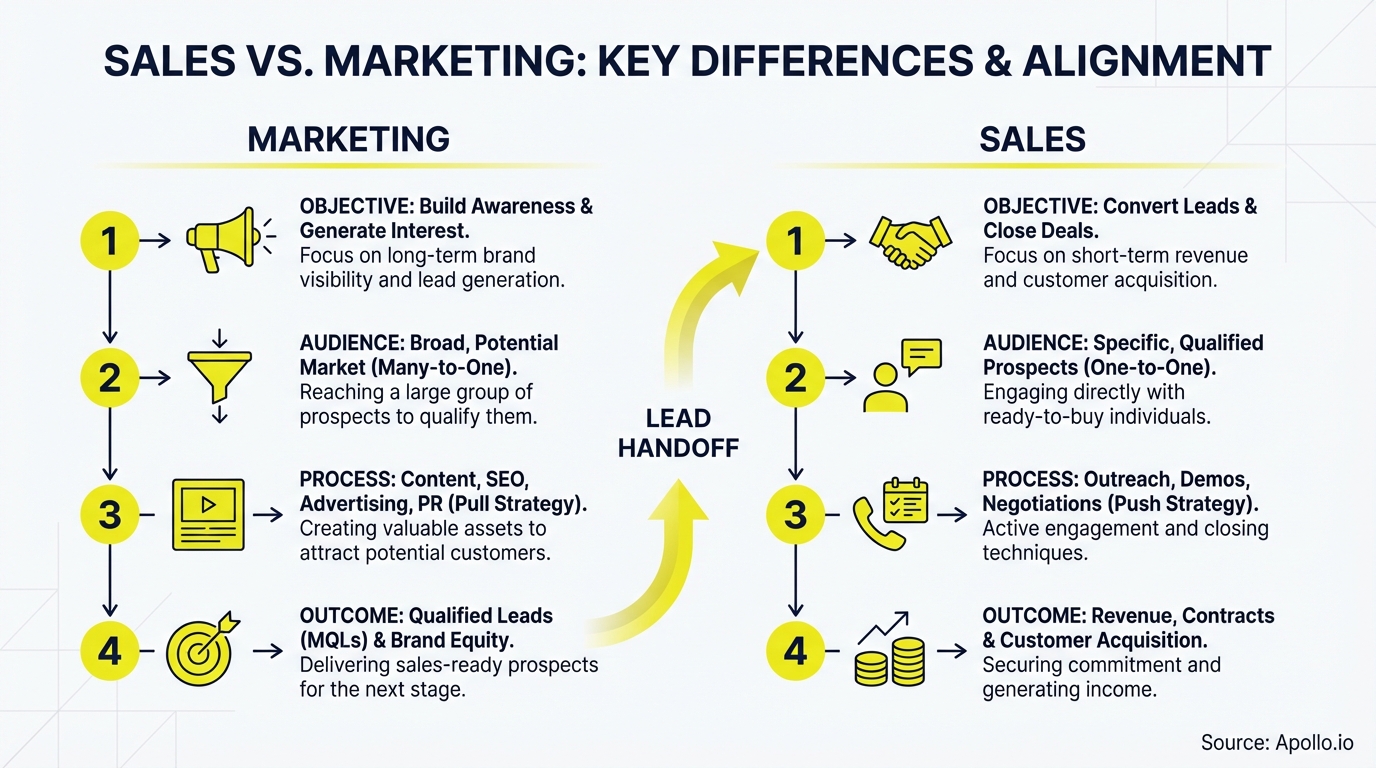
Marketing is responsible for creating awareness, generating demand, and nurturing prospects until they are ready for a sales conversation. It operates at the top and middle of the funnel, working across broad audiences over longer timeframes.
Sales is responsible for converting qualified prospects into customers. It operates at the bottom of the funnel through direct, often one-to-one engagement: calls, demos, proposals, and negotiations.
| Dimension | Marketing | Sales |
|---|---|---|
| Primary goal | Generate and nurture demand | Convert demand into revenue |
| Time horizon | Long-term brand and pipeline building | Short-term quota and deal cycles |
| Audience | Broad segments and personas | Individual buyers and buying committees |
| Key outputs | MQLs, content, campaigns, brand equity | SQLs, closed-won deals, revenue |
| Primary metrics | Pipeline influence, MQL volume, CAC | Win rate, quota attainment, ARR |
| Engagement style | One-to-many (campaigns, content, ads) | One-to-one (calls, demos, proposals) |
Where the Real Difference Lies: Perception vs. Reality
The most damaging gap in most organizations isn't the functional difference between sales and marketing — it's the perception gap about how well those functions work together. Research from Foleon reveals that 65% of sales and marketing professionals experience a lack of alignment between their organization's leaders, even though 82% of C-level executives believe their teams are aligned.
That disconnect surfaces most clearly at the handoff. When marketing passes a lead to sales, both teams need a shared, written definition of what qualifies that lead for outreach. Without it, sales ignores leads and marketing loses confidence in the pipeline. To understand how B2B marketing metrics actually drive revenue growth, both teams need to agree on what they're measuring in the first place.
Turn Funnel Guesswork Into Real Pipeline
Marketing leads stalling before they ever reach sales. Apollo surfaces verified, in-market contacts so your funnel fills with opportunities — not dead ends. Over 550K companies stopped guessing and started closing.
Start Free with Apollo →How the Rep-Free Buying Trend Reshapes the Sales/Marketing Boundary
Buyer behavior has fundamentally shifted the handoff point between marketing and sales. According to Gartner, 61% of B2B buyers now prefer an overall rep-free buying experience.
This means buyers are completing significant portions of their evaluation — pricing research, competitive comparisons, implementation planning, risk assessment — before ever speaking to a rep.
The practical implication: marketing now owns a larger share of the buyer journey, including content that was previously handled in sales conversations. Pre-contact assets that marketing must now own include:
- Transparent pricing pages or ROI calculators
- Implementation guides and onboarding overviews
- Security and compliance documentation
- Competitive comparison pages
- Case studies segmented by industry and use case
Sales, in turn, becomes more selective and specialized: entering later in the cycle to handle complex objections, commercial negotiations, and multi-stakeholder consensus. Handling objections in 2026 requires reps to be deeply informed about what buyers have already researched — making tight marketing-sales communication essential.
Need to qualify and engage inbound leads faster? Apollo's sales engagement tools help sales teams act on marketing-sourced leads with automated, multi-channel sequences the moment a prospect signals intent.

Why Alignment Breaks Down (and How to Fix It)
Alignment fails at the definition level. When marketing defines a qualified lead differently than sales does, every handoff becomes a point of friction. The fix is structural, not cultural.
The Sales-Marketing SLA Framework
A Service Level Agreement (SLA) between sales and marketing creates mutual accountability. It should specify:
- Lead definitions: Explicit criteria for MQL (Marketing Qualified Lead) and SQL (Sales Qualified Lead), agreed upon by both teams.
- Handoff triggers: What action or score causes a lead to move from marketing to sales ownership.
- Follow-up SLAs: How quickly sales must follow up on a handed-off lead (e.g., within 24 hours).
- Feedback loops: How sales communicates lead quality back to marketing (e.g., weekly disposition reports).
- Shared pipeline metrics: Both teams review the same pipeline dashboard, not siloed reports.
Understanding how Revenue Operations drives growth is the next step — RevOps provides the operational layer that enforces these SLAs through shared systems, routing rules, and attribution models.
Measuring What Actually Matters: Beyond MQLs and SQLs
Most teams measure MQL and SQL volume, but flat marketing budgets and revenue pressure demand a more rigorous approach. Research from Influ2 shows that companies achieving effective handoffs and high audience overlap between sales and marketing — only 11% of companies — see marketing influence up to 29% of their pipeline.
The metrics that drive accountability across both functions:
| Metric | Owned By | Why It Matters |
|---|---|---|
| Pipeline sourced by marketing | Marketing | Proves direct revenue contribution |
| Pipeline influenced by marketing | Marketing | Captures assist value from content and campaigns |
| MQL-to-SQL conversion rate | Shared | Signals lead quality and handoff effectiveness |
| Lead response time | Sales | Directly correlates to conversion rates |
| Win rate by lead source | Shared | Identifies which marketing channels produce best buyers |
| Customer acquisition cost (CAC) | Shared | Measures combined efficiency of both functions |
For a deeper look at the marketing side of this equation, explore demand gen metrics that drive revenue — the KPIs that hold marketing accountable to pipeline, not just traffic.
"The thing that made me most excited as somebody who's been in sales development a long time was Apollo's integration between sales data and sales engagement and the magic that you can make happen when those two are together on the same platform."
How RevOps Bridges the Sales-Marketing Divide
Revenue Operations has become the default operating model for organizations serious about sales-marketing alignment. RevOps doesn't eliminate the difference between sales and marketing — those functional differences are real and necessary.
Instead, it creates a shared infrastructure: common data definitions, unified dashboards, consistent attribution rules, and integrated workflows that connect both teams to the same revenue outcome.
The practical effect is that sales and marketing retain their distinct skills and motions, but are measured through a single revenue system. This eliminates the most common sources of misalignment: inconsistent lead data, competing metrics, and disputed pipeline ownership.
"Apollo enriches everything we have: contacts, leads, accounts... And we don't really have to touch it, it just works."
When both teams work from the same enriched contact and account data, handoffs become seamless. Data sync across B2B sales and marketing systems is the technical foundation that makes RevOps work in practice — eliminating duplicate records, stale contacts, and conflicting information between CRM and marketing automation.
Struggling to build a pipeline that both teams can trust? Apollo's AI-powered pipeline builder gives sales and marketing a shared source of truth for prospecting, lead qualification, and deal progression — all in one workspace.
Conclusion: Stop Debating the Difference, Start Designing the Handoff
The difference between sales and marketing is real — different goals, different motions, different timeframes. But the organizations winning in 2026 aren't just clear on the distinction; they've engineered the connection.
They've written SLAs, aligned on lead definitions, built shared dashboards, and created pre-contact content that serves buyers who prefer to self-educate before talking to a rep.
The companies that treat sales and marketing as separate silos pay for it in lost pipeline, duplicated effort, and deals that fall through the cracks. The companies that unify them around shared data and shared accountability compound the strengths of both functions into a single revenue engine.
Apollo gives both sales and marketing teams a unified platform to prospect, engage, enrich, and track — from first touch to closed deal. Start Prospecting and see how Apollo connects your go-to-market teams in one workspace.
Prove Pipeline ROI With Apollo
ROI pressure killing your next budget approval? Apollo delivers measurable pipeline impact your leadership can't ignore. Leadium 3x'd their annual revenue — see what Apollo can do for your numbers.
Start Free with Apollo →Don't miss these
Sales
Inbound vs Outbound Marketing: Which Strategy Wins?
Sales
What Is a Sales Funnel? The Non-Linear Revenue Framework for 2026
Sales
What Is a Go-to-Market Strategy? The 2026 GTM Playbook
See Apollo in action
We'd love to show how Apollo can help you sell better.
By submitting this form, you will receive information, tips, and promotions from Apollo. To learn more, see our Privacy Statement.
4.7/5 based on 9,690 reviews
