InsightsSalesWhat Are the Best Cold Calling Tips That Actually Book Meetings in 2026?
What Are the Best Cold Calling Tips That Actually Book Meetings in 2026?
February 9, 2026
Written by The Apollo Team
What Are the Best Cold Calling Tips That Actually Book Meetings in 2026?
Cold calling remains one of the most direct paths to decision-makers, but only if you do it right. With buyers overwhelmed by outreach and AI transforming sales workflows, the old scripts and spray-and-pray tactics no longer cut it. According to recent cold calling statistics, while the average success rate sits at just 2%, organizations that engage in cold calling experience 42% more growth than those that don't.
The difference between reps who book meetings and those who get hung up on comes down to preparation, personalization, and process. This guide breaks down the proven cold calling tips that win conversations in 2026, backed by real data and practical frameworks you can implement today.
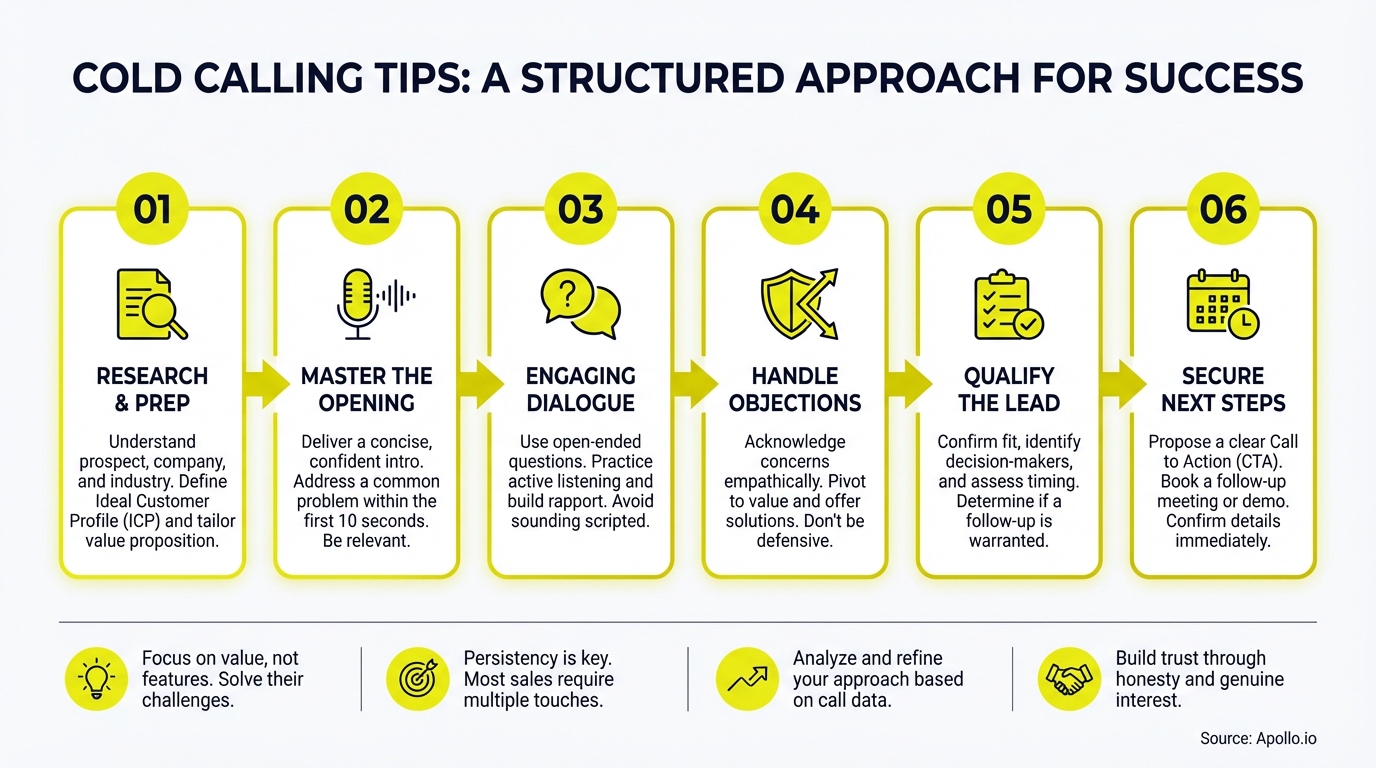
Infographic summarizing key prospecting workflow with actionable steps
LEAD GENERATION EFFICIENCY
Apollo Finds Quality Leads While You Sleep
Tired of slow lead generation killing your pipeline? Apollo's AI identifies your exact ICP with 96% email accuracy—no manual research needed. Join 550K+ companies closing more deals.
Cold calling delivers 42% more growth for organizations that execute it properly, with 69% of buyers accepting calls from new salespeople in the past year.
Research and personalization before dialing dramatically increase connect rates. AI-powered tools now cut prospect research from hours to minutes.
Multi-touch cadences combining phone, email, and social outreach require an average of 18 calls to connect with buyers, with 80% of sales needing five follow-ups after initial contact.
Hybrid selling strategies that balance human interaction with digital engagement will dominate B2B sales through 2030, as 75% of buyers prefer human-first experiences.
Integrating AI automation for research and data enrichment while maintaining authentic conversations creates the highest-performing cold calling approach.
Why Cold Calling Still Works in 2026
Despite predictions of its demise, cold calling remains a cornerstone of B2B sales. Data from B2B sales research shows that 57% of C-level executives prefer being contacted by phone, and 82% of buyers accept meetings with sellers who reach out to them proactively.
The key shift is execution. Modern cold calling requires deep research, contextual relevance, and integration with digital channels. Research by Gartner predicts that by 2030, 75% of B2B buyers will prefer sales experiences prioritizing human interaction over AI, making the phone more valuable than ever for building genuine relationships.
Cold calling also provides immediate feedback. You learn objections in real-time, test messaging instantly, and adjust your approach on the fly.
No other channel offers this direct feedback loop for refining your go-to-market strategy.
How Do You Research Prospects Before Calling?
The biggest mistake in cold calling is picking up the phone without context. Effective research means understanding the prospect's business challenges, recent company news, tech stack, and potential pain points before you dial.
Start with these research priorities:
Company triggers: Funding rounds, leadership changes, product launches, expansion announcements
Role-specific challenges: What keeps this person up at night based on their title and department?
Tech stack analysis: What tools are they currently using? Where are the gaps?
Recent content: LinkedIn posts, company blog articles, podcast appearances
Mutual connections: Shared network that can provide warm introductions or context
"Apollo could be a third of the cost if you look at the full price of what we were spending on ZoomInfo, Outreach, Salesforce, and admins to make it all work."
Sales development rep on a call wearing a professional headset planning outreach campaigns
The most effective reps spend 10-15 minutes researching before each call block, then personalize their opening 30 seconds based on what they learned. This research-first approach transforms cold calls into warm conversations.
What's the Best Cold Call Opening Structure?
Your first 15 seconds determine whether the prospect stays on the line or hangs up. The most effective opening follows this proven structure:
Permission-based intro (5 seconds): "Hi [Name], this is [Your Name] from [Company]. Did I catch you at a bad time?"
Reason for the call (10 seconds): "I'm calling because [specific trigger/research point]."
Value proposition (10 seconds): "We help [similar companies] solve [specific problem]. Worth a quick conversation?"
This structure respects their time, demonstrates you've done homework, and quickly establishes relevance. Avoid lengthy introductions or asking "How are you today?" which immediately signals a sales call.
The permission-based opening is critical. When you ask if it's a bad time, most prospects will either commit to the conversation or offer a better time to reconnect.
Either outcome is better than a hard hang-up.
How Do You Handle Common Objections?
Every cold caller faces the same objections repeatedly. The key is preparing responses that acknowledge the concern, provide context, and move the conversation forward.
Objection
Response Framework
Next Step
"Not interested"
"I understand. Most clients said the same thing before learning about [specific benefit]. Can I ask what you're currently doing for [pain point]?"
Discovery question
"Send me information"
"Happy to. Before I do, can I ask two quick questions so I send the right materials?"
Qualify, then send
"We're already working with someone"
"Great, who are you using? Most clients use us alongside [competitor] for [differentiated capability]."
Position as complementary
"Call me back in [timeframe]"
"Absolutely. Before we hang up, what's changing in [timeframe] that makes it a better time?"
Qualify timing
"No budget"
"I hear you. When does your budget refresh? And what would need to happen for this to become a priority?"
Future pipeline
The goal isn't to overcome every objection on the first call. It's to understand whether this prospect has genuine potential and, if so, establish the next step. For a deeper dive into proven techniques, explore our guide on cold calling techniques that work in 2026.
What's the Ideal Cold Calling Cadence and Follow-Up Strategy?
It takes an average of 18 calls to connect with a buyer, and 80% of sales require five follow-up calls after the initial meeting. This means persistence is non-negotiable, but it must be strategic.
An effective cold calling cadence integrates multiple channels over 2-3 weeks:
Day 1: Initial call + personalized email if no answer
Day 3: Second call attempt + LinkedIn connection request
Day 5: Third call + value-driven email (case study, insight)
Day 8: Fourth call + LinkedIn message referencing previous attempts
Day 12: Fifth call + breakup email ("Should I close your file?")
Day 15: Final call attempt
This multi-channel approach increases touchpoints while respecting boundaries. Each interaction should add value, whether it's sharing a relevant article, highlighting a case study, or providing industry insights.
"We reduced the complexity of three tools into one. We're getting higher reply rates, open rates are doubled, meetings are up, and speed to booking a meeting is cut in half."
Track your cadence performance metrics: connect rate, conversation rate, meeting set rate, and show rate. Optimize based on what the data tells you. Learn more about building effective sequences in our sales cadence guide.
Professional researching leads on laptop at a clean desk planning outreach campaigns
How Can AI and Automation Improve Cold Calling Results?
AI doesn't replace cold calling—it supercharges it. The most effective sales teams use AI for research, data enrichment, and administrative tasks, freeing reps to focus on conversations.
Key AI applications for cold calling:
Prospect research automation: AI tools analyze company data, recent news, and social signals to surface talking points instantly
Contact data enrichment: Automatically verify phone numbers, update job titles, and enrich records with current information
Call transcription and analysis: Record calls, extract insights, and identify coaching opportunities at scale
Personalization at scale: Generate customized email follow-ups based on call notes and prospect data
Optimal timing prediction: Use historical data to identify the best times to reach specific prospects
What Metrics Should You Track to Improve Cold Calling Performance?
You can't improve what you don't measure. The most successful cold calling teams track these core metrics weekly:
Dial-to-connect ratio: Percentage of calls that reach a live person (benchmark: 15-25%)
Connect-to-conversation ratio: Percentage of connects that turn into meaningful conversations (benchmark: 30-40%)
Conversation-to-meeting ratio: Percentage of conversations that result in booked meetings (benchmark: 20-30%)
Meeting show rate: Percentage of booked meetings where prospect actually shows up (benchmark: 60-70%)
Meeting-to-opportunity ratio: Percentage of meetings that advance to qualified pipeline (benchmark: 30-50%)
Track these metrics by rep, by list, and by messaging variant. This granular data reveals exactly where your process breaks down and where to focus coaching efforts.
Pair quantitative metrics with qualitative call reviews to identify specific improvement areas.
Advanced teams also track leading indicators like average conversation length, objection types, and time-to-first-meeting. These predictive metrics help you course-correct before lagging indicators like pipeline suffer.
How Do You Scale Cold Calling Without Sacrificing Quality?
Scaling cold calling requires systematizing the research, personalization, and follow-up processes that drive results. The goal is to maintain quality while increasing volume.
Proven scaling strategies:
Build specialized lists: Segment prospects by industry, company size, and pain point so reps can develop deep expertise and reusable talk tracks
Create modular scripts: Develop frameworks with customizable sections rather than rigid word-for-word scripts
Implement call blocks: Dedicate specific time blocks to calling similar prospect types, allowing reps to get into rhythm
Automate data enrichment: Ensure CRM data stays current automatically so reps aren't calling outdated numbers
Leverage team learning: Share winning talk tracks, objection handlers, and insights across the team weekly
Technology enables scale, but process enables quality at scale. Document your best practices, continuously test variations, and refine based on results. For comprehensive strategies on outbound prospecting at scale, explore our complete playbook.
Start Booking More Meetings with Smarter Cold Calling
Cold calling works when you combine thorough research, authentic conversations, strategic persistence, and smart automation. The reps who succeed in 2026 aren't the ones making the most calls—they're the ones making the most relevant calls to the right prospects at the right time.
Focus on these fundamentals: research before you dial, personalize your opening, handle objections with curiosity, follow up across multiple channels, and let AI handle the busy work so you can focus on conversations. The data is clear—organizations that execute cold calling well grow 42% faster than those that don't.
Ready to transform your cold calling results? Start free with Apollo and access 224M+ verified contacts, AI-powered research tools, and integrated sales engagement to book more meetings faster.
ROI JUSTIFICATION
Prove Apollo's Value In Your First Week
Budget approval stuck on unclear metrics? Apollo tracks every touchpoint to pipeline—quantify time saved, meetings booked, and revenue impact instantly. Built-In increased win rates 10% with measurable scoring insights.