What Is Email Marketing? The 2026 Revenue-Focused Guide
Email marketing is the practice of sending targeted messages to a list of contacts to build relationships, nurture prospects, and drive revenue. It remains one of the highest-ROI channels in B2B go-to-market strategy, but the rules have fundamentally changed.
In 2026, email marketing is less about creative copy and more about identity, deliverability, and measurable pipeline impact.
According to research from SalesHive, email marketing consistently delivers $36 to $42 in revenue for every $1 spent when executed effectively. That ROI only holds if your emails actually reach the inbox.

Apollo Turns Research Into Revenue
Tired of burning hours manually hunting contact info that's already outdated? Apollo delivers verified business contacts instantly so your team sells instead of searches. Join 550K+ companies building pipeline faster.
Start Free with Apollo →Key Takeaways
- Email marketing is a direct communication channel used to nurture leads, convert prospects, and retain customers at scale.
- Modern email success depends on deliverability, authentication (SPF/DKIM/DMARC), and list hygiene, not just subject lines.
- Open rates are increasingly unreliable as a KPI. Click quality, pipeline influence, and revenue attribution are the metrics that matter.
- B2B email programs that use behavior-triggered automation consistently outperform broadcast campaigns.
- Email works best as part of a multi-channel outreach system, not as a standalone tactic.
What Is Email Marketing and What Is It Not?
Email marketing IS: A permission-based, targeted communication strategy that uses email to move contacts through a defined journey, from awareness through to closed revenue. It includes promotional campaigns, newsletters, drip sequences, transactional messages, and lifecycle nurture programs.
Email marketing IS NOT: Blasting a purchased list with generic pitches. That approach destroys sender reputation, triggers spam filters, and violates regulations. Effective email marketing is built on verified contacts, audience segmentation, and relevant messaging. For a deeper look at the consent-first approach, see permission-based email marketing.
The Four Core Types of Email Marketing
| Type | Purpose | Example |
|---|---|---|
| Promotional | Drive immediate action or conversion | Product launch, limited-time offer |
| Transactional | Confirm or follow up on a user action | Welcome email, purchase receipt |
| Newsletter | Build authority and keep audience engaged | Weekly industry roundup, product updates |
| Drip / Lifecycle | Nurture contacts based on behavior or stage | Onboarding sequence, re-engagement series |
For B2B teams, drip email marketing and lifecycle sequences are the highest-leverage programs because they respond to buyer behavior automatically, without manual effort each time.
How Email Marketing Works: The Delivery Chain
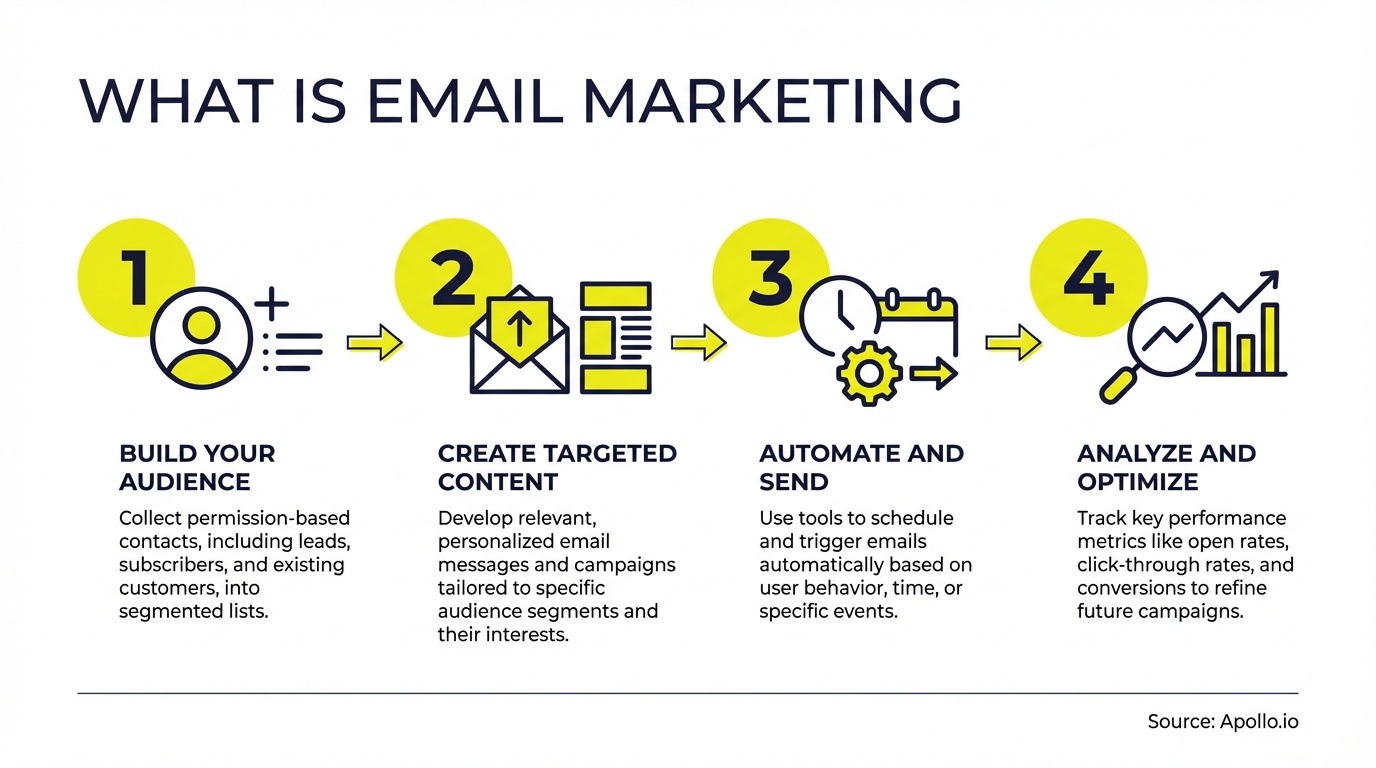
An email marketing program has four key layers working together:
- Contact list: Verified, segmented, permission-based contacts organized by role, behavior, or funnel stage.
- Email service provider (ESP): The platform that sends, schedules, and tracks emails (e.g., your sales engagement tool or marketing automation platform).
- Authentication: SPF, DKIM, and DMARC records that verify your domain identity and tell inbox providers your emails are legitimate.
- Inbox placement: Whether your message lands in the primary inbox, promotions tab, or spam folder, determined by sender reputation, engagement history, and compliance signals.
Authentication is now a first-order constraint. Microsoft announced that after May 5, 2025, Outlook routes messages from high-volume senders (over 5,000 emails per day) that fail authentication requirements directly to the Junk folder.
This makes SPF/DKIM/DMARC configuration table stakes, not optional hygiene.
"With this kind of AI system, my BDRs can send 10x more personalized emails. Their productivity and growth has skyrocketed."

What Email Marketing Metrics Actually Matter in 2026?
Open rate is the most widely reported email metric and also the least reliable. Apple's Mail Privacy Protection inflates open data significantly, making it a poor signal for optimization decisions.
Shift your measurement model to metrics tied to actual engagement and revenue.
| Metric | Why It Matters | Benchmark Context |
|---|---|---|
| Click-through rate (CTR) | Measures genuine content engagement | Global average: ~3.56% (GDMA, 2024) |
| Reply rate | Key for B2B outbound sequences | Varies by segment and personalization depth |
| Inbox placement rate | Confirms deliverability health | Target 95%+ for healthy programs |
| Pipeline influenced | Connects email to revenue outcomes | The metric CFOs actually care about |
| Unsubscribe rate | Signals list/content relevance issues | Keep below 0.5% per send |
For a comprehensive view of which metrics drive revenue decisions, see what B2B marketing metrics actually drive revenue growth.
Need better contacts to email? Sending to stale or unverified data tanks your deliverability and wastes your team's effort. Keep your contact data fresh and verified with Apollo's enrichment tools.
Turn Funnel Gaps Into Qualified Pipeline
Pipeline forecasting a guessing game because quality leads never convert? Apollo surfaces in-market buyers with precision targeting so your funnel fills with opportunities, not noise. Over 550K+ companies forecast with confidence.
Schedule a Demo →How to Build a B2B Email Marketing Strategy That Drives Pipeline
A revenue-focused email strategy has five components. Each must be in place for the others to work.
- Define your ICP and segments: Who are you emailing, and why are they a good fit? Segment by industry, role, funnel stage, and intent signals. Generic lists produce generic results.
- Set measurable goals: Pipeline generated, meetings booked, or customer retention rates, not vanity metrics like total sends.
- Choose the right email type per stage: Cold outbound uses short, personalized sequences. Warm nurture uses educational content. Post-demo uses case studies and proof points.
- Automate based on behavior: Triggered emails (opened a pricing page, attended a webinar, downloaded a guide) outperform scheduled broadcasts. See how lifecycle marketing uses behavioral signals to personalize at scale.
- Govern your list: Remove bounces, suppress unengaged contacts, and honor opt-outs immediately. List hygiene directly protects your sender reputation.
"These plays have completely removed the task of manually filtering and enrolling the contacts in sequences for the SDRs. It saves our reps over two hours of their workday to focus on higher-value activities."
Email Deliverability: The Non-Negotiable Foundation
Deliverability determines whether your strategy reaches anyone at all. Teams that treat it as a technical afterthought leave revenue on the table. The core requirements for high inbox placement are:
- SPF record: Authorizes which servers can send email on behalf of your domain.
- DKIM signature: Cryptographically signs outgoing messages to verify they haven't been tampered with.
- DMARC policy: Tells inbox providers what to do if SPF or DKIM checks fail (monitor, quarantine, or reject).
- List hygiene: Regularly remove hard bounces, spam trap addresses, and long-term unengaged contacts.
- Complaint rate management: Keep spam complaint rates below 0.1% to maintain sender reputation with major providers.
- One-click unsubscribe: Required by major inbox providers for bulk senders and essential for compliance with regulations like CAN-SPAM and similar frameworks.
For high-volume B2B sends, review bulk email best practices to protect deliverability as you scale. Separately, what works in B2B email marketing in 2026 covers the latest sequencing and segmentation tactics.
AI and Personalization: Where Data Quality Wins
AI-generated email copy is now table stakes. Every team has access to AI writing tools, which means AI alone no longer differentiates your outreach.
What separates high-performing programs is the quality of data behind the personalization: accurate contact details, relevant firmographic signals, and timely behavioral triggers.
Personalization that converts uses specific context: the prospect's role, their company's recent news, a relevant pain point tied to their industry. Generic "Hi [First Name], I noticed you work in sales" messages are immediately recognized and ignored. For tactical guidance, see email personalization strategies that actually drive replies.
Spending hours on manual outreach while your competitors automate? Build and automate multi-channel sequences with Apollo's sales engagement tools, combining email, phone, and social outreach in one unified workflow.
Frequently Asked Questions About Email Marketing
How often should you send marketing emails?
There is no universal answer. B2B cold outbound sequences typically run 5 to 8 touches over 2 to 4 weeks.
Newsletter cadence depends on content quality and audience expectations. The right frequency is the one that maintains engagement without increasing unsubscribe rates.
Monitor both metrics together.
What is the difference between email marketing and cold email outreach?
Email marketing typically refers to campaigns sent to opted-in contacts or existing customers. Cold email outreach targets prospects who have not previously engaged with your brand.
Both use similar deliverability principles but differ in consent, sequencing approach, and compliance requirements.
How do you build an email list without buying contacts?
Build lists through content offers, webinar registrations, demo requests, and product sign-ups. For B2B outbound, use verified business contact databases with accurate role and company data.
The quality of the list matters more than its size.
Is email marketing still effective in 2026?
Yes. Research from Straight In shows that 59% of B2B marketers rank email as their biggest revenue driver, second only to in-person events and webinars. Effectiveness is tied directly to data quality, deliverability, and relevance, not the channel itself.

Conclusion: Email Marketing Is a Revenue System, Not a Send Button
The teams winning with email in 2026 treat it as an infrastructure decision: verified contacts, authenticated domains, behavior-triggered sequences, and revenue-tied measurement. Creative copy matters, but it cannot overcome poor deliverability or irrelevant targeting.
If your email program is built on strong data, proper authentication, and segmented sequences, it compounds over time. If it's built on volume and guesswork, inbox providers and disengaged recipients will both push back.
Start with the foundation: clean data, authenticated sending domain, and a sequenced outreach approach tied to real pipeline goals. Schedule a Demo to see how Apollo helps B2B teams build email programs that actually reach the inbox and convert.
Prove Pipeline ROI With Apollo
ROI pressure killing your tool budget before it even starts? Apollo delivers measurable pipeline impact fast — so you walk into every budget review with proof, not promises. Leadium 3x'd their revenue. You're next.
Start Free with Apollo →Don't miss these
Sales
Inbound vs Outbound Marketing: Which Strategy Wins?
Sales
What Is a Sales Funnel? The Non-Linear Revenue Framework for 2026
Sales
What Is a Go-to-Market Strategy? The 2026 GTM Playbook
See Apollo in action
We'd love to show how Apollo can help you sell better.
By submitting this form, you will receive information, tips, and promotions from Apollo. To learn more, see our Privacy Statement.
4.7/5 based on 9,690 reviews
