
What Is the Best CRM for Small Sales Teams in 2026?
Small sales teams face a unique challenge: they need enterprise-grade CRM capabilities without enterprise complexity or budgets. The best CRM for a small sales team consolidates prospecting, engagement, and pipeline management into one workspace, eliminating the cost and friction of juggling multiple tools. With Sellers Commerce reporting the global CRM market reaching $112.91 billion in 2025, more platforms are competing for your business—but only a few deliver real ROI for teams of 3-10 reps.
This guide cuts through the noise with practical implementation frameworks, ROI modeling, and specific recommendations for SDRs, AEs, and sales leaders managing lean teams. Whether you're replacing spreadsheets or consolidating a bloated tech stack, you'll find actionable criteria for choosing a CRM that scales revenue without adding overhead.

Get Verified Contacts, Not Dead Ends
Tired of spending hours verifying contact info that bounces? Apollo delivers 96% email accuracy and verified mobile numbers instantly. Join 550K+ companies closing more deals with quality data.
Start Free with Apollo →Key Takeaways
- Small teams need CRMs that combine data, engagement, and pipeline tools to cut tech stack costs by consolidating 3-5 separate platforms
- According to Get Colby, small businesses that successfully adopt a CRM see a 21% boost in sales productivity and a 34% increase in overall efficiency
- The best CRMs for 2026 offer AI-powered automation, native integrations, and fast onboarding (days, not months) to deliver measurable ROI quickly
- Look for platforms with transparent pricing, flexible seat models, and built-in prospecting data to avoid hidden costs and vendor lock-in
Why Do Small Sales Teams Need a CRM in 2026?
A CRM organizes customer interactions, tracks pipeline stages, and automates repetitive tasks so reps focus on selling instead of administrative work. For small teams, the ROI is measurable: Pipeline CRM reports CRM delivers an average ROI of $8.71 for every dollar spent, with some projections suggesting up to $30.48 per dollar in 2023.
Small teams operate with resource constraints—limited headcount, tight budgets, and no dedicated RevOps support. Without a CRM, reps waste hours updating spreadsheets, chasing deal status, and manually logging outreach. A properly implemented CRM eliminates this friction while providing visibility for sales leaders to coach effectively and forecast accurately.
The shift toward agentic AI is changing what small teams should demand from CRMs. Platforms now offer AI call assistants, automated follow-ups, and intelligent lead scoring—capabilities that were enterprise-only two years ago.
For founders and sales leaders building outbound motions, these tools level the playing field against better-funded competitors.
What Should Small Sales Teams Look for in a CRM?
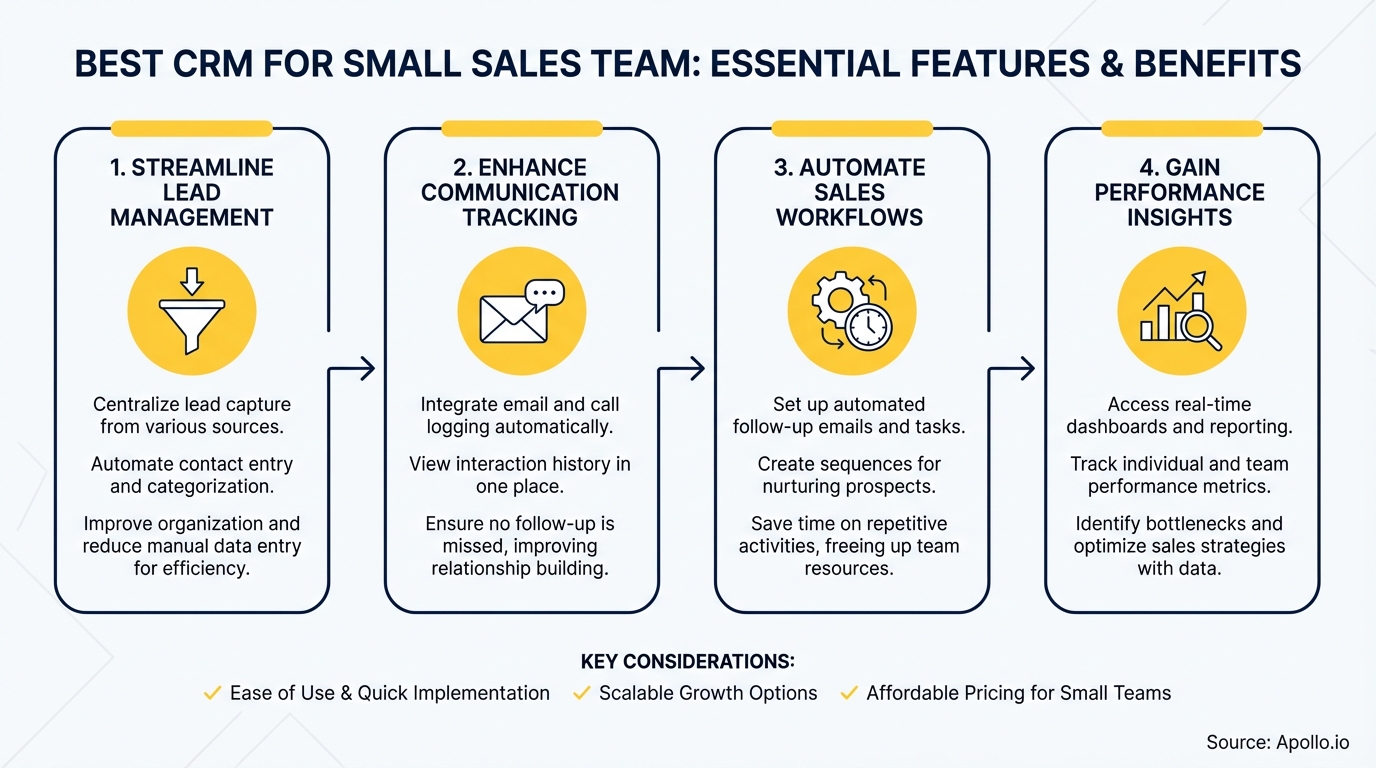
The best CRM for a small sales team combines five core capabilities: verified contact data, multi-channel engagement, pipeline visibility, native integrations, and fast implementation. Here's what matters most:
| Capability | Why It Matters for Small Teams | What to Evaluate |
|---|---|---|
| Built-in Prospecting Data | Eliminates need for separate data provider subscriptions | Database size, email accuracy rate, filters available |
| Sales Engagement Tools | Automates outreach sequences across email, phone, and social | Sequence builder, personalization tokens, A/B testing |
| Pipeline Management | Provides deal visibility and forecasting for leaders | Custom stages, drag-and-drop interface, reporting dashboards |
| Native Integrations | Syncs with existing tools without expensive middleware | HubSpot, Salesforce, Slack, calendar sync |
| AI Automation | Reduces manual data entry and surfaces next-best actions | Call transcription, email drafting, task prioritization |
Struggling to find qualified leads without paying for multiple tools? Search Apollo's 224M+ contacts with 65+ filters and build lists in minutes.
See Every Deal In Real Time With Apollo
Forecasting unreliable because you can't track deal stages. Apollo gives you live pipeline visibility and intent signals so you know exactly where every opportunity stands. Built-In increased win rates 10% with Apollo's scoring.
Start Free with Apollo →How Do SDRs and AEs Benefit from the Right CRM?
SDRs need a CRM that accelerates prospecting and automates repetitive outreach. The best platforms provide pre-built filters to identify ideal prospects, one-click contact exports, and email sequences with proven subject lines that book meetings faster. For teams without dedicated BDRs, this means reps spend less time researching and more time having conversations.
Account Executives benefit from deal intelligence and pipeline hygiene. A strong CRM surfaces account history, tracks stakeholder engagement, and flags at-risk deals based on activity patterns.
AEs managing 20-30 active opportunities need automated reminders, task prioritization, and quick access to conversation history—features that prevent deals from slipping through the cracks.

For small teams where reps wear multiple hats, tool consolidation is critical. "We reduced the complexity of three tools into one," reports Collin Stewart from Predictable Revenue. Platforms like Apollo combine prospecting, engagement, and CRM functionality, eliminating the need to toggle between systems and reducing monthly software spend.
What About Sales Leaders Managing Small Teams?
Sales leaders need visibility into team activity, pipeline health, and forecast accuracy without micromanaging reps. The right CRM provides dashboards showing daily activity (calls made, emails sent, meetings booked), stage-by-stage conversion rates, and win/loss analysis.
This data powers coaching conversations and helps leaders identify process bottlenecks before they impact revenue.
For founders building their first sales motion, simplicity matters more than feature depth.
Look for CRMs with guided onboarding, pre-built playbooks, and templates that accelerate time-to-first-deal. Small business sales software should feel intuitive from day one, not require weeks of configuration or external consultants.
How Does Apollo Help Small Sales Teams Consolidate Their Tech Stack?
Apollo serves as an all-in-one GTM platform for small sales teams, combining verified contact data, engagement automation, and deal management in a single workspace. Instead of paying for ZoomInfo plus Outreach plus a separate CRM, teams use Apollo to prospect, sequence, call, and track deals—cutting software costs while improving workflow efficiency.
The platform includes 224M verified business contacts with 96% email accuracy, eliminating the need for separate data enrichment services. SDRs build targeted lists using 65+ filters (industry, company size, job title, technology stack), export contacts directly into sequences, and track engagement across email, phone, and social channels.
This integrated approach saves hours of manual list building and data cleanup.
"We cut our costs in half," reports the team at Census. "Having everything in one system was a game changer," adds Cyera. For small teams evaluating CRM options, Apollo's transparent pricing and native integrations with HubSpot and Salesforce make it easy to test and adopt without long-term contracts or hidden fees.
What Are the Hidden Costs Small Teams Should Watch For?
Pricing transparency varies dramatically across CRM vendors. Some platforms advertise low per-seat costs but charge separately for data access, email sends, or advanced features.
Small teams should calculate total cost of ownership by adding base subscription, data enrichment fees, integration costs, and potential overages for usage-based pricing.
- Data Access Fees: Some CRMs charge per contact exported or per email verification, which adds up quickly for outbound teams
- Seat-Based Limitations: Platforms that charge full price for "view-only" users inflate costs for cross-functional teams
- Integration Middleware: Connecting your CRM to other tools may require Zapier or similar services, adding $50-200/month
- Implementation Services: Enterprise CRMs often require paid consultants for setup, delaying time-to-value by weeks or months
Spending hours on manual outreach without seeing results? Automate your sequences with Apollo's multi-channel engagement platform.
How Should Small Teams Implement a CRM for Fast ROI?
The fastest path to CRM ROI follows a phased rollout: start with core pipeline tracking (week 1), add outreach automation (week 2-3), then layer in reporting and integrations (week 4+). This approach gets reps using the system immediately while avoiding overwhelming them with too many features at once.
Begin by mapping your existing sales process to CRM stages. If you currently use "Lead → Qualified → Demo → Proposal → Closed," replicate that exact structure in your new CRM. Train reps on deal creation, stage progression, and activity logging before introducing advanced features like sequences or AI tools. According to HappSales, companies that use CRM systems have seen a 17% increase in lead conversions, a 16% boost in customer retention, and a 21% improvement in sales productivity.
Set clear adoption KPIs for the first 30 days: 100% of deals in CRM, daily activity logging (calls, emails, meetings), and at least one automated sequence launched per rep. Sales leaders should review these metrics weekly and provide hands-on coaching to accelerate adoption. Fast wins build momentum and prove value to skeptical reps.
Start Building Pipeline with the Right CRM
The best CRM for small sales teams in 2026 eliminates tool sprawl, reduces manual work, and delivers measurable ROI within weeks. Look for platforms that combine prospecting data, engagement automation, and pipeline management in one workspace—avoiding the hidden costs and complexity of multi-vendor stacks.
Small teams need systems that scale with revenue growth, not headcount growth. Choose a CRM with transparent pricing, native integrations, and AI-powered workflows that free up reps to focus on high-value activities like discovery calls and deal progression. For founders and sales leaders building outbound motions, the right platform becomes your competitive advantage.

Ready to consolidate your sales tech stack and accelerate pipeline growth? Start your free trial with Apollo and experience verified contact data, automated sequences, and deal management in one unified platform.
Prove Apollo's ROI In Your First 30 Days
Budget approval stuck on unclear metrics? Apollo delivers measurable pipeline impact from day one—track every touchpoint, attribute revenue, and show leadership exactly what they're getting. Customer. io achieved 50% YoY growth.
Start Free with Apollo →Don't miss these
Sales
Inbound vs Outbound Marketing: Which Strategy Wins?
Sales
What Is a Sales Funnel? The Non-Linear Revenue Framework for 2026
Sales
What Is a Go-to-Market Strategy? The 2026 GTM Playbook
See Apollo in action
We'd love to show how Apollo can help you sell better.
By submitting this form, you will receive information, tips, and promotions from Apollo. To learn more, see our Privacy Statement.
4.7/5 based on 9,690 reviews
