
BDR Sales: Strategies to Hit Quota and Streamline Your Process
BDR sales professionals face mounting pressure in 2026: buyers expect personalized experiences, quotas keep climbing, and juggling multiple tools eats up precious selling time. The role demands more than cold calls—it requires strategic prospecting, AI-powered personalization, and the ability to differentiate your offering in crowded markets.
This guide shows you exactly how top-performing BDRs achieve quota while cutting their tech stack complexity.

Reclaim 4+ Hours Daily With Apollo
Tired of spending half your day hunting for contact info? Apollo delivers 224M+ verified contacts instantly so you can focus on closing. Join 550K+ companies who stopped wasting time on research.
Start Free with Apollo →Key Takeaways
- BDR sales success in 2026 depends on situational buyer insights, not generic messaging—focus on personalization at every funnel stage
- AI-powered automation handles research and outreach busywork, freeing BDRs to focus on high-value conversations that close deals
- Consolidating your tech stack into one platform cuts costs in half while improving data accuracy and team productivity
- Buyer confidence drives purchase quality—deliver seller-assisted digital experiences that build trust and reduce decision regret
- Job-specific playbooks for BDRs, SDRs, and AEs create measurable lift in meeting bookings and pipeline velocity
What Is BDR Sales?
BDR sales (Business Development Representative sales) is the process of identifying and qualifying potential customers through outbound prospecting activities. BDRs research target accounts, initiate first contact via cold calls and emails, and schedule meetings for Account Executives to close. Unlike SDRs who often handle inbound leads, BDRs focus exclusively on outbound prospecting to fill the top of the sales funnel with qualified opportunities.
The BDR role bridges marketing and sales by converting cold prospects into warm leads. They spend their days building targeted lists, crafting personalized outreach sequences, and navigating gatekeepers to reach decision-makers.
Success requires persistence, strong communication skills, and the ability to articulate value propositions that resonate with specific buyer personas.
How Do BDRs Generate Pipeline in 2026?
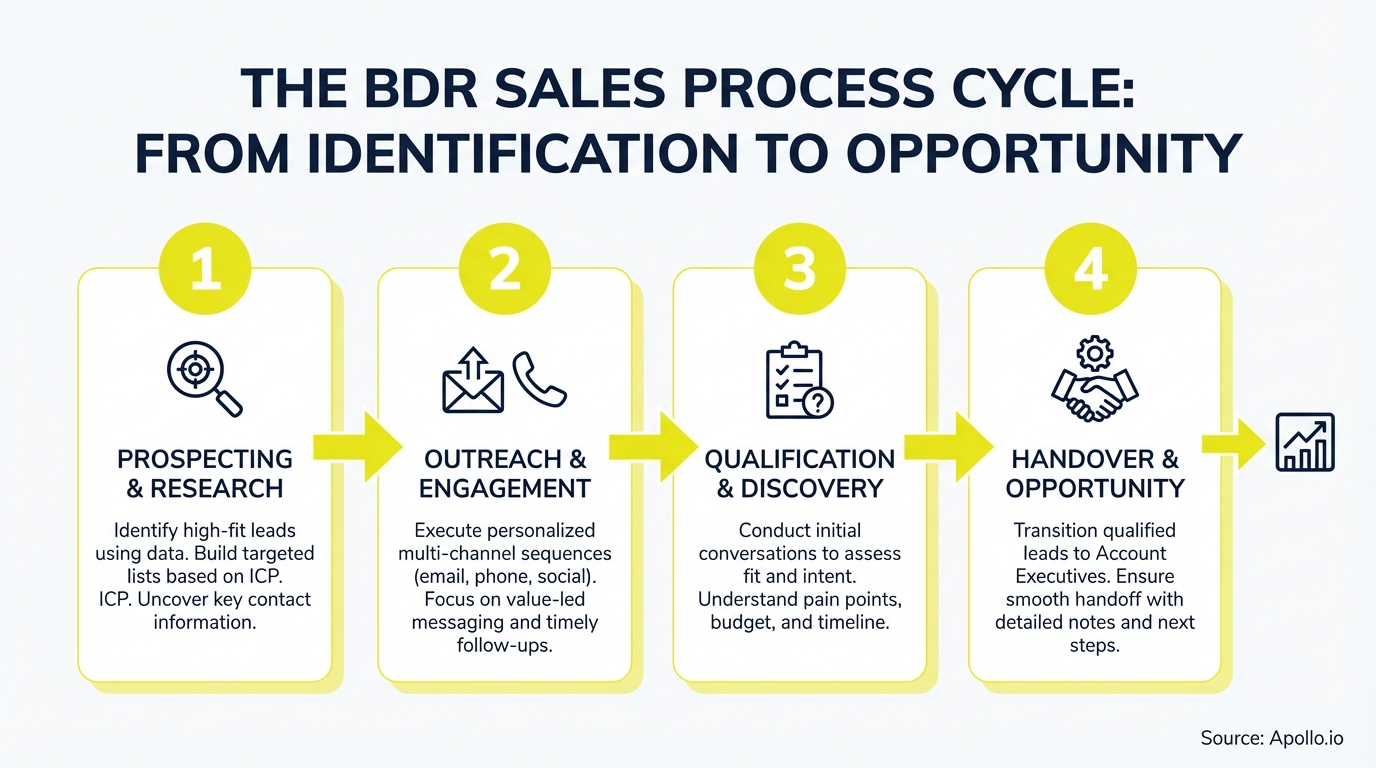
BDRs generate pipeline by combining strategic account research with multi-channel outreach campaigns. The modern BDR workflow starts with identifying ideal customer profiles using firmographic and technographic data filters.
They then build personalized sequences that include cold emails, LinkedIn touches, phone calls, and video messages tailored to each prospect's business context and pain points.
Research by Gartner shows that B2B buyers with high decision confidence are 10 times more likely to make high-quality purchases. BDRs create this confidence by delivering situational insights—not generic pitches—that address specific challenges at each buying stage. This approach requires deep account intelligence and the ability to pivot messaging based on prospect responses.
Struggling to find qualified leads? Search Apollo's 224M+ contacts with 65+ filters to build targeted lists in minutes.
What Tools Do BDRs Use Daily?
Top-performing BDRs in 2026 use integrated platforms that combine prospecting, engagement, and analytics in one workspace. Essential capabilities include contact databases with verified emails and phone numbers, sequence automation for multi-touch campaigns, conversation intelligence for call coaching, and pipeline tracking to measure activity-to-outcome metrics. However, data from Forrester indicates that technology transformation is reshaping how BDRs work, with AI and automation playing increasingly significant roles.
Many teams consolidate tools to eliminate data silos and reduce costs. As one sales development leader noted: "We reduced the complexity of three tools into one" (Predictable Revenue). This consolidation approach cuts subscription costs while improving data accuracy and team adoption rates.
Why Is Personalization Critical for BDR Success?
Personalization separates top-performing BDRs from those who struggle to hit quota because generic outreach gets ignored. In 2026, buyers receive hundreds of cold emails weekly, and 64% cannot differentiate between one brand's digital experience and another's.
BDRs who reference specific company initiatives, recent funding rounds, or technology stack details earn significantly higher response rates than those using templated messages.
Effective personalization requires three elements: accurate data, contextual research, and situational insights. BDRs must understand not just who they're contacting, but why that person cares about solving a specific problem right now.
This level of customization takes time—unless you leverage AI-powered research tools that surface relevant company signals and suggest personalized talking points automatically.
The shift toward seller-assisted digital experiences means BDRs must balance automation with authentic human connection. Buyers want efficient self-service options backed by knowledgeable sellers who provide expertise when needed. BDRs who master this balance book 35-46% more meetings than peers using purely automated or purely manual approaches.
See Every Deal Stage In Real Time With Apollo
Forecasting unreliable because you can't see where deals actually stand. Apollo gives you instant pipeline visibility across every stage so you can predict revenue with confidence. Built-In improved win rates 10% with Apollo's scoring.
Start Free with Apollo →How Do BDRs Measure Success?
BDRs measure success through a combination of activity metrics and outcome-based KPIs. Key performance indicators include:
| Metric Category | Example KPIs | Target Benchmarks |
|---|---|---|
| Activity Metrics | Calls made, emails sent, LinkedIn touches | 50+ touches daily |
| Response Rates | Email opens, replies, call connects | 15-20% email open, 2-5% reply |
| Conversion Metrics | Meetings booked, SQLs generated | 10-15 meetings monthly |
| Pipeline Impact | Opportunities created, revenue influenced | $200K+ pipeline quarterly |
Modern sales analytics platforms track these metrics in real-time, allowing BDRs and managers to identify what's working and adjust strategies quickly. The most valuable metric is pipeline contribution—how much qualified revenue opportunity each BDR generates for Account Executives to close.
Sales Leaders managing BDR teams also track efficiency ratios like cost-per-meeting and time-to-first-meeting. These metrics reveal whether process improvements or tool investments deliver ROI.
Teams using consolidated platforms report 30-40% faster ramp times for new BDRs because they learn one system instead of navigating multiple disconnected tools.
What Are the Biggest Challenges BDRs Face?
BDRs in 2026 struggle with three primary challenges: data quality issues, tool complexity, and differentiation in crowded markets. Poor contact data wastes hours on bounced emails and disconnected numbers.
Tool sprawl creates friction as BDRs toggle between prospecting databases, CRMs, sequencing platforms, and conversation intelligence tools—each requiring separate logins and manual data entry.
The differentiation challenge proves most difficult. McKinsey research shows that 57% of sellers disregard marketing-produced content because it feels generic and unresponsive to buyer needs.
BDRs must craft messaging that stands out while maintaining high activity volumes. This tension between personalization and scale drives many teams toward AI-powered solutions that automate research without sacrificing relevance.
Spending hours on manual outreach? Automate your sequences with Apollo's multi-channel platform that personalizes at scale.
How Do Top BDRs Overcome These Obstacles?
Elite BDRs solve data, tool, and differentiation challenges by consolidating their tech stack into platforms that handle prospecting, engagement, and analytics in one workspace. This approach eliminates data silos and reduces the time spent on administrative tasks.
As one RevOps leader reported: "We cut our costs in half" (Census) by replacing separate tools with an integrated solution.
For differentiation, top performers use AI-powered research agents that surface company signals, news mentions, and technology stack changes automatically. This intelligence enables situational messaging that references specific business contexts rather than generic pain points. The result: higher response rates and faster progression from cold prospect to qualified meeting.
How Can BDRs Book More Meetings?
BDRs book more meetings by focusing on three high-impact strategies: precise targeting, multi-channel persistence, and value-first messaging. Start by narrowing your ideal customer profile using firmographic data (company size, industry, revenue) and technographic signals (current tools, tech stack gaps).
This precision targeting ensures you contact prospects who actually need your solution.
Multi-channel persistence means touching prospects 8-12 times across email, phone, LinkedIn, and video before declaring them unresponsive. Research shows most BDRs give up after 2-3 touches, but decision-makers often need repeated exposure before responding.
The key is varying your message and channel—not just sending the same email multiple times.

Value-first messaging shifts from "let me tell you about our product" to "here's an insight that solves your specific problem." Reference proven sales playbooks that lead with customer success stories, industry benchmarks, or actionable tips. This approach positions you as a trusted advisor rather than another vendor pitching features.
What Role Does AI Play in Modern BDR Sales?
AI transforms BDR sales by automating time-consuming research and personalizing outreach at scale. Modern AI GTM systems analyze millions of data points to suggest ideal prospects, generate personalized email copy based on company context, and recommend optimal contact timing. This technology handles the busywork that traditionally consumed 60-70% of a BDR's day.
AI-powered conversation intelligence records calls, transcribes discussions, and identifies winning talk tracks based on what top performers say. BDRs review these insights to refine their messaging and objection handling.
Some platforms even provide real-time coaching during calls, suggesting responses to common questions or flagging buying signals the BDR should explore.
The combination of AI research and engagement automation enables BDRs to maintain high activity levels while delivering personalized experiences. Teams report 35-46% increases in meeting bookings when using AI-assisted workflows compared to manual approaches.
The technology doesn't replace human sellers—it amplifies their effectiveness by removing repetitive tasks.
Start Scaling Your BDR Sales Success
BDR sales in 2026 requires balancing high activity volumes with personalized, situational outreach that builds buyer confidence. The most successful BDRs consolidate their tools into integrated platforms that provide accurate data, multi-channel automation, and AI-powered intelligence in one workspace.
This approach cuts costs, improves efficiency, and delivers measurable pipeline impact.
Focus on the fundamentals: precise targeting using detailed filters, multi-touch sequences across channels, and value-first messaging that addresses specific buyer situations. Measure what matters—not just activity metrics, but pipeline contribution and revenue influence.
Leverage AI to automate research and personalization at scale, freeing your time for high-value conversations that move deals forward.
Ready to transform your BDR performance? Start free with Apollo and access 224M+ verified contacts, AI-powered sequences, and the all-in-one platform that top BDR teams use to exceed quota. Having everything in one system is a game changer.
Prove Apollo's ROI In Your First 30 Days
Budget approval stuck on unclear metrics? Apollo tracks every dollar spent to pipeline generated with real-time ROI dashboards. Built-In increased win rates 10% and ACV 10% with measurable impact.
Start Free with Apollo →Don't miss these
Sales
Inbound vs Outbound Marketing: Which Strategy Wins?
Sales
What Is a Sales Funnel? The Non-Linear Revenue Framework for 2026
Sales
What Is a Go-to-Market Strategy? The 2026 GTM Playbook
See Apollo in action
We'd love to show how Apollo can help you sell better.
By submitting this form, you will receive information, tips, and promotions from Apollo. To learn more, see our Privacy Statement.
4.7/5 based on 9,690 reviews
