
B2B Sales Strategy: How to Win More Deals in 2024
Modern B2B sales has fundamentally shifted. Buyers now control the journey, conducting extensive research before engaging with sellers. According to Sopro, buyers review an average of 11 pieces of content before contacting a vendor, with nearly three-quarters beginning their research online. Sales teams need strategies that align with this self-directed buying behavior while maintaining human connection at critical moments. Success in 2026 requires B2B sales organizations to balance automation, data intelligence, and strategic human engagement.

Skip Hours Of Research - Apollo Finds Contacts
Tired of spending 4+ hours daily hunting for contact info? Apollo delivers 224M verified contacts with 96% email accuracy instantly. Join 550K+ companies closing deals faster.
Start Free with Apollo →Key Takeaways
- 61% of B2B buyers prefer rep-free experiences, demanding self-service assets and content that enable autonomous research and decision-making
- Hybrid selling models combining AI automation with human expertise at high-stakes moments deliver the strongest conversion rates in 2026
- CRM-integrated sales plays with consistent messaging across all channels eliminate the content drift that causes 73% of buyers to avoid irrelevant suppliers
- SDRs and AEs using unified platforms report faster prospect research, higher response rates, and shorter sales cycles compared to fragmented tool stacks
- Omnichannel strategies supporting digital self-service, remote interactions, and in-person meetings match how buyers actually split their time during evaluation
What Is B2B Sales Strategy in 2026?
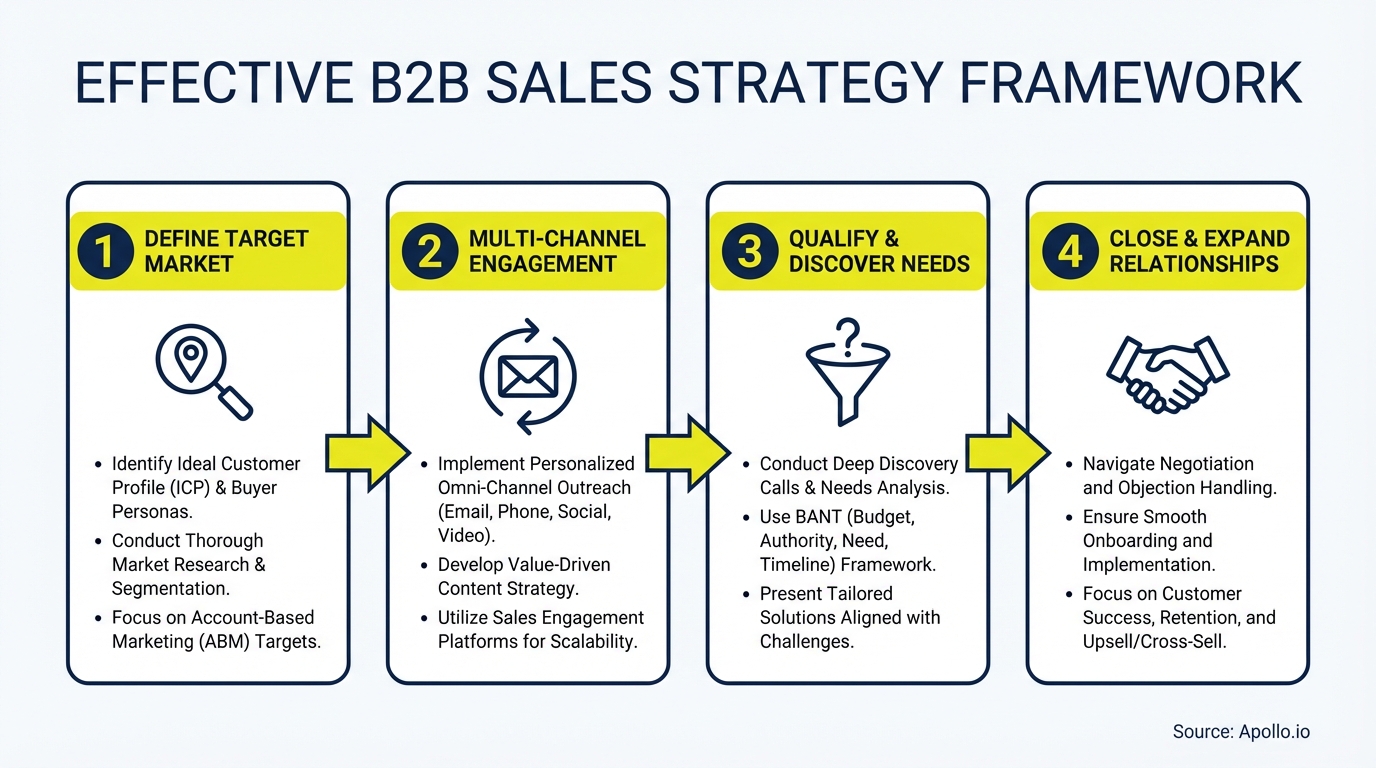
B2B sales strategy is a structured approach to identifying, engaging, and converting business customers through coordinated processes, tools, and messaging. Modern B2B sales strategy centers on buyer enablement rather than seller control. A Gartner survey from August-September 2024 found that 61% of B2B buyers prefer an overall rep-free buying experience, favoring independent research through digital channels.
This shift requires strategies built around self-service content, transparent pricing information, and interactive tools that empower buyers to progress without seller involvement. The most effective strategies provide seamless transitions between digital self-service and human expertise when buyers signal readiness for conversation.
Teams must design for omnichannel buying patterns where prospects split time between web research, remote meetings, and in-person discussions.
Why Do Sales Leaders Need a Documented Strategy?
A documented strategy creates alignment across sales, marketing, and customer success teams while establishing measurable benchmarks. Without clear documentation, 69% of B2B buyers report inconsistencies between website information and what sellers communicate, creating trust gaps that kill deals.
Strategy documentation ensures message consistency, defines qualification criteria, and maps content assets to specific buyer stages.
For RevOps leaders, documented strategies enable predictable forecasting and resource allocation. Sales leaders use strategy documents to onboard new reps faster, enforce best practices, and identify coaching opportunities through deviation analysis.
Founders building outbound motions need documented strategies to scale beyond founder-led sales while maintaining deal quality and conversion rates.
How Do SDRs Build Pipeline with Modern Buyer Behavior?
SDRs in 2026 focus on relevance and timing rather than volume. With 73% of B2B buyers actively avoiding suppliers who send irrelevant outreach, SDRs must use intent signals, firmographic data, and buying-group intelligence to personalize every interaction.
The modern SDR role combines AI-assisted research with human judgment about account fit and message customization.
Struggling to find qualified leads? Search Apollo's 224M+ contacts with 65+ filters to identify prospects showing active buying signals.
Successful SDRs build sequences that combine email, phone, and social outreach based on prospect behavior. They create value in first touch by sharing relevant insights, not pushing meetings. Teams using B2B sales techniques focused on buyer enablement report higher response rates and more qualified meetings booked.
What Sales Plays Drive Consistent Revenue Growth?
Sales plays are repeatable frameworks that guide sellers through specific scenarios like new logo acquisition, expansion, or competitive displacement.
Effective plays integrate into CRM systems with automated triggers, content templates, and success metrics.
However, 70% of companies struggle to integrate sales plays into their revenue technology stack, limiting execution and measurement.
High-performing plays include:

- Inbound conversion plays: Automated routing, instant response protocols, and qualification frameworks for leads showing purchase intent
- Account-based plays: Multi-threaded engagement strategies targeting buying committees with role-specific messaging and proof points
- Expansion plays: Usage-triggered outreach, success metrics reviews, and cross-sell/upsell frameworks based on customer outcomes
- Competitive displacement plays: Differentiation messaging, migration support, and risk mitigation content that addresses switching concerns
For Account Executives managing complex deals, documented plays reduce decision fatigue and ensure consistent execution across opportunities. AEs using play-based approaches report faster deal velocity and higher win rates because they follow proven paths rather than improvising strategy for each account.
Turn Forecast Guesswork Into Revenue Certainty
Marketing leads not converting to real opportunities. Apollo identifies sales-ready prospects with 96% email accuracy and intent signals. Built-In increased win rates 10% with Apollo's buyer scoring.
Start Free with Apollo →How Does Technology Enable Strategy Execution?
Technology consolidation has become critical as teams recognize the cost and complexity of managing 8-12 separate sales tools. According to Apollo customers, unified platforms eliminate data silos, reduce context switching, and cut technology costs significantly. One customer reported: "We reduced the complexity of three tools into one" (Predictable Revenue), while another noted: "We cut our costs in half" (Census).
Research from HubSpot shows AI adoption in sales surged from 24% in 2023 to 43% in 2024, with teams reporting measurable improvements in response rates and cycle times. Modern platforms integrate AI for research automation, message personalization, and conversation intelligence while maintaining human control over strategy and relationship building.
Spending hours on manual outreach? Automate your sequences with Apollo's multi-channel engagement platform to scale personalized outreach without sacrificing relevance.
| Technology Layer | Strategic Function | Key Capabilities |
|---|---|---|
| Data & Intelligence | Account identification and prioritization | Contact databases, intent signals, technographic data, buying-group mapping |
| Engagement & Automation | Multi-channel outreach execution | Email sequences, dialer, social touch automation, A/B testing |
| Conversation Intelligence | Deal coaching and message refinement | Call recording, transcript analysis, objection tracking, win/loss insights |
| Pipeline Management | Forecasting and resource allocation | Deal tracking, stage progression, activity logging, revenue forecasting |
What Content Assets Support Buyer-Led Journeys?
Buyer-led journeys require self-service assets that answer questions, demonstrate value, and reduce perceived risk without requiring seller involvement. Effective content strategies map assets to specific buyer tasks rather than generic funnel stages.
Teams must provide interactive tools like ROI calculators, product comparison guides, implementation roadmaps, and security documentation that buyers can access and share internally.
Content governance ensures consistency between website information and sales conversations. Single source of truth (SOT) systems with claim libraries, version control, and review workflows eliminate the messaging drift that creates buyer confusion.
Sales enablement teams should audit content quarterly, updating statistics, case studies, and competitive positioning based on market changes and win/loss feedback.
Channel-native content formats matter as buyers move between web research, email nurture, and live conversations. Web content prioritizes scannability and depth with expandable sections and downloadable resources.
Email content emphasizes brevity and clear next actions. In-meeting content focuses on visual storytelling and interactive discussion guides that facilitate buying-group consensus.
How Should Sales Leaders Measure Strategy Effectiveness?
Strategy measurement requires leading and lagging indicators across pipeline generation, conversion efficiency, and revenue outcomes. Leading indicators like outbound response rates, meeting-to-opportunity conversion, and average deal size provide early signals about strategy performance.
Lagging indicators like win rates, sales cycle length, and customer acquisition cost validate long-term effectiveness.
Key metrics by role:
- SDRs/BDRs: Accounts touched, response rate, meetings booked, meeting-to-SQL conversion, average prospect engagement score
- AEs: Opportunity win rate, average deal size, sales cycle length, multi-threading score, champion identification rate
- Sales Leaders: Team quota attainment, pipeline coverage ratio, forecast accuracy, rep ramp time, tool adoption rate
- RevOps: Cost per acquisition, customer lifetime value, technology ROI, data quality scores, process compliance rate
Understanding sales analytics enables leaders to identify bottlenecks, optimize resource allocation, and validate strategy changes with data rather than intuition. Regular strategy reviews should examine metric trends, competitive win/loss patterns, and team feedback to inform continuous improvement.

Build Your Winning B2B Sales Strategy
Successful B2B sales strategy in 2026 balances buyer autonomy with strategic seller engagement. Teams that provide self-service content while maintaining human expertise at critical decision points outperform those relying solely on traditional seller-led approaches.
Strategy documentation, CRM-integrated plays, and unified technology platforms eliminate execution gaps that prevent teams from realizing their strategy's full potential.
Focus on relevance over volume, data quality over database size, and consistent messaging across all buyer touchpoints. Measure what matters to your business model, whether that's new logo acquisition, expansion revenue, or market share in specific segments.
Invest in technology that consolidates your stack rather than adding complexity. As one Apollo customer noted: "Having everything in one system was a game changer" (Cyera).
Ready to consolidate your sales tech stack and execute your strategy more effectively? Schedule a Demo to see how Apollo unifies prospecting, engagement, and intelligence in one platform.
Prove Apollo's Value In Your First Week
Budget approval stuck on unclear metrics? Apollo tracks every touchpoint from first contact to closed deal. Built-In increased win rates 10% and ACV 10% with measurable pipeline impact.
Start Free with Apollo →Don't miss these
Sales
Inbound vs Outbound Marketing: Which Strategy Wins?
Sales
What Is a Sales Funnel? The Non-Linear Revenue Framework for 2026
Sales
What Is a Go-to-Market Strategy? The 2026 GTM Playbook
See Apollo in action
We'd love to show how Apollo can help you sell better.
By submitting this form, you will receive information, tips, and promotions from Apollo. To learn more, see our Privacy Statement.
4.7/5 based on 9,690 reviews
