B2B Sales Process: A Complete Guide for Modern Sales Teams
The B2B sales process in 2026 looks nothing like it did five years ago. Buyers demand hybrid experiences that blend digital self-service with strategic human touchpoints, while sales teams race to consolidate their tech stacks and adopt data-driven methodologies. According to Gartner research, 65% of B2B sales organizations have already transitioned from intuition-based to data-driven decision-making by 2026. This shift requires a modern B2B sales framework that balances automation with authentic relationships.

Apollo Eliminates 4+ Hours Of Daily Research
Tired of spending 4+ hours daily hunting for contact info? Apollo delivers 224M verified contacts with 96% email accuracy—instantly. Join 550K+ companies who replaced manual research with predictable pipeline.
Start Free with Apollo →Key Takeaways
- Modern B2B sales processes blend digital self-service channels with strategic human interaction to match buyer preferences
- Data-driven selling with unified workflows replaces gut-feel decision-making, improving deal quality and predictability
- Hybrid selling models combining in-person, remote, and e-commerce touchpoints dominate successful sales organizations
- Tool consolidation into all-in-one platforms cuts costs and complexity while improving team performance
- Buyer-conflict mitigation strategies address the 74% of teams experiencing unhealthy decision dynamics
What Is a B2B Sales Process in 2026?
A B2B sales process is a structured, repeatable framework that guides sales teams from initial prospect identification through deal closure and customer retention. Unlike consumer sales, B2B processes involve multiple decision-makers, longer sales cycles, and higher transaction values. In 2026, successful B2B sales processes integrate data intelligence, automated workflows, and hybrid engagement models to meet modern buyer expectations.
The modern process operates across three parallel tracks:
- Digital self-service channels for buyer-led research and transactions
- Sales-assisted engagement for complex deals requiring human expertise
- Data governance infrastructure ensuring consistent information across all touchpoints
Research by McKinsey confirms that hybrid selling has become the dominant B2B sales strategy, combining in-person, remote, and e-commerce interactions to meet evolving customer preferences.
How Does the Modern B2B Sales Process Work?
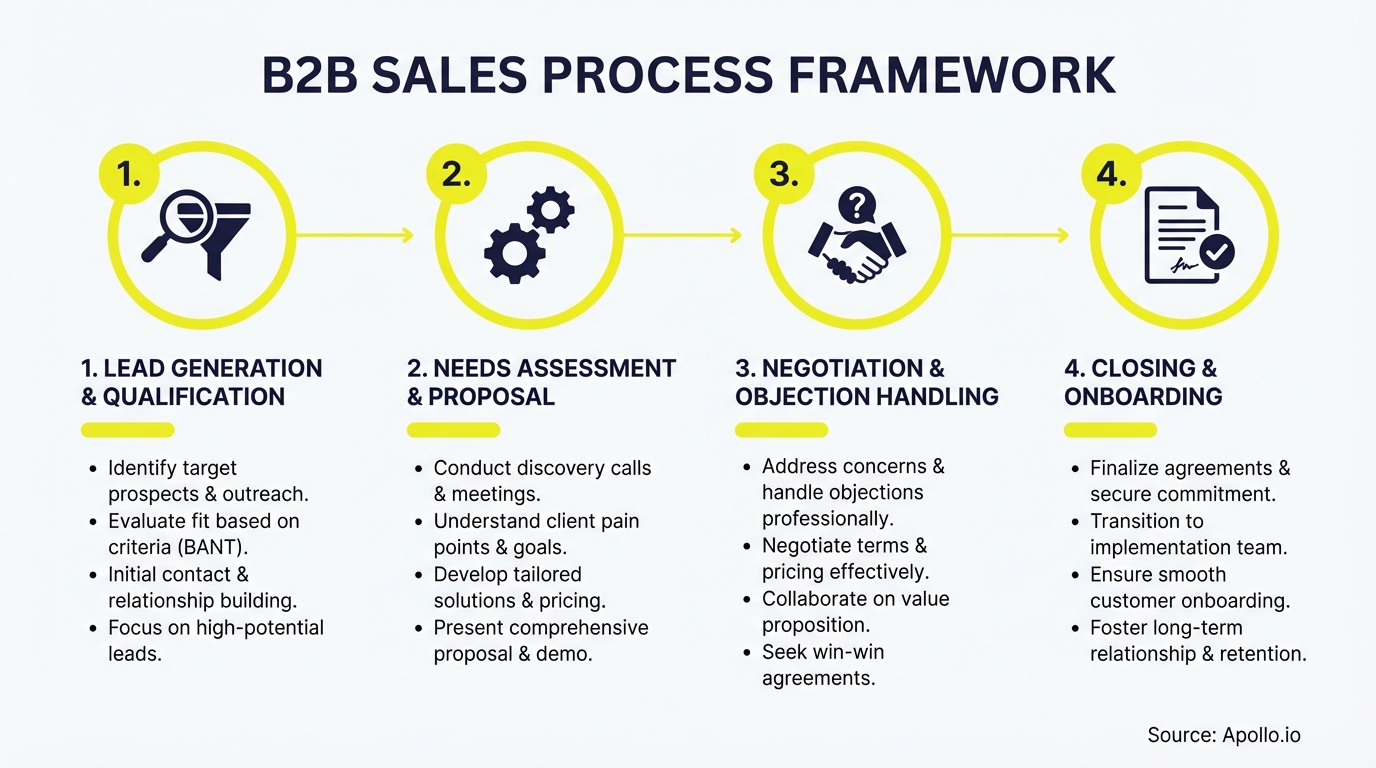
The 2026 B2B sales process operates through six core stages, each enhanced by data intelligence and automation. The key difference from legacy approaches is the integration of buyer-controlled digital channels alongside traditional sales activities.
| Stage | Primary Activities | Key Metrics |
|---|---|---|
| Prospecting & Research | ICP identification, intent signal monitoring, contact discovery | Qualified leads generated, data accuracy rate |
| Initial Outreach | Multi-channel engagement, personalized messaging, response tracking | Response rate, meeting conversion rate |
| Discovery & Qualification | Needs analysis, stakeholder mapping, BANT/MEDDIC qualification | Opportunity win rate, average deal size |
| Solution Presentation | Demo delivery, ROI modeling, competitive positioning | Demo-to-proposal conversion, objection resolution time |
| Negotiation & Closing | Pricing discussions, contract review, stakeholder alignment | Close rate, sales cycle length, discount depth |
| Onboarding & Expansion | Implementation support, success planning, upsell identification | Time-to-value, net revenue retention, expansion rate |
Struggling to find qualified leads at scale? Search Apollo's 224M+ verified contacts with 65+ filters to build your ideal prospect list.
How Do SDRs Execute the Prospecting Stage?
SDRs in 2026 rely on data intelligence platforms rather than manual research to identify and engage prospects. The prospecting stage now combines intent data signals, technographic filters, and buying committee identification to prioritize outreach.
Modern SDR workflows include:
- ICP filtering: Using firmographic data (revenue, employee count, industry) to identify target accounts
- Intent monitoring: Tracking buying signals like content downloads, product page visits, and competitor research
- Contact enrichment: Automatically appending verified email addresses, phone numbers, and social profiles
- Sequence automation: Deploying multi-channel cadences across email, LinkedIn, and phone touchpoints
SDRs using unified platforms report 40-60% time savings on research activities, allowing them to focus on personalization and relationship-building rather than data gathering.
See Every Deal Stage In Real Time With Apollo
Pipeline forecasting a guessing game? Apollo gives you live visibility into every deal stage so you can forecast with confidence. Built-In boosted win rates 10% with Apollo's real-time insights.
Start Free with Apollo →Why Is Data-Driven Selling Critical in 2026?
Data-driven selling replaces intuition-based decision-making with measurable insights across the entire sales process. This approach addresses the quality and consistency issues that plague traditional B2B sales methodologies.
A 2024 Gartner survey found that 74% of B2B buyer teams experience unhealthy conflict during the decision process, leading to a 2.5 times higher likelihood of low-quality deals. Data-driven processes mitigate this risk by providing clear, objective information that reduces buyer confusion and internal misalignment.

Key benefits for sales leaders and RevOps teams:
- Predictable pipeline: Accurate forecasting based on historical conversion rates and deal velocity metrics
- Coaching at scale: Identifying skill gaps and best practices through conversation intelligence and activity analysis
- Resource optimization: Allocating team capacity to highest-value opportunities based on win probability scores
- Single source of truth: Eliminating data silos across CRM, engagement platforms, and analytics tools
For Account Executives managing complex deals, data-driven insights reveal buying committee dynamics, competitive threats, and optimal timing for proposal delivery. RevOps leaders leverage unified data to reduce tech stack complexity and eliminate manual data entry that slows rep productivity.
What Are the Components of Hybrid Selling Models?
Hybrid selling balances buyer preferences for self-service with the strategic value of sales expertise. The model recognizes that 61% of B2B buyers prefer rep-free experiences for routine transactions, while still valuing human guidance for complex purchases.
Effective hybrid models include:
- Digital storefronts: E-commerce platforms for straightforward product purchases and reorders
- Self-service resources: Product demos, ROI calculators, comparison guides, and implementation documentation
- Strategic sales engagement: Account Executives focused on consultative selling for deals over $50K
- Inside sales support: SDRs and BDRs handling inbound qualification and outbound prospecting
- Customer success touchpoints: Proactive outreach for renewal conversations and expansion opportunities
Spending hours on manual outreach across disconnected tools? Automate your multi-channel sequences with Apollo's unified engagement platform.
How Do Sales Teams Implement Process Governance?
Process governance ensures consistency across channels and prevents the data fragmentation that undermines buyer confidence. Without governance, prospects receive conflicting information from your website, sales reps, and support teams.
Governance framework essentials:

- Content management system: Centralized repository for sales collateral, pricing sheets, and competitive intelligence
- Data quality standards: Rules for contact enrichment, duplicate management, and field validation
- Role definitions: Clear RACI matrices defining who owns prospecting, qualification, demo delivery, and closing activities
- Technology stack: Integrated platform reducing tool sprawl and data sync issues
Organizations that consolidate from 5-7 point solutions into unified platforms report 50% reductions in implementation time and 30-40% cost savings. As one Apollo customer from Census noted, "We cut our costs in half" by replacing separate prospecting, enrichment, and engagement tools.
What Tools Do Modern Sales Teams Need?
The 2026 sales tech stack prioritizes consolidation over best-of-breed point solutions. Sales Leaders and Founders building outbound motions now seek all-in-one platforms that eliminate integration headaches and reduce vendor management overhead.
Essential platform capabilities:
- Prospecting database: 224M+ verified business contacts with 65+ filtering dimensions
- Engagement automation: Email sequences, LinkedIn messaging, and AI call assistants in one workspace
- Pipeline management: Deal tracking, forecasting, and revenue analytics
- Conversation intelligence: Call recording, transcription, and coaching insights
- CRM integration: Bi-directional sync with Salesforce, HubSpot, and other systems
According to customer testimonials, unified platforms deliver measurable results. Predictable Revenue reported, "We reduced the complexity of three tools into one." Cyera's team found that "having everything in one system was a game changer" for ramping new reps and maintaining data accuracy across their sales organization.
Ready to Modernize Your B2B Sales Process?
The shift to data-driven, hybrid selling is no longer optional for competitive B2B organizations. Teams that cling to intuition-based processes and fragmented tech stacks will lose deals to competitors leveraging unified intelligence and automated workflows.
Modern sales processes deliver three core advantages:
- Higher win rates through better targeting, personalization, and buyer-conflict mitigation
- Shorter sales cycles via parallel digital and human engagement tracks
- Lower cost of sale by consolidating tools and automating repetitive tasks
Apollo provides the unified platform that powers modern B2B sales processes for 550K+ companies. From prospecting through closing, everything operates in one workspace with AI-powered automation that helps SDRs book 46% more meetings and AEs increase bookings by 35%.
Start Your Free Trial and see how Apollo eliminates the complexity of managing multiple tools while improving every stage of your sales process.
Prove Apollo's ROI In Your First 30 Days
Budget approval stuck on unclear metrics? Apollo delivers measurable impact from day one—track time saved, pipeline generated, and win rates improved. Built-In increased ACV 10% rates 10% with Apollo's real-time insights.
Start Free with Apollo →Don't miss these
Sales
Inbound vs Outbound Marketing: Which Strategy Wins?
Sales
What Is a Sales Funnel? The Non-Linear Revenue Framework for 2026
Sales
What Is a Go-to-Market Strategy? The 2026 GTM Playbook
See Apollo in action
We'd love to show how Apollo can help you sell better.
By submitting this form, you will receive information, tips, and promotions from Apollo. To learn more, see our Privacy Statement.
4.7/5 based on 9,690 reviews
