What Is a B2B Marketing Funnel? Framework, Metrics, and Optimization for 2026
The B2B marketing funnel has evolved from a simple linear path into a multi-stakeholder decision journey. In 2026, buyers conduct most of their research independently, involve larger buying committees, and expect self-serve experiences backed by decision-assurance content.
This guide covers the modern funnel framework, stage-specific tactics, and optimization strategies aligned with how B2B buyers actually make decisions.

Apollo Turns Research Hours Into Revenue Time
Tired of spending 4+ hours daily hunting for contact info? Apollo delivers 224M verified contacts with 96% email accuracy. Join 550K+ companies closing more deals.
Start Free with Apollo →Key Takeaways
- B2B funnels must account for buying groups averaging 13 stakeholders and 69% of the purchase journey happening before sales engagement
- Visitor-to-lead conversion rates typically range between 1-3%, requiring strategic content at every stage
- Modern funnels integrate intent data, buying-group alignment, and consensus-building assets to reduce internal conflict
- According to Semrush, 84% of B2B marketers reported that their content marketing built brand awareness in the last year
- Self-serve and digital channels now drive the majority of B2B interactions, shifting content requirements toward interactive decision tools
What Is a B2B Marketing Funnel?
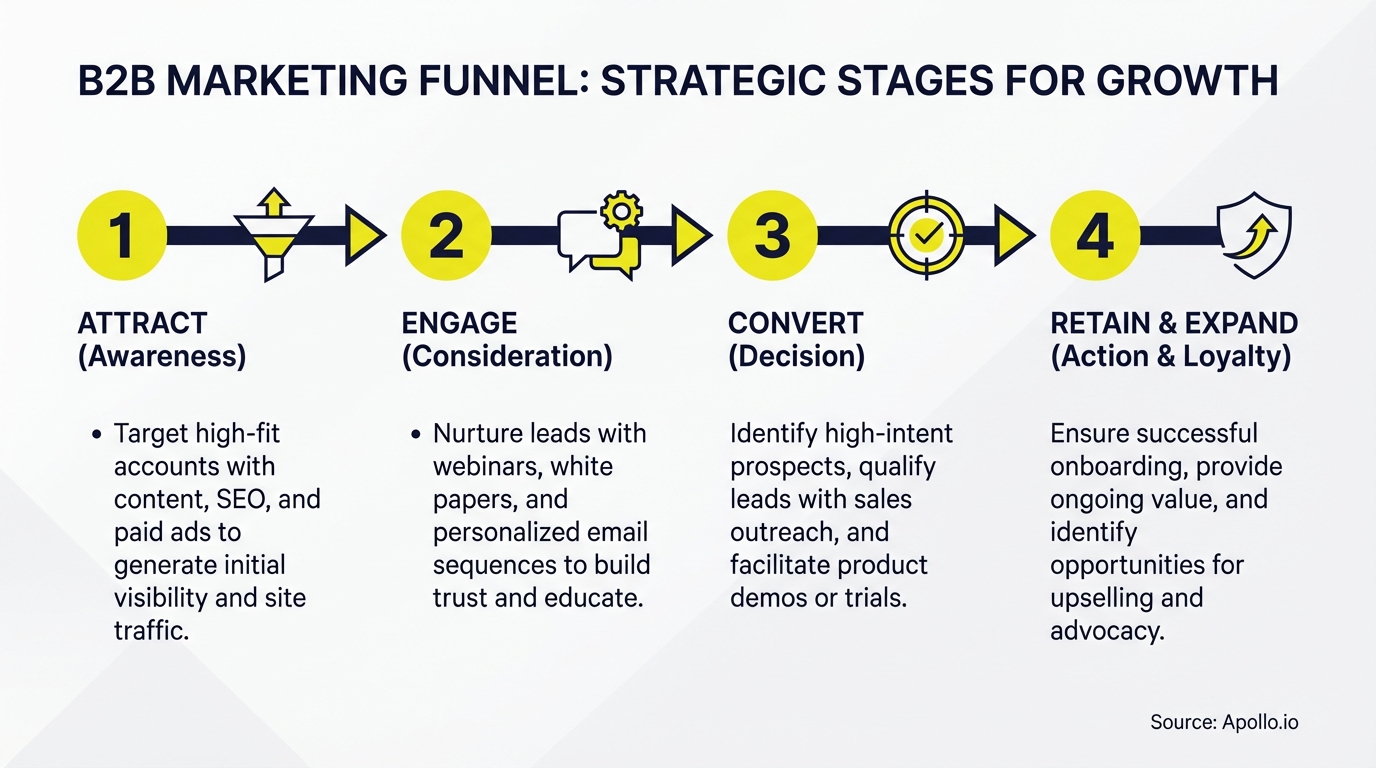
A B2B marketing funnel is a strategic framework that maps how businesses move from initial awareness to purchase decision. Unlike B2C funnels, B2B funnels account for longer sales cycles, multiple decision-makers, and complex approval processes.
The funnel visualizes three core stages:
- Top of Funnel (TOFU): Awareness and education
- Middle of Funnel (MOFU): Consideration and evaluation
- Bottom of Funnel (BOFU): Decision and purchase
In 2026, the funnel is no longer linear. Buyers loop back, skip stages, and conduct research across channels. Research from Usermaven shows that visitor-to-lead conversion rates typically range between 1-3%, making every touchpoint critical.
"Apollo helps us turn data into action... we are living and breathing inside the tool."
How Has the B2B Funnel Changed in 2026?
Three shifts define the modern B2B funnel:
1. Buying Groups, Not Individual Buyers
Decisions now involve an average of 13 people across multiple departments. Your funnel must address different personas with role-specific content, business cases, and stakeholder alignment tools.
2. Pre-Sales Decision-Making
Buyers complete 69% of their purchase journey before engaging sales. This means your awareness and consideration content must do the heavy lifting of criteria-setting, vendor comparison, and internal consensus-building.
3. Self-Serve Preference
According to BookYourData, by 2025, 80% of B2B sales interactions between suppliers and buyers are expected to occur through digital channels. Buyers want to research, evaluate, and even purchase without sales involvement.
Struggling to align content with buying-group needs? Enrich accounts with Apollo's 224M+ verified contacts to map decision-makers by role and department.
What Are the Stages of a B2B Marketing Funnel?
| Stage | Buyer Mindset | Content Types | Key Metrics |
|---|---|---|---|
| Awareness (TOFU) | Problem identification, category education | Blog posts, social content, webinars, thought leadership | Traffic, engagement, email sign-ups |
| Consideration (MOFU) | Solution evaluation, vendor comparison | Guides, case studies, comparison pages, demo videos | MQLs, content downloads, demo requests |
| Decision (BOFU) | Vendor selection, stakeholder alignment | ROI calculators, implementation guides, testimonials, trials | SQLs, conversion rate, deal velocity |
Top of Funnel (Awareness): Buyers recognize a problem but haven't defined a solution. Content should educate on industry challenges, emerging trends, and category frameworks. Research from Extu shows that infographics and blogs (65%), webinars and digital events (52%), and white papers and ebooks (50%) were the top content formats B2B buyers found most appealing.
Middle of Funnel (Consideration): Buyers evaluate solutions and compare vendors. This stage requires proof points, differentiation content, and buying-group alignment assets. Case studies, interactive demos, and stakeholder-specific guides help move deals forward.
Bottom of Funnel (Decision): Buyers need decision assurance, consensus tools, and implementation clarity. ROI calculators, risk checklists, mutual action plans, and customer testimonials reduce purchase anxiety and accelerate close rates.

What Content Works at Each Funnel Stage?
Awareness Stage Content:
- Educational blog posts addressing pain points
- Industry research reports and trend analyses
- Webinars featuring subject matter experts
- Social content that sparks conversation
- SEO-optimized guides answering buyer questions
Consideration Stage Content:
- Detailed product comparison pages
- Customer case studies with measurable outcomes
- Buying guides and requirement checklists
- Interactive product demos and walkthroughs
- Email nurture sequences with educational value
Decision Stage Content:
- ROI and TCO calculators
- Implementation roadmaps and timelines
- Video testimonials from similar customers
- Free trials and proof-of-concept programs
- Stakeholder briefing templates and business case kits
For detailed tactics on building converting funnels, see our guide on how to build a B2B marketing funnel.
"We reduced the complexity of three tools into one. We're getting higher reply rates, open rates are doubled, meetings are up, and speed to booking a meeting is cut in half."
Spot Ready-To-Buy Accounts Before They Go Cold
Missing in-market prospects while competitors strike first? Apollo surfaces buying intent signals and tracks website visitors so you engage at the perfect moment. Built-In increased win rates 10% with Apollo's scoring.
Start Free with Apollo →How Do You Measure B2B Funnel Performance?
Track these metrics by stage to identify leaks and optimize conversion:
| Metric | What It Measures | Benchmark |
|---|---|---|
| Visitor-to-Lead Rate | Website conversion effectiveness | 1-3% |
| MQL-to-SQL Rate | Lead qualification accuracy | 10-30% |
| SQL-to-Opportunity Rate | Sales qualification effectiveness | 20-40% |
| Opportunity-to-Close Rate | Deal execution and consensus-building | 20-30% |
| Average Deal Velocity | Time from MQL to closed-won | 60-180 days |
Leading Indicators: Content engagement, email open/click rates, demo attendance, and feature adoption signal buyer intent before conversion events.
Lagging Indicators: Revenue, CAC, LTV, and win rate measure ultimate funnel effectiveness but require time to materialize.
For comprehensive measurement frameworks, explore our guide on B2B marketing metrics that drive revenue growth.

What Are Advanced B2B Funnel Optimization Tactics?
1. Intent-Based Segmentation
Use firmographic data and buying signals to personalize content by account. High-intent accounts get BOFU assets, while early-stage prospects receive educational content.
2. Buying-Group Alignment
Create persona-specific content tracks. Technical buyers need product specs, while economic buyers require ROI justification. Map content to each stakeholder's decision criteria.
3. Consensus-Building Assets
Develop stakeholder briefing kits, comparison matrices, and business case templates that help buyers gain internal alignment and reduce decision conflict.
4. Self-Serve Decision Tools
Interactive ROI calculators, product configurators, and guided demos let buyers evaluate solutions without sales involvement while collecting qualification data.
5. Re-Engagement Sequences
Automate nurture flows for stalled deals with updated case studies, new features, and competitive insights. Time triggers based on inactivity thresholds.
Need to scale personalized outreach across funnel stages? Automate multi-channel sequences with Apollo's sales engagement platform.
How Do You Align Sales and Marketing Around the Funnel?
Funnel alignment requires shared definitions, handoff processes, and unified metrics:
Define MQL and SQL Criteria: Agree on scoring thresholds based on fit (firmographics) and behavior (engagement). Document what qualifies a lead for sales outreach.
Establish SLAs: Marketing commits to lead volume and quality. Sales commits to follow-up speed and feedback. Track adherence and iterate quarterly.
Close the Loop: Sales reports on lead quality, win/loss reasons, and messaging effectiveness. Marketing adjusts targeting and content based on closed-loop data.
Unified Tech Stack: Integrate your CRM, marketing automation, and sales engagement tools. Ensure both teams work from the same data on accounts, contacts, and activity history.
For related strategies, see our coverage of B2B digital marketing strategy and B2B sales techniques.
Start Building a Revenue-Driving B2B Funnel
The modern B2B marketing funnel is a multi-stakeholder, self-serve decision journey. Success requires stage-specific content, buying-group alignment, consensus-building assets, and measurement clarity.
Apollo consolidates prospecting, engagement, and enrichment into one platform. With 224M+ verified contacts, AI-powered sequencing, and full-funnel analytics, you can build a funnel that drives predictable pipeline.
Prove Pipeline ROI In Days, Not Quarters
Budget approval stuck on unclear metrics? Apollo tracks every touchpoint from prospect to closed deal with built-in attribution. Built-In increased win rates 10% and ACV 10% with Apollo's scoring and signals.
Start Free with Apollo →Don't miss these
Sales
Inbound vs Outbound Marketing: Which Strategy Wins?
Sales
What Is a Sales Funnel? The Non-Linear Revenue Framework for 2026
Sales
What Is a Go-to-Market Strategy? The 2026 GTM Playbook
See Apollo in action
We'd love to show how Apollo can help you sell better.
By submitting this form, you will receive information, tips, and promotions from Apollo. To learn more, see our Privacy Statement.
4.7/5 based on 9,690 reviews
