What Is B2B Content Marketing? Rep-Free Buyer Enablement Guide for 2026
B2B content marketing is a strategic approach that uses valuable, relevant content to attract, educate, and convert business buyers without requiring sales rep intervention. In 2026, this means building a self-serve content engine that buyers trust more than your salespeople.
Buyers have spoken: they prefer to research independently. With business contact information and buyer intent signals available at scale, content marketing now powers the entire revenue cycle from first touch to closed-won.

Apollo Cuts Research From Hours To Seconds
Tired of spending 4+ hours daily hunting for contact info? Apollo delivers 224M verified contacts with 96% email accuracy instantly. Join 550K+ companies who ditched manual research.
Start Free with Apollo →Key Takeaways
- B2B content marketing creates self-serve buyer experiences that reduce dependency on sales reps while accelerating deal velocity
- According to NY Times Licensing, 71% of B2B marketers reported that content marketing has become more important to their organization in the last year
- Effective content engines require a single source of truth across all channels, AI governance for consistency, and modular assets designed for omnichannel distribution
- Research from Content Marketing Institute shows 45% of B2B marketers anticipate their content marketing budget will increase in 2024 compared to 2023
- Measurement now focuses on pipeline influence, sales enablement adoption, and revenue attribution rather than vanity metrics like traffic
Why B2B Content Marketing Drives Revenue in 2026
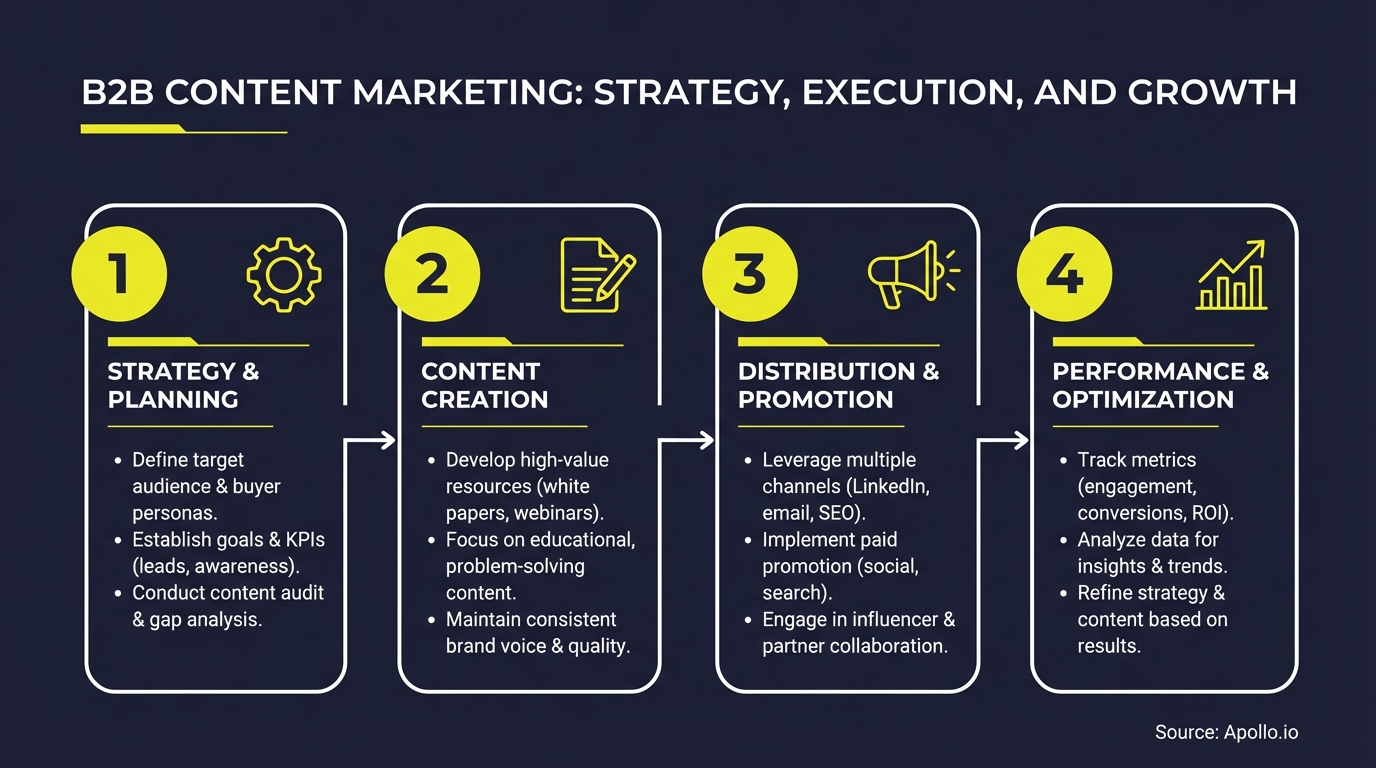
B2B content marketing is the strategic practice of creating and distributing content that addresses specific business challenges, educates decision-makers, and builds trust throughout long sales cycles. Unlike consumer content, B2B content targets multiple stakeholders (technical buyers, economic buyers, end users) and must deliver measurable business outcomes.
The buying landscape has fundamentally shifted. Buyers now complete most of their research before engaging sales, making your content library the primary revenue driver.
Your content either enables self-serve decisions or creates friction that sends buyers to competitors.
"Apollo could be a third of the cost if you look at the full price of what we were spending on ZoomInfo, Outreach, Salesforce, and admins to make it all work."
Content marketing delivers compounding value. A single well-researched guide can generate qualified pipeline for years, while paid ads stop working the moment you stop paying.
Evergreen assets become your always-on sales team.
What Makes B2B Content Different From B2C?
B2B content marketing addresses complex buying committees, longer sales cycles (often 6-18 months), and higher transaction values. Key differences include:
| Dimension | B2B Content | B2C Content |
|---|---|---|
| Audience | Multiple stakeholders, committees | Individual consumers |
| Decision Timeline | 6-18 months, multiple touchpoints | Minutes to days |
| Content Depth | Technical specs, ROI calculators, implementation guides | Emotional triggers, lifestyle benefits |
| Proof Required | Case studies, security docs, compliance certifications | Reviews, social proof |
| Distribution | Sales enablement, gated assets, account-based plays | Social virality, paid acquisition |
B2B buyers demand substance over style. They need implementation playbooks, total cost of ownership models, and vendor comparison matrices.
Surface-level content that worked in 2020 now actively damages trust.
How to Build a Rep-Free Content Engine
A rep-free content engine enables buyers to self-educate, self-qualify, and reach purchase decisions without mandatory sales conversations. This requires strategic architecture, not just more blog posts.
Start with a content taxonomy aligned to buyer stages:
- Awareness: Problem identification, market education, trend reports
- Consideration: Solution comparisons, framework guides, implementation planning
- Decision: ROI calculators, security documentation, migration playbooks
- Expansion: Advanced use cases, optimization guides, community content
Build modular content blocks that can be assembled into different formats. A single research project becomes a webinar, blog series, gated guide, sales one-pager, and social content. This maximizes ROI from every content investment.
Create a single source of truth for all product claims, features, and competitive positioning. When your website says one thing and your sales deck says another, buyers notice.
Centralize content governance to eliminate the inconsistencies that erode trust.
Struggling to identify and reach your ideal buyer personas? Search Apollo's 224M+ business contacts with 65+ filters to build precise audience segments.

What Content Formats Drive Pipeline in 2026?
Content format selection should map to buyer intent and decision stage. High-performing teams prioritize formats that enable action, not just consumption.
| Format | Best For | Pipeline Impact |
|---|---|---|
| Interactive Tools | ROI calculators, assessment quizzes, configurators | High (captures intent + contact data) |
| Comparison Guides | Vendor evaluation, feature matrices | High (late-stage decision support) |
| Implementation Playbooks | Migration planning, technical setup | High (reduces purchase risk) |
| Video Demos | Product walkthroughs, use case showcases | Medium-High (visual proof) |
| Case Studies | Social proof, outcome validation | Medium-High (builds confidence) |
| Research Reports | Thought leadership, market trends | Medium (awareness + credibility) |
| SEO Blog Content | Organic discovery, problem education | Medium (top-of-funnel volume) |
Genesys Growth reports that videos deliver ROI 49% faster than text-based content, making them essential for teams focused on velocity.
The shift toward bottom-of-funnel content reflects market saturation at the top. When everyone has a blog, differentiation comes from decision-stage assets that competitors haven't built: total cost of ownership models, security questionnaires, implementation timelines, and migration checklists.
"Apollo has increased the likelihood that we're going to get someone on the phone and we're going to get someone to reply to an email."
See Every Deal Stage In Real Time With Apollo
Pipeline forecasting a guessing game? Apollo delivers live visibility across every deal stage so you can predict revenue accurately. Built-In boosted win rates 10% with Apollo's scoring.
Start Free with Apollo →How to Distribute Content Across Omnichannel Buyers
Distribution strategy determines content ROI more than content quality. The best guide in your content library is worthless if buyers can't find it when they need it.
Owned channels (blog, email, website) give you control but require audience building. Earned channels (SEO, social shares, PR) deliver compounding returns but take time. Paid channels (ads, syndication) provide speed but require ongoing investment.
According to Taboola, social media platforms (organic) are used by 90% of B2B marketers for content distribution, making social a non-negotiable distribution channel.
Sales enablement is your highest-leverage distribution channel. When sellers use your content in conversations, you achieve two goals simultaneously: educating buyers and ensuring message consistency. Equip reps with one-pagers, competitive battle cards, and objection-handling guides tied to your content taxonomy.
Need to automate content distribution across email, phone, and social channels? Apollo's sales engagement platform orchestrates multi-touch sequences at scale.
For more on building effective distribution systems, see our guide on B2B digital marketing strategy.
What Metrics Actually Measure Content Performance?
Content measurement is shifting from engagement metrics (views, clicks, time-on-page) to business impact metrics (pipeline influence, deal velocity, win rates). High-performing teams track:
- Pipeline influenced: Deals where content was consumed pre-opportunity creation
- Sales enablement adoption: Which assets reps actually use in deals
- Content-to-close velocity: How content consumption affects deal speed
- Multi-touch attribution: Content role across the entire buyer journey
- Self-serve conversion: Buyers who purchase without sales conversations
Vanity metrics (traffic, social shares) still matter for top-of-funnel awareness, but they don't predict revenue. A blog post with 100 views that generates 3 qualified opportunities outperforms a viral post with 10,000 views and zero pipeline.
Build measurement frameworks that connect content consumption to revenue outcomes. Tag content assets in your CRM, track which pieces appear in closed-won deals, and measure the delta in win rates when specific content is used versus not used.
Learn more about tracking the right indicators in our guide to B2B marketing metrics.
How AI Governance Ensures Content Consistency
AI is shifting from content generation to content governance. The biggest content risk in 2026 isn't producing enough, it's maintaining consistency and accuracy across hundreds of assets published by multiple teams.
Implement AI-powered content QA workflows:
- Claim verification: Automated checks that product claims match documentation
- Competitive accuracy: Alerts when competitor information becomes outdated
- Tone consistency: AI scoring to ensure brand voice alignment
- Version control: Centralized tracking of content updates across channels
- Citation management: Verification that statistics have valid sources
The 69% of buyers who report inconsistencies between website content and seller messaging aren't just confused, they're actively losing trust. AI governance closes these gaps by enforcing a single source of truth.
For related automation strategies, explore our insights on enterprise marketing automation.
How Apollo Powers B2B Content Marketing
Apollo consolidates your go-to-market tech stack into one workspace, connecting content strategy to revenue execution. Instead of juggling separate tools for data, outreach, and analytics, Apollo unifies your content distribution engine.
Target the right audience: Apollo's 224M+ verified business contacts and 30M+ companies let you build precise segments for content distribution. Filter by job title, department, company size, technology stack, and buying signals to ensure content reaches decision-makers.
Personalize at scale: Apollo's data enrichment automatically populates contact and company details, enabling dynamic content personalization without manual data entry. Reference a prospect's industry, tech stack, or company size directly in your messaging.
Orchestrate multi-channel sequences: Distribute content via email, phone, and social in coordinated sequences. Apollo's sales engagement platform ensures your content reaches buyers through their preferred channels.
Measure pipeline impact: Apollo's deal management and analytics connect content touchpoints to revenue outcomes, showing which assets actually drive closed-won deals.
For a complete view of Apollo's capabilities, see our guide to B2B marketing tools.

Start Building Your Content Engine
B2B content marketing in 2026 requires a strategic shift from volume to enablement. Buyers don't need more content, they need better systems that let them research, evaluate, and decide on their timeline.
Build your content engine around a single source of truth, implement AI governance for consistency, design modular assets for omnichannel distribution, and measure pipeline influence over vanity metrics. The teams that master rep-free buyer enablement will dominate their markets while competitors still rely on outdated sales-led motions.
Ready to connect your content strategy to revenue execution? Start prospecting free with Apollo and build a content engine powered by verified business contact data.
Prove Apollo's ROI In Your First 30 Days
Budget approval stuck on unclear metrics? Apollo tracks every dollar impact—from contact to close. Built-In increased win rates 10% and ACV 10% with Apollo's scoring.
Start Free with Apollo →Don't miss these
Sales
Inbound vs Outbound Marketing: Which Strategy Wins?
Sales
What Is a Sales Funnel? The Non-Linear Revenue Framework for 2026
Sales
What Is a Go-to-Market Strategy? The 2026 GTM Playbook
See Apollo in action
We'd love to show how Apollo can help you sell better.
By submitting this form, you will receive information, tips, and promotions from Apollo. To learn more, see our Privacy Statement.
4.7/5 based on 9,690 reviews
