AI Tools for Sales: How to Choose the Right Solutions for Your Team
Sales teams face mounting pressure: hit quota, shorten cycles, personalize at scale. Knock Knock App reports AI adoption in sales has surged, with 81% of sales teams testing or fully utilizing AI solutions in 2026, up from 39% in 2023. The shift is real, but the question isn't whether to adopt AI tools for sales. It's which ones drive measurable revenue impact and how to move from pilot to production without wasting budget on tools that don't integrate or data that's dirty. AI sales tools now span prospecting, engagement, forecasting, and coaching, but most teams struggle with governance, data readiness, and ROI measurement.

Apollo Finds Verified Contacts In Seconds
Tired of spending 4+ hours daily hunting for contact info? Apollo delivers 224M verified contacts with 96% email accuracy. Join 550K+ companies closing more deals.
Start Free with Apollo →Key Takeaways
- AI adoption in sales reached 81% in 2026, but 30% of pilots fail due to poor data quality and unclear business value
- Sales reps spend 70% of their time on non-selling tasks, creating massive automation opportunity with AI
- Companies using AI report 76% higher win rates and 32% increased conversions when implementation includes governance and clean data
- Domain-specific AI models tailored to sales workflows will represent over 50% of enterprise AI by 2027
- Successful AI adoption requires end-to-end workflow coverage, not just email drafting or single-point tools
What Are AI Tools for Sales?
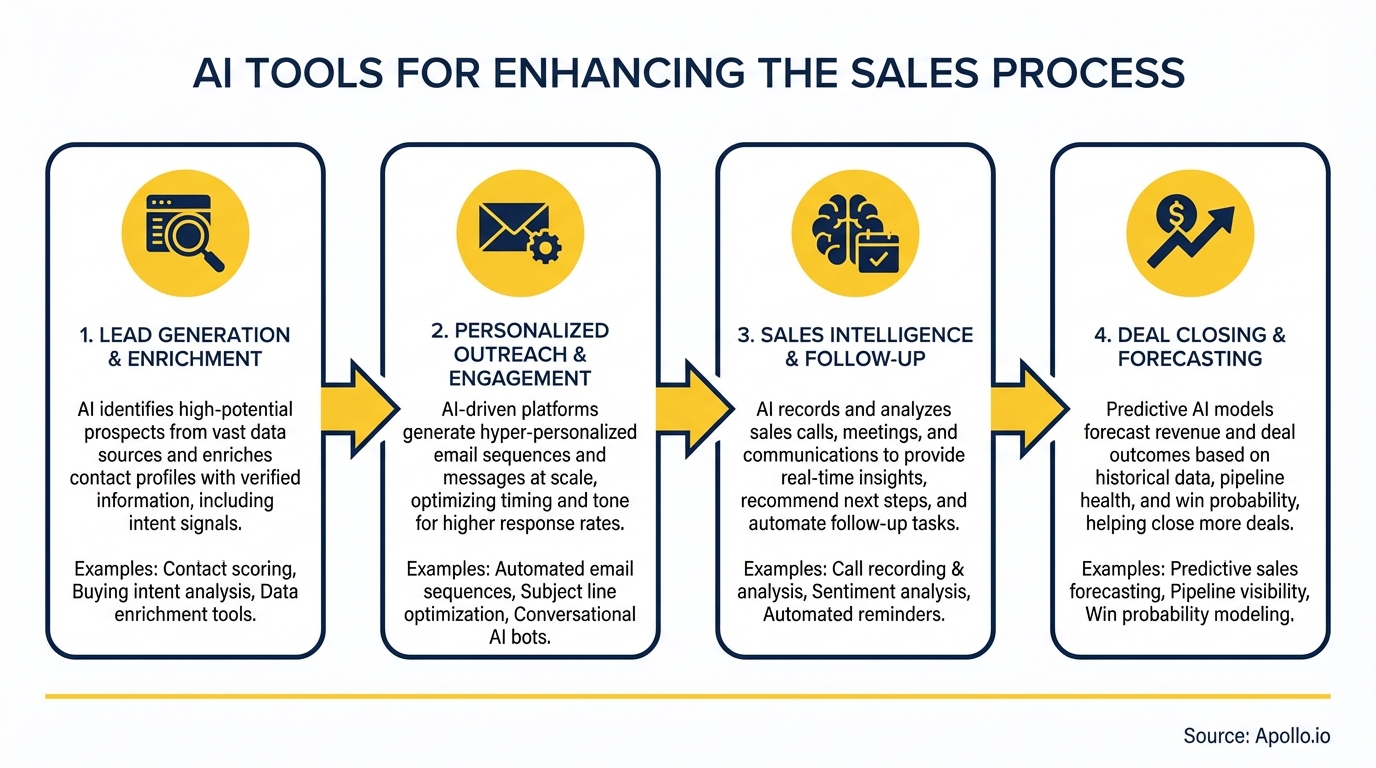
AI tools for sales are software platforms that use machine learning, natural language processing, and predictive analytics to automate prospecting, personalize outreach, forecast pipeline, and coach reps. They range from contact discovery and enrichment platforms to engagement automation, conversation intelligence, and deal management systems.
The best AI sales tools integrate across your tech stack, ground insights in CRM data, and deliver measurable impact on quota attainment and revenue growth.
In 2026, Cirrus Insight reports 56% of sales professionals use AI daily. The shift from "assistive" AI (drafting emails) to "agentic" AI (autonomous prospecting workflows) is accelerating. Major vendors like Salesforce, HubSpot, and Microsoft are embedding AI agents directly into seller workflows, positioning chat interfaces like Slack and Teams as the primary control plane for revenue teams.
Why Do Sales Teams Need AI Tools in 2026?
Sales reps report spending 70% of their time on non-selling activities like research, data entry, and administrative work. AI tools reclaim that time by automating manual tasks, surfacing buyer intent signals, and generating personalized outreach at scale. Cubeo AI research shows companies utilizing AI technologies experience 76% higher win rates and 32% increased conversions.
For SDRs and BDRs, AI tools mean less time searching for contacts and more time having conversations. For Account Executives, AI provides pre-meeting intelligence and suggests next-best actions based on deal stage and buyer signals.
RevOps leaders gain cleaner data, fewer integration headaches, and a single source of truth. Sales Leaders get visibility into team performance, predictable forecasting, and the ability to coach at scale using conversation intelligence.

What Problems Do AI Sales Tools Solve?
- Dirty data: Enrichment and waterfall verification keep CRM records accurate and actionable
- Manual prospecting: AI-powered search filters 224M+ contacts by intent signals, tech stack, funding, and 65+ attributes
- Generic outreach: Personalization engines tailor messaging using account context, recent activity, and role-specific pain points
- Pipeline visibility gaps: Deal intelligence surfaces risks, predicts close probability, and recommends actions
- Inconsistent coaching: Call recording and AI summaries turn every conversation into a coaching moment with scorecards and next steps
Struggling to find qualified leads? Search Apollo's 224M contacts with 65+ filters and AI-powered intent signals.

How Do SDRs and AEs Use AI Tools Effectively?
SDRs use AI to identify high-intent prospects, automate multi-channel sequences, and personalize outreach without manual research. Platforms like Apollo's AI writing tools generate tailored emails based on account context, recent news, and buyer role. The best SDRs combine AI prospecting with human judgment, using AI to surface the right accounts and craft the first draft, then adding authentic personalization before hitting send.
Account Executives leverage AI for deal intelligence and forecasting. AI call assistants transcribe meetings, generate summaries, and extract action items automatically.
Conversation intelligence platforms analyze talk-to-listen ratios, question patterns, and objection handling to surface coaching opportunities. AEs managing complex deals use AI to predict close probability, identify risks based on engagement patterns, and recommend next-best actions grounded in historical win/loss data.
What Workflows Benefit Most From AI Automation?
| Workflow | Manual Process | AI-Powered Approach | Impact |
|---|---|---|---|
| Prospecting | Manual list building searches, spreadsheet exports | AI filters 224M+ contacts by intent, tech stack, funding, job changes | Reduces research time, increases list quality |
| Outreach | One-size-fits-all templates, manual personalization | AI generates tailored emails using account context and recent activity | Higher reply rates, faster response times |
| Follow-up | Manual reminders, tracking in CRM notes | Automated sequences with conditional logic based on engagement | Consistent touchpoints, no deals slip through |
| Meeting prep | Google searches stalking, CRM history review | AI surfaces account insights, recent news, stakeholder maps, past interactions | Better discovery questions, higher close rates |
| Call recaps | Manual note-taking, delayed CRM updates | AI transcribes calls, generates summaries, extracts next steps | Accurate records, faster handoffs, better coaching |
Turn Forecast Guesswork Into Revenue Certainty
Missing quota because your pipeline data is always outdated? Apollo gives you real-time deal visibility and intent signals that make forecasting reliable. Built-In boosted win rates 10% with Apollo's scoring.
Start Free with Apollo →What Are the Best AI Tools for Sales in 2026?
The best AI sales tools integrate prospecting, engagement, enrichment, and intelligence in one platform. Tool consolidation reduces costs, eliminates data silos, and simplifies workflows. According to Martal Group, 92% of companies plan to increase AI investment over the next three years to drive revenue growth and streamline sales.
Apollo combines 224M verified business contacts, multi-channel engagement sequences, AI-powered personalization, call recording, and deal management in one workspace. Teams using Apollo report significant time savings and higher booking rates. "We reduced the complexity of three tools into one," says Collin Stewart, Founder of Predictable Revenue. "We cut our costs in half," reports the Census team. "Having everything in one system was a game changer," notes Cyera's revenue operations leader.
What Features Should You Prioritize?
- Prospecting intelligence: Intent signals, tech stack data, funding events, job changes
- Data quality: Real-time enrichment, waterfall verification, mobile number accuracy
- Engagement automation: Multi-channel sequences (email, phone, social), A/B testing, conditional logic
- AI personalization: Context-aware email generation, dynamic variables, account-based messaging
- Conversation intelligence: Call recording, transcription, AI summaries, coaching scorecards
- CRM integration: Bi-directional sync, automated logging, trigger-based workflows
- Pipeline visibility: Deal scoring, risk alerts, forecasting accuracy, rep dashboards
How Do You Move From Pilot to Production With AI Sales Tools?
Gartner predicts 30% of GenAI projects will be abandoned after proof of concept by end of 2026 due to poor data quality, inadequate risk controls, escalating costs, or unclear business value. Successful AI adoption requires a structured approach focused on data readiness, governance, and measurable outcomes.
What Does a Production-Ready AI Sales Stack Require?
- Clean CRM data: Dedupe records, standardize fields, enrich missing contact info before deploying AI
- Governance framework: Define approval workflows for AI-generated content, set quality thresholds, assign ownership
- Integration strategy: Map data flows between CRM, engagement platform, analytics tools, and AI assistants
- Measurement plan: Track reply rates, meeting bookings, pipeline created, and quota attainment by rep and segment
- Training program: Equip reps with AI tool proficiency, best practices for prompt engineering, and quality review processes
Start with one high-impact workflow like outbound prospecting or meeting follow-up. Measure baseline metrics (reply rate, meetings booked, time spent).
Deploy AI tools with clear success criteria. Run A/B tests comparing AI-assisted outreach vs. manual.
Iterate based on data. Scale what works.
What Role Do Domain-Specific AI Models Play in Sales?
Gartner predicts that by 2027, over 50% of GenAI models used by enterprises will be domain-specific, up from 1% in 2024. For sales teams, domain-specific models trained on B2B sales conversations, email patterns, and objection handling outperform generic large language models.
Domain-specific AI models understand sales terminology, recognize buying signals, and generate messaging that converts. They're trained on millions of successful sales interactions, not just general internet text.
This means better email subject lines, more effective objection responses, and follow-up sequences grounded in what actually works in B2B sales.
Why Does Model Specificity Matter for Revenue Teams?
- Generic AI hallucinates or produces corporate jargon that doesn't resonate with buyers
- Sales-specific models recognize intent signals like "exploring options" vs. "just browsing"
- Vertical models understand industry pain points, compliance requirements, and buying committee dynamics
- Fine-tuned models learn from your win/loss data, adapting messaging to what works for your ICP
Spending hours on manual outreach? Automate your multi-channel sequences with Apollo's AI-powered engagement platform.
How Do Sales Leaders Measure AI Tool ROI?
AI tool ROI comes down to three metrics: time saved, pipeline created, and deals closed. Sales Leaders should track rep productivity (activities per day, meetings booked per week), pipeline velocity (days in stage, conversion rates), and quota attainment (percent to goal, win rate).
Sales Leaders using Apollo report visibility improvements across forecasting accuracy, rep performance benchmarking, and coaching effectiveness. The key is instrumenting your workflows so you can attribute pipeline and revenue back to specific AI-driven activities.
What Metrics Indicate Successful AI Adoption?
| Metric | Baseline (Manual) | AI-Assisted Target | Measurement Frequency |
|---|---|---|---|
| Prospecting time per lead | 15-20 minutes | 2-5 minutes | Weekly |
| Email reply rate | 2-5% | 8-12% | Per campaign |
| Meetings booked per week | 5-8 | 12-18 | Weekly |
| CRM data accuracy | 60-70% | 90-95% | Monthly |
| Time spent on admin tasks | 70% | 30-40% | Quarterly |
Start Closing More Deals With AI-Powered Sales Tools
AI tools for sales have moved from experimental to essential. The teams winning in 2026 aren't just buying AI, they're operationalizing it with clean data, clear governance, and measurable outcomes.
Whether you're an SDR looking to book more meetings, an AE managing complex deals, or a Sales Leader building a scalable revenue engine, the right AI tools eliminate manual work and surface the insights that matter.
Apollo consolidates your sales tech stack into one AI-powered platform. From prospecting 224M+ verified contacts to automating multi-channel sequences, recording calls, and managing deals, Apollo helps teams at every stage close more revenue. "We reduced the complexity of three tools into one," says Predictable Revenue. "Having everything in one system was a game changer," reports Cyera.
Ready to see how AI can transform your sales process? Request a Demo and discover how Apollo helps sales teams prospect smarter, engage faster, and close more deals.
Prove Apollo's ROI In Your First 30 Days
Budget approval stuck on unclear metrics? Apollo delivers measurable pipeline impact from day one—track time saved, meetings booked, and revenue generated. Built-In increased win rates 10% and ACV 10% with Apollo's scoring.
Start Free with Apollo →Don't miss these
Sales
Inbound vs Outbound Marketing: Which Strategy Wins?
Sales
What Is a Sales Funnel? The Non-Linear Revenue Framework for 2026
Sales
What Is a Go-to-Market Strategy? The 2026 GTM Playbook
See Apollo in action
We'd love to show how Apollo can help you sell better.
By submitting this form, you will receive information, tips, and promotions from Apollo. To learn more, see our Privacy Statement.
4.7/5 based on 9,690 reviews
