What Is AI Sales Enablement? Strategy, KPIs, and Implementation for 2026
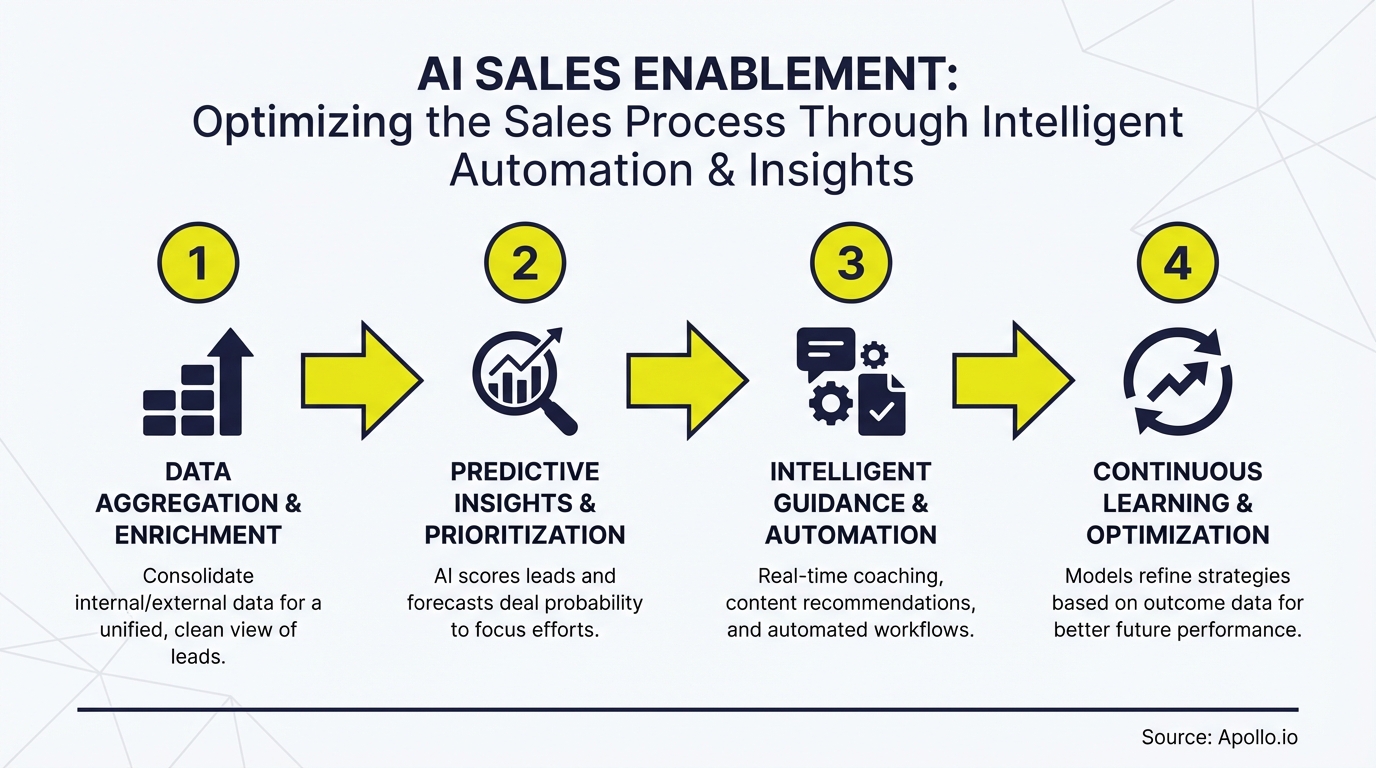
AI sales enablement is the practice of using artificial intelligence to equip sales teams with the right content, data, coaching, and workflows at the right moment in the selling process. It goes beyond tool adoption: the highest-performing programs build an operating model first, then layer in technology.
The market is moving fast. According to Grand View Research, the global AI in sales market was estimated at USD 24.64 billion in 2024 and is projected to reach USD 145.12 billion by 2033, growing at a CAGR of 22.2%. Teams that treat AI as a plug-in rather than a structural change will be left behind.

Research Less, Close More With Apollo
Tired of your reps burning hours on manual lead research instead of selling? Apollo surfaces verified contacts instantly so your team spends time closing, not digging. Join 550K+ companies building pipeline faster.
Start Free with Apollo →Key Takeaways
- AI sales enablement combines data, content intelligence, coaching, and automation into a unified GTM operating model.
- AI adoption in sales surged from 24% in 2023 to 43% in 2024, with approximately 75% of sales organizations expected to use AI-powered tools by 2026.
- The biggest gap is not tool access but cross-functional alignment: nearly half of CSOs say sales and marketing define a qualified lead differently.
- Governance and KPI frameworks determine whether AI investments produce measurable revenue outcomes or just activity metrics.
- Platform consolidation reduces operational drag and lets AI work across the full selling motion, from prospecting to deal close.
What AI Sales Enablement Is (and Is Not)
AI sales enablement IS: a system that continuously delivers accurate data, on-brand content, personalized coaching, and automated workflows to help sellers engage the right buyers at the right time.
AI sales enablement IS NOT: simply adding a generative AI writing tool to your existing stack, automating email blasts, or replacing human judgment with algorithms. Governance, alignment, and measurement still require human ownership.
| Capability | What AI Handles | What Humans Own |
|---|---|---|
| Prospecting | ICP scoring, contact enrichment, signal detection | Target account strategy, relationship judgment |
| Content | Personalization at scale, asset recommendations | Brand voice, approval, compliance review |
| Coaching | Call analysis, talk-track scoring, skill gaps | Manager feedback, career development |
| Pipeline | Deal health scoring, next-step suggestions | Negotiation, executive relationships |
| Governance | Usage logging, anomaly flagging | Policy setting, audit review, risk decisions |
Why AI Sales Enablement Matters Now
HubSpot reports that AI adoption in sales surged from 24% in 2023 to 43% in 2024. Meanwhile, Cubeo AI projects approximately 75% of sales organizations will use AI-powered tools by 2026. The window for competitive differentiation through AI is narrowing.
The shift is also structural. Major platform vendors shipped significant AI capabilities in early 2026, with enablement suites moving AI from supplementary insights into core workflow execution.
The market is transitioning from individual AI tools to interconnected agent ecosystems. Revenue leaders who delay building governance and measurement frameworks now will face much harder retrofits later.
For teams focused on sales performance management, AI enablement is becoming the primary lever for hitting quota at scale.

The AI Sales Enablement Maturity Model
Most organizations progress through three stages. Understanding your current stage determines which investments will have the most immediate impact.
| Stage | Description | Primary Focus | Key Risk |
|---|---|---|---|
| Stage 1: Light | AI used in isolated tools (email drafting, basic enrichment) | Reduce manual tasks, improve data quality | Shadow AI, inconsistent brand voice |
| Stage 2: Embedded | AI integrated into CRM and engagement workflows | Personalization at scale, pipeline visibility | Data silos, poor adoption by reps |
| Stage 3: Systemic | AI orchestrates plays, coaching, and cross-functional handoffs | Revenue outcomes, ramp time reduction, governance | Over-automation, compliance exposure |
Most teams with 12+ months of AI tooling are operating at Stage 2. Moving to Stage 3 requires a defined operating model: clear data taxonomy, approved content libraries, documented handoff SLAs between marketing and sales, and audit-ready governance.
Cross-Functional Alignment: The Hidden Blocker
Tools alone cannot fix misalignment. Gartner surveyed 243 senior sales leaders and found that 49% said their organization's definition of a qualified lead differs greatly from marketing's definition.
AI systems fed inconsistent lead definitions produce inconsistent results.
Before deploying AI at scale, align on three definitions in writing:
- ICP criteria: firmographic and behavioral thresholds that qualify an account for outreach
- Lead stages: agreed MQL, SQL, and SAL definitions with measurable criteria
- Handoff SLAs: time-to-contact windows, follow-up sequences, and feedback loop cadence
Once these are documented, AI can enforce them systematically, flagging leads that miss criteria, routing records by score, and triggering follow-up sequences automatically. Without documentation, AI accelerates misalignment rather than eliminating it.
"The moment we select someone in our database, they're instantly added to a sequence and we can take action right away. We're effective and efficient with our outreach."
Turn Blind Forecasts Into Pipeline Clarity
Pipeline forecasting a guessing game because your deal data is always a step behind? Apollo surfaces real-time buyer signals so your team knows exactly where to focus. Join 550K+ companies building predictable pipeline.
Schedule a Demo →KPIs That Prove AI Enablement Is Working
Activity metrics (emails sent, calls logged) measure effort. Revenue teams need outcome metrics that connect AI investment to pipeline and quota attainment.
Use this framework as your baseline measurement layer.
| KPI Category | Metric | Why It Matters |
|---|---|---|
| Productivity | Selling time as % of total work hours | AI should shift time from admin to revenue activities |
| Pipeline Quality | SQL-to-opportunity conversion rate | Better AI scoring improves downstream conversion |
| Ramp Time | Days to first closed deal (new hires) | AI coaching accelerates rep readiness |
| Content Effectiveness | Content-influenced pipeline by asset | Measures which AI-assisted assets actually drive deals |
| Engagement | Reply rate and meeting conversion rate | Validates personalization quality from AI-assisted outreach |
| Revenue Impact | Win rate, average deal size, quota attainment | Connects enablement investment to business outcomes |
Revenue organizations that adopted AI in 2024 reported 29% higher growth rates than those that did not. Establish baseline measurements before deployment so you can attribute improvement accurately.
Want to see pipeline impact in real time? Apollo's AI-powered pipeline builder connects prospecting data directly to your sales sequences so every qualified contact moves into action immediately.
Content Governance: Protecting Brand and Compliance at Scale
AI-generated content scales fast, which means brand and compliance risks scale equally fast without guardrails. A content governance framework for AI-assisted selling should include:
- Approved prompt library: standardized prompts for common use cases (cold outreach, follow-up, objection handling) reviewed by marketing and legal
- Content taxonomy: a structured library of approved claims, competitive positioning, and product messaging that AI can draw from
- Review tiers: auto-publish thresholds for low-risk content (internal notes), human-review requirements for customer-facing assets
- Audit trails: logs of who generated, approved, and sent each AI-assisted asset
As AI agents gain the ability to execute workflows autonomously, governance moves from optional to a core buying criterion. Teams building governance infrastructure now will have a significant advantage when evaluating more autonomous AI capabilities.
For a broader view of how sales automation software fits into a governed enablement framework, see Apollo's detailed breakdown of automation categories and use cases.

How Apollo Powers AI Sales Enablement
Apollo is a unified go-to-market platform that consolidates prospecting, engagement, conversation intelligence, and pipeline management in one workspace. Instead of stitching together separate tools for data, sequences, and call recording, teams can run their entire AI-enabled selling motion from a single platform.
"With this kind of AI system, my BDRs can send 10x more personalized emails. Their productivity and growth has skyrocketed."
Apollo's AI capabilities span the full selling workflow:
- AI-assisted prospecting: score and filter contacts from 224M+ verified records using 65+ filters and intent signals
- Automated sequences: multi-channel outreach across email, phone, and social with AI-generated personalization
- AI call assistant: real-time conversation intelligence with auto-transcription, next-step recommendations, and coaching insights
- Data enrichment: automatic CRM enrichment so contact and account records stay current without manual maintenance
- Workflow automation: trigger-based plays that enroll contacts, route leads, and notify reps based on behavior signals
Spending too much time on manual research before every outreach call? Apollo's sales engagement platform automates personalized multi-channel sequences so your team spends time selling, not preparing.
To compare Apollo against other options in a structured way, see which AI sales tools actually close more deals and how to evaluate them for your specific use case.
Implementation: A Phased Approach
Successful AI sales enablement follows a deliberate sequence. Rushing to automation before foundations are in place is the most common cause of failed rollouts.
- Weeks 1-4: Foundation. Audit CRM data quality. Document ICP, lead definitions, and handoff SLAs. Identify the two or three highest-friction workflows to target first.
- Weeks 5-8: Pilot. Deploy AI in a single workflow (prospecting or outreach personalization). Measure baseline KPIs before and after. Train a small rep cohort.
- Weeks 9-16: Expand. Roll out to the full team based on pilot results. Build approved prompt libraries and content taxonomy. Connect AI outputs to CRM for tracking.
- Ongoing: Govern and optimize. Review KPIs monthly. Audit AI-generated content quarterly. Update prompts and workflows as products and messaging evolve.
Change management is non-negotiable at each phase. Reps who understand how AI improves their quota attainment adopt it.
Reps who feel surveilled or replaced resist it. Frame every AI capability in terms of what it does for the rep, not for management reporting.
For a deeper look at building the full supporting infrastructure, see how to build a sales tech stack that scales revenue.
Conclusion: Build the Operating Model, Then Scale the Tools
AI sales enablement is not a tool category. It is an operating model that uses AI to make every stage of the selling process faster, smarter, and more consistent.
The teams winning in 2026 are not the ones with the most AI tools. They are the ones with clear data governance, aligned definitions, measurable KPIs, and a unified platform that eliminates the gaps between prospecting, engagement, and deal execution.
Apollo gives sales teams everything they need in one workspace: verified data, AI-powered sequences, conversation intelligence, and pipeline management. No stitching.
No data silos. Just a faster path from prospect to revenue.
Ready to put AI to work across your entire sales motion? Get Leads Now and see why 550K+ companies use Apollo to power their go-to-market strategy.
Prove Pipeline ROI With Apollo
Budget approval stuck on unclear metrics? Apollo delivers measurable pipeline impact your leadership can act on. Leadium 3x'd their annual revenue — see your ROI from day one.
Start Free with Apollo →Don't miss these
Sales
Inbound vs Outbound Marketing: Which Strategy Wins?
Sales
What Is a Sales Funnel? The Non-Linear Revenue Framework for 2026
Sales
What Is a Go-to-Market Strategy? The 2026 GTM Playbook
See Apollo in action
We'd love to show how Apollo can help you sell better.
By submitting this form, you will receive information, tips, and promotions from Apollo. To learn more, see our Privacy Statement.
4.7/5 based on 9,690 reviews
