
What Is ACV in Sales? Definition, Formula, and Growth Strategies for 2026
Annual Contract Value (ACV) is one of the most important metrics in B2B sales, yet it's frequently misunderstood or miscalculated. For subscription and SaaS businesses, ACV directly determines how you segment customers, forecast revenue, set quotas, and prioritize deals.
Get it wrong and your entire go-to-market strategy drifts off course.
The stakes are rising. According to Martal, the median ACV across private SaaS companies reached $26.3K in 2025, up from prior-year levels. Meanwhile, ACV attainment is bifurcating: mid-market and key accounts are hitting new contract value highs, while sub-$50K deals are stalling. Knowing where your ACV strategy fits in this landscape is now a competitive necessity.

Research Less, Pipeline More With Apollo
Tired of your reps burning hours on manual lead research instead of closing deals? Apollo surfaces verified contacts instantly so your team spends time selling, not searching. Join 550K+ companies building predictable pipeline.
Start Free with Apollo →Key Takeaways
- ACV measures the annualized revenue from a single contract, excluding one-time fees.
- ACV differs from ARR (portfolio-wide) and TCV (total contract value including all years and one-time fees).
- Disciplined discounting matters: SaaS companies lose an average of 18% of ACV to discounts.
- Longer sales cycles and multi-stakeholder buying committees are now the norm for higher-ACV deals.
- Retention-first strategies directly protect and grow ACV over time through expansion revenue.
What Does ACV Mean in Sales?
ACV (Annual Contract Value) is the average annualized revenue generated by a single customer contract. It normalizes multi-year or irregular deals into a consistent annual figure, making it easier to compare deal sizes, set quotas, and model revenue.
ACV is not: total contract value, one-time implementation fees, or a portfolio-wide metric. It measures one contract, annualized.
| Metric | What It Measures | Includes One-Time Fees? | Scope |
|---|---|---|---|
| ACV | Annualized value of one contract | No | Single contract |
| ARR | Total annualized recurring revenue | No | Entire customer base |
| TCV | Full value of a contract across its entire term | Yes | Single contract, all years |
| MRR | Monthly recurring revenue | No | Entire customer base |
How Do You Calculate ACV in Sales?
The ACV formula is straightforward: divide the total contract value (excluding one-time fees) by the number of years in the contract.
ACV Formula:
ACV = (Total Contract Value – One-Time Fees) ÷ Contract Length in Years
Example: A 3-year contract worth $150,000 with a $15,000 implementation fee has an ACV of ($150,000 – $15,000) ÷ 3 = $45,000.
For month-to-month contracts, multiply the monthly recurring fee by 12. For multi-tier contracts with annual price escalators, calculate the average annual value across all contract years.
One critical watch-out: SalesHive reports that SaaS companies lose an average of 18% of their ACV to discounts. That's a significant revenue leak that disciplined, value-based selling can close. Tracking discounted ACV versus list ACV separately gives revenue operations teams a cleaner picture of pricing health. Learn how to build stronger sales analytics frameworks to catch these gaps early.
Why ACV Matters More Than Ever in 2026
ACV isn't just a reporting metric. It's a strategic lever that shapes your entire go-to-market motion.
- Quota setting: ACV benchmarks determine realistic rep targets. Bridge Group's 2024 data shows the median SaaS AE annual ACV quota reached $800K, reflecting continued productivity pressure.
- Retention modeling: SaaS Capital research found that companies with the highest Net Revenue Retention have median growth rates 83% higher than the population median. Protecting ACV at renewal is a growth strategy, not just a defense play.
- Segmentation:Pavilion's B2B SaaS benchmarks recommend a New CAC Ratio goal of $1.50 or lower for companies with ACV above $10K, meaning efficiency expectations tighten as deal sizes grow.
- Deal prioritization: ACV segmentation helps sales leaders allocate rep time toward accounts with the highest revenue potential and lowest churn risk.
"Now we know exactly what we want to say and who we want to say it to. It's just a matter of going into Apollo and making it happen."
The New ACV Sales Environment: Longer Cycles, More Stakeholders
Higher ACV deals come with compounding complexity. According to Everstage, the average mid-market B2B sales cycle lengthened to 6.2 months in 2024, with enterprise cycles extending 7–9 months depending on deal size. That's a significant runway where deals can stall, competitors can enter, and budgets can shift.
Forrester's 2025 Buyers' Journey Survey found that 73% of purchases now involve 3 or more departments, with an average of 13 internal stakeholders participating in the buying decision. For ACV sales teams, this means winning one champion is no longer enough.
What this requires in practice:
- Multi-threading: Map and engage multiple stakeholders across finance, IT, legal, and business units simultaneously.
- Role-specific proof packs: CFOs need ROI models. Security teams need compliance documentation. Procurement needs pricing flexibility analysis. One pitch doesn't serve all.
- Mutual action plans: Shared timelines with defined milestones keep large buying groups aligned and reduce cycle drift.
For high-ACV enterprise deals, read the full playbook on breaking into enterprise accounts and closing mega deals.
Struggling to identify and reach the right stakeholders across large accounts? Search Apollo's 224M+ contacts with 65+ filters to find every decision-maker in your target accounts.

ACV Sales Best Practices for 2026
1. Qualify on Fit, Not Just Budget
ACV growth comes from landing accounts where your solution delivers outsized value, not just accounts that can afford you. Use sales analytics to identify which customer profiles renew, expand, and refer. Build your ICP around retention data, not just initial deal size.
2. Protect ACV from Discount Erosion
Discounting is the fastest way to compress ACV and set bad renewal anchors. Train reps on value-based selling and require deal desk approval for discounts above a defined threshold.
Track discounted ACV as a separate KPI so leadership can see the true cost of pricing concessions.
3. Build Self-Serve Proof Assets
A Gartner survey found that 61% of B2B buyers prefer a rep-free buying experience, and 73% actively avoid suppliers sending irrelevant outreach. Your content and sales assets need to do pre-sales work before a rep ever enters the conversation. ROI calculators, case studies segmented by use case, and deployment guides reduce friction for self-directed evaluators.
4. Tie Expansion to ACV Growth
New logo ACV is only one growth lever. Expansion ACV from upsells, seat additions, and usage increases can grow your revenue base without adding CAC.
SaaS Capital research shows that improving NRR from the 90–100% range to 100–110% improves median growth rates by 5 percentage points. Build expansion plays into your post-sale customer success motion from day one.
5. Use Intent Signals to Focus Prospecting
For higher-ACV deals, wasted cycles are expensive. Intent-based targeting helps teams focus effort on accounts actively evaluating solutions in your category, shortening time-to-pipeline and improving qualification rates. Connect intent data to your sales pipeline to prioritize the accounts most likely to convert at your target ACV.
"A lot of deals at the enterprise level are driven through outbound. Apollo has been huge in helping us to get our foot in the door with those accounts."
Turn Blind Forecasts Into Pipeline Clarity
Pipeline forecasting a guessing game because deal stages shift without warning? Apollo's real-time signals show exactly where opportunities stand — so your team acts before deals go cold. Join 90K paying customers forecasting with confidence.
Schedule a Demo →Key ACV Sales KPIs to Track
| KPI | What It Tells You | Why It Matters for ACV |
|---|---|---|
| Average ACV | Mean contract value across new deals | Benchmark for quota and segmentation |
| ACV Win Rate | % of qualified opportunities closed | Measures sales effectiveness at target deal size |
| Discounted ACV Rate | % of list price given away in discounts | Tracks pricing discipline |
| Expansion ACV | Annualized value added from upsells/renewals | Measures growth from existing customers |
| ACV CAC Ratio | Cost to acquire $1 of new ACV | Efficiency signal for GTM investment |
| Sales Cycle Length by ACV Tier | Days from opportunity to close, segmented | Identifies where deals stall by deal size |
For a complete list of metrics to monitor across your revenue function, see What Sales KPIs Should You Track in 2026?
How to Handle ACV Sales Objections and Long Cycles
Long ACV sales cycles create more opportunities for objections to accumulate. The most common blockers: budget justification, multi-stakeholder consensus, and competitive pressure at renewal.
- Budget objections: Anchor conversations to business outcomes and quantified ROI, not feature lists. Use customer case studies with specific results to validate investment.
- Consensus delays: Proactively map the buying committee early. Offer to facilitate internal presentations with role-specific materials for each stakeholder group.
- Competitive pressure: Differentiate on implementation support, retention outcomes, and total cost of ownership rather than point-in-time feature comparisons.
For a practical framework, see How Do You Handle Sales Objections in 2026? and explore high-ticket sales closing strategies for additional tactics at larger deal sizes.
Conclusion: ACV Is a Strategy, Not Just a Number
ACV in sales is the foundation for quota design, customer segmentation, retention strategy, and revenue forecasting. In 2026, with sales cycles lengthening, buying committees expanding, and acquisition costs rising, teams that treat ACV as a strategic metric rather than a reporting field will outperform those that don't.
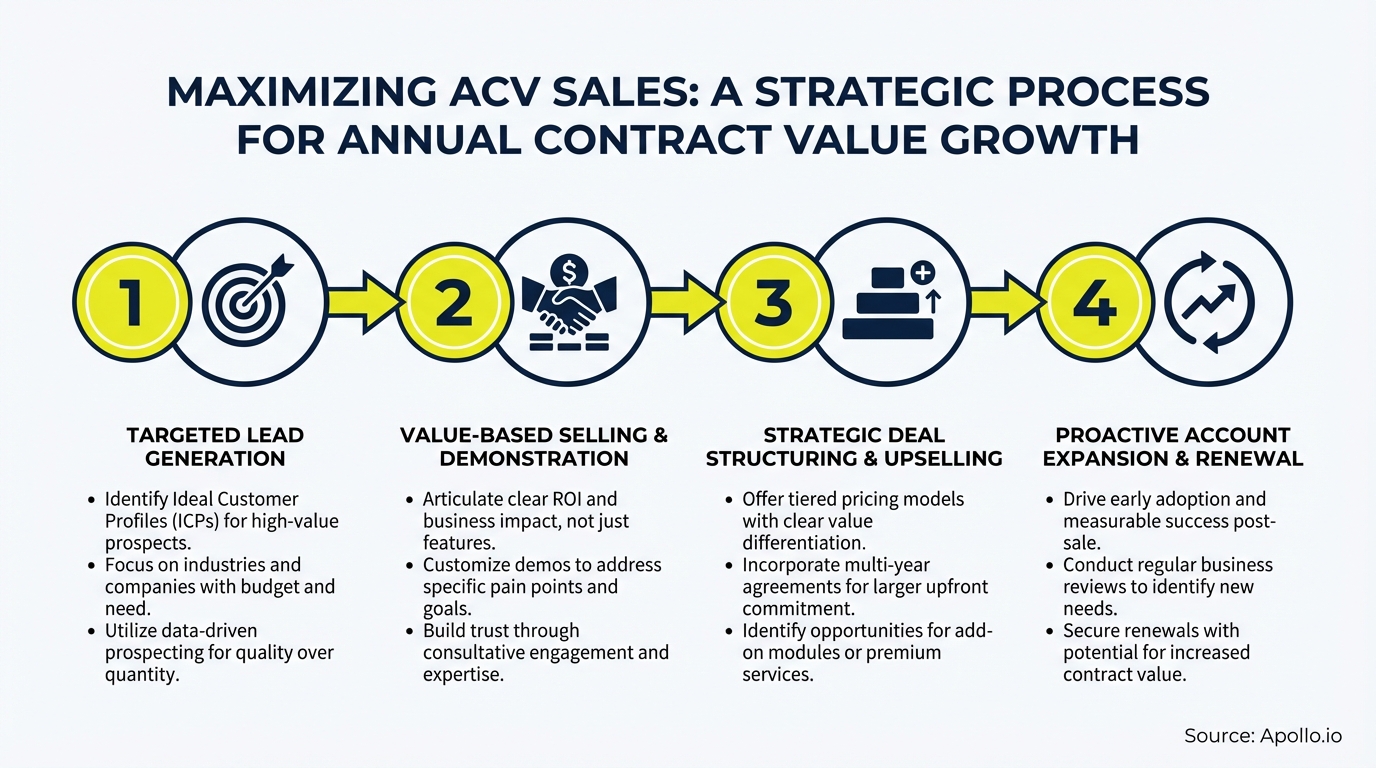
The best ACV growth strategies combine precise account targeting, disciplined pricing, multi-stakeholder enablement, and a retention-first mindset that turns initial contract value into durable, expanding revenue. Tools that unify your prospecting, engagement, and pipeline data in one place remove the friction that kills high-ACV deals.
Start Free with Apollo and build the pipeline, data, and engagement workflows your ACV strategy requires, all in one platform.
Prove Pipeline ROI With Apollo
Budget approval stuck because you can't quantify pipeline impact? Apollo gives sales teams measurable wins fast — so you justify the investment with real results. Leadium 3x'd annual revenue. Start yours today.
Start Free with Apollo →Don't miss these
Sales
Inbound vs Outbound Marketing: Which Strategy Wins?
Sales
What Is a Sales Funnel? The Non-Linear Revenue Framework for 2026
Sales
What Is a Go-to-Market Strategy? The 2026 GTM Playbook
See Apollo in action
We'd love to show how Apollo can help you sell better.
By submitting this form, you will receive information, tips, and promotions from Apollo. To learn more, see our Privacy Statement.
4.7/5 based on 9,690 reviews
