
Virtual Sales Assistant: How AI Tools Transform Your Sales Process
Sales teams in 2026 face mounting pressure to hit quotas while managing data entry, prospect research, and follow-up sequences. Virtual sales assistants now handle these repetitive tasks, freeing reps to focus on high-value conversations. Research by the World Economic Forum shows companies utilizing virtual sales assistants have observed a 25% reduction in customer acquisition costs.

Apollo Eliminates 4+ Hours Of Daily Research
Tired of spending 4+ hours daily hunting for contact info? Apollo delivers 224M verified contacts instantly so your reps can focus on closing. Join 550K+ companies saving time and hitting quota.
Start Free with Apollo →Key Takeaways
- Virtual sales assistants automate prospecting, data enrichment, and outreach, saving reps 15+ hours per week
- AI-powered assistants increase lead conversion rates by 30% through intelligent routing and personalization
- Modern platforms consolidate 3-5 tools into one workspace, cutting tech costs in half
- SDRs using virtual assistants book 46% more meetings with AI-powered research and messaging
- Implementation takes 6-8 weeks with proper CRM integration and team training
What Is a Virtual Sales Assistant?
A virtual sales assistant is an AI-powered platform that automates repetitive sales tasks including prospect research, data enrichment, outreach sequencing, and meeting scheduling. Unlike human assistants, these systems operate 24/7 across your entire sales workflow, handling everything from contact discovery to follow-up tracking.
Virtual sales assistants differ from basic automation tools by combining multiple capabilities in one platform. They search databases, verify contact information, personalize messages, schedule meetings, and track engagement without requiring manual intervention. Modern AI sales automation platforms integrate directly with your CRM to maintain clean, actionable data.
According to the Global Cold Chain Alliance, the integration of AI-powered virtual assistants in B2B sales processes has led to a 30% increase in lead conversion rates.
This performance gain comes from intelligent lead scoring, optimal send-time prediction, and dynamic message personalization.
How Do Virtual Sales Assistants Work?
Virtual sales assistants connect to your existing sales infrastructure through API integrations with your CRM, email provider, and communication tools. They pull data from multiple sources to build comprehensive prospect profiles, then execute predefined workflows based on triggers and conditions you set.
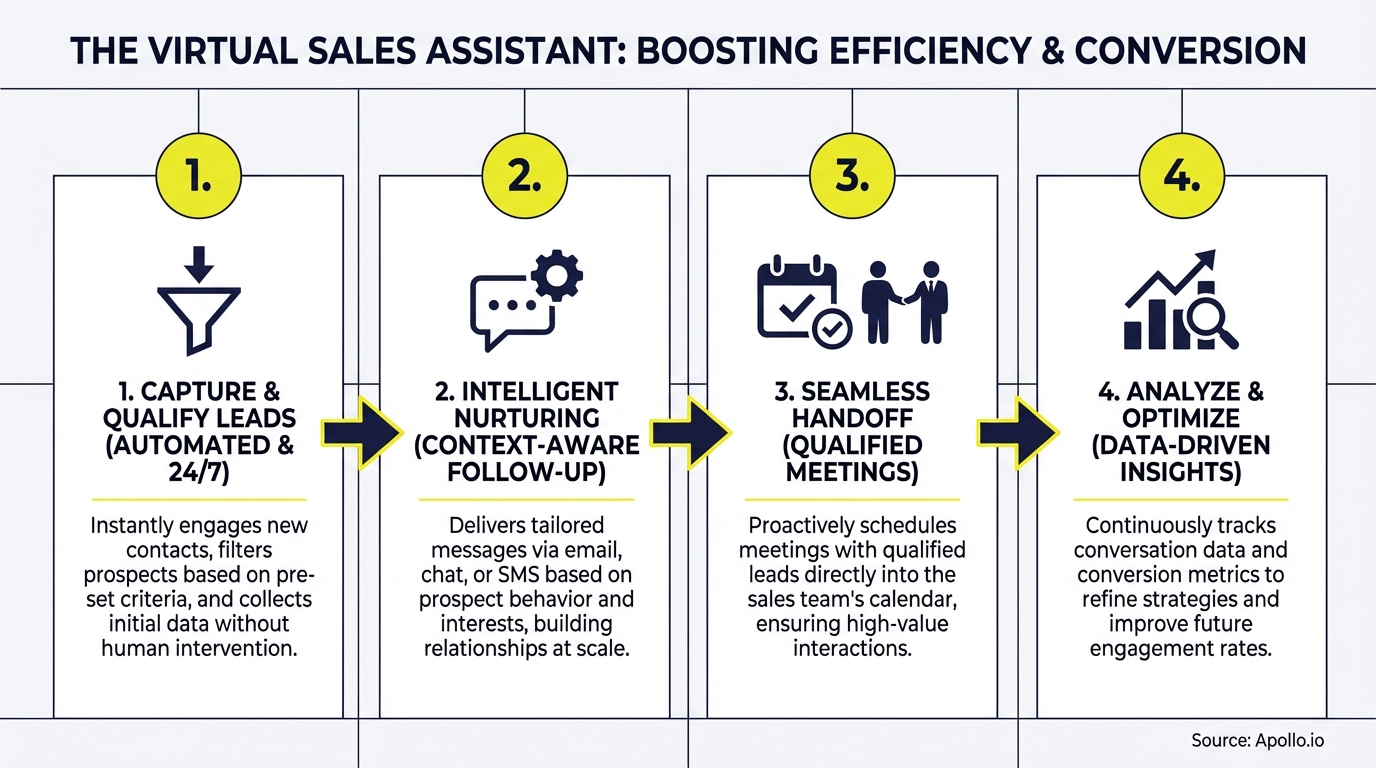
The workflow typically follows this pattern:
- Prospect Identification: Search 224M+ business contacts using 65+ filters for job title, company size, industry, and technology usage
- Data Enrichment: Automatically append verified phone numbers, email addresses, and company intelligence to each record
- Outreach Sequencing: Send personalized emails, LinkedIn messages, and calls across multiple touchpoints
- Meeting Coordination: Schedule demos directly on rep calendars when prospects respond
- Activity Tracking: Log all interactions in your CRM with engagement metrics and next-step recommendations
Struggling to keep your pipeline full? Search Apollo's 224M+ verified contacts with 65+ filters to find your ideal buyers.
How Do SDRs Use Virtual Sales Assistants?
SDRs using virtual sales assistants focus on conversations instead of data work. The assistant handles prospect research, contact verification, and initial outreach sequences, allowing SDRs to jump in when prospects show buying signals.
A typical SDR workflow with virtual assistants looks like this:
| Task | Without Assistant | With Assistant |
|---|---|---|
| Prospect Research | 2-3 hours daily | 15 minutes reviewing AI insights |
| Data Entry | 1-2 hours daily | Automated sync to CRM |
| Email Sequences | 1 hour daily | AI-generated, rep-approved |
| Follow-up Tracking | 30-60 minutes daily | Automatic reminders and scheduling |
SDRs report booking 46% more meetings when using AI call assistants that provide real-time prospect intelligence during conversations. The system surfaces recent company news, mutual connections, and conversation starters before each call.
What Are the Key Benefits for Sales Teams?
Sales teams implementing virtual assistants see immediate productivity gains and cost savings. The primary benefits include consolidated tech stacks, automated busywork, and data-driven personalization at scale.
Tool Consolidation: Replace separate prospecting, enrichment, sequencing, and dialer tools with one unified platform. Census cut their costs in half by consolidating their sales stack. Cyera found that having everything in one system was a game changer for team adoption.
Time Savings: Reps save 15-20 hours per week on manual tasks. Predictable Revenue reduced the complexity of three tools into one, allowing their team to focus on revenue-generating activities instead of platform management.

Revenue Impact: Companies see 35% increases in bookings through AI-powered messaging that adapts to prospect behavior. AI sales tools analyze winning message patterns and automatically optimize send times, subject lines, and call-to-action placement.
Turn Forecast Chaos Into Revenue Certainty
Pipeline forecasting a guessing game? Apollo delivers real-time deal visibility and AI-powered insights so you can forecast with confidence. Built-In boosted win rates 10% with Apollo's signals.
Start Free with Apollo →How Do You Implement a Virtual Sales Assistant?
Implementation follows a structured 6-8 week process covering integration, workflow design, team training, and optimization. Success requires executive sponsorship, clear success metrics, and dedicated change management resources.
Week 1-2: Integration & Data Migration
- Connect CRM, email, and calendar systems via API
- Import existing contact lists and deduplicate records
- Map custom fields and establish data governance rules
- Set up user permissions and team hierarchies
Week 3-4: Workflow Configuration
- Design outreach sequences for different buyer personas
- Create email templates with personalization variables
- Configure lead scoring and routing logic
- Establish meeting scheduling rules and calendar availability
Week 5-6: Team Training & Pilot
- Conduct role-specific training for SDRs, AEs, and managers
- Launch pilot with 5-10 reps on controlled campaigns
- Gather feedback and refine workflows
- Document best practices and create enablement materials
Week 7-8: Full Rollout & Optimization
- Expand to entire sales team with staged deployment
- Monitor adoption metrics and provide ongoing coaching
- A/B test messaging, timing, and channel mix
- Establish weekly reviews to analyze performance data
RevOps leaders implementing virtual assistants should prioritize building a sales tech stack that maintains data quality while reducing integration complexity. Focus on platforms that offer native CRM sync rather than third-party connectors.
What ROI Can Sales Leaders Expect?
Sales leaders tracking ROI measure three primary metrics: cost savings from tool consolidation, productivity gains from time savings, and revenue increases from improved conversion rates. Most teams see positive ROI within 90 days of full implementation.
| Metric | Baseline | With Virtual Assistant | Impact |
|---|---|---|---|
| Tool Costs (per rep/month) | $300-500 | $150-250 | 40-50% reduction |
| Time Spent on Admin | 20-25 hours/week | 5-8 hours/week | 60-70% time savings |
| Meetings Booked (per SDR/month) | 15-20 | 22-29 | 46% increase |
| Lead Conversion Rate | 2-3% | 3.9-4.5% | 30% improvement |
| Customer Acquisition Cost | $500 | $375 | 25% reduction |
For a 10-person sales team, this translates to $18,000-30,000 in annual tool savings, 150-170 additional hours of selling time per rep, and 84-108 more qualified meetings per month. Founders scaling outbound teams find virtual assistants enable faster ramp times and more predictable pipeline generation.
Start Automating Your Sales Workflow in 2026
Virtual sales assistants have evolved from nice-to-have tools to essential infrastructure for competitive sales teams. The combination of AI-powered automation, verified contact data, and unified workflows delivers measurable impact across productivity, costs, and revenue.
The key to success lies in choosing platforms that consolidate multiple tools into one workspace. Teams using fragmented tech stacks waste time switching contexts, managing integrations, and reconciling data conflicts. Modern B2B sales organizations prioritize platforms that handle prospecting, engagement, enrichment, and analytics in a single system.
Ready to cut your tech stack and boost productivity? Start a free trial of Apollo and see how 550K+ companies use virtual sales assistants to replace 3-5 tools while increasing pipeline by 46%.
Show Budget Impact In Days, Not Quarters
Budget approvals stuck on unclear metrics? Apollo tracks every touchpoint from first email to closed deal so you prove ROI instantly. Built-In increased win rates 10% with Apollo's measurable insights.
Start Free with Apollo →Don't miss these
Sales
Inbound vs Outbound Marketing: Which Strategy Wins?
Sales
What Is a Sales Funnel? The Non-Linear Revenue Framework for 2026
Sales
What Is a Go-to-Market Strategy? The 2026 GTM Playbook
See Apollo in action
We'd love to show how Apollo can help you sell better.
By submitting this form, you will receive information, tips, and promotions from Apollo. To learn more, see our Privacy Statement.
4.7/5 based on 9,690 reviews
