
Types of Sales: Definition, Methods, and Strategies That Work
Sales has evolved far beyond cold calling and door-to-door pitches. In 2026, buyers expect seamless digital experiences, AI-powered personalization, and human connection at critical moments. Understanding the different types of sales helps SDRs, AEs, and sales leaders build strategies that match how modern buyers actually want to buy. B2B sales teams now blend technology with relationship-building to close deals faster.

Apollo Eliminates 4+ Hours Of Daily Research
Tired of spending hours hunting for verified contact info? Apollo delivers 224M+ contacts with 96% email accuracy—instantly. Join 550K+ companies who replaced manual prospecting with predictable pipeline.
Start Free with Apollo →Key Takeaways
- Sales types range from transactional inside sales to complex enterprise deals requiring executive access
- Digital self-service now accounts for 34% of B2B revenue, with AI transforming how buyers research and purchase
- SDRs and AEs who combine human touch with data-driven prospecting book 46% more meetings
- The most successful teams consolidate tools into one platform to cut costs and improve efficiency
- By 2030, 75% of buyers will prefer human interaction at key decision points despite AI adoption
What Are the Main Types of Sales?
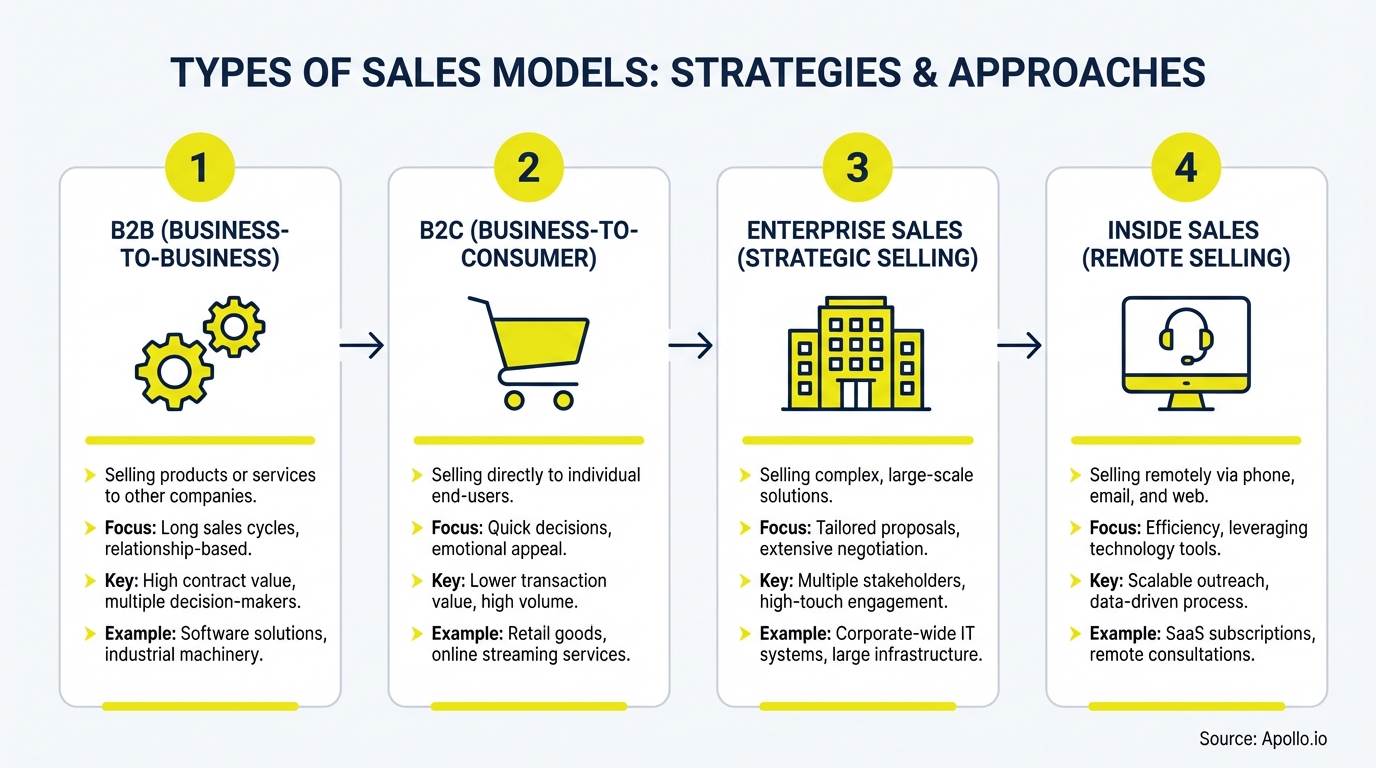
Sales types are distinct approaches to selling based on deal complexity, buyer journey, and engagement model. The main categories include inside sales, outside sales, enterprise sales, channel sales, and digital self-service sales.
Each type requires different skills, tools, and processes. Inside sales teams work remotely using phones and video calls. Outside sales reps meet prospects face-to-face. Enterprise sales involves long cycles with multiple stakeholders. Channel sales leverages partners to reach customers. Digital self-service lets buyers purchase without rep involvement.
Research by McKinsey shows e-commerce became the leading B2B channel in 2024, accounting for 34% of revenue and surpassing in-person sales for the first time.
What Is Inside Sales and Why Does It Matter?
Inside sales is a remote selling approach where reps engage prospects through phone, email, video, and digital channels without in-person meetings. SDRs and BDRs typically handle prospecting and qualification, while inside AEs close deals.

This model dominates modern B2B sales because it's scalable and cost-effective. Teams can reach more prospects faster than field sales. Inside sales teams at companies like HubSpot use data-driven prospecting to book hundreds of meetings monthly.

SDRs using inside sales methods report higher efficiency when they consolidate prospecting, engagement, and pipeline tools into one workspace. "We reduced the complexity of three tools into one," reports Predictable Revenue.
How Does Outside Sales Work in 2026?
Outside sales involves field reps who travel to meet prospects and customers in person. This approach works best for high-value deals, complex solutions, and industries where relationship-building requires face time.
While digital channels have grown, Gartner predicts that by 2030, 75% of B2B buyers will prefer sales experiences prioritizing human interaction over AI, especially for strategic decisions.
Outside sales reps now blend in-person meetings with digital research and follow-up. They use AI tools to prepare for conversations but close deals through personal connection.
The most effective reps use platforms that provide pre-meeting intelligence and automate administrative tasks.
Find Buyers Ready To Close With Apollo
Pipeline forecasting a guessing game? Apollo surfaces in-market prospects with real-time intent signals and visitor tracking. Built-In boosted win rates 10% using Apollo's scoring.
Start Free with Apollo →What Makes Enterprise Sales Different?
Enterprise sales targets large organizations with deals typically exceeding $100K and involving 6-10 decision-makers. Sales cycles range from 6-18 months and require executive access, custom solutions, and proof of ROI.
Account Executives managing enterprise deals need deep product knowledge, business acumen, and relationship management skills. Successful enterprise sellers map organizational structures, identify champions, and navigate procurement processes.
RevOps teams supporting enterprise sales consolidate data across systems to provide AEs with account intelligence. "Having everything in one system was a game changer," reports Cyera's sales team after moving to a unified platform.
Struggling to track complex enterprise deals? Get complete pipeline visibility with Apollo's deal management platform.
How Do SDRs Use Digital Self-Service Sales?
Digital self-service sales enables buyers to research, evaluate, and purchase without speaking to a rep. This model now processes over half of large B2B transactions above $1M, according to Forrester research.
SDRs support self-service buyers by creating helpful content, optimizing product pages, and engaging prospects who show buying intent. The best teams monitor digital signals and reach out at the right moment with personalized value.
Modern sales development teams blend automated nurture sequences with human touchpoints. They let buyers control their journey while staying available to answer questions and accelerate decisions.
What Sales Tools Help Teams Close More Deals?
Sales teams in 2026 need integrated platforms that combine prospecting, engagement, intelligence, and analytics. The best tools eliminate busywork so reps focus on conversations that matter.
Key capabilities include:
- Verified contact databases with 224M+ business profiles
- Multi-channel engagement across email, phone, and social
- AI-powered research agents that surface buyer insights
- Conversation intelligence that captures action items
- Pipeline tracking that forecasts revenue accurately
Sales Leaders building tech stacks should prioritize consolidation. "We cut our costs in half" by moving from multiple tools to one platform, reports Census. Modern sales tech stacks reduce complexity while improving team performance.
Tired of juggling 5+ sales tools? Consolidate your tech stack with Apollo's all-in-one GTM platform.
Conclusion: Choose the Right Sales Approach for Your Market
The most effective sales strategy combines multiple types based on your product, market, and buyer preferences. Inside sales works for scalable outreach.
Outside sales builds deep relationships. Enterprise sales handles complex deals.
Digital self-service meets modern buyer expectations.
Successful teams in 2026 use data to determine which approach fits each opportunity. They equip reps with integrated tools that eliminate context-switching and surface the insights needed to close deals faster. AI-powered platforms now deliver 10x sales effectiveness by automating research and personalizing outreach at scale.
Whether you're an SDR booking meetings, an AE closing enterprise deals, or a sales leader building a high-performing team, the right combination of sales types and technology determines your success. Start by understanding your buyers' preferences, then build processes that match how they want to buy.
Ready to transform your sales approach? Start a free trial and discover how Apollo's unified platform helps teams prospect smarter, engage faster, and close more deals.
Prove Apollo's ROI In Your First 30 Days
Budget approval stuck on unclear metrics? Apollo tracks every touchpoint from prospect to closed deal—quantifying time saved, pipeline impact, and win rate lift. Built-In increased win rates 10% and ACV 10% using Apollo's scoring.
Start Free with Apollo →Don't miss these
Sales
Inbound vs Outbound Marketing: Which Strategy Wins?
Sales
What Is a Sales Funnel? The Non-Linear Revenue Framework for 2026
Sales
What Is a Go-to-Market Strategy? The 2026 GTM Playbook
See Apollo in action
We'd love to show how Apollo can help you sell better.
By submitting this form, you will receive information, tips, and promotions from Apollo. To learn more, see our Privacy Statement.
4.7/5 based on 9,690 reviews
