
How Do Sales Videos Accelerate B2B Buying Decisions in 2026?
Sales videos aren't optional anymore. According to Zebracat, 70% of B2B buyers report that watching a video helped them make a purchasing decision faster. The shift is clear: buyers want self-serve answers before they talk to reps. Your video library is now your most scalable sales asset.
The challenge? Most teams create scattered, promotional videos that don't answer buyer questions.
Instructional, task-specific videos dramatically outperform hype reels. This guide shows you how to build a rep-free video library that accelerates deals, reduces sales cycles, and scales your best reps' knowledge across every prospect.

Apollo Eliminates Hours Of Daily Research
Tired of spending 4+ hours daily hunting for contact info? Apollo delivers 224M verified contacts with 96% email accuracy. Join 550K+ companies who replaced manual research with instant prospecting.
Start Free with Apollo →Key Takeaways
- Task-based videos outperform promotional content: Instructional videos in the 3-5 minute range average 74% engagement vs. 43% for general videos
- Distribution matters more than production: Only 28% of professionals spend more time promoting videos than creating them, creating a massive opportunity gap
- Rep-free buying is the new default: 61% of B2B buyers prefer an overall rep-free experience, making your video library your first sales hire
- B2B marketers who integrate video see revenue growth that is nearly 49% faster compared to those who don't (via Scopic Studios)
- Governance prevents deal delays: Inconsistent claims across videos, website, and reps create trust gaps that kill momentum
What Sales Videos Actually Are (And What They're Not)
Sales videos are task-specific recordings that answer a buyer's question or enable a specific decision without requiring rep time. They ARE instructional tools that replace or enhance human conversations.
They ARE NOT brand awareness content or top-of-funnel entertainment.
The distinction matters because buyers increasingly avoid suppliers who send irrelevant outreach (73% actively avoid them, per Gartner). Your video must answer: "Does this solve my specific problem?" not "Is this company impressive?"
Sales Videos vs. Marketing Videos
| Dimension | Sales Videos | Marketing Videos |
|---|---|---|
| Primary Goal | Answer buyer question, enable decision | Build awareness, generate interest |
| Typical Length | 90 seconds to 5 minutes | 15-60 seconds or 10+ minutes |
| Content Type | Product walkthroughs, pricing logic, implementation paths | Brand stories, customer testimonials, thought leadership |
| Distribution | Email sequences, rep shares, embedded in proposals | Social media, paid ads, website homepage |
| Success Metric | Meeting booked, deal advanced, objection resolved | Views, shares, brand lift |
"The thing that made me most excited as somebody who's been in sales development a long time was Apollo's integration between sales data and sales engagement and the magic that you can make happen when those two are together on the same platform."
The Rep-Free Video Journey Blueprint
Map every buying task to a video. Most teams create videos around what they want to say.
Winning teams create videos around what buyers need to decide. Start by listing every question a buyer asks between first touch and close.
Then prioritize videos that remove the most common bottlenecks.
Priority Video Types by Buying Stage
| Buying Stage | Video Type | Recommended Length | Purpose |
|---|---|---|---|
| Problem Recognition | "Is this my problem?" diagnostic | 90-120 seconds | Help buyer self-identify fit |
| Solution Exploration | Product fit walkthrough | 3-4 minutes | Show how you solve their specific use case |
| Vendor Evaluation | Pricing logic explainer | 2-3 minutes | Justify cost and prevent sticker shock |
| Implementation Planning | Onboarding preview | 4-5 minutes | Reduce perceived risk and timeline concerns |
| Post-Purchase | Quick-start tutorial | 2-3 minutes | Accelerate time-to-value |
Need help identifying high-intent buyers faster? Search Apollo's 224M+ contacts with 65+ filters to find prospects ready for your video content.

Length-by-Use-Case: Data-Driven Video Duration Framework
Shorter isn't always better. The right length depends on the buyer's job-to-be-done.
Instructional videos in the 3-5 minute range average 74% engagement, but only when they match the complexity of the decision.
90-120 seconds: Qualification and fit checks. Use for "Is this relevant to me?" questions. Example: "3 signs you need a sales engagement platform."
2-3 minutes: Feature explanations and objection handling. Use for "How does this work?" questions. Example: "How our dialer improves connect rates."
3-5 minutes: Full product walkthroughs and implementation paths. Use for "Can I actually use this?" questions. Example: "Setting up your first outbound sequence in Apollo."
5+ minutes: Deep-dive enablement for technical buyers or complex integrations. Use sparingly and include chapter markers. Example: "API integration workshop for RevOps teams."
Turn Unreliable Forecasts Into Revenue Clarity
Can't trust your pipeline data because visibility is outdated. Apollo tracks every deal stage in real-time so your forecasts reflect reality. Built-In boosted win rates 10% with Apollo's scoring.
Start Free with Apollo →Distribution and Repurposing: The Overlooked Revenue Driver
Only 28% of professionals spend more time promoting their videos than creating them. This is the single biggest opportunity in sales video.
A great video that reaches 50 people loses to a decent video that reaches 5,000.
Multi-Channel Distribution Playbook
Embed in email sequences: Drop task-specific videos at key sequence steps. Don't attach files (they get blocked). Use GIF thumbnails linking to hosted pages.
Rep-triggered shares: Enable reps to send personalized intros with standardized video content. Record a 15-second "here's why this matters to you" intro, then link to your library video.
Website self-serve paths: Create video-first landing pages for common buyer questions. Example: yoursite.com/pricing-explained with a 2-minute video plus FAQ.
Sales room inclusions: Add relevant videos to your digital sales rooms or mutual action plans. Buyers share these internally; make it easy for them to educate their team.
Struggling with manual outreach workflows? Automate your video-powered sequences with Apollo's engagement platform.
Repurposing Framework
One 5-minute video creates 10+ assets. Clip key 30-second segments for social.
Extract audio for podcast snippets. Turn transcripts into blog posts or email copy.
Build a searchable video library organized by buyer question, not by product feature.
"Apollo could be a third of the cost if you look at the full price of what we were spending on ZoomInfo, Outreach, Salesforce, and admins to make it all work."
Governance Framework: Ensuring Claim Consistency Across Channels
Your video says "90% accuracy." Your website says "industry-leading accuracy." Your rep says "basically perfect data." The buyer sees three different stories and stalls. Governance prevents this.
Central claims registry: Document every quantitative claim (accuracy rates, customer counts, performance benchmarks) in a shared source of truth. Reference this registry in every script.
Quarterly video audits: Review existing videos for outdated stats, deprecated features, or contradictory messaging. Archive or update anything that no longer aligns.
Approval workflow: Require legal and product sign-off on any video making compliance, performance, or competitive claims. This prevents costly takedowns or buyer trust issues.
Version control: Use consistent naming conventions (v1.0, v1.1) and publish dates. When you update a video, redirect old links to the new version to prevent dead ends.
Emerging Video Technologies Reshaping Sales in 2026
Agentic AI is turning sales video into an automated workflow. Tools now trigger video creation and delivery based on buyer actions like demo requests, event attendance, or no-shows.
The shift moves from "recording" to "orchestration."
AI avatars and camera-optional video are becoming acceptable in B2B contexts, especially for follow-up and enablement. Multiple platforms invest in realistic avatars with disclosure and safeguards, aiming to scale personalization without consuming rep recording time.
Sales video performance is increasingly measured like a first-class revenue signal. Teams want video watch data synced to CRM contacts and deals so managers can coach, sequences can branch based on engagement, and attribution can be defended in sales analytics reviews.
Role-Specific Video Playbooks for Maximum Impact
SDRs and BDRs: Create 60-90 second "why this matters to you" videos personalized by industry or role. Send after initial outreach to differentiate from text-only competitors. Track view rates as a leading indicator of interest.
Account Executives: Build a demo follow-up library addressing common objections (pricing, implementation timeline, integration complexity). Send within 2 hours of the call while it's fresh.
Sales Leaders: Use internal enablement videos to scale best practices. Record your top performer's discovery framework as a 4-minute video. New reps ramp faster when they can watch repeatable examples. Learn more about sales productivity strategies that scale.
Customer Success: Create a "getting started" video series for new customers. Reduce support tickets by answering the first 10 questions every customer asks.
Start Your Sales Video Library in 30 Days
Week 1: Audit buyer questions. Interview 5 recent customers and 5 deals you lost. List every question they asked. Prioritize the top 5 that appear in every deal.
Week 2: Script and record. Write tight scripts (aim for 70% of your target length when reading aloud). Record in one batch session. Don't over-edit; authenticity beats polish for sales videos.
Week 3: Build distribution infrastructure.
Set up a video hosting platform with engagement tracking.
Create email templates and sequence steps.
Train reps on when to use each video.
Week 4: Launch and measure. Deploy videos in 3 active deals. Track views, engagement duration, and whether the deal advanced. Iterate based on real buyer behavior, not assumptions.
According to Siege Media, for 93% of B2B buyers, video content is an important way to foster trust. Your video library becomes your always-on trust builder.
Measuring Video ROI: Metrics That Matter for Revenue Teams
Track these metrics to prove video impact:
- View rate: Percentage of recipients who clicked play (benchmark: 45-60% for targeted, rep-sent videos)
- Engagement rate: Percentage of video watched (benchmark: 60%+ completion for sub-3-minute videos)
- Deal velocity: Days to close for deals with video engagement vs. without (target: 20-30% reduction)
- Meeting conversion: Percentage of video viewers who book next steps (benchmark: 25-35% for high-intent videos)
- Content attribution: Deals influenced by video touchpoints (track in CRM as a campaign type)
Integrate video tracking with your deal management platform to connect engagement to revenue outcomes.

Conclusion: Video as Your Scalable Sales Advantage
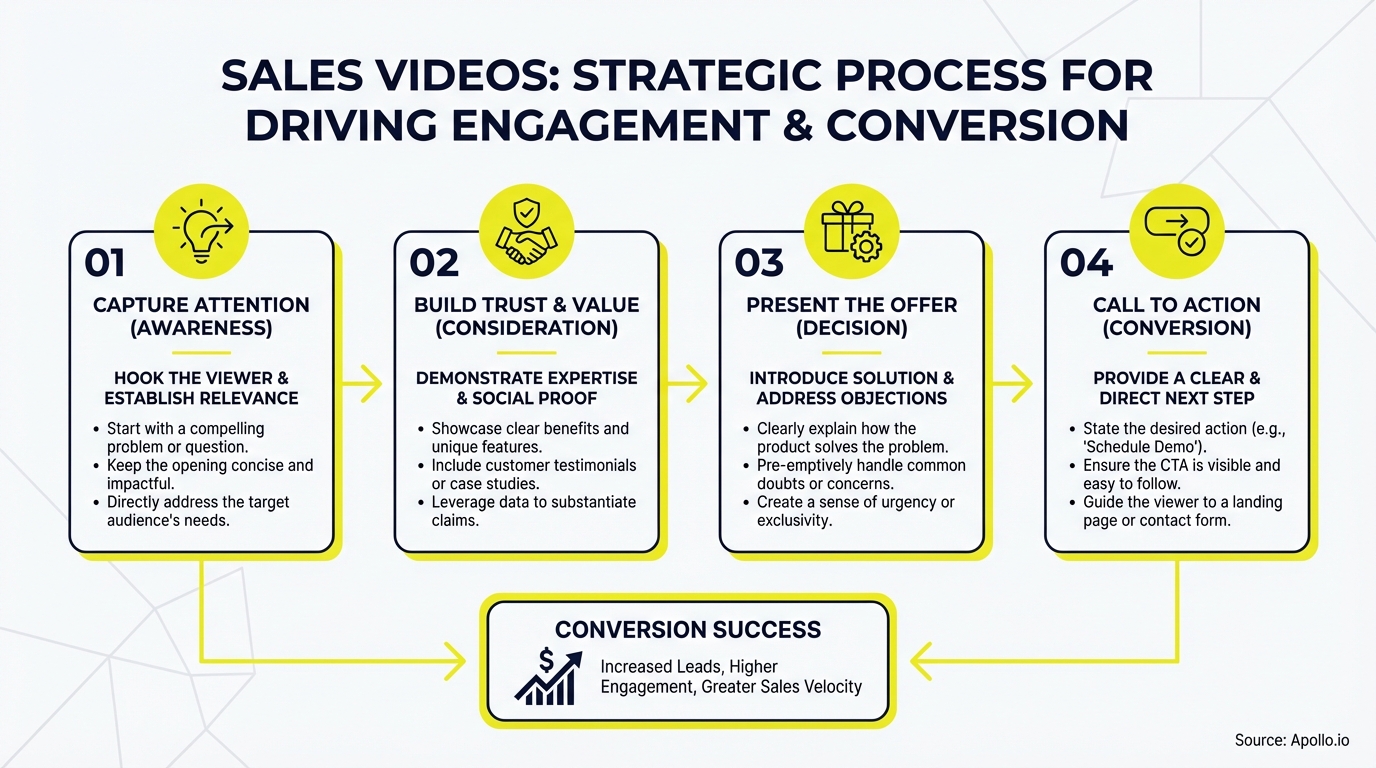
Sales videos aren't a "nice-to-have" content type. They're the most efficient way to answer buyer questions at scale, reduce sales cycles, and enable rep-free buying journeys.
The teams winning in 2026 treat video as core sales infrastructure, not a marketing project.
Start with your top 5 buyer questions. Record task-specific answers.
Distribute them everywhere your prospects look for answers. Measure what drives deals forward.
Iterate based on real engagement data, not intuition.
Your best reps can only talk to one prospect at a time. Your video library talks to thousands simultaneously.
Build it like you'd build your sales team: strategically, with clear goals, and with continuous improvement.
Ready to build a video-powered sales motion? Start a trial with Apollo to connect your video library with prospecting, engagement, and deal tracking in one unified platform.
Prove Apollo's ROI In Your First 30 Days
Budget approval stuck on unclear metrics? Apollo tracks pipeline impact from day one—quantifiable time savings, measurable deal velocity, and real revenue growth. Customer. io achieved 50% YoY growth.
Start Free with Apollo →Don't miss these
Sales
Inbound vs Outbound Marketing: Which Strategy Wins?
Sales
What Is a Sales Funnel? The Non-Linear Revenue Framework for 2026
Sales
What Is a Go-to-Market Strategy? The 2026 GTM Playbook
See Apollo in action
We'd love to show how Apollo can help you sell better.
By submitting this form, you will receive information, tips, and promotions from Apollo. To learn more, see our Privacy Statement.
4.7/5 based on 9,690 reviews
