What Is Sales Transformation and Why Does It Matter in 2026?
Sales transformation is the strategic overhaul of your sales operating model—people, processes, technology, and data—to meet changing buyer expectations and drive revenue growth. In 2026, this means shifting from rep-led pitching to content-led selling, automating admin work, and building AI governance frameworks that scale.
The urgency is real. Buyers now control the journey, AI agents are reshaping workflows, and teams without a clear transformation roadmap risk falling behind.
This guide provides a focused, actionable framework for building a modern sales engine that converts.

Apollo Eliminates 4+ Hours Of Daily Research
Tired of spending 4+ hours daily hunting for contact info? Apollo finds verified emails and mobile numbers instantly with 96% accuracy. Join 500,000+ companies who stopped wasting time on manual research.
Start Free with Apollo →Key Takeaways
- Sales transformation now requires content-led selling frameworks to support the 61% of buyers who prefer rep-free experiences
- AI governance has become a revenue risk-control function, not just a compliance checkbox
- Organizations with strong sales and marketing alignment achieve 208% higher marketing revenue
- Sales automation saves teams an average of 12 hours per week, directly increasing selling time
- Modern transformation focuses on modular content operations, agentic AI workflows, and measurable time-back metrics
What Is Sales Transformation?
Sales transformation is a structural change to how your organization generates, qualifies, and closes revenue. It goes beyond adopting new tools—it's about redesigning workflows, aligning teams, and building systems that support both buyer autonomy and seller productivity.
In 2026, successful transformation programs address three core shifts:
- Buyer control: Modern buyers want self-serve journeys with on-demand content, not gated demos
- Seller productivity: Reps need automation to reclaim time from admin tasks and focus on high-value conversations
- AI integration: GenAI and agentic workflows require governance, QA processes, and clear ROI tracking
According to Brainstorm Club, organizations with strong sales and marketing alignment achieve 208% higher marketing revenue than those with poor alignment. This data point underscores why transformation must be a cross-functional initiative, not a sales-only project.
Why Traditional Sales Models Are Failing
Legacy sales approaches built around cold outreach, generic pitches, and rep-controlled timelines no longer match how buyers evaluate and purchase. The gap between seller behavior and buyer expectations is widening, creating friction that kills pipeline.
Three structural problems are forcing transformation:
- Time waste: Reps spend 70% of their time on non-selling tasks like data entry, research, and admin work
- Content misalignment:Landbase reports that 60%-70% of all created marketing content remains unused, often due to a lack of alignment on content needs between sales and marketing
- Relevance failure: Generic outreach actively destroys pipeline—73% of B2B buyers avoid suppliers who send irrelevant messages
These aren't minor inefficiencies. They're systemic barriers that prevent teams from scaling revenue without proportional headcount increases.
Transformation addresses the root causes, not the symptoms.
The Content-Led Transformation Framework
The modern transformation framework starts with a Rep-Free Journey Content Map—a structured asset library that supports buyers at every stage, whether they engage with reps or not. This approach recognizes that 61% of B2B buyers prefer an overall rep-free buying experience.
Stage 1: Discovery Content
Buyers at this stage are identifying problems and evaluating potential solutions. Your content must educate, not sell.
- Category POVs and thought leadership (ungated)
- Peer comparison frameworks and benchmarks
- Problem-symptom diagnostic tools
- Executive storytelling and vision content
Stage 2: Evaluation Content
Buyers are now comparing specific vendors and building internal consensus. Provide proof and specificity.
- Product comparison tables with clear differentiation
- ROI calculators tailored to persona and use case
- Technical validation docs (security, compliance, integration)
- Customer proof (case studies, video testimonials, win-loss analysis)
Stage 3: Validation Content
Buyers need final confidence before committing. Remove friction and risk.
- Implementation timelines and success metrics
- Deployment proof (sandbox access, trial frameworks)
- Pricing transparency and contract clarity
- Change management and onboarding resources
Struggling to build consistent content that converts? Automate your outreach sequences with Apollo's engagement platform to deliver the right message at the right stage.
AI Governance: The New Revenue Risk Function
Forrester's 2026 B2B predictions warn that ungoverned GenAI use will destroy enterprise value. For sales leaders, this means AI governance is no longer optional—it's a board-level operating rhythm issue.
Your AI governance framework must include:
| Governance Area | Key Controls | Owner |
|---|---|---|
| Use Case Approval | Approved prompts, output QA, claim substantiation | RevOps + Legal |
| Data Provenance | Source tracking, accuracy validation, version control | Data Team |
| Brand Safety | Tone guidelines, prohibited language, review workflows | Marketing + Sales Enablement |
| Performance Metrics | Conversion lift, time saved, error rates, buyer feedback | RevOps |
According to The Future of Commerce, Gartner predicts that 60% of B2B seller work will be done by generative AI technologies by 2028, a significant increase from less than 5% in 2023. This rapid adoption makes governance frameworks critical for managing risk while capturing value.
"Apollo could be a third of the cost if you look at the full price of what we were spending on ZoomInfo, Outreach, Salesforce, and admins to make it all work."
Turn Forecast Guesswork Into Revenue Certainty
Pipeline forecasting a guessing game? Apollo's real-time deal tracking and buyer intent signals give you accurate visibility across every stage. Built-In boosted win rates 10% with Apollo's intelligence.
Start Free with Apollo →Building Modular Content Operations
Content Operations is the infrastructure layer that turns your Rep-Free Journey Content Map from a concept into a scalable system. Without it, content remains siloed, outdated, and underutilized.
Your Content Ops blueprint should include:
- Modular Library: Atomic content units (sections, proof points, objection handlers) that can be assembled into multiple formats
- Taxonomy: Consistent tagging by stage, persona, use case, and channel for easy retrieval
- Approval Workflows: Clear review paths with version control and stakeholder sign-off
- CRM Integration: Content recommendations surfaced in-flow based on deal stage and account attributes
- Performance Tracking: Usage metrics, conversion impact, and feedback loops to prioritize updates
This operational foundation directly addresses the time-waste problem. Research from Utmost Agency shows that sales teams using automation save an average of 12 hours every week. When reps can instantly access the right content, those hours convert to selling time.

Measuring Transformation ROI
Transformation initiatives fail when teams measure vanity metrics instead of business outcomes. In 2026, the metrics that matter are time-back, conversion velocity, and win-rate improvement.
| Metric Category | What to Track | Target Improvement |
|---|---|---|
| Time Efficiency | Admin time reduction, speed to first meeting, research time saved | 20-30% reduction |
| Pipeline Quality | Lead-to-opp conversion, stage velocity, deal size by source | 15-25% lift |
| Win Rate | Close rate by persona, win-loss themes, competitive displacement | 10-15% improvement |
| Content Impact | Asset usage, engagement by stage, content-influenced revenue | 50%+ utilization |
According to Salesforce, many AI adopters saw conversion rates and sales productivity improve by 10-30% in 2023. These gains come from reducing friction and focusing seller time on high-value activities.
"We reduced the complexity of three tools into one. We're getting higher reply rates, open rates are doubled, meetings are up, and speed to booking a meeting is cut in half."
Implementation Roadmap
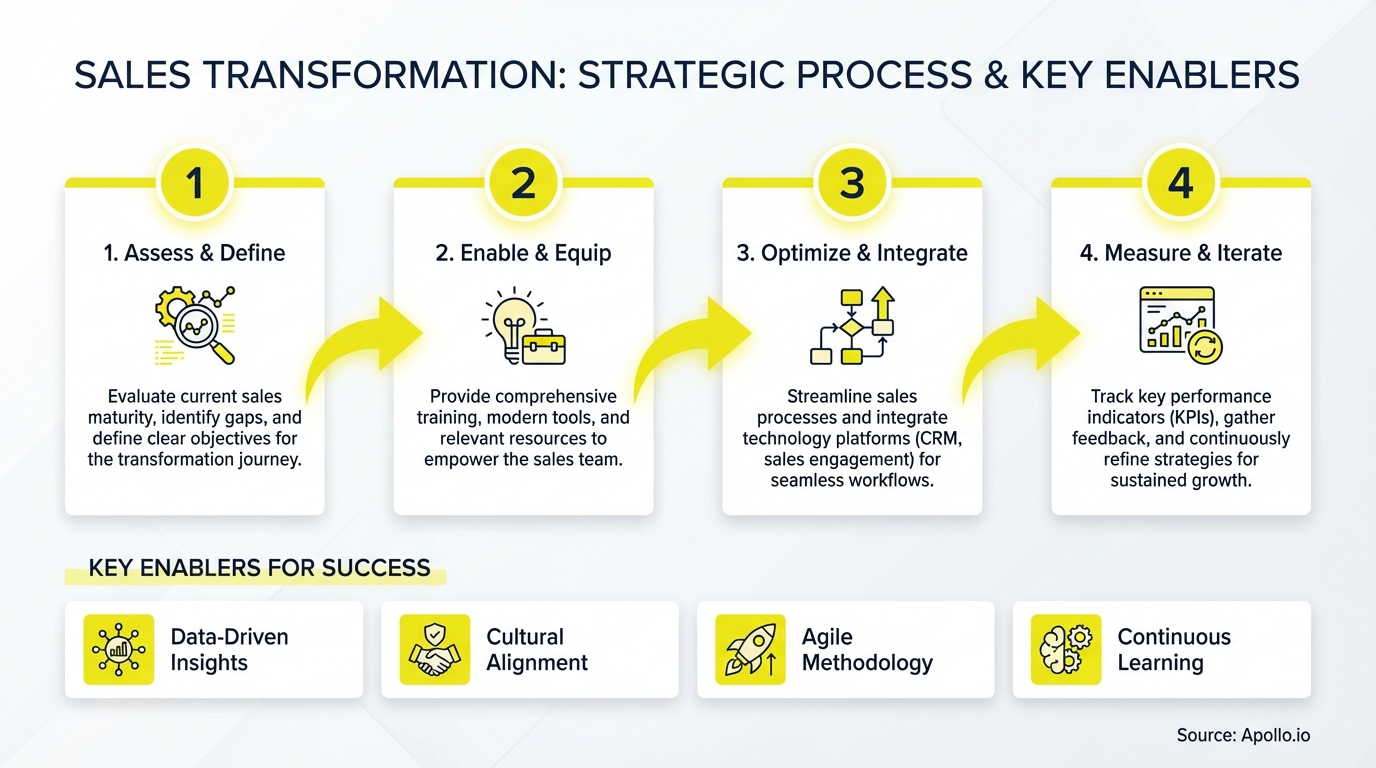
Transformation isn't a one-time project. It's a phased rollout with clear milestones, governance roles, and feedback loops. Here's a practical 90-day roadmap to get started:
Phase 1: Foundation (Days 1-30)
- Audit current content inventory and identify gaps by buying stage
- Map buyer journey with actual customer interviews and win-loss data
- Define AI use cases and governance policies with Legal and RevOps
- Establish baseline metrics for time allocation, conversion rates, and win rates
Phase 2: Build (Days 31-60)
- Create modular content library with taxonomy and version control
- Implement Content Ops workflows (approval paths, CRM integration, tracking)
- Launch pilot AI workflows with 1-2 teams and strict QA protocols
- Train reps on new content access and AI tool usage
Phase 3: Scale (Days 61-90)
- Roll out content library and AI tools to full sales org
- Instrument performance dashboards and weekly review cadence
- Iterate on content based on usage data and buyer feedback
- Document wins and share best practices across teams
Need help consolidating your tech stack? Explore Apollo's unified go-to-market platform to reduce tool sprawl and accelerate transformation.
Common Transformation Pitfalls
Most transformation initiatives stall because teams underestimate change management, overestimate technology, or lack executive sponsorship. Avoid these traps:
- Tooling without training: New platforms fail when reps don't understand the workflows or see clear ROI
- Content without governance: Creating assets without approval processes leads to outdated, off-brand materials
- AI without guardrails: Ungoverned GenAI creates compliance risk and erodes buyer trust
- Metrics without action: Dashboards are useless if insights don't trigger workflow changes
For more on building effective sales systems, see our guides on revenue operations, sales productivity, and sales KPIs.
Get Started with Sales Transformation Today
Sales transformation in 2026 means building content-led systems, implementing AI governance, and measuring outcomes that matter. Start with a content audit, define your AI policies, and instrument metrics that track time saved and conversion lift.
The teams that move now will capture disproportionate value as buyer expectations continue to shift and AI capabilities mature. The teams that wait will find themselves outpaced by competitors who made transformation a strategic priority.
Ready to transform your sales engine? Get leads now with Apollo's all-in-one go-to-market platform.
Prove Apollo's ROI In Your First 30 Days
Budget approval stuck on unclear metrics? Apollo tracks every touchpoint from prospect to closed deal, giving leadership the pipeline impact data they demand. Customer. io achieved 50% YoY growth with measurable automation ROI.
Start Free with Apollo →Don't miss these
Sales
Inbound vs Outbound Marketing: Which Strategy Wins?
Sales
What Is a Sales Funnel? The Non-Linear Revenue Framework for 2026
Sales
What Is a Go-to-Market Strategy? The 2026 GTM Playbook
See Apollo in action
We'd love to show how Apollo can help you sell better.
By submitting this form, you will receive information, tips, and promotions from Apollo. To learn more, see our Privacy Statement.
4.7/5 based on 9,690 reviews
