Sales Strategy Examples That Actually Drive Revenue in 2026
Modern B2B sales is fragmenting. Buyers now use 10+ channels to research and purchase, while 61% prefer self-service options over talking to reps. Yet sellers who combine human expertise with AI tools are 3.7 times more likely to hit quota. The question isn't whether to adapt, but how to build a sales strategy that wins across every channel. This guide shows you exactly how with proven enterprise sales tactics and practical playbooks you can implement today.

Scale Your Team Without The Growing Pains
Tired of inconsistent processes slowing down your growing sales team? Apollo standardizes workflows and automates lead research so every rep performs like your top seller. Join 550K+ companies scaling smarter.
Start Free with Apollo →Key Takeaways
- Hybrid selling strategies combining AI automation with human touch drive 3.7x higher quota attainment in 2026
- 65% of B2B sales organizations are shifting from gut-based to data-driven decision-making this year
- SDRs and AEs using unified platforms report 46% more meetings and 35% higher booking rates
- 74% of buyer teams experience conflict during decisions, making consensus-building frameworks essential
- Tool consolidation cuts costs in half while improving team productivity and data accuracy
What Is a Sales Strategy Example in 2026?
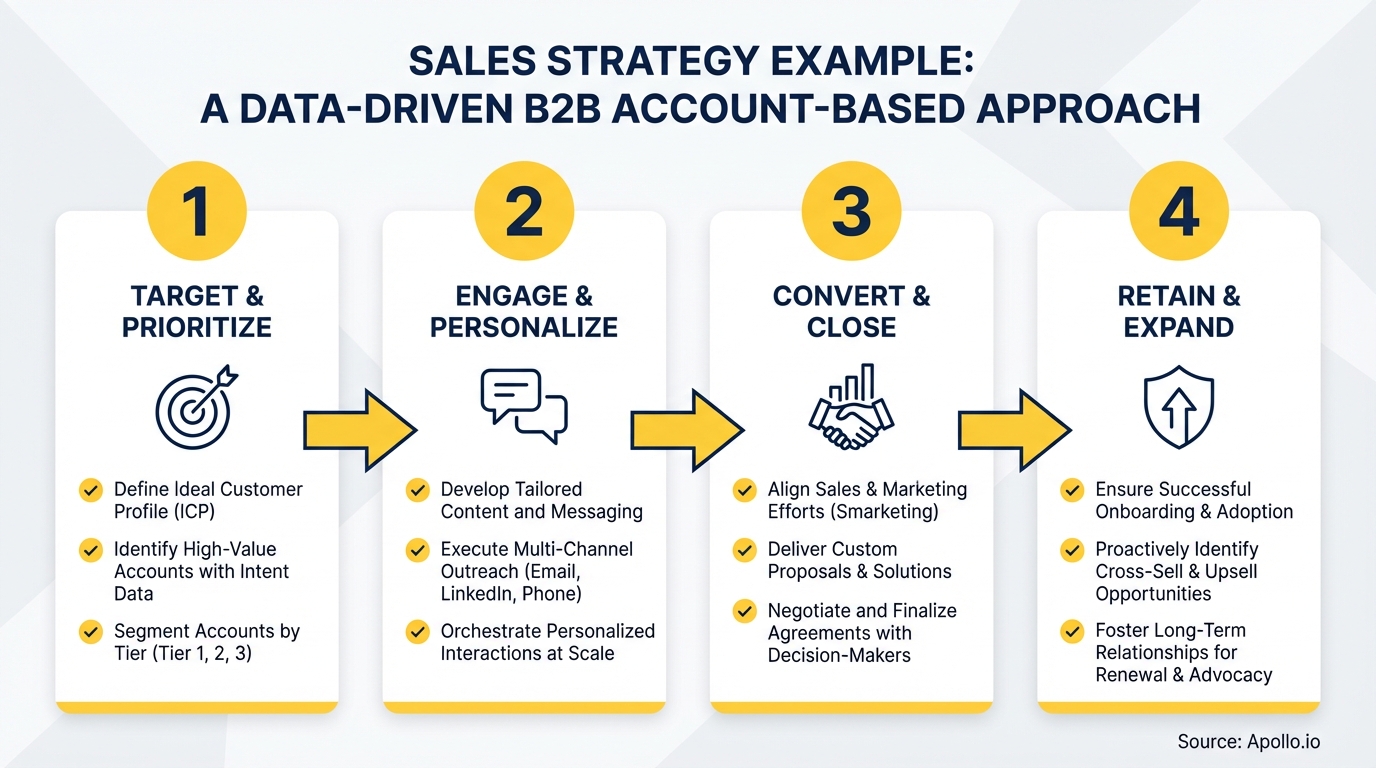
A sales strategy example is a documented approach that defines how your team identifies prospects, engages buyers, and closes revenue across multiple channels.
According to Gartner, 65% of B2B sales organizations will transition from intuition-based to data-driven decision-making by 2026.
Modern strategies integrate AI-powered prospecting, multi-channel engagement sequences, and consensus-building frameworks that address buyer team dynamics.
Effective sales strategies in 2026 balance automation with personalization.
Research by McKinsey shows B2B buyers now use up to 10 channels during their purchasing journey, doubling from five years ago.
Your strategy must orchestrate consistent messaging across email, phone, social, video, and self-service channels while maintaining human connection points where buyers need guidance.
Why Do Sales Leaders Need Hybrid Selling Frameworks?
Sales leaders face a paradox: 61% of B2B buyers prefer rep-free experiences, yet 75% will prioritize human interaction over AI by 2030.
Hybrid frameworks solve this by deploying self-service resources for research-phase buyers while reserving human sellers for high-value consultative moments.
RevOps teams using hybrid models report cleaner data, faster deal cycles, and predictable pipeline growth.
The framework starts with segmentation.
Divide your total addressable market by buyer journey stage and deal size.
Assign AI-powered outreach to early-stage, lower-value prospects.
Reserve your best AEs for enterprise accounts requiring complex solution selling.
This tiered approach maximizes team capacity while delivering the right experience to each buyer segment.
What Are the Core Components?
- AI-Powered Prospecting: Use machine learning to score 224M+ contacts and identify buying signals
- Multi-Channel Sequences: Orchestrate email, phone, LinkedIn, and video across 10+ touchpoints
- Self-Service Resources: Deploy interactive demos, ROI calculators, and content libraries
- Human Intervention Triggers: Define clear handoff points from automation to live reps
- Consensus-Building Tools: Provide frameworks that help buyer teams align internally
How Do SDRs Build Data-Driven Prospecting Strategies?
SDRs using data-driven strategies book 46% more meetings than those relying on intuition.
Start by defining your ideal customer profile with 15+ firmographic and technographic filters: company size, industry, tech stack, growth signals, hiring trends, and funding events.
Pull verified contact lists from a consolidated platform rather than juggling multiple tools.
Struggling to find qualified leads? Search Apollo's 224M+ contacts with 65+ filters to build targeted prospect lists in minutes.
Next, layer intent data to prioritize accounts showing active buying signals.
Track website visits, content downloads, job postings, and technology changes.
SDRs at companies like Cyera report that "having everything in one system was a game changer" for connecting these data points.
How to Build Your Prospecting Workflow
| Step | Action | Tool/Method | Time Investment |
|---|---|---|---|
| 1. Define ICP | Document 15+ qualifying criteria | CRM data analysis + customer interviews | 2 hours initially |
| 2. Build Lists | Filter database by ICP criteria | Advanced search with saved filters | 15 minutes daily |
| 3. Enrich Data | Verify emails, add mobile numbers | Waterfall enrichment across sources | Automated |
| 4. Score Leads | Rank by fit + intent signals | AI scoring models | Automated |
| 5. Assign Sequences | Route to appropriate sales cadence | Workflow automation | 5 minutes per batch |
What Multi-Channel Engagement Sequences Convert Best?
Top-performing sequences in 2026 span 12-15 touchpoints across 21 days, mixing email, LinkedIn, phone, and video.
AEs using this approach see 35% higher booking rates than single-channel outreach.
The key is varying your message and medium while maintaining thematic consistency around the buyer's core challenge.
Start with a pattern-interrupt email that references a specific trigger event: a funding round, executive hire, or product launch.
Follow with LinkedIn connection requests that add value, not just ask for meetings.
Layer in phone calls on days 3, 7, and 14.
Use video messages on days 5 and 12 to showcase your sales pitch personality and differentiate from text-only competitors.
Sample 21-Day Hybrid Sequence
- Day 1: Trigger-based email with specific insight (open rate: 45%)
- Day 2: LinkedIn profile view + connection request
- Day 3: Phone call attempt #1, voicemail with next steps
- Day 5: Personalized video email addressing their challenge
- Day 7: Phone call attempt #2, text if no answer
- Day 9: Value-add email: case study or industry report
- Day 11: LinkedIn message referencing mutual connection
- Day 12: Video message: "3 ways companies like yours..."
- Day 14: Phone call attempt #3 with specific meeting agenda
- Day 16: Break-up email with opt-out option (reply rate: 18%)
- Day 19: Final value offer: tool, template, or assessment
- Day 21: LinkedIn content engagement + thoughtful comment
Spending hours on manual outreach? Automate your sequences with Apollo's multi-channel platform and track engagement across every touchpoint.
Fill Your Pipeline With Sales-Ready Prospects
Marketing leads never converting to opportunities. Apollo identifies and scores in-market buyers so every lead your team touches is qualified and ready. Built-In increased win rates 10% with Apollo's buyer signals.
Start Free with Apollo →How Do Account Executives Handle Buyer Team Conflict?
A study from Gartner found 74% of B2B buyer teams demonstrate unhealthy conflict during the decision process.
AEs who proactively address this close deals 40% faster than those who ignore internal buyer dynamics.
The solution is building consensus frameworks directly into your sales process.
Start discovery calls by mapping the decision-making unit.
Identify economic buyers, technical evaluators, end users, and potential blockers.
Ask explicitly: "Who else needs to be convinced for this to move forward?" Then provide tools that help champions sell internally.
This includes ROI calculators, comparison matrices, implementation timelines, and executive briefing decks that address each stakeholder's unique concerns.
Consensus-Building Toolkit for AEs
- Stakeholder Map Template: Visual diagram of decision makers and their priorities
- Internal Champion Playbook: Scripts and slides for your champion to present
- Multi-Threaded Engagement: Separate nurture tracks for each stakeholder persona
- Objection Response Library: Pre-built answers to common blocker concerns
- Executive Summary One-Pager: C-suite focused business case on single page
- Peer Comparison Report: How similar companies evaluated and chose
Why Is Tool Consolidation Critical for Revenue Teams?
Sales teams using 5+ disconnected tools waste 32% of their time on data entry, context switching, and reconciliation.
Companies that consolidate onto unified platforms report significant improvements.
Census cut costs in half. Predictable Revenue reduced the complexity of three tools into one.
For founders and sales leaders, tool consolidation means faster team ramp, cleaner data, and predictable revenue growth.
The math is simple: paying for separate prospecting databases, engagement platforms, enrichment services, dialers, and meeting schedulers costs $15,000+ per rep annually. A unified go-to-market platform cuts that to $5,000-7,000 while eliminating integration headaches.
RevOps teams save 20+ hours monthly on data syncing and troubleshooting. More importantly, reps spend time selling instead of wrestling with technology.
What Does Consolidation Look Like?
| Old Stack (5 Tools) | Unified Platform | Impact |
|---|---|---|
| ZoomInfo + Outreach + Gong + Calendly + Clearbit | All-in-one GTM platform | 50% cost reduction |
| Data silos across systems | Single source of truth | 96% data accuracy |
| Manual data syncing | Automatic enrichment | 20 hours saved/month |
| Disjointed reporting | Unified deal management | Real-time visibility |
| Complex training for new reps | One workspace for everything | 50% faster ramp time |
What Results Can Sales Teams Expect?
Teams implementing hybrid selling strategies with consolidated tech stacks report measurable improvements within 90 days. According to Gartner, sellers who effectively partner with AI tools are 3.7 times more likely to meet their sales quotas. The combination of data-driven prospecting, multi-channel sequences, and unified platforms creates compounding advantages.

SDRs see 46% more meetings booked when using AI research agents to personalize outreach. AEs shorten sales cycles by 25% with conversation intelligence that surfaces objections and coaching opportunities.
Sales leaders gain complete pipeline visibility with forecasting accuracy above 90%. For revenue operations teams, the shift from fragmented tools to unified systems means spending time on strategy instead of firefighting data issues.

90-Day Implementation Benchmarks
- Week 1-4: ICP definition, data cleanup, platform migration (expect 20% productivity dip)
- Week 5-8: Sequence build-out, A/B testing, team training (productivity returns to baseline)
- Week 9-12: Full rollout, optimization, coaching (see 15-25% lift in key metrics)
- Beyond 90 Days: Continuous improvement, advanced workflows, scaling successful patterns
Ready to Build Your Hybrid Selling Strategy?
The shift to hybrid selling isn't optional in 2026. Buyers expect seamless experiences across 10+ channels, backed by self-service resources and human expertise when they need it.
Sales teams that combine AI-powered automation with strategic human touchpoints win more deals, faster. The foundation is a unified platform that eliminates tool sprawl while providing verified data, intelligent automation, and complete visibility.
Start by auditing your current tech stack and identifying redundancies. Map your buyer journey and define clear handoff points between automated nurture and human engagement.
Build consensus-building frameworks that help your champions sell internally. Most importantly, give your team a single workspace where prospecting, engagement, enrichment, and deal management happen in one place.
Apollo provides 2M+ sales professionals with the all-in-one platform to execute hybrid selling strategies. From 224M verified business contacts to AI-powered automation to conversation intelligence, everything you need is in one system. Companies using Apollo report 46% more meetings, 35% higher booking rates, and significant cost savings from consolidating their tech stack. Get Leads Now.
Prove Apollo's Value In Your First Week
Budget approval stuck on unclear metrics? Apollo tracks every touchpoint from first contact to closed deal—quantifying time saved and pipeline impact in real dollars. Built-In increased win rates 10% and ACV 10% with measurable Apollo insights.
Start Free with Apollo →Don't miss these
Sales
Inbound vs Outbound Marketing: Which Strategy Wins?
Sales
What Is a Sales Funnel? The Non-Linear Revenue Framework for 2026
Sales
What Is a Go-to-Market Strategy? The 2026 GTM Playbook
See Apollo in action
We'd love to show how Apollo can help you sell better.
By submitting this form, you will receive information, tips, and promotions from Apollo. To learn more, see our Privacy Statement.
4.7/5 based on 9,690 reviews
