
How Do You Build Sales Sheet Templates That Convert in 2026?
Your sales sheet is no longer just collateral—it's your self-serve sales rep. With 61% of B2B buyers now preferring a rep-free buying experience, your one-pager must work independently: educating, validating, and moving deals forward without human intervention.
The old feature-dump format fails this test.
Modern sales sheets serve as validation engines. They answer buyer questions before they're asked, provide proof on demand, and maintain message consistency across every touchpoint.
This guide shows you how to build modular, governance-backed templates that scale personalization while driving measurable outcomes.

Stop Manual Research - Apollo Finds Contacts Fast
Tired of spending 4+ hours daily hunting for contact info? Apollo delivers 224M+ verified contacts with 96% email accuracy instantly. Join 550K+ companies closing more deals.
Start Free with Apollo →Key Takeaways
- Sales sheets must function as self-serve product pages, not rep-dependent handouts—61% of buyers prefer rep-free experiences
- Modular templates with locked governance sections and variable personalization fields prevent the 69% inconsistency problem between website and seller messaging
- Validation-first architecture (ROI models, implementation timelines, proof blocks) addresses buyer needs at the 67.7% journey mark where most first contact occurs
- Organizations with formal sales enablement programs achieve a 49% higher win rate on forecasted deals
- Measurable templates with attribution tracking and A/B testing capabilities turn collateral into a revenue instrument
What Makes a Sales Sheet Template Effective in 2026?
A sales sheet template is a structured, one-page document that communicates your value proposition, proof points, and next steps.
Unlike static PDFs, effective 2026 templates are modular systems with three layers: locked brand/legal sections, approved content blocks, and variable personalization fields.
The shift matters because 50% to 90% of the B2B buying journey happens before a prospect even talks to a sales rep.
Your template must educate early-stage researchers and validate late-stage decision-makers without rep support.
Core Components That Drive Conversion
| Component | Purpose | Governance Level |
|---|---|---|
| Executive Summary | Deliver outcome-focused value prop in 2-3 sentences | Locked (Legal-approved) |
| Problem/Solution Fit | Map buyer pain to specific capabilities | Modular (Industry variants) |
| ROI Proof Block | Quantified outcomes with attribution | Locked (Finance-verified) |
| Implementation Timeline | Realistic rollout milestones and inputs required | Modular (Deal size variants) |
| Social Proof | Customer quotes, case links, benchmarks | Approved library |
| Next Steps CTA | Clear action with friction-reducing offer | Locked (Revenue Ops) |
"Apollo enriches everything we have: contacts, leads, accounts... And we don't really have to touch it, it just works."
Why Traditional Sales Sheets Fail Rep-Free Buyers
Gartner's 2024 research reveals a critical gap: 73% of B2B buyers actively avoid suppliers sending irrelevant outreach, yet 69% see inconsistencies between website claims and seller messaging. Traditional sales sheets amplify both problems.
The failure pattern is predictable. Reps create custom one-pagers without governance, leading to outdated pricing, unverified claims, and off-brand messaging.
When buyers compare your sheet to your website, they notice mismatches and disengage. Without measurement, teams never know which versions work.
The Three Gaps Killing Conversion
Relevance Gap: Generic feature lists ignore that buyers have requirements 88% defined before engaging sellers.
Your template must speak to their validated needs with industry-specific proof.
Validation Gap: Feature descriptions without ROI models, implementation realities, or security/compliance snapshots fail late-stage buyers evaluating vendor risk. They need proof architecture, not promises.
Consistency Gap: Ad-hoc template creation means your sales sheet contradicts your website, sales presentations, and other collateral.
Buyers notice and lose trust.

How to Build Modular, Governance-Backed Templates
Modular templates solve the personalization-at-scale problem.
Instead of creating hundreds of custom PDFs, you build a system: locked sections ensuring consistency, approved content blocks for flexibility, and variable fields for personalization.
Three-Layer Template Architecture
Layer 1: Locked Governance Sections (Legal, Finance, Product Marketing owns)
Value proposition headline, pricing guardrails, compliance statements, approved claims with sources, brand elements. These never change without formal review.
Layer 2: Approved Content Blocks (Sales Enablement maintains library)
Industry pain points, role-specific outcomes, implementation scenarios, proof points (quotes, case links, benchmarks), security/compliance snapshots. Reps select from pre-approved options.
Layer 3: Variable Personalization Fields (Reps or AI populate)
Company name, industry, specific use case, relevant metrics from discovery, recommended next step. These pull from CRM or are manually entered.
Need to scale your outreach with consistent messaging? Apollo's sales engagement platform lets you automate personalized sequences while maintaining brand control.
Version Control and Change Management
Every template needs an owner, a review cadence, and a change log.
When Product updates positioning or Legal revises a claim, the system propagates changes to all instances.
Reps using outdated versions get automated alerts.
Best practice: quarterly reviews with cross-functional stakeholders (Product Marketing, Legal, Sales Enablement, Revenue Ops). Monthly for fast-moving markets.
Find Buyers Ready To Close With Apollo
Pipeline forecasting a guessing game? Apollo reveals which prospects are actually in-market with real-time buying signals. Built-In boosted win rates 10% using Apollo's scoring.
Start Free with Apollo →What Proof Architecture Do Validation-Stage Buyers Need?
Buyers at the 67.7% journey mark (where most first contact occurs) need validation, not education.
Your template must answer: Does this actually work? Can we implement it? What's the real ROI?
Four Proof Blocks That Close Deals
Quantified Customer Outcomes: Not testimonials—specific metrics with attribution. "35% increase in pipeline" links to case study with methodology. Avoid generic claims.
ROI Model with Inputs: Calculator showing payback period based on buyer's deal size, team size, or transaction volume. Make it interactive or provide clear formula.
Implementation Reality Check: Honest timeline with milestones, required buyer inputs, and potential blockers. Transparency builds trust and qualifies fit.
Security/Compliance Snapshot: One-sentence status for SOC 2, GDPR, industry-specific requirements. Link to detailed documentation. Buyers need this for procurement.
"We reduced the complexity of three tools into one. We're getting higher reply rates, open rates are doubled, meetings are up, and speed to booking a meeting is cut in half."
How Do You Measure Sales Sheet Performance?
According to BuyYourData research, despite 81% of organizations measuring content performance, only 42% consider their approach very effective. The gap? Most teams track downloads, not outcomes.
Metrics That Matter
| Metric | What It Reveals | Action Threshold |
|---|---|---|
| Share Rate | Rep confidence in template quality | <50% = content problem |
| Engagement Time | Whether buyers actually read it | <90 sec = relevance issue |
| Progression Rate | Does it move deals forward? | Compare to non-sheet deals |
| Win Rate Correlation | Template's impact on closed-won | A/B test variants |
Track at the variant level: which industry template drives highest progression? Which proof block correlates with wins? Use this data to optimize your content library.
Looking to connect your sales content to pipeline outcomes? Apollo's deal management tools let you track which content assets influence deal velocity and close rates.
Common Sales Sheet Template Mistakes to Avoid
Feature Dumping Without Outcomes: Listing capabilities without connecting them to buyer results. Buyers care about outcomes, not features. Lead with "increase pipeline by X" not "includes 65+ filters."
Unverified Claims: Using phrases like "industry-leading" or "best-in-class" without attribution. Legal risk aside, buyers see through it. Use customer quotes or benchmark data instead.
Ignoring Mobile: By 2025, 80% of B2B sales interactions between buyers and sellers will occur in digital channels. If your PDF doesn't render well on mobile, you lose buyers researching on phones.
No Clear Next Step: Ending with "Contact us to learn more" creates friction. Offer a specific, low-friction action: "Book a 15-min product tour" with calendar link, "Download implementation guide," or "Start free trial."
Static, Non-Trackable Format: PDFs sent via email provide zero engagement data. Use trackable links or enablement platforms that show who viewed what and for how long.
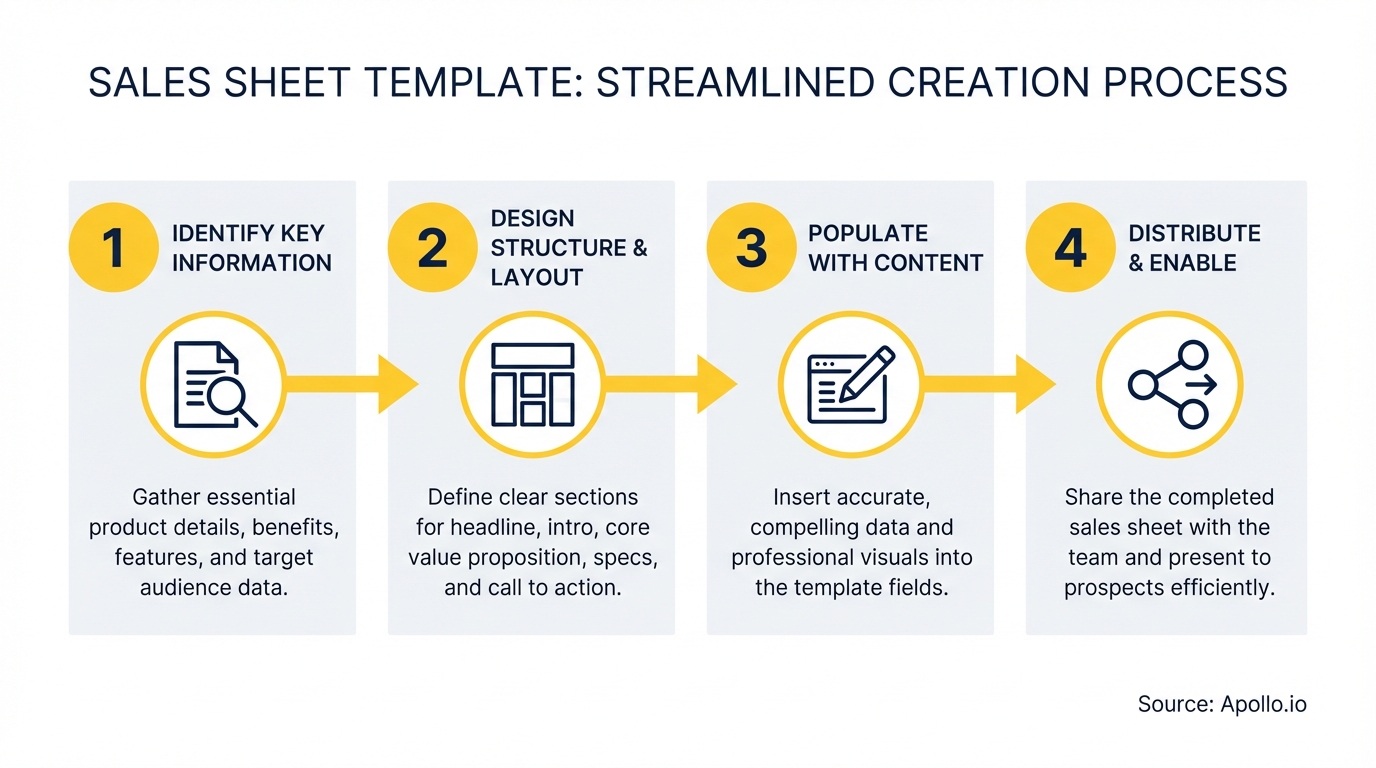
How to Implement a Scalable Template System
Companies with effective sales enablement programs experience 15% higher sales growth than those without. Here's how to build yours.
Four-Week Implementation Plan
Week 1: Audit and Governance
Inventory existing templates. Identify inconsistencies and outdated claims. Establish ownership: who approves locked sections? Who maintains content library? Who tracks performance?
Week 2: Build Core Template
Create master template with three layers. Write locked sections with Legal/Product Marketing. Build initial content block library (3-5 industry variants, 3-5 role variants). Define variable fields.
Week 3: Pilot with High-Performers
Test with your best reps on active deals. Collect feedback on usability, relevance, and buyer response. Iterate based on real-world usage before full rollout.
Week 4: Rollout and Measurement
Train full team on template system. Set up tracking (share rates, engagement, progression). Schedule first review for 30 days post-launch.
For more on building revenue-driving processes, explore our sales tech stack playbook and sales productivity blueprint.

Get Started with High-Converting Sales Sheets
The shift from static PDFs to modular, governance-backed templates isn't optional.
With buyers preferring rep-free experiences and actively avoiding inconsistent messaging, your sales sheet must function as a standalone validation tool.
Start with your highest-volume use case.
Build one well-governed template with locked brand sections, approved proof blocks, and variable personalization fields.
Measure what matters: share rates, engagement time, and deal progression. Iterate based on data.
The teams winning in 2026 treat sales sheets as revenue instruments, not design projects.
They know which templates drive pipeline, which proof points close deals, and which claims resonate with buyers.
That requires measurement infrastructure, not just better graphics.
Ready to consolidate your sales tech stack and drive measurable outcomes? Try Apollo Free and discover how our all-in-one platform helps teams build pipeline faster with verified data, automated outreach, and deal tracking in one unified workspace.
Prove Apollo's ROI In Your First 30 Days
Budget approval stuck on unclear metrics? Apollo tracks every touchpoint from first contact to closed deal. Built-In increased win rates 10% and ACV 10% with measurable attribution.
Start Free with Apollo →Don't miss these
Sales
Inbound vs Outbound Marketing: Which Strategy Wins?
Sales
What Is a Sales Funnel? The Non-Linear Revenue Framework for 2026
Sales
What Is a Go-to-Market Strategy? The 2026 GTM Playbook
See Apollo in action
We'd love to show how Apollo can help you sell better.
By submitting this form, you will receive information, tips, and promotions from Apollo. To learn more, see our Privacy Statement.
4.7/5 based on 9,690 reviews
