
How Do You Handle Sales Objections in 2026? A Data-Driven Blueprint
Every sales objection signals a buyer in conflict. According to Gartner research, 74% of B2B buyer teams experience unhealthy conflict during the decision process, leading to a 2.5x higher likelihood of low-quality deals. The objection you hear isn't just pushback from one person; it's often a symptom of internal disagreement that derails deals.
Modern sales objection handling isn't about clever rebuttals. It's about building consensus across buyer teams, leveraging AI for personalized responses, and balancing digital self-service with strategic human engagement.
Research shows sellers who partner with AI are 3.7x more likely to meet quota, while 61% of B2B buyers now prefer rep-free experiences for routine tasks.

Apollo Finds Verified Contacts In Seconds
Tired of spending 4+ hours daily hunting for contact info? Apollo delivers 224M verified contacts with 96% email accuracy instantly. Join 550K+ companies who ditched manual research.
Start Free with Apollo →Key Takeaways
- Internal buyer conflict causes 74% of deal stalls; objection handling must address committee dynamics, not just individual concerns
- AI-augmented objection handling increases quota attainment by 3.7x through data-driven personalization and response optimization
- Hybrid selling balances buyer self-service preferences (61% prefer rep-free) with high-value human touchpoints for complex objections
- Data-driven sales frameworks track objection patterns, resolution rates, and conversion impact across buyer journey stages
- Consensus-building playbooks reduce deal cycle time by aligning stakeholders early and preventing late-stage objections
Why Do Buyer Teams Stall Deals? Understanding Internal Conflict
Sales objections rarely emerge from a single decision-maker. Most B2B purchases involve 6-10 stakeholders with competing priorities.
When finance wants ROI proof, IT demands security compliance, and operations needs seamless integration, you're not handling objections; you're mediating internal conflict.
Data from Forrester's 2023 Global Buyers' Journey Survey shows nearly 90% of business buyers reported stalled purchase processes. The root cause? Misaligned stakeholder expectations and lack of consensus-building frameworks.
| Objection Type | Root Cause | Stakeholder Conflict | Resolution Strategy |
|---|---|---|---|
| Budget | Competing priorities | Finance vs. Operations | ROI calculator + phased rollout |
| Authority | Unclear decision process | Manager vs. Executive | RACI matrix + champion enablement |
| Fit | Requirements mismatch | IT vs. End Users | Proof of concept + use-case mapping |
| Timing | Competing initiatives | Leadership vs. Teams | Risk analysis + pilot program |
| Trust | Vendor uncertainty | Legal vs. Procurement | Customer references + security docs |
"Apollo helps us turn data into action... we are living and breathing inside the tool."

How Do You Build Consensus Across Buyer Teams?
Consensus-building transforms objection handling from reactive defense to proactive alignment. Start by mapping stakeholder roles using a RACI framework (Responsible, Accountable, Consulted, Informed).
Identify champions, blockers, and influencers early.
Step 1: Stakeholder Mapping
Create a decision map during discovery. Ask: "Who else needs to approve this?" and "What concerns will [stakeholder] raise?" Document each person's priorities, objections, and success metrics.
Step 2: Preemptive Objection Handling
Address objections before they surface in group settings. Schedule 1:1 calls with key stakeholders to understand individual concerns. This prevents public objections that trigger group conflict.
Step 3: Mutual Action Plans
Co-create a decision timeline with clear milestones, owners, and success criteria. Include objection resolution checkpoints. When stakeholders commit to a shared plan, they're less likely to introduce last-minute blockers.
Need better visibility into your deal pipeline and stakeholder engagement? Track every interaction and objection pattern in one workspace.
What Role Does AI Play in Modern Objection Handling?
AI doesn't replace human objection handling; it amplifies your effectiveness. Sellers who leverage AI tools are 3.7x more likely to meet quota because they personalize responses at scale and identify objection patterns invisible to manual analysis.
AI Use Cases for Objection Handling:
- Pattern Recognition: Analyze hundreds of sales calls to identify which objections correlate with lost deals vs. closed-won opportunities
- Response Optimization: Test multiple objection-handling approaches and surface the highest-converting language for each objection type
- Personalization at Scale: Generate tailored objection responses based on prospect industry, role, company size, and stated concerns
- Real-Time Coaching: Get in-call suggestions during live conversations when specific objections arise
"With this kind of AI system, my BDRs can send 10x more personalized emails. Their productivity and growth has skyrocketed."
Struggling to keep up with personalized outreach? Automate your objection responses with AI-powered sequences that adapt to prospect behavior.
Turn Unreliable Forecasts Into Revenue Clarity
Pipeline forecasting a guessing game? Apollo tracks deal stages in real-time with buying signals that predict close rates. Built-In increased win rates 10% with Apollo's scoring and visibility.
Start Free with Apollo →How Do You Balance Digital Self-Service With Human Engagement?
The paradox of modern B2B sales: 61% of buyers prefer rep-free experiences, yet complex objections still require human expertise. The solution isn't choosing between digital and human; it's designing a hybrid journey that delivers both.
Digital Self-Service for Routine Objections:
Create resource libraries that address common objections without rep involvement. Include ROI calculators, comparison guides, security documentation, and implementation timelines. Let buyers self-educate on their schedule.
Human Escalation Thresholds:
Trigger rep engagement when buyers exhibit specific behaviors: multiple visits to pricing pages, downloads of technical specs, or time spent on competitor comparison content. These signals indicate objections that need human context.
Hybrid Engagement Framework:
| Buyer Stage | Digital Touchpoints | Human Touchpoints | Objection Type |
|---|---|---|---|
| Awareness | Educational content, calculators | None (unless requested) | Fit, Timing |
| Consideration | Product demos, case studies | Solution consultation | Authority, Budget |
| Decision | Contract templates, onboarding docs | Stakeholder alignment calls | Trust, Risk |
For more on building effective hybrid sales motions, explore our guide on strategic sales development approaches.
What Metrics Should You Track for Objection Handling?
By 2026, 65% of B2B sales organizations are expected to transition from intuition-based to data-driven decision-making. Measuring objection-handling effectiveness requires specific KPIs tied to revenue outcomes.
Critical Objection Handling Metrics:
- Objection Resolution Rate: Percentage of objections successfully addressed (target: 70%+)
- Time to Resolution: Average days from objection to resolution (benchmark: <7 days)
- Objection-to-Close Ratio: Conversion rate after specific objection types are handled
- Repeat Objection Rate: Frequency of same objections resurfacing in deal cycle (red flag if >30%)
- Stakeholder Alignment Score: Number of aligned stakeholders vs. total buying committee size
Build dashboards that track objection patterns by deal stage, prospect segment, and rep performance. Identify which objections correlate with closed-won vs. closed-lost outcomes. Use this data to refine your objection-handling frameworks and training programs.

What Are the Most Effective Objection Handling Frameworks?
Three frameworks dominate modern sales objection handling, each suited to different objection types and buyer contexts.
1. LAER Framework (Listen, Acknowledge, Explore, Respond)
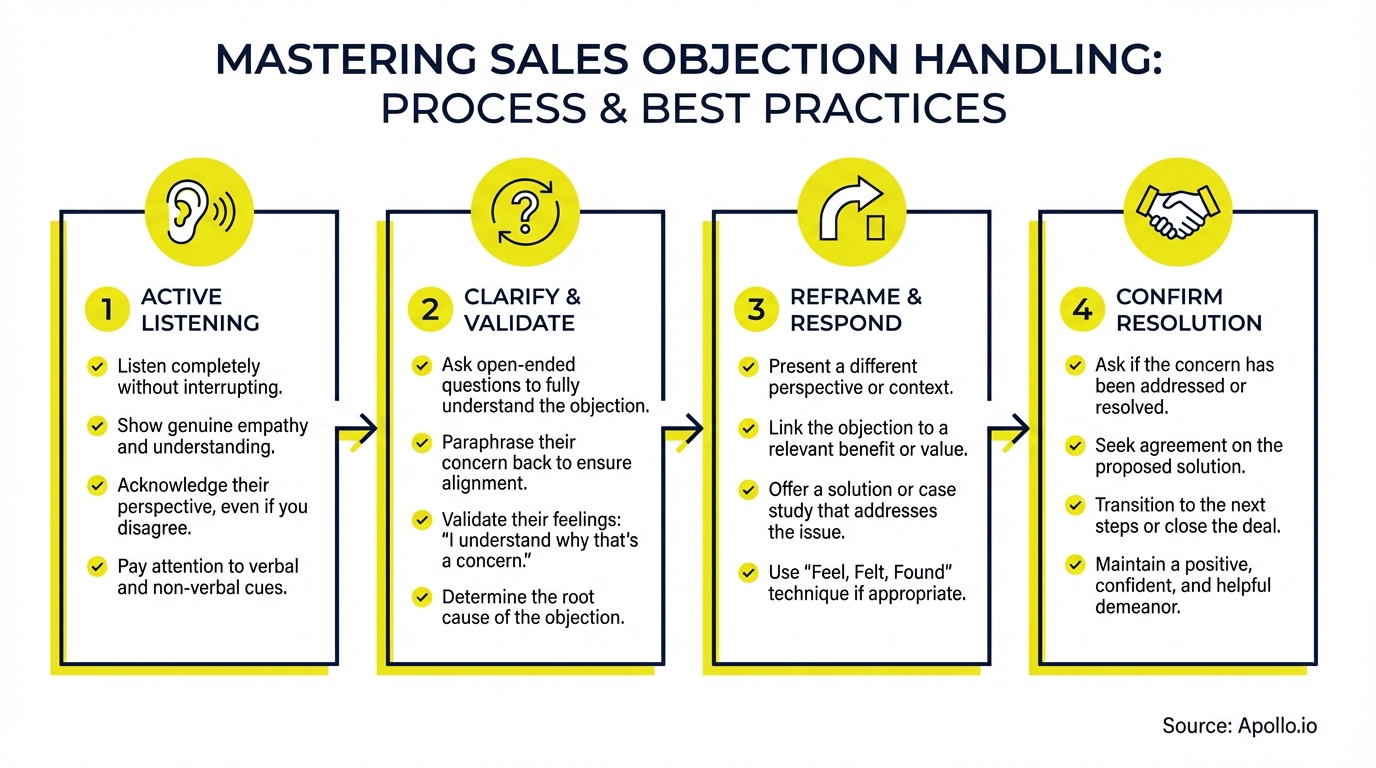
Best for complex objections requiring deep discovery. Listen without interrupting, acknowledge the concern's validity, explore root causes through questions, then respond with tailored solutions. Effective for authority and fit objections.
2. Feel-Felt-Found Method
Best for trust and risk objections. "I understand how you feel. Other customers felt the same way. What they found was..." This framework builds empathy while providing social proof. Use customer quotes and case studies as evidence.
3. Question-Based Reframing
Best for budget and timing objections. Instead of defending, ask questions that reframe the objection: "What would need to change for this to become a priority?" or "How are you currently solving this problem, and what's that costing you?"
Learn how top performers handle objections by studying proven sales playbooks from high-growth companies.
How Do You Implement a Data-Driven Objection Handling System?
Implementation requires technology, training, and ongoing optimization. Here's a phased rollout approach:
Phase 1: Audit & Baseline (Weeks 1-2)
Record and analyze 50+ sales calls to identify most common objections. Document current response patterns and conversion rates. Establish baseline metrics.
Phase 2: Framework Selection & Training (Weeks 3-4)
Map objection types to appropriate frameworks. Train reps on LAER, Feel-Felt-Found, and Question-Based Reframing. Create objection-handling playbooks with scripted responses.
Phase 3: AI Integration & Automation (Weeks 5-8)
Implement AI tools for call analysis, objection detection, and response suggestions. Build digital resource libraries for self-service objection resolution. Automate follow-up sequences based on objection type.
Phase 4: Measurement & Iteration (Ongoing)
Track objection resolution rates, time to resolution, and impact on deal velocity. A/B test different response approaches. Refine playbooks based on performance data.
For help building your sales tech stack, check out our comprehensive guide on sales tools that actually scale revenue.
Conclusion: From Reactive Rebuttals to Proactive Consensus
Sales objection handling in 2026 is fundamentally different from traditional rebuttal techniques. The data is clear: 74% of buyer teams experience internal conflict that stalls deals, 61% prefer self-service for routine questions, and AI-enabled sellers are 3.7x more likely to hit quota.
The winning approach combines consensus-building frameworks that address stakeholder conflict, AI-powered personalization that scales objection handling, hybrid engagement models that balance digital and human touchpoints, and data-driven optimization that continuously improves conversion rates.
Stop treating objections as obstacles to overcome. Start treating them as signals of misalignment that reveal opportunities to build consensus, deliver value, and accelerate deals.
Ready to transform your objection handling? Start free with Apollo and access 224M+ verified contacts, AI-powered engagement tools, and deal management features that turn objections into closed deals.
Prove Apollo ROI In Your First 30 Days
Budget approval stuck on unclear metrics? Apollo tracks measurable pipeline impact from day one—time saved, meetings booked, deals closed. Customer. io achieved 50% YoY growth with quantifiable automation ROI.
Start Free with Apollo →Don't miss these
Sales
Inbound vs Outbound Marketing: Which Strategy Wins?
Sales
What Is a Sales Funnel? The Non-Linear Revenue Framework for 2026
Sales
What Is a Go-to-Market Strategy? The 2026 GTM Playbook
See Apollo in action
We'd love to show how Apollo can help you sell better.
By submitting this form, you will receive information, tips, and promotions from Apollo. To learn more, see our Privacy Statement.
4.7/5 based on 9,015 reviews
