
What Is a Sales Message? Strategies, AI Tools, Best Practices (2026)
A sales message is any communication designed to move a prospect through the buying journey, from initial awareness to closed deal. In 2026, effective sales messaging balances AI automation with human connection across email, calls, social channels, and in-person interactions. As writing effective sales emails becomes more sophisticated with AI, sellers who master personalized, multi-channel messaging close deals faster and build stronger pipelines.

Skip The 4-Hour Research Grind With Apollo
Tired of spending 4+ hours daily hunting for contact info? Apollo delivers 224M verified contacts instantly—no more manual research. Join 550K+ companies who closed deals faster.
Start Free with Apollo →Key Takeaways
- Sales messages must balance digital efficiency with human connection as 61% of B2B buyers prefer rep-free experiences while 75% will demand human interaction by 2030
- AI-powered sales messaging increases quota attainment by 3.7x when sellers effectively partner with automation tools
- Hybrid messaging strategies reduce buyer-team conflicts and accelerate consensus across multi-stakeholder decision processes
- Inclusive, persona-driven messaging improves engagement rates and builds trust with diverse buyer committees
- Measurable ROI from sales messaging requires clear metrics, attribution models, and continuous optimization
What Is a Sales Message in 2026?
A sales message is a targeted communication that addresses a prospect's specific pain point and guides them toward a purchasing decision. It includes outbound emails, cold calls, social media outreach, video messages, and in-person conversations tailored to individual buyer needs.
According to Gartner research, 61% of B2B buyers now prefer a rep-free buying experience, making digital sales messages more critical than ever. However, this trend will reverse as Gartner predicts that by 2030, 75% of B2B buyers will prefer sales experiences prioritizing human interaction over AI.
The most effective sales messages in 2026 combine data-driven personalization with authentic human insight. They're concise, value-focused, and delivered through the channels where prospects are most active.
How Do SDRs and AEs Craft Effective Sales Messages?
SDRs and Account Executives use a structured approach combining research, personalization, and multi-touch sequences. The process starts with deep prospect research using verified contact data, followed by message crafting that speaks directly to role-specific challenges.

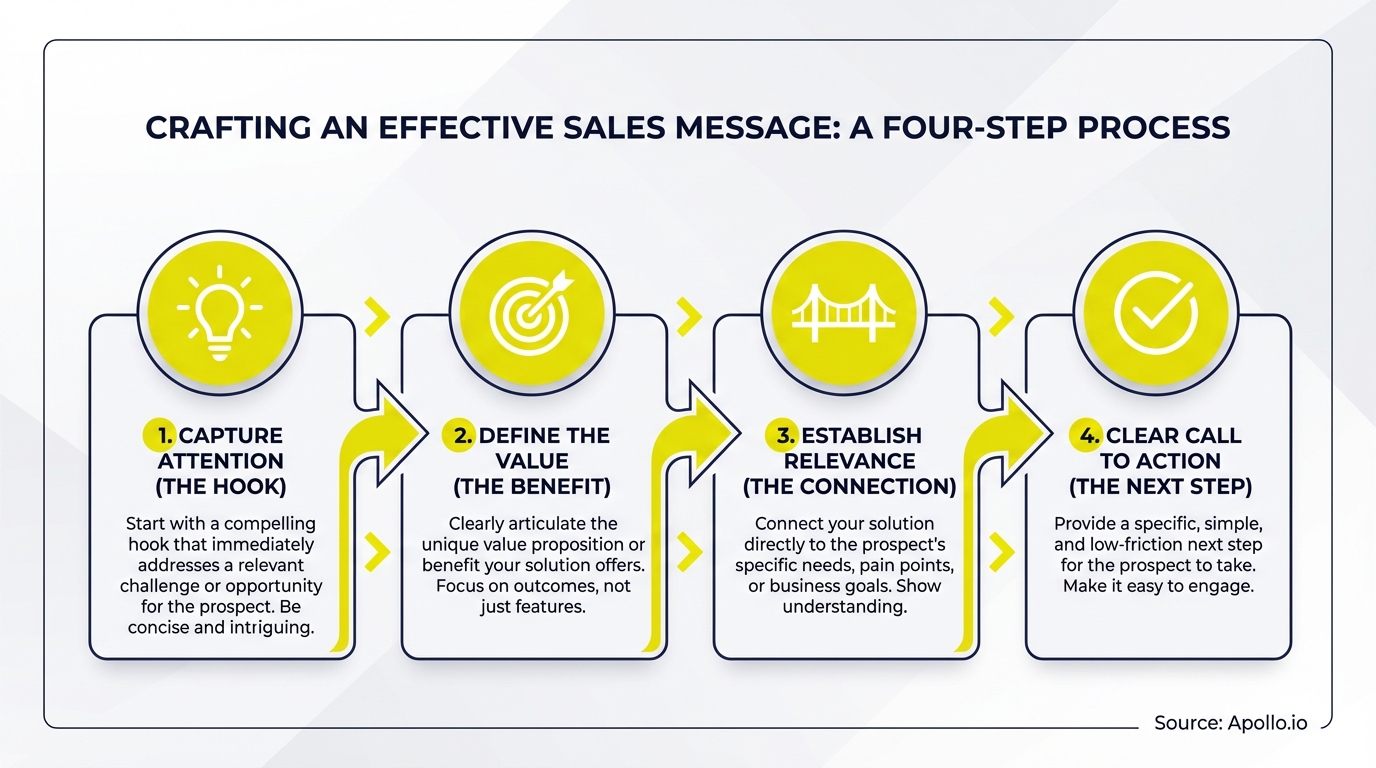
For SDRs focused on booking meetings, successful messages follow this framework:
- Hook: Reference a specific trigger event or pain point relevant to the prospect's role
- Value prop: Connect your solution to their measurable business outcome
- Social proof: Include brief customer results from similar companies
- Clear CTA: Ask for a specific next step with low friction
Account Executives managing complex deals layer in stakeholder-specific messaging. Each buyer persona receives tailored content addressing their unique concerns, from technical specs for engineers to ROI calculations for CFOs. Enterprise sales solutions enable AEs to coordinate these multi-threaded conversations at scale.

Struggling to personalize messages at scale? Apollo's AI automation tailors messages based on buyer context and generates sequences that book 46% more meetings.
What Are AI-Powered Sales Messaging Best Practices?
AI-powered sales messaging uses machine learning to personalize outreach, optimize send times, and predict which messages will resonate. Research by Gartner shows sellers who effectively partner with AI tools are 3.7 times more likely to meet their sales quotas.
The most impactful AI messaging practices include:
| Practice | Implementation | Expected Impact |
|---|---|---|
| Dynamic personalization | AI analyzes prospect data to customize messaging variables | 35-50% higher open rates |
| Send time optimization | Algorithms predict optimal engagement windows per prospect | 20-30% increase in response rates |
| Content suggestions | AI recommends messaging angles based on similar won deals | 25% faster message creation |
| Sentiment analysis | Tools evaluate reply tone and suggest appropriate follow-ups | 15-20% improvement in conversion |
Sales leaders implementing AI sales tools report significant time savings and quality improvements. The key is maintaining human oversight while leveraging AI for research, drafting, and optimization tasks.
See Every Deal Stage In Real Time With Apollo
Pipeline forecasting a guessing game? Apollo delivers live visibility into every deal stage so you can forecast with confidence. Built-In increased win rates 10% with Apollo's scoring and signals.
Start Free with Apollo →How Does Hybrid Messaging Balance Digital and Human Touch?
Hybrid messaging strategies combine automated digital touchpoints with personalized human interactions throughout the buyer journey. This approach recognizes that different stages and buyer types require varying levels of automation versus personal engagement.
The optimal hybrid model allocates channels strategically:
- Awareness stage: Automated email sequences, social media engagement, content sharing
- Consideration stage: Mix of automated nurture and personalized video messages or calls
- Decision stage: High-touch human engagement with executive involvement and custom proposals
For RevOps leaders managing messaging governance, hybrid models require clear SLAs defining when automation hands off to human sellers. Sales development teams use scoring models to trigger these handoffs based on engagement thresholds and buying signals.
The HubSpot sales playbook demonstrates how top performers blend automation with personalization, using AI to handle research and initial outreach while reserving human effort for high-value conversations.
Why Does Buyer-Team Consensus Matter in Sales Messaging?
Buyer-team consensus is critical because Gartner found that 74% of B2B buyer teams experience unhealthy conflict during the decision process. Sales messages must address diverse stakeholder concerns and facilitate alignment rather than creating friction.
Effective consensus-building messaging includes:
- Stakeholder mapping content that identifies all decision influencers
- Role-specific value propositions addressing each buyer's priorities
- Internal champion enablement materials they can share with their team
- Objection-handling frameworks anticipating cross-functional concerns
Sales leaders train teams to message the collective buying committee rather than individual contacts. This means creating content assets that prospects can circulate internally, from one-pagers for executives to technical deep-dives for implementation teams.
Tired of deals stalling in committee review? Apollo's deal management tracks all stakeholder interactions and surfaces consensus risks before they derail your pipeline.
How Do You Measure Sales Message Performance?
Sales message performance measurement requires tracking both leading indicators (opens, clicks, replies) and lagging outcomes (meetings booked, opportunities created, revenue influenced). The best measurement frameworks connect message tactics directly to pipeline impact.
Key metrics by message type:
| Message Type | Primary Metrics | Success Benchmarks (2026) |
|---|---|---|
| Cold email | Open rate, reply rate, meeting conversion | 25-35% opens, 5-8% replies, 15-20% meetings |
| LinkedIn outreach | Connection acceptance, response rate, demo requests | 35-45% accepts, 10-15% responses |
| Cold calls | Connection rate, conversation rate, follow-up agreement | 20-30% connects, 8-12% conversations |
| Video messages | View rate, watch time, response rate | 60-70% views, 40%+ completion, 12-18% replies |
Founders and CEOs building outbound programs should implement attribution models that credit messages appropriately across multi-touch sequences. Sales analytics platforms provide visibility into which message variations drive the highest conversion rates.
What Does the Future of Sales Messaging Look Like?
The future of sales messaging combines AI efficiency with human authenticity, inclusive practices, and consolidated technology. As platforms integrate more capabilities, sellers will manage entire messaging workflows from a single workspace rather than juggling multiple tools.
Emerging trends shaping 2026 and beyond:
- Voice and video dominance: Text-based messages give way to asynchronous video and voice notes for higher engagement
- Predictive personalization: AI predicts prospect needs before they articulate them, enabling proactive outreach
- Platform consolidation: Teams replace 3-5 point solutions with unified platforms handling prospecting through close
- Inclusive messaging standards: Organizations adopt guidelines ensuring messages resonate with diverse audiences
- Privacy-first approaches: Messaging respects data regulations while maintaining personalization
Sales teams using social selling tools and LinkedIn strategies will integrate these channels into cohesive messaging journeys. The winners will be sellers who balance technological leverage with genuine relationship building.
Start Crafting Sales Messages That Convert
Sales messaging in 2026 requires a strategic blend of AI automation, human insight, and multi-channel coordination. The most successful teams use data-driven personalization while maintaining authentic connections that build trust and drive consensus across complex buying committees.
From SDRs booking initial meetings to AEs closing enterprise deals, effective sales messages address specific pain points, provide clear value, and guide prospects through seamless buying experiences. The shift toward hybrid models balancing digital efficiency with human touch reflects evolving buyer preferences and the maturing role of AI in sales.
Ready to transform your sales messaging? Start a free Apollo trial and access 224M+ verified contacts, AI-powered message generation, and multi-channel engagement tools in one consolidated platform. Join 550K+ companies who cut their tech stack and increased pipeline with Apollo's all-in-one GTM solution.
Prove Apollo's ROI In Your First 30 Days
Budget approval stuck on unclear metrics? Apollo tracks every touchpoint from first contact to closed deal—quantifying exact time savings and pipeline impact. Built-In increased win rates 10% and ACV 10% with Apollo's scoring.
Start Free with Apollo →Don't miss these
Sales
Inbound vs Outbound Marketing: Which Strategy Wins?
Sales
What Is a Sales Funnel? The Non-Linear Revenue Framework for 2026
Sales
What Is a Go-to-Market Strategy? The 2026 GTM Playbook
See Apollo in action
We'd love to show how Apollo can help you sell better.
By submitting this form, you will receive information, tips, and promotions from Apollo. To learn more, see our Privacy Statement.
4.7/5 based on 9,690 reviews
