
What Are the Best Sales Interview Questions to Hire Top Performers in 2026?
Sales hiring has entered a new era. With AI-driven candidate coaching and regulatory scrutiny around automated hiring tools intensifying, your interview questions must test real skill, not rehearsed responses. According to Onward Search, unfilled sales roles can cost a company up to $20,000 per week in potential business. The stakes have never been higher for structured, defensible interview processes that identify genuine sales talent.
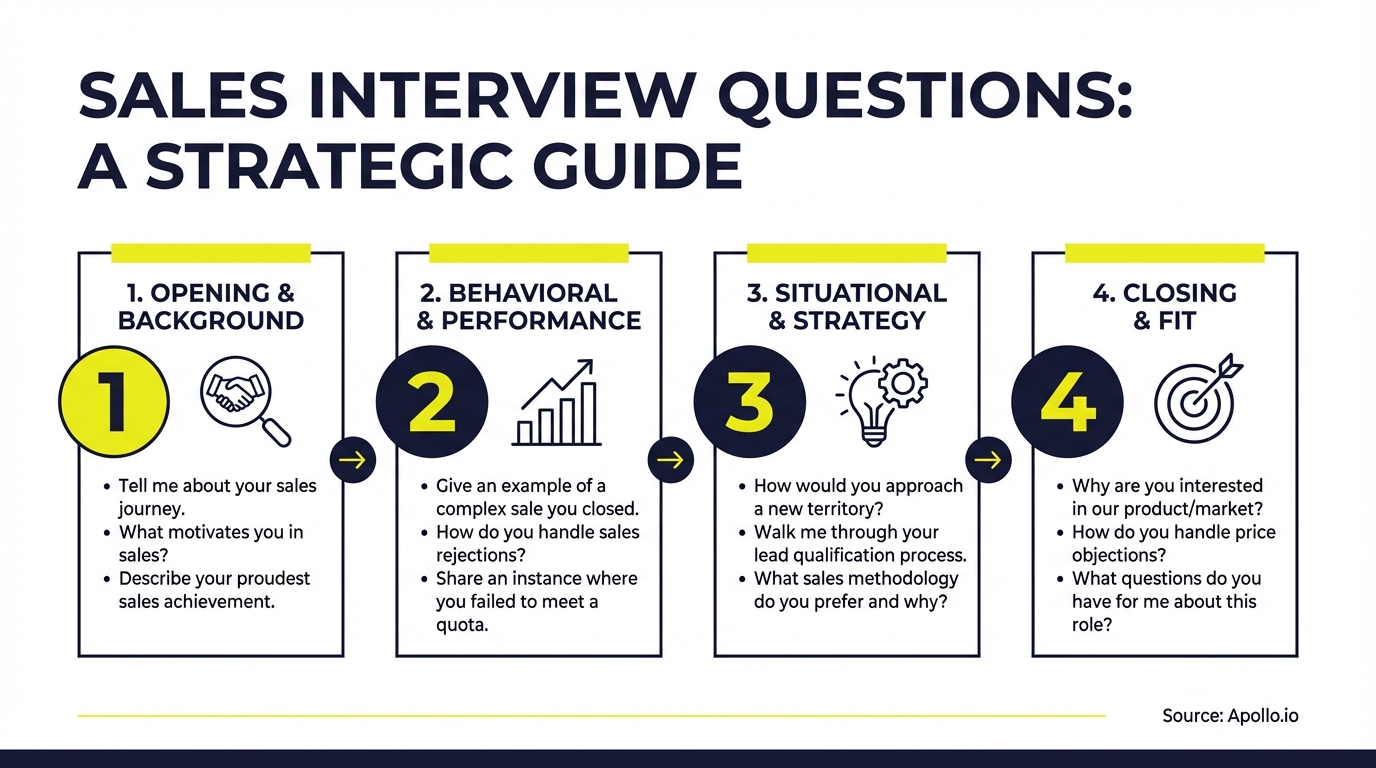
This guide delivers a proven framework for sales interview questions designed for 2026's reality: omnichannel selling, AI-augmented workflows, and rep-light buyer journeys. You'll get question banks, scoring rubrics, and practical exercises that reveal whether candidates can create value in modern B2B environments.

Apollo Finds Verified Contacts In Seconds
Tired of spending 4+ hours daily hunting for contact info? Apollo delivers 224M verified contacts with 96% email accuracy. Join 550K+ companies closing more deals.
Start Free with Apollo →Key Takeaways
- Structured interview questions with anchored scoring reduce bias and improve predictiveness in sales hiring.
- Modern sales interviews must test AI fluency, omnichannel orchestration, and cross-functional alignment with marketing and RevOps.
- Role-play scenarios and work samples reveal real skill better than behavioral storytelling in an era of AI-coached candidates.
- RevOps alignment questions predict pipeline quality and forecast accuracy, not just personality fit.
- Regulatory compliance demands auditable question sets with clear job-relatedness and consistent scoring criteria.
Why Sales Interview Questions Must Evolve for 2026
The sales profession is transforming faster than most interview playbooks. BookYourData reports that by 2025, 80% of B2B sales interactions between suppliers and buyers will occur through digital channels. Your interview questions must assess whether candidates can sell effectively across email, phone, social, video, and self-serve platforms.
Beyond channel diversity, regulatory pressure is reshaping how we interview. A December 2025 audit of NYC's Local Law 144 enforcement revealed significant compliance gaps in AI-driven hiring tools, pushing organizations toward more structured, defensible interview processes.
Sales leaders need question banks that can withstand bias audits while actually predicting performance.
"Apollo could be a third of the cost if you look at the full price of what we were spending on ZoomInfo, Outreach, Salesforce, and admins to make it all work."
Core Sales Interview Questions by Competency
Effective sales interviews test five critical competencies: discovery and qualification, AI-augmented workflows, omnichannel execution, RevOps discipline, and cross-functional collaboration. Here's how to structure your question bank.
Discovery and Value Creation Questions
Modern buyers resist generic outreach. Your questions must reveal whether candidates can create sensemaking value rather than just deliver information. Try these prompts:
- "Walk me through how you'd prepare for a first call with a prospect who downloaded a whitepaper but hasn't responded to emails. What research would you do and what would you say in the first 30 seconds?"
- "A prospect says, 'We're already working with [competitor].' How do you respond without bashing the competitor?"
- "Describe a time you disqualified a deal that looked good on paper. What signals told you it wasn't worth pursuing?"
Score answers on relevance-first thinking, research depth, and willingness to walk away from bad-fit deals. The best candidates demonstrate curiosity and pattern recognition, not pitch memorization.
AI Fluency and Workflow Questions
Research from Martal Group shows sales teams using AI for personalization and lead scoring have improved reply rates by up to 300% and reduced prospecting time by 50%. Test whether candidates understand AI as a research and workflow tool:
- "How would you use AI to personalize outreach to 50 similar prospects without it feeling robotic?"
- "What's your process for verifying AI-generated research before using it in a sales conversation?"
- "Describe how you'd use conversation intelligence tools to improve your discovery questions."
Look for answers that balance efficiency with authenticity. Red flags include over-reliance on automation or inability to articulate when human judgment matters. Need smarter prospecting workflows? Apollo's 224M+ contact database with AI-powered insights helps sales teams find and engage the right prospects faster.
Omnichannel Orchestration Questions
B2B buyers now use 10+ channels across their journey. Your interview must assess channel fluency and handoff execution:
- "A prospect engaged with your cold email but didn't reply. What's your next move and why?"
- "How do you coordinate messaging across email, phone, and social channels to avoid sounding repetitive?"
- "Walk me through how you'd handle a warm inbound lead from a webinar versus a cold outbound prospect."
Strong candidates articulate clear sequencing logic and recognize when to switch channels. They understand that consistency across touchpoints matters because buyers notice message mismatches.

Role-Specific Sales Interview Questions
| Role | Core Competency | Sample Question |
|---|---|---|
| SDR/BDR | Prospecting & Qualification | "Show me how you'd research and write a cold email to a VP of Sales at a 200-person SaaS company." |
| Account Executive | Multi-Threading & Closing | "You're three weeks from month-end with a $50K deal stalled at the champion level. Walk me through your next steps." |
| Sales Manager | Coaching & Pipeline Hygiene | "One of your AEs has a 45% close rate but consistently sandbags their forecast. How do you address this?" |
| Sales Engineer | Technical Discovery | "A prospect asks about a feature we don't have. How do you handle the conversation without losing the deal?" |
Customize these questions based on your sales cycle, average deal size, and go-to-market motion. For transactional sales, emphasize velocity and qualification. For enterprise sales, test patience, political navigation, and multi-stakeholder orchestration.
Turn Forecast Chaos Into Revenue Clarity
Pipeline forecasting a guessing game? Apollo's real-time deal intelligence gives you accurate visibility across every stage. Built-In boosted win rates 10% with Apollo's scoring and signals.
Start Free with Apollo →RevOps Alignment and Data Discipline Questions
According to HyperScayle, 75% of high-growth B2B organizations will have a dedicated RevOps function by the end of 2025. Sales candidates must demonstrate CRM discipline and cross-functional alignment:
- "Walk me through your daily CRM hygiene routine. What fields do you update and why?"
- "How do you define a Marketing Qualified Lead versus a Sales Qualified Lead? Where do handoff issues typically happen?"
- "Describe a time you ran an experiment in your sales process. What did you test and what did you learn?"
Top performers understand that revenue operations depends on accurate data and clear stage definitions. They speak the language of conversion rates, velocity metrics, and attribution models.
"Apollo has increased the likelihood that we're going to get someone on the phone and we're going to get someone to reply to an email."
Scenario-Based Role-Play Exercises
With candidates using AI to polish behavioral stories, live role-plays reveal real-time thinking. Try these exercises during your sales interview process:
Cold Email Teardown
Show candidates a mediocre cold email and ask them to critique it and rewrite it on the spot. Evaluate research depth, personalization quality, and clear value proposition.
Discovery Call Simulation
Have candidates run a 10-minute discovery call with you playing a skeptical prospect. Score their question quality, active listening, and ability to uncover pain without sounding scripted.
Objection Handling Drill
Throw common objections at candidates rapid-fire: "We don't have budget," "We're happy with our current solution," "Can you send me some information?" Watch how they think on their feet.
Scoring Rubric and Evaluation Framework
Structured scoring reduces bias and improves hiring predictiveness. Use this 1-5 scale for each competency area:
| Score | Discovery & Qualification | AI & Tools Fluency | RevOps Discipline |
|---|---|---|---|
| 5 - Exceptional | Asks layered questions that uncover hidden needs; disqualifies confidently | Articulates specific AI workflows with quality controls; balances automation with judgment | Describes detailed CRM processes; understands funnel math and attribution |
| 3 - Competent | Asks solid qualifying questions; sometimes misses deeper pain points | Uses AI tools but workflow is basic; some automation without personalization checks | Updates CRM consistently but limited understanding of pipeline metrics |
| 1 - Weak | Generic questions; pitches too early; avoids disqualification | No AI usage or over-reliance without verification; can't explain workflow | Inconsistent CRM usage; no understanding of data hygiene or funnel metrics |
Require at least a 3 in every category and a 4+ in two core competencies relevant to the role. Document scoring in real-time to reduce recency bias and ensure consistency across interviewers.

Red Flags and Disqualifying Signals
Watch for these warning signs during sales interviews:
- Blame externalizing: Candidate attributes all losses to bad leads, bad product, or bad timing without self-reflection.
- CRM avoidance: Can't articulate pipeline stages or talks about CRM as "admin work" rather than strategic tool.
- One-channel fixation: Only comfortable with email or phone; can't orchestrate multi-touch sequences.
- Competitor bashing: Disparages previous employers or competitors unprofessionally.
- No learning system: Can't describe how they stay current on industry trends, tools, or methodologies.
These patterns predict poor cultural fit and performance issues. Trust your structured scoring and move on to stronger candidates.
Building Your Sales Interview Question Bank
Create a living document with 30-50 questions organized by competency area. Include:
- Discovery questions that test research, relevance, and value creation
- AI workflow questions that assess tool fluency and judgment
- Omnichannel questions that reveal sequencing logic and channel orchestration
- RevOps questions that test CRM discipline and data hygiene
- Cross-functional questions that probe marketing handoffs and product collaboration
Refresh your question bank quarterly based on market shifts, new tools, and hiring outcomes. Track which questions predict performance and which don't. Looking to consolidate your sales tech stack? Apollo unifies prospecting, engagement, and deal management in one workspace so your team focuses on selling, not tool-switching.
Implementation: Your 30-Day Rollout Plan
Week 1: Audit current interview questions for bias, vagueness, and legal risk. Document which questions actually predict performance based on past hires.
Week 2: Build your core question bank with input from top performers. Create scoring rubrics with anchored examples for each competency level.
Week 3: Train interviewers on structured scoring and note-taking. Run practice interviews and calibrate scoring across the team.
Week 4: Launch pilot with next three hires. Collect feedback, refine questions, and document what's working. For additional insights on tough sales interview questions, explore proven frameworks that test resilience and problem-solving.
Conclusion: Hire Smarter with Structured Sales Interviews
Sales interview questions in 2026 must go beyond behavioral storytelling to test real skill in AI-augmented, omnichannel environments. Structured question banks with anchored scoring rubrics reduce bias, improve predictiveness, and create defensible hiring processes that withstand regulatory scrutiny.
Start by building your core competency framework, creating role-specific question sets, and implementing live role-play exercises that reveal how candidates think under pressure. The organizations that master structured sales interviewing will build teams that execute faster, align better with RevOps, and drive predictable revenue growth.
Ready to build a high-performing sales team? Start a free trial with Apollo and give your team the all-in-one platform that consolidates prospecting, engagement, and intelligence into one workspace.
Prove Apollo's ROI In Your First 30 Days
Budget approval stuck on unclear metrics? Apollo delivers measurable pipeline impact from day one—quantifiable time savings, faster deal velocity, and real revenue growth. Built-In increased win rates 10% and ACV 10% using Apollo's scoring.
Start Free with Apollo →Don't miss these
Sales
Inbound vs Outbound Marketing: Which Strategy Wins?
Sales
What Is a Sales Funnel? The Non-Linear Revenue Framework for 2026
Sales
What Is a Go-to-Market Strategy? The 2026 GTM Playbook
See Apollo in action
We'd love to show how Apollo can help you sell better.
By submitting this form, you will receive information, tips, and promotions from Apollo. To learn more, see our Privacy Statement.
4.7/5 based on 9,690 reviews
