
What Is Sales Enablement? Definition, Tools, ROI (2026)
Sales enablement transforms how revenue teams operate by equipping sellers with the right content, training, and technology to close deals faster. In 2026, as Gartner reports that 80% of B2B sales interactions occur in digital channels, enablement has evolved from simple training programs to data-driven revenue engines. Companies investing in sales performance management strategies see measurable improvements in win rates, deal velocity, and quota attainment.

Apollo Finds Contacts While You Focus On Selling
Tired of spending 4+ hours daily hunting for contact info? Apollo delivers 224M verified contacts with 96% email accuracy. Join 550K+ companies who closed deals instead of chasing data.
Start Free with Apollo →Key Takeaways
- Sales enablement equips revenue teams with content, training, and technology to increase win rates and shorten sales cycles
- Data-driven enablement delivers 35% higher win rates and reduces ramp time for new sellers by 40%
- Modern enablement consolidates tools into unified platforms, cutting costs in half while improving team productivity
- Buyer enablement focuses on helping customers make confident purchase decisions with self-service resources
- Revenue enablement expands beyond sales to align marketing, customer success, and product teams around growth
What Is Sales Enablement?
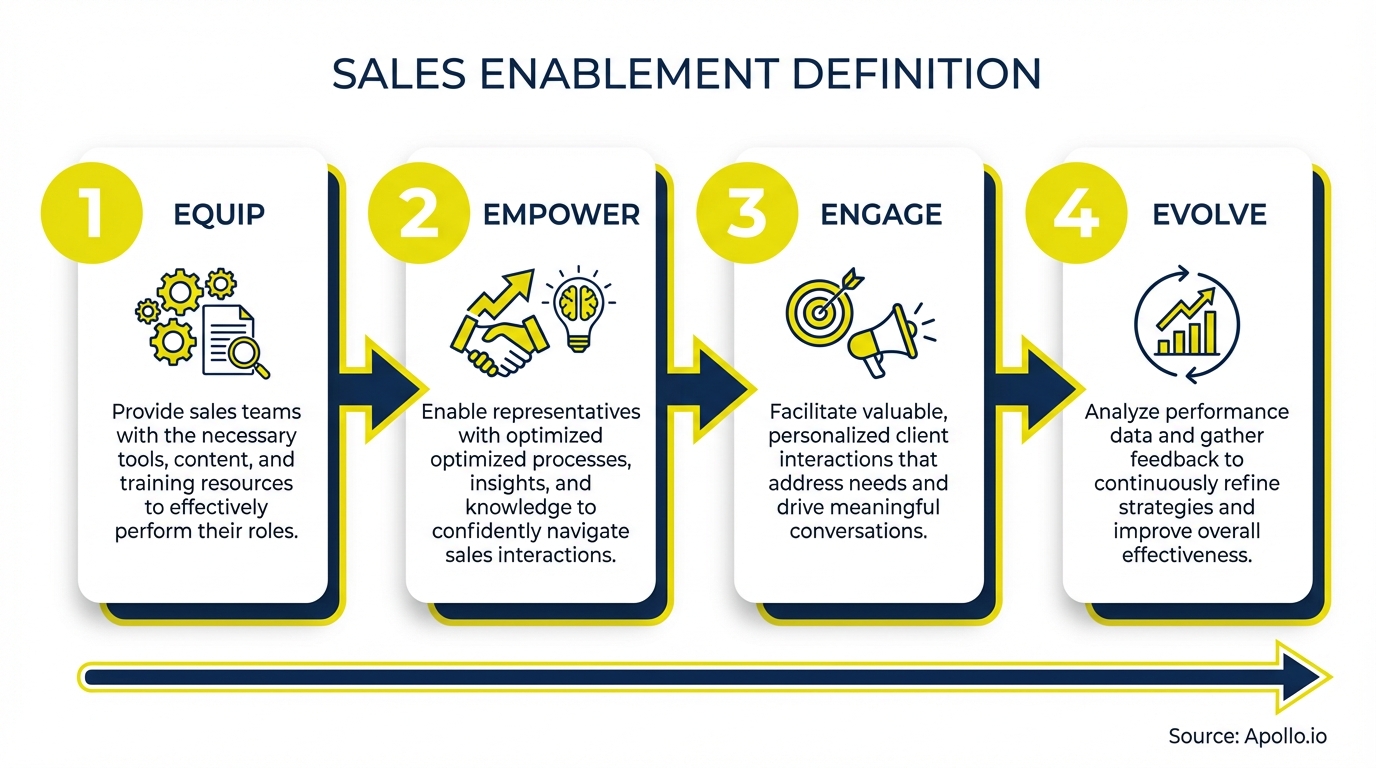
Sales enablement is a strategic function that provides revenue teams with the resources, training, and technology needed to engage buyers effectively and close deals. It bridges the gap between marketing content creation and sales execution by ensuring sellers have access to the right materials at the right time. According to Gartner, sales enablement budgets are projected to increase by 50% by 2027 as organizations recognize its impact on revenue growth.
Enablement encompasses four core pillars:
- Content Management: Creating and organizing sales collateral, case studies, battle cards, and pitch decks that address specific buyer needs
- Training & Onboarding: Developing programs that accelerate ramp time and continuously improve seller skills
- Technology & Tools: Implementing platforms that streamline workflows and provide actionable buyer intelligence
- Analytics & Optimization: Measuring what works and refining strategies based on performance data
Unlike traditional sales training, enablement is continuous. It adapts to market changes, buyer behavior shifts, and new competitive threats. For B2B sales teams, this means having updated materials for every stage of the buyer journey.
Why Is Sales Enablement Important in 2026?
Sales enablement directly impacts revenue by reducing the time sellers spend searching for information and increasing time spent with buyers. Research by Gartner shows that 60% of B2B sales organizations have transitioned to data-driven selling approaches, making enablement critical for competitive advantage.
The business impact is measurable:
| Metric | Impact of Enablement |
|---|---|
| Win Rate | 25-35% increase |
| Quota Attainment | 15-20% improvement |
| Ramp Time | 40% reduction for new hires |
| Deal Velocity | 30% faster close rates |
For SDRs and BDRs, enablement means having battle-tested templates and scripts that book more meetings.
Account Executives gain access to competitive intelligence and ROI calculators that address objections.
RevOps leaders benefit from unified dashboards that show what content drives pipeline.
Struggling with scattered tools and inconsistent messaging? Consolidate your tech stack with Apollo's all-in-one sales engagement platform.
What Is Buyer Enablement?
Buyer enablement shifts focus from equipping sellers to empowering buyers with self-service resources that facilitate confident purchase decisions. Data from Gartner indicates that customers who receive helpful information easing the purchase process are three times more likely to buy bigger solutions with less regret.
Buyer enablement includes:
- Self-Service Content: Interactive demos, ROI calculators, comparison guides, and implementation checklists
- Buying Committee Resources: Materials designed for multiple stakeholders (technical, financial, executive)
- Digital Buying Rooms: Centralized hubs where prospects access all relevant materials
- Post-Sale Enablement: Onboarding guides and success plans that reduce time-to-value
With 43% of B2B customers preferring minimal sales interaction, buyer enablement addresses modern purchasing behavior. Sales teams that provide comprehensive self-service options see higher conversion rates and larger deal sizes. Companies like HubSpot have mastered this approach by creating extensive knowledge bases that answer buyer questions before sales conversations begin.
How Do Sales Leaders Implement Enablement Programs?
Effective enablement requires cross-functional collaboration between sales, marketing, and revenue operations. Sales Leaders begin by auditing current resources, identifying content gaps, and establishing clear success metrics tied to revenue outcomes.
Implementation follows this framework:

- Assess Current State: Survey sellers to identify pain points, content gaps, and workflow inefficiencies
- Define Success Metrics: Set KPIs for content usage, training completion, ramp time, and win rates
- Build Content Library: Create core assets (pitch decks, case studies, objection handlers, ROI tools)
- Select Technology Platform: Choose tools that integrate with existing CRM and provide usage analytics
- Launch Training Programs: Develop onboarding tracks, product certification, and ongoing skill development
- Measure & Iterate: Track which content drives pipeline and refine based on performance data
Founders and CEOs building outbound teams should prioritize enablement from day one. Early investment prevents costly mistakes and establishes repeatable processes. RevOps leaders managing multiple tools can achieve significant cost savings through tech stack consolidation. As Census found when switching to unified platforms, "We cut our costs in half" while improving team productivity.
Turn Forecast Guesswork Into Revenue Certainty
Pipeline forecasting a guessing game? Apollo gives you real-time deal visibility and intent signals that make revenue planning predictable. Built-In increased win rates 10% with Apollo's scoring.
Start Free with Apollo →What Tools Do Revenue Teams Use for Enablement?
Modern enablement stacks typically include 5-7 separate tools: CRM, content management, training platforms, conversation intelligence, and analytics dashboards. This fragmentation creates data silos, integration headaches, and unnecessary costs.
Smart teams are consolidating.
Essential enablement capabilities:
| Capability | Function | ROI Impact |
|---|---|---|
| Content Repository | Centralized library with search and recommendations | 70% reduction in content search time |
| Learning Management | Onboarding tracks, certifications, skill assessments | 40% faster ramp for new hires |
| Conversation Intelligence | Call recording, transcription, coaching insights | 25% improvement in talk-to-listen ratio |
| Sales Engagement | Sequence automation, email templates, cadence tracking | 3x increase in touchpoints per prospect |
| Analytics Dashboard | Content performance, skill gaps, revenue attribution | 35% better forecast accuracy |
Teams using AI-powered sales tools report 46% more meetings booked and 35% increases in conversion rates. Cyera consolidated their enablement stack and found that "having everything in one system was a game changer" for team adoption and performance visibility. Tired of managing multiple disconnected tools? Unify your go-to-market strategy with Apollo's revenue platform.
How Do SDRs and AEs Measure Enablement ROI?
Enablement investments must demonstrate measurable business impact. SDRs and BDRs track leading indicators like meeting booking rates and response rates.
Account Executives focus on deal velocity, win rates, and average contract value. Revenue leaders monitor broader metrics including quota attainment, forecast accuracy, and customer acquisition cost.
Key performance indicators by role:
- SDRs/BDRs: Meetings booked per rep, email response rate, call-to-meeting conversion, time to first meeting
- Account Executives: Win rate, average deal size, sales cycle length, multi-threading success rate
- Sales Leaders: Team quota attainment, forecast accuracy, rep ramp time, revenue per rep
- RevOps: Content utilization rate, training completion, tool adoption, cost per closed deal
Organizations with mature enablement functions report 15-20% higher team quota attainment and 30% faster deal cycles. The key is connecting enablement activities to revenue outcomes through attribution modeling. Teams using sales analytics platforms can track which training modules correlate with higher win rates and which content assets drive pipeline progression.
What Is the Future of Sales Enablement?
Sales enablement is evolving into revenue enablement, expanding beyond sales to include marketing, customer success, and product teams. This holistic approach aligns all customer-facing functions around unified messaging, shared metrics, and collaborative workflows.
By 2026, leading organizations have replaced siloed enablement programs with integrated revenue operations.

Emerging trends shaping enablement:
- AI-Powered Personalization: Dynamic content recommendations based on buyer signals and deal context
- Just-in-Time Learning: Microlearning delivered at the moment of need rather than scheduled training sessions
- Predictive Analytics: AI models that identify at-risk deals and recommend next-best actions
- Buyer Journey Orchestration: Automated workflows that deliver relevant content based on prospect behavior
- Revenue Intelligence: Unified dashboards connecting enablement activities to pipeline and revenue outcomes
Teams that embrace AI-powered automation report 2.5x revenue growth compared to manual approaches. The future belongs to organizations that break down departmental silos and create seamless buyer experiences across every touchpoint.
Start Building Your Sales Enablement Strategy
Sales enablement drives measurable revenue impact when executed strategically. By equipping revenue teams with the right content, training, and technology, organizations accelerate deal cycles, improve win rates, and scale predictably.
The shift toward data-driven, buyer-centric enablement represents the future of B2B sales.
For teams ready to consolidate their tech stack and implement world-class enablement, Apollo provides an all-in-one platform with 224M+ verified contacts, AI-powered workflows, and conversation intelligence. As Predictable Revenue discovered, "We reduced the complexity of three tools into one" while improving team performance across all metrics.
Ready to transform your sales enablement? Try Apollo Free and experience how unified revenue platforms accelerate growth.
Prove Apollo's ROI In Your First 30 Days
Budget approval stuck on unclear metrics? Apollo tracks every touchpoint from prospect to closed deal—quantifying time saved, pipeline generated, and win rates improved. Built-In increased ACV 10% with Apollo's scoring.
Start Free with Apollo →Don't miss these
Sales
Inbound vs Outbound Marketing: Which Strategy Wins?
Sales
What Is a Sales Funnel? The Non-Linear Revenue Framework for 2026
Sales
What Is a Go-to-Market Strategy? The 2026 GTM Playbook
See Apollo in action
We'd love to show how Apollo can help you sell better.
By submitting this form, you will receive information, tips, and promotions from Apollo. To learn more, see our Privacy Statement.
4.7/5 based on 9,690 reviews
