What Is Sales Efficiency and How Do You Measure It in 2026?
Sales efficiency measures how effectively your team converts resources into revenue. It's the ratio of output (meetings booked, deals closed, revenue generated) to input (time, budget, headcount).
In 2026, sales efficiency isn't about working harder; it's about eliminating friction, consolidating tools, and giving sellers more time to actually sell.
The stakes are higher than ever. According to recent HubSpot research, sales representatives spend only about 2 hours per day actively selling, with approximately 1 hour per day dedicated to administrative tasks. Meanwhile, industry projections indicate that by 2025, 80% of B2B sales interactions between suppliers and buyers will occur through digital channels. That shift demands a new approach to efficiency, one that balances automation with authentic connection.

Apollo Delivers 96% Accurate Contacts Instantly
Tired of bounced emails and dead phone numbers killing your pipeline? Apollo verifies 224M+ contacts so every dial connects. Join 550K+ companies closing more deals with clean data.
Start Free with Apollo →Key Takeaways
- Sales efficiency = revenue output divided by resource input (time, budget, people)
- Sellers spend less than 25% of their week actually selling; the rest is admin, research, and coordination
- Unified platforms cut tech stack complexity and reduce context-switching between tools
- AI-driven workflows automate research, personalization, and follow-up at scale
- Measuring efficiency requires tracking time-to-value metrics, not just activity counts
Why Sales Efficiency Matters More in 2026
Sales efficiency directly impacts your bottom line. When reps spend most of their day on non-selling activities (data entry, tool-switching, manual research), revenue suffers.
The efficiency problem compounds when teams use fragmented tech stacks that create data silos and require reps to toggle between five or more platforms just to complete one outreach sequence.
Modern buyers expect seamless, personalized experiences across every touchpoint. Research from HubSpot shows that in 2024, 52% of sales professionals observed an increase in B2B customers utilizing self-serve tools compared to the previous year. That means your content, your outreach, and your sales process must work harder even when reps aren't directly involved.
"Apollo could be a third of the cost if you look at the full price of what we were spending on ZoomInfo, Outreach, Salesforce, and admins to make it all work."
Core Components of Sales Efficiency
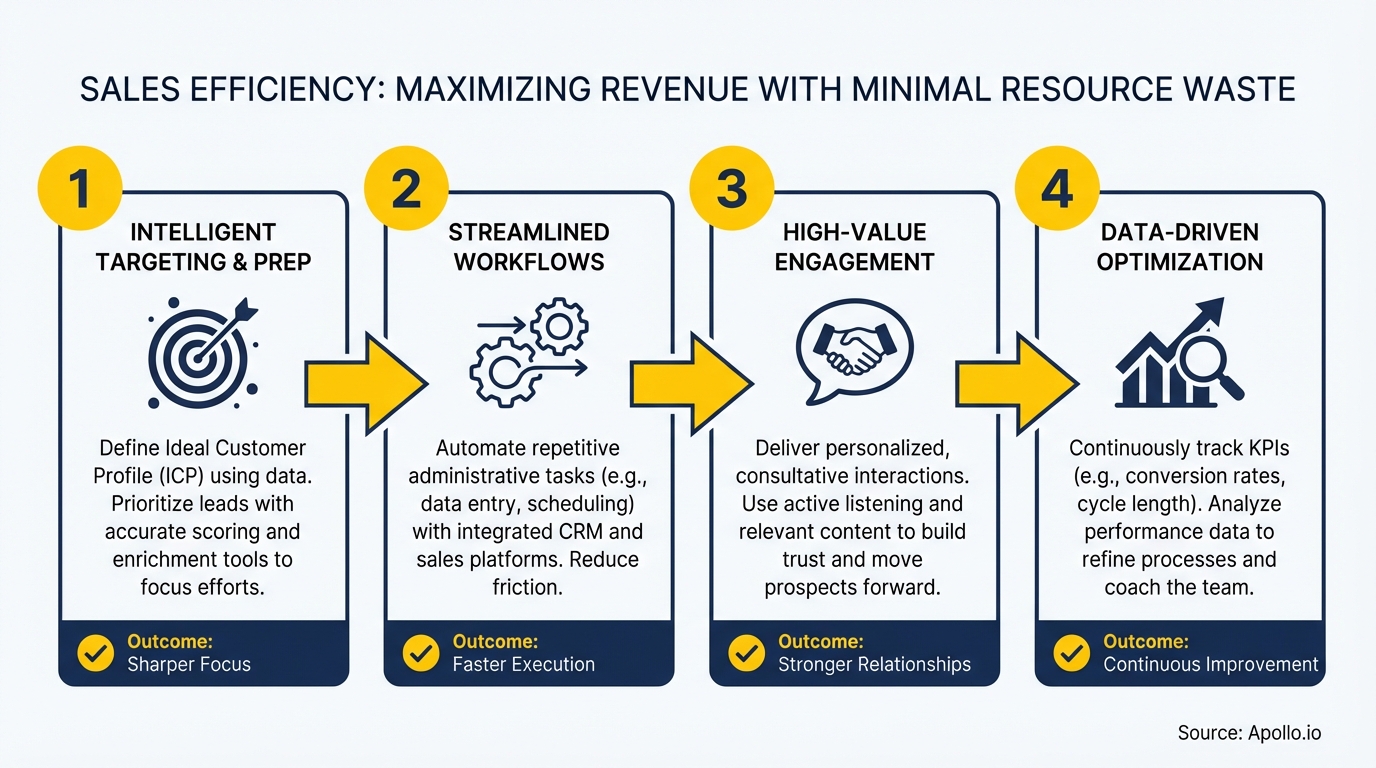
Sales efficiency rests on three pillars: time optimization, data quality, and process automation. Each pillar directly influences how much revenue your team can generate without adding headcount or budget.
Time Optimization
Time is your reps' scarcest resource. Every minute spent on manual data entry, researching prospects, or switching between tools is a minute not spent selling. Sales productivity improves when you eliminate low-value tasks and give reps more time for high-impact activities like discovery calls and closing conversations.
Data Quality
Bad data kills efficiency. When contact information is outdated or incomplete, reps waste hours chasing dead ends. Accurate, enriched data means your team spends less time verifying emails and more time booking meetings. Need clean, verified contacts? Start with Apollo's 224M+ verified B2B contacts.
Process Automation
Automation handles repetitive tasks at scale: sequencing emails, logging activities, updating CRM records, and triggering follow-ups. Sales automation software frees your team to focus on strategy and relationship-building instead of manual busywork.
How to Measure Sales Efficiency
Sales efficiency isn't a single metric; it's a system of indicators that reveal where your process creates value and where it bleeds resources. Track these four core metrics to baseline your current efficiency and identify improvement opportunities.
| Metric | Formula | What It Reveals |
|---|---|---|
| Sales Efficiency Ratio | New Revenue ÷ Sales & Marketing Spend | Overall ROI of your GTM investment |
| Time-to-Productivity | Days from hire to first closed deal | Onboarding effectiveness and ramp speed |
| Activity-to-Outcome Ratio | Meetings booked ÷ outreach touches | Quality of targeting and messaging |
| Tool Utilization Rate | Active users ÷ total licenses | Tech stack bloat and adoption gaps |
A recent benchmark study found that 42% of companies experienced a decrease in quota attainment in 2022, highlighting the urgency of improving efficiency across the entire sales motion.
Turn Forecast Guesswork Into Revenue Certainty
Pipeline forecasting a guessing game? Apollo scores every prospect with real-time buying signals so you know exactly which deals will close. Built-In increased win rates 10% with Apollo's intelligence.
Start Free with Apollo →The Tech Stack Consolidation Imperative
Tool proliferation is the silent killer of sales efficiency. When your team uses separate platforms for data, engagement, dialer, and CRM, they lose minutes (or hours) every day to context-switching, manual data syncing, and reconciling conflicting information across systems.
Consolidating your tech stack into a unified platform delivers measurable efficiency gains. Teams report fewer login cycles, faster onboarding, and cleaner data flows when they move from a patchwork of point solutions to an all-in-one workspace.
"We reduced the complexity of three tools into one. We're getting higher reply rates, open rates are doubled, meetings are up, and speed to booking a meeting is cut in half."
Want to cut your sales tech stack? Explore Apollo's unified sales engagement platform that combines data, outreach, and insights in one workspace.
AI-Driven Efficiency: Automating Research and Personalization
AI transforms sales efficiency by handling the grunt work that traditionally consumed hours of rep time. Modern AI tools can research prospects, draft personalized emails, suggest talking points, and even score leads based on fit and intent signals.
The key is using AI to augment human judgment, not replace it. AI excels at pattern recognition and data synthesis; humans excel at empathy, negotiation, and relationship-building.
The most efficient sales teams use AI to handle research and first-draft content, then let reps add the human touch that closes deals.
GenAI adoption is accelerating across sales organizations. Teams that integrate AI-powered workflows report measurable improvements in outreach volume, personalization quality, and rep productivity. Learn more about AI sales tools that actually close deals.

Building a Sales Efficiency Action Plan
Improving sales efficiency requires a systematic approach. Start with a 90-day sprint focused on quick wins and measurable outcomes.
Days 1-30: Baseline and Diagnose
- Audit current time allocation (how much time do reps actually spend selling?)
- Map your tech stack and identify redundant tools
- Assess data quality (email accuracy, contact completeness, firmographic coverage)
- Survey reps on their biggest time-wasters and process friction points
Days 31-60: Implement and Optimize
- Consolidate overlapping tools into a unified platform
- Deploy automation for repetitive tasks (sequencing, logging, enrichment)
- Train reps on new workflows and establish adoption metrics
- Refine targeting and messaging based on early engagement data
Days 61-90: Scale and Measure
- Roll out optimized workflows across the full team
- Establish ongoing dashboards for efficiency metrics
- Document playbooks and best practices
- Plan next-quarter improvements based on data insights
For deeper guidance on structuring your revenue engine, explore revenue operations best practices that align sales, marketing, and customer success.
Common Sales Efficiency Pitfalls to Avoid
Even well-intentioned efficiency initiatives can backfire. Watch for these common mistakes:
- Optimizing for activity instead of outcomes: More emails sent doesn't equal more revenue. Focus on conversion rates, not just volume.
- Ignoring sales and marketing alignment: According to recent research, only 8% of companies have achieved strong alignment between their sales and marketing departments. Misalignment creates rework and wastes resources.
- Over-automating without human oversight: Automation should free reps to focus on high-value work, not replace judgment entirely.
- Skipping data hygiene: No amount of automation fixes bad data. Prioritize data quality before scaling outreach.
Measuring Success: KPIs That Matter
Track these leading and lagging indicators to gauge your efficiency improvements:
- Time spent selling (% of total work hours): Aim for 40%+ vs the current baseline of ~24%
- Cost per opportunity: Total sales spend divided by pipeline opportunities created
- Sales cycle length: Days from first touch to closed-won
- Win rate by rep: Percentage of opportunities that convert to revenue
- Revenue per rep: Total bookings divided by seller headcount
For a comprehensive view of what to track, review essential sales KPIs for 2026.
Ready to Scale Sales Efficiency?
Sales efficiency isn't a one-time project; it's an ongoing discipline. The teams that win in 2026 will be those that ruthlessly eliminate friction, consolidate their tech stacks, and empower reps to spend more time selling and less time administering.
Start by auditing where your team spends time today. Identify the biggest time-wasters. Then systematically eliminate them through automation, better data, and unified workflows.
Apollo helps teams at growing startups, mid-market companies, and enterprise organizations improve sales efficiency with an all-in-one platform for prospecting, engagement, and deal execution. Try Apollo Free and see how consolidating your sales tech stack can give your reps more time to close deals.
Prove Apollo's ROI In Your First 30 Days
Budget approval stuck on unclear metrics? Apollo tracks every touchpoint from prospect to closed deal so you can show leadership exactly what's working. Built-In increased win rates 10% and ACV 10% with Apollo's intelligence.
Start Free with Apollo →Don't miss these
Sales
Inbound vs Outbound Marketing: Which Strategy Wins?
Sales
What Is a Sales Funnel? The Non-Linear Revenue Framework for 2026
Sales
What Is a Go-to-Market Strategy? The 2026 GTM Playbook
See Apollo in action
We'd love to show how Apollo can help you sell better.
By submitting this form, you will receive information, tips, and promotions from Apollo. To learn more, see our Privacy Statement.
4.7/5 based on 9,690 reviews
