
How to Build a Sales Budget That Drives Revenue Growth
Your sales budget determines whether your team hits quota or struggles to keep up. In 2026, B2B sales leaders face a tough choice: invest in multiple point solutions or consolidate into unified platforms that deliver measurable ROI. With B2B e-commerce reaching $1.94 trillion, smart budgeting directly impacts your ability to compete. Modern sales tech stacks need strategic allocation across prospecting, engagement, and pipeline management.

Apollo Eliminates 4+ Hours Of Daily Research
Tired of spending 4+ hours daily hunting for contact info? Apollo delivers 224M verified contacts with 96% email accuracy instantly. Join 550K+ companies who stopped manual prospecting.
Start Free with Apollo →Key Takeaways
- Sales budgets connect investments directly to pipeline and revenue outcomes through data-driven planning
- AI-powered tools reduce costs while improving performance, with 95% of B2B marketers adopting automation
- Consolidating your tech stack into unified platforms cuts costs in half and eliminates integration headaches
- RevOps leaders use budget allocation to align sales and marketing around shared revenue goals
- Strategic budget planning includes prospecting, engagement, data enrichment, and conversation intelligence
What Is a Sales Budget?
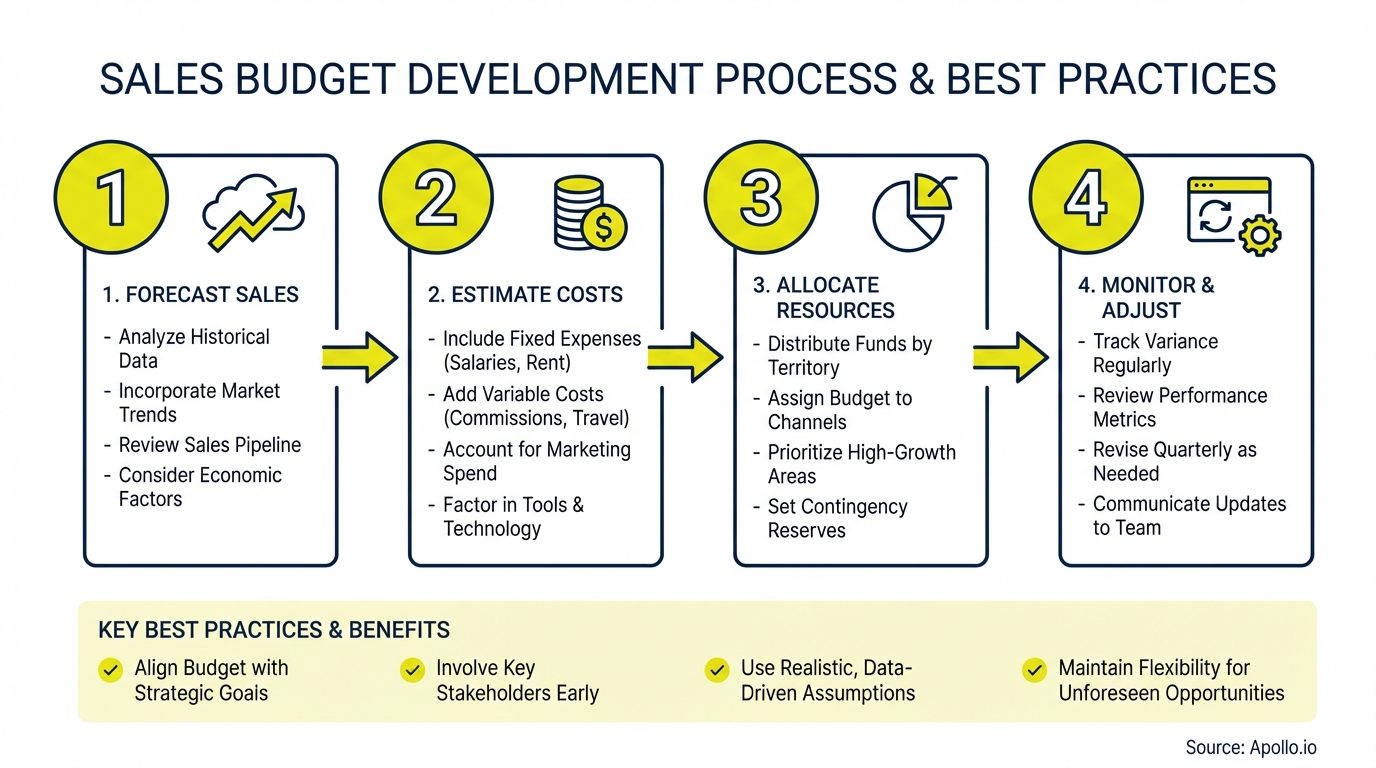
A sales budget is a financial plan that allocates resources across people, tools, training, and campaigns to achieve revenue targets. It maps investments to expected outcomes, showing how much you'll spend on prospecting tools, engagement platforms, data enrichment, and team compensation.
Sales Leaders use budgets to forecast pipeline generation and track ROI across channels.
The budget breaks down into fixed costs (salaries, software subscriptions) and variable costs (advertising, events, commissions). For example, if your team needs to generate $5M in pipeline, you calculate backward: conversion rates, deal sizes, activities required, and the tools needed to execute. B2B sales organizations typically allocate 15-25% of projected revenue to sales operations.
Why Do Sales Leaders Need Strategic Budget Planning?
Strategic budget planning prevents wasted spending and aligns investments with revenue goals. According to recent research, 69% of marketers increased their budgets in 2024, but many lack frameworks connecting spend to pipeline outcomes. Without clear allocation, teams overspend on redundant tools while underfunding high-impact activities.

RevOps leaders face pressure to demonstrate ROI for every dollar. Data from UMA Technology shows 78% of B2B marketers attribute success to personalized content, yet few budget specifically for personalization tools. Strategic planning ensures you invest in capabilities that directly impact conversion rates, deal velocity, and customer acquisition costs.
What Are the Core Components of a Sales Budget?
Modern sales budgets include six essential categories that cover the entire revenue generation process:
| Budget Category | Allocation Range | Key Investments |
|---|---|---|
| Prospecting & Data | 20-30% | Contact databases, enrichment tools, intent signals |
| Sales Engagement | 15-25% | Outreach platforms, sequence automation, multi-channel tools |
| Conversation Intelligence | 10-15% | Call recording, AI analysis, coaching platforms |
| Pipeline Management | 10-15% | CRM systems, deal tracking, forecasting tools |
| Team Compensation | 40-50% | Salaries, commissions, bonuses, benefits |
| Training & Enablement | 5-10% | Onboarding, skill development, sales playbooks |
The exact percentages vary by company stage, market, and strategy. Early-stage companies often allocate more to prospecting tools, while enterprise teams invest heavily in conversation intelligence and enterprise sales solutions.
How Do SDRs and AEs Benefit From Proper Budget Allocation?
SDRs benefit when budgets prioritize high-quality prospecting tools and automation. Teams using unified platforms report booking 46% more meetings because they spend less time switching between systems.
Proper allocation means SDRs get verified contact data, automated sequences, and AI-powered research instead of manual list building.
Account Executives need budget allocated to conversation intelligence and deal management. When AEs have access to call transcripts, AI-generated summaries, and pipeline visibility tools, they shorten sales cycles by 35%. Struggling to manage your pipeline across multiple tools? Consolidate deal tracking and forecasting in one platform with Apollo.
How Should Sales Leaders Budget for AI and Automation in 2026?
AI and automation now represent 15-25% of modern sales budgets. Research from ASJA shows 95% of B2B marketers are using or adopting AI applications, with 89% leveraging AI for content creation. Sales teams applying similar adoption rates see dramatic efficiency gains.
Budget for these AI capabilities:
- AI Research Agents: Automate account research and personalization prep (10-15% of tool budget)
- Conversation Intelligence: Record, transcribe, and analyze calls for coaching insights (15-20%)
- Predictive Analytics: Score leads and forecast pipeline with machine learning (10-15%)
- Automated Outreach: Generate personalized emails and sequences at scale (20-25%)
The ROI justifies the investment. Teams using AI sales tools report 500% year-over-year growth in platform adoption because these tools eliminate busywork and improve conversion rates.
Turn Forecast Chaos Into Revenue Certainty
Pipeline forecasting a guessing game? Apollo tracks every deal stage in real time so you can forecast with confidence. Built-In increased win rates 10% with Apollo's pipeline intelligence.
Start Free with Apollo →What Budget Mistakes Do Sales Teams Make Most Often?
The biggest mistake is buying redundant tools that create integration nightmares. Sales teams often pay for separate prospecting databases, engagement platforms, enrichment services, and dialer systems when unified solutions exist.
This fragmentation wastes 30-40% of tool budgets on overlapping capabilities.
Other common errors include:
- Underfunding Data Quality: Cheap contact databases cost more when reps waste time on bad numbers
- Ignoring Training: New tools fail without proper onboarding and ongoing coaching
- Neglecting Conversation Intelligence: Teams miss coaching opportunities without call recording and analysis
- Overbuying Licenses: Paying for seats that go unused due to poor adoption planning
RevOps leaders prevent these mistakes by auditing current spending, identifying overlaps, and building consolidated tech stacks that reduce complexity. As one customer noted, "Having everything in one system was a game changer" (Cyera).
How Can Sales Leaders Maximize ROI From Their Budget?
Maximize ROI by consolidating tools into unified platforms that cover prospecting, engagement, and pipeline management. Companies switching to all-in-one solutions report cutting costs in half (Census) while improving team performance.
The key is eliminating context switching and data silos that slow reps down.
Focus budget on high-impact activities:
- Quality Over Quantity: Invest in verified contact data rather than massive unverified lists
- Automation: Allocate 20-30% to tools that automate repetitive tasks like research and follow-ups
- Coaching: Use conversation intelligence to identify what top performers do differently
- Personalization: Budget for AI tools that tailor messaging at scale
Track metrics that matter: cost per qualified lead, customer acquisition cost, pipeline generated per dollar spent, and sales cycle length. Wasting budget on disconnected tools? Unify your go-to-market strategy with Apollo's all-in-one platform.
Take Control of Your Sales Budget in 2026
Smart sales budgeting connects every dollar to pipeline outcomes. In 2026, successful teams consolidate redundant tools, invest in AI automation, and allocate strategically across prospecting, engagement, and intelligence.
RevOps leaders who audit spending and eliminate overlaps gain competitive advantage through lower costs and higher performance.
Start by mapping your current spending to revenue outcomes. Identify tools with overlapping capabilities, calculate the true cost of fragmented systems, and explore unified platforms that reduce complexity.
Modern sales organizations need budgets that reflect how teams actually work: prospecting, engaging, and closing deals in one integrated workspace.
Ready to cut your sales tech stack and maximize budget ROI? Schedule a Demo to see how Apollo's all-in-one platform consolidates prospecting, engagement, and pipeline management into a single workspace that drives measurable revenue growth.
Prove Apollo's ROI In Your First 30 Days
Budget approval stuck on unclear metrics? Apollo tracks every dollar spent to pipeline generated with built-in ROI dashboards. Built-In increased win rates 10% and ACV 10% with measurable impact.
Start Free with Apollo →Don't miss these
Sales
Inbound vs Outbound Marketing: Which Strategy Wins?
Sales
What Is a Sales Funnel? The Non-Linear Revenue Framework for 2026
Sales
What Is a Go-to-Market Strategy? The 2026 GTM Playbook
See Apollo in action
We'd love to show how Apollo can help you sell better.
By submitting this form, you will receive information, tips, and promotions from Apollo. To learn more, see our Privacy Statement.
4.7/5 based on 9,690 reviews
