What Is SaaS Sales? Definition, Process, and Strategies for 2026
SaaS sales is the process of selling cloud-based software solutions through subscription models to business customers. Unlike traditional software sales that involve one-time purchases and physical installations, SaaS sales focuses on recurring revenue relationships where customers pay monthly or annually for access to web-based applications. This model has transformed how companies acquire and deploy business software, creating a $562.6 billion global market expected to grow at 23% CAGR through 2029, according to Technavio's market research.

Eliminate 4+ Hours Of Manual Research Daily
Tired of reps spending half their day hunting for contact info? Apollo delivers 224M verified contacts with 96% email accuracy instantly. Join 550K+ companies who stopped researching and started selling.
Start Free with Apollo →Key Takeaways
- SaaS sales involves selling subscription-based cloud software with recurring revenue models and digital-first engagement strategies
- The average sales cycle for deals over $100k extends six months or more, requiring strategic nurturing and executive alignment
- AI-powered sales automation now reduces sales cycle time by 65% while increasing conversion rates by 30%
- Marketing-sales alignment remains the biggest barrier to goal achievement, with 44% of teams citing it as their primary challenge
- Companies using annual billing models grow 10% faster than those with monthly billing due to upfront cash flow advantages
What Is SaaS Sales?
SaaS sales is the discipline of selling Software-as-a-Service products to business customers through subscription-based pricing models. Unlike traditional enterprise software that requires on-premise installation, SaaS products are accessed via web browsers with the vendor hosting and maintaining the infrastructure.
This creates a fundamentally different sales approach focused on demonstrating immediate value, reducing friction to adoption, and building long-term customer relationships rather than closing one-time deals.
The SaaS sales model operates on recurring revenue principles where customer lifetime value (LTV) matters more than initial deal size. Sales teams must balance acquisition costs against retention rates, making the sales process extend well beyond the initial contract signature. Research by Gitnux shows that SaaS companies with annual billing receive upfront cash that fuels 10% faster growth compared to monthly billing cycles.
For SDRs and AEs in 2026, understanding B2B sales fundamentals remains critical as 80% of B2B sales interactions now occur through digital channels. This digital-first reality requires sales professionals to master virtual selling, leverage data-driven insights, and demonstrate ROI through remote product demonstrations.
How Does the SaaS Sales Process Work?
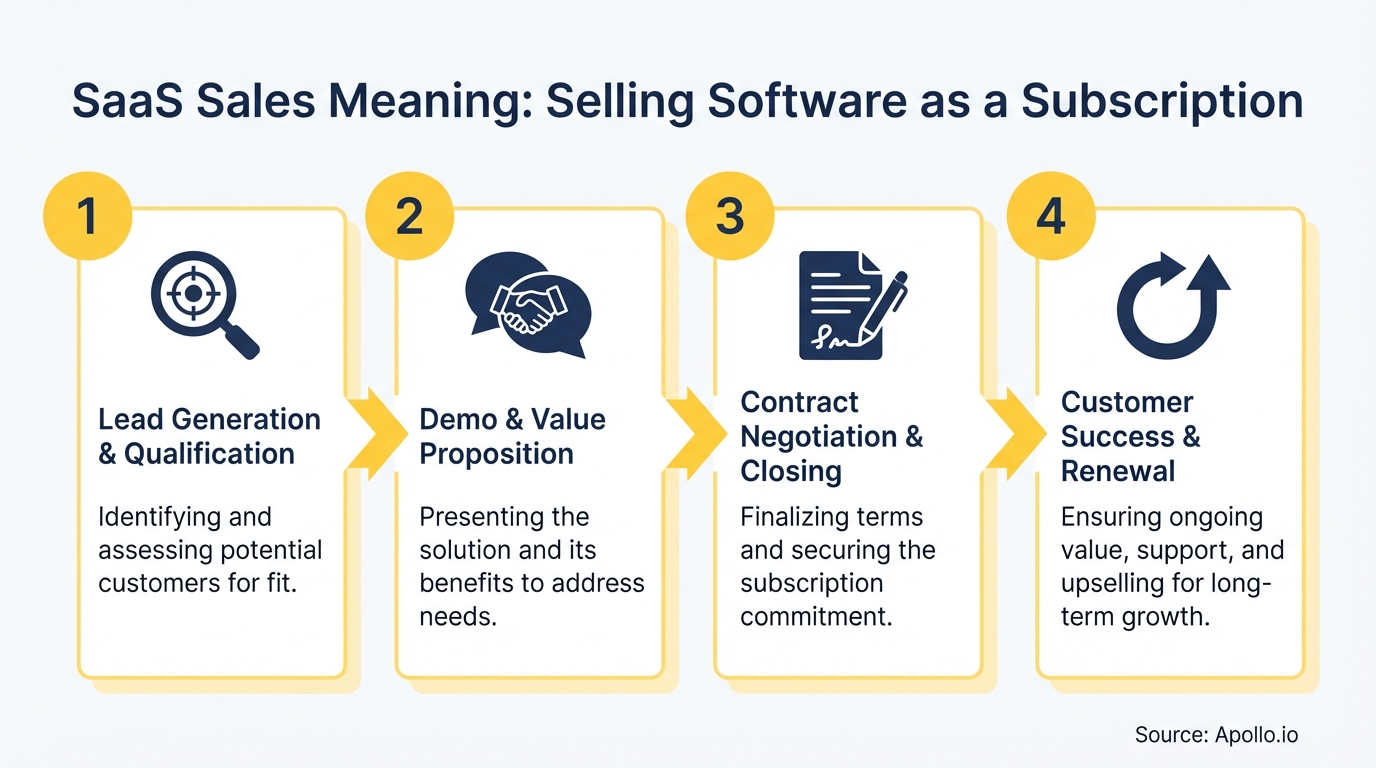
The SaaS sales process follows a structured journey from prospecting to closed-won deals, with distinct stages optimized for subscription business models. The process begins with identifying ideal customer profiles (ICPs) using firmographic and technographic data, then engaging prospects through multi-channel outreach including email, LinkedIn, and phone.
Unlike traditional sales, SaaS sales emphasizes product-led growth where prospects can often trial the software before committing to paid plans.
Key stages include:
- Prospecting and Lead Generation: SDRs identify target accounts using databases with 224M+ business contacts and 65+ filtering criteria
- Qualification: Teams use frameworks like BANT or MEDDIC to assess fit, urgency, and budget alignment
- Demo and Discovery: AEs conduct tailored product demonstrations addressing specific pain points and use cases
- Proposal and Negotiation: Sales teams present pricing options, typically offering annual vs. monthly plans with discounts for upfront payment
- Closing and Onboarding: The sale completes with contract signature followed by customer success handoff for implementation
Struggling to find qualified prospects in your ICP? Search Apollo's 224M+ verified contacts with 65+ filters to build targeted lists in minutes.
The process differs significantly by deal size. Enterprise SaaS sales involving contracts over $100k require six months or more, with multiple stakeholder meetings and procurement reviews. Conversely, self-service or low-touch SaaS sales can close within days through automated workflows and product-led conversion funnels.
Why Is SaaS Sales Different From Traditional Software Sales?
SaaS sales fundamentally differs from traditional software sales in pricing structure, customer relationships, and sales cycles. Traditional software involved large upfront license fees with optional maintenance contracts, while SaaS operates on recurring subscription revenue where customers can cancel monthly or annually.
This creates a "land and expand" dynamic where initial deals may be smaller but grow through upsells and cross-sells over time.
Critical distinctions include:
| Aspect | Traditional Software | SaaS Sales |
|---|---|---|
| Revenue Model | One-time perpetual licenses | Recurring monthly/annual subscriptions |
| Implementation | On-premise installation, long deployment | Cloud-based, immediate access |
| Sales Cycle | 9-18 months for enterprise deals | Days to 6 months depending on deal size |
| Customer Success | Minimal post-sale engagement | Ongoing support critical for retention |
| Upgrades | Separate purchase decisions | Continuous feature releases included |
For Sales Leaders managing SaaS teams, success metrics shift from bookings to monthly recurring revenue (MRR), churn rate, and net revenue retention (NRR). The emphasis on customer lifetime value means sales teams collaborate closely with customer success to prevent cancellations and identify expansion opportunities. Building optimized SaaS sales funnels requires understanding these unique dynamics and structuring processes accordingly.
Turn Forecast Guesswork Into Pipeline Clarity
Forecasts falling apart because you can't see where deals really stand. Apollo's real-time signals and scoring reveal exactly which opportunities are moving forward. Built-In boosted win rates 10% with Apollo's pipeline intelligence.
Start Free with Apollo →How Do SDRs Generate Pipeline in SaaS Sales?
SDRs generate pipeline in SaaS sales by executing targeted outbound prospecting campaigns and qualifying inbound leads for Account Executives. Their primary responsibility involves identifying decision-makers at target accounts, initiating conversations through personalized multi-channel sequences, and booking qualified discovery meetings.
In 2026, top-performing SDRs leverage AI-powered research tools and intent data to prioritize accounts showing buying signals.
Effective SDR strategies include:
- Account-Based Prospecting: Focusing on high-fit accounts rather than mass outreach, using technographic data to identify companies using competitive or complementary tools
- Multi-Channel Cadences: Combining email, LinkedIn, phone, and video messages across 8-12 touchpoints over 2-3 weeks
- Personalization at Scale: Using AI to research prospects and tailor messaging based on recent company news, funding rounds, or job changes
- Social Selling: Building presence on LinkedIn through strategic engagement and content sharing
Spending hours researching prospects manually? Let Apollo's AI Research Agent deliver 46% more meetings by automating prospect intelligence gathering.
Data from StartUPulse research shows that companies implementing AI-driven sales tools report a 65% reduction in sales cycle time and a 30% increase in conversion rates. SDRs using AI-powered platforms can research accounts, personalize outreach, and track engagement signals without juggling multiple tools, reducing their tech stack complexity while improving results.
What Are the Key Metrics for SaaS Sales Success?
Key metrics for SaaS sales success center on recurring revenue growth, customer acquisition efficiency, and retention rates. Unlike traditional sales that measure closed deals and revenue quotas, SaaS sales teams track metrics that reflect the subscription business model's unique economics.
Sales Leaders and RevOps teams monitor these KPIs to forecast revenue, optimize resource allocation, and identify process improvements.
Essential SaaS sales metrics include:
- Monthly Recurring Revenue (MRR): Predictable monthly subscription revenue, the primary growth indicator
- Annual Recurring Revenue (ARR): MRR multiplied by 12, used for annual planning and valuation
- Customer Acquisition Cost (CAC): Total sales and marketing expenses divided by new customers acquired
- Customer Lifetime Value (LTV): Total revenue expected from a customer relationship
- LTV:CAC Ratio: Ideal ratio is 3:1 or higher, indicating efficient growth
- Sales Cycle Length: Average days from first contact to closed-won deal
- Win Rate: Percentage of qualified opportunities that convert to customers
- Net Revenue Retention (NRR): Revenue retained from existing customers including expansions minus churn
For RevOps leaders, consolidating sales tools into a unified platform provides cleaner data and more accurate forecasting. Companies report that building integrated sales tech stacks eliminates data silos between prospecting, engagement, and deal management systems. As one RevOps leader shared: "Having everything in one system was a game changer" (Cyera).
How Can Sales Teams Improve SaaS Sales Performance?
Sales teams improve SaaS sales performance by implementing AI-powered automation, aligning marketing and sales processes, and adopting hyper-personalization strategies at scale. The most successful teams in 2026 focus on tool consolidation, eliminating the complexity of managing separate platforms for prospecting, outreach, call tracking, and deal management. According to MarTech research, 44% of teams cite marketing-sales alignment problems as their primary barrier to achieving revenue goals.
Proven improvement strategies include:
- Unified GTM Platform: Replacing 3-5 separate tools with an all-in-one platform for prospecting, engagement, and pipeline management
- AI-Powered Personalization: Using AI to generate tailored messaging based on prospect context, resulting in 35% increases in booking rates
- Sales and Marketing SLAs: Establishing clear lead handoff criteria, response time expectations, and feedback loops
- Data-Driven Coaching: Analyzing call recordings, email performance, and deal progression to identify coaching opportunities
- Account-Based Strategies: Coordinating sales and marketing efforts around high-value target accounts
Founders and CEOs building outbound teams report significant cost savings through tool consolidation. "We reduced the complexity of three tools into one" (Predictable Revenue), while another customer shared: "We cut our costs in half" (Census). These savings come from eliminating redundant subscriptions, reducing integration maintenance, and improving team productivity with a single workspace.

Account Executives managing complex deals benefit from deal management platforms that provide complete pipeline visibility and automate follow-up tasks. Combined with AI sales tools that handle research and outreach, modern SaaS sales teams can focus on high-value activities like relationship building and strategic selling rather than administrative busywork.
Start Scaling Your SaaS Sales in 2026
SaaS sales success in 2026 requires mastering digital-first engagement, leveraging AI automation, and building efficient recurring revenue engines. The fundamentals remain constant: understand your ideal customer profile, deliver personalized value propositions, and focus on long-term customer relationships rather than transactional deals.
However, the tools and tactics have evolved dramatically, with AI-powered platforms now handling research, personalization, and follow-up at scales previously impossible.
For SDRs, BDRs, AEs, and Sales Leaders looking to hit quota in an increasingly competitive market, the key differentiator is tool consolidation. Rather than juggling separate platforms for contact data, email sequencing, call recording, and pipeline tracking, leading teams operate from unified workspaces that provide 224M+ verified contacts, AI-powered messaging, conversation intelligence, and deal management in one system.
Ready to cut your tech stack and accelerate your SaaS sales? Start a free trial with Apollo and discover how 550K+ companies are using AI-powered sales automation to book more meetings, shorten sales cycles, and grow recurring revenue faster.
Prove Apollo's ROI In Your First 30 Days
Budget approval stuck on unclear metrics? Apollo tracks every touchpoint from prospect to closed deal—quantify exactly how many hours saved and pipeline dollars generated. Built-In increased win rates 10% and ACV 10% with measurable Apollo impact.
Start Free with Apollo →Don't miss these
Sales
Inbound vs Outbound Marketing: Which Strategy Wins?
Sales
What Is a Sales Funnel? The Non-Linear Revenue Framework for 2026
Sales
What Is a Go-to-Market Strategy? The 2026 GTM Playbook
See Apollo in action
We'd love to show how Apollo can help you sell better.
By submitting this form, you will receive information, tips, and promotions from Apollo. To learn more, see our Privacy Statement.
4.7/5 based on 9,690 reviews
