
What Is Permission-Based Email Marketing? The Deliverability Blueprint for 2026
Permission-based email marketing is no longer just a compliance checkbox. In 2026, it's the difference between inboxing and getting filtered. Major mailbox providers now tie permission signals directly to deliverability thresholds: Gmail enforces a 0.3% spam-complaint ceiling, Yahoo requires two-day unsubscribe turnaround, and Microsoft joined the enforcement wave in 2025. According to Powered by Search, 77% of B2B buyers prefer to be contacted by email over any other channel. The stakes are clear: get permission right, or your sequences go dark.
This guide connects permission signals to inbox placement, DMARC authentication, opt-out UX, and ROI measurement. You'll walk away with actionable playbooks for B2B teams sending at scale.

Stop Manual Research - Apollo Finds Leads Fast
Tired of spending 4+ hours daily hunting for contact info? Apollo delivers 224M verified contacts with 96% email accuracy. Join 550K+ companies who turned research time into selling time.
Start Free with Apollo →Key Takeaways
- Permission controls ARE deliverability controls: Gmail's 0.3% spam-rate ceiling and one-click unsubscribe requirements are now table stakes for inbox placement.
- Authentication is non-negotiable: only 7.6% of B2B senders enforce DMARC, correlating with major inbox placement drops in 2025.
- List hygiene protects revenue: B2B contact decay and stricter filtering make verification, suppression, and re-permissioning essential.
- ROI measurement builds credibility: with 64% of B2B marketing leaders distrusting their measurement, permission quality must tie to pipeline impact.
- One-click opt-out is mandatory: Yahoo, Gmail, and Microsoft all require frictionless unsubscribe flows; non-compliance risks sender reputation.
What Is Permission-Based Email Marketing?
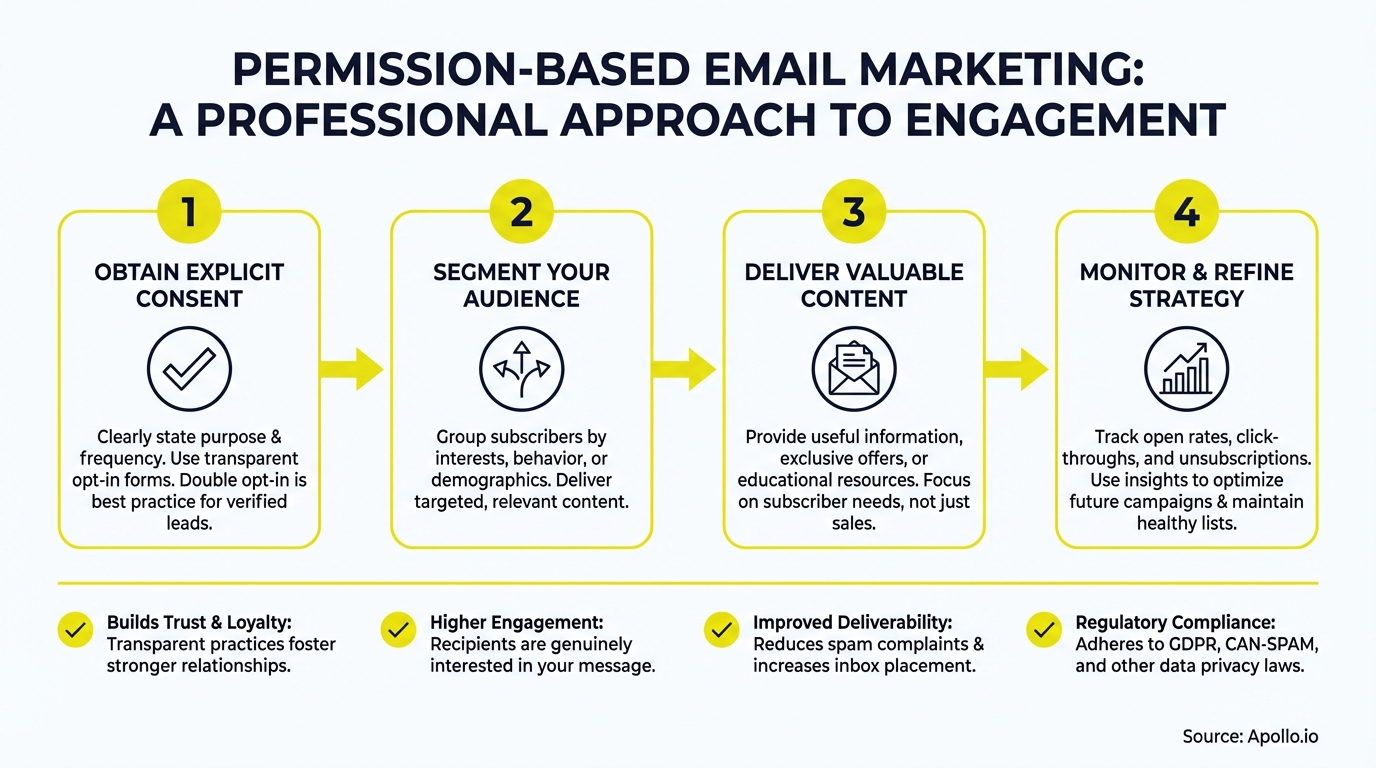
Permission-based email marketing means sending messages only to contacts who explicitly opted in to receive them. It is NOT buying lists, scraping contacts, or adding people to sequences without their knowledge.
In 2026, permission-based email is defined by three operational pillars:
- Explicit Consent: Contacts knowingly subscribe through forms, checkboxes, or documented opt-in flows.
- Easy Opt-Out: One-click unsubscribe that processes within two days (Yahoo requirement) and includes both list-unsubscribe headers and in-body links.
- Verified Identity: SPF, DKIM, and DMARC authentication prove you are who you claim to be, reducing spam flagging.
Permission-based email is NOT about legal compliance alone. It's about deliverability engineering: mailbox providers reward permission signals with inbox placement and penalize violations with filtering or blocking.
Why Permission Signals Control Inbox Placement in 2026
Mailbox providers treat permission as a proxy for email quality. Strong permission signals correlate with low complaint rates, high engagement, and verified sender identity.
Weak permission signals trigger filtering algorithms.
| Provider | Spam Complaint Threshold | Unsubscribe Requirement | Authentication Requirement |
|---|---|---|---|
| Gmail (Bulk Senders) | Below 0.1% (hard ceiling at 0.3%) | One-click unsubscribe for marketing messages | SPF, DKIM, DMARC (aligned) |
| Yahoo | Below 0.3% | List-unsubscribe honored within 2 days | DMARC with p=none minimum (must pass) |
| Microsoft (5,000+ emails/day) | Below 0.3% | One-click unsubscribe recommended | SPF, DKIM, DMARC enforcement |
Key insight: exceeding the 0.3% complaint rate makes bulk senders ineligible for mitigation. Permission-based practices (clear opt-in, relevant targeting, easy opt-out) keep complaint rates low and protect your sender reputation.
Need verified contacts to build permission-based lists? Apollo's 224M+ verified contacts include 96% email accuracy.
The Permission-to-Inbox Operating Model
Permission signals translate into inboxing outcomes through three mechanisms:
1. Complaint Rate Governance
Every "Report Spam" click damages your sender reputation. Permission-based lists (opt-in provenance, engagement tracking, lifecycle signals) reduce complaints.
Target: stay below 0.1% to maintain strong reputation.
2. Authentication Scoring
SPF, DKIM, and DMARC prove your domain ownership. Mailbox providers penalize unauthenticated senders.
Only 18.2% of top domains have valid DMARC records, and just 7.6% enforce DMARC (quarantine/reject). This authentication gap correlates with inbox placement drops of 20+ percentage points year-over-year.
3. Engagement Signals
Opens, clicks, replies, and forwards signal recipient interest. Low engagement (common with purchased lists or unverified contacts) triggers spam filters.
Permission-based lists generate higher engagement because recipients expect and want your emails.
"Apollo enriches everything we have: contacts, leads, accounts... And we don't really have to touch it, it just works."

DMARC Rollout Blueprint for B2B Teams
DMARC (Domain-based Message Authentication, Reporting, and Conformance) is now a deliverability requirement, not a security nice-to-have. Here's a phased rollout for B2B marketers working with IT:
| Phase | Action | Timeline | Stakeholder |
|---|---|---|---|
| 1. Audit | Verify SPF and DKIM records for all sending domains | Week 1-2 | IT/Security |
| 2. Monitor | Set DMARC policy to p=none and collect reports | Week 3-8 | RevOps/IT |
| 3. Quarantine | Upgrade to p=quarantine after validating legitimate traffic | Week 9-16 | IT/Security |
| 4. Enforce | Move to p=reject once all sending sources are aligned | Week 17+ | IT/Security |
Why this matters: unauthenticated domains face filtering penalties. Authenticated domains with DMARC enforcement (p=quarantine or p=reject) signal trust to mailbox providers and protect against spoofing.
Turn Forecast Chaos Into Revenue Clarity
Pipeline forecasting a guessing game? Apollo's real-time deal intelligence gives you accurate visibility into every opportunity. Built-In boosted win rates 10% with Apollo's scoring and signals.
Start Free with Apollo →One-Click Unsubscribe: UX and Compliance
One-click unsubscribe is now mandatory for bulk senders on Gmail, Yahoo, and Microsoft. The requirement has two components:
- List-Unsubscribe Header: RFC 8058-compliant header that allows recipients to unsubscribe without opening the email.
- In-Body Unsubscribe Link: Visible, accessible link in every email footer.
Best practices for opt-out UX:
- Process unsubscribes within 2 days (Yahoo requirement) or faster
- Confirm unsubscribe immediately on-screen (no "check your email" flow)
- Suppress unsubscribed contacts across all sending lists and sequences
- Track unsubscribe rates by campaign, audience, and content type to identify friction points
Pro tip: if unsubscribe rates spike above 0.5%, audit your targeting, frequency, and content relevance. High unsubscribe rates often precede high complaint rates.
List Hygiene and Verification Workflows
B2B contact data decays at an estimated 22-30% annually (job changes, role shifts, company closures). Without active list hygiene, your permission-based list becomes a deliverability liability.
Only 23.6% of B2B marketers verify email lists before campaigns, contributing to poor inbox placement.
Recommended hygiene cadence:
- Monthly: Remove hard bounces, suppress spam complaints, flag inactive contacts (90+ days no engagement)
- Quarterly: Run email verification on entire list, re-permission inactive segments, update job titles and company data
- Annually: Full list audit, re-permission campaign for disengaged contacts, purge unverified or unresponsive contacts
Struggling with list decay? Apollo's data enrichment keeps contact records current with automatic updates.
"We benchmarked ZoomInfo versus Apollo, Clearbit, Lusha, and Seamless, and ultimately Apollo won on all fronts, especially in enrichment. Higher quality than ZoomInfo, greater breadth than Clearbit."
Measuring Permission-Based Email ROI
According to Martal, the average ROI for email marketing in 2025 is estimated between $36 and $40 for every $1 spent. Yet 64% of B2B marketing leaders don't trust their organization's measurement. To build credibility, tie permission quality directly to pipeline impact:
| Metric | What It Measures | Target Benchmark |
|---|---|---|
| Complaint Rate | Spam reports / emails delivered | Below 0.1% |
| Unsubscribe Rate | Opt-outs / emails delivered | Below 0.5% |
| Inbox Placement Rate | Emails in inbox / emails sent | Above 90% |
| Engagement Rate | Opens + clicks + replies / emails delivered | Above 15% |
| Pipeline Contribution | Revenue attributed to email touchpoints | Track quarterly |
Advanced measurement: use multi-touch attribution to connect permission-based email touchpoints to closed deals. Track which acquisition sources (webinar opt-ins, content downloads, event sign-ups) generate the highest-quality permission and longest customer lifetime value.
Permission-Based Email in Practice: What Works
Successful permission-based programs share these characteristics:
- Clear Value Exchange: Opt-in forms articulate what recipients will receive (content type, frequency, topics)
- Preference Centers: Let subscribers control content types, frequency, and topics rather than forcing all-or-nothing unsubscribe
- Re-Permission Campaigns: Periodically ask disengaged contacts to re-confirm interest ("Still want to hear from us?")
- Segmentation by Engagement: Send high-frequency campaigns only to highly engaged segments; reduce frequency for low-engagement contacts
- Authentication Enforcement: Implement DMARC p=quarantine or p=reject to prove sender identity
For more on crafting effective B2B email strategies, see our guides on B2B email marketing in 2026, writing sales emails that get responses, and bulk email best practices.

Common Permission-Based Email Mistakes
Even experienced teams make these errors:
- Pre-Checked Opt-In Boxes: GDPR and many US state laws prohibit pre-checked consent. Always require active opt-in.
- Ignoring Unsubscribes: Continuing to email after unsubscribe is illegal in most jurisdictions and destroys sender reputation.
- Purchasing Email Lists: Purchased lists have no permission provenance, generate high complaint rates, and damage sender reputation. Learn why in our guide on why buying email lists fails.
- Weak Authentication: Skipping DMARC or leaving it at p=none indefinitely signals low sender trustworthiness.
- No Suppression List: Failing to maintain a global suppression list across all campaigns leads to accidental re-mailing of unsubscribed contacts.
Getting Started: Your First 30 Days
Launching a permission-based email program? Follow this priority sequence:
- Week 1: Audit current list sources. Document opt-in provenance for all contacts. Remove any contacts without clear permission.
- Week 2: Implement SPF, DKIM, and DMARC (p=none) on all sending domains. Set up DMARC reporting to monitor authentication.
- Week 3: Add one-click unsubscribe (list-unsubscribe header + in-body link) to all email templates. Test unsubscribe flow end-to-end.
- Week 4: Launch preference center allowing subscribers to control frequency and content type. Monitor complaint and unsubscribe rates daily.
For deeper technical guidance, review our resources on email deliverability and improving deliverability with sequence diagnostics.
Conclusion: Permission-Based Email as Competitive Advantage
Permission-based email marketing is no longer optional. With Gmail, Yahoo, and Microsoft enforcing strict complaint thresholds, one-click unsubscribe requirements, and authentication standards, permission signals directly control inbox placement.
B2B teams that invest in clean acquisition, DMARC enforcement, list hygiene, and opt-out UX will outperform competitors still relying on purchased lists and unauthenticated sending.
The opportunity is clear: email marketing is consistently cited as the most profitable digital channel. Teams that treat permission as a deliverability strategy (not just a legal requirement) will capture that ROI while others watch their sequences get filtered.
Ready to build permission-based email programs that actually reach the inbox? Schedule a Demo to see how Apollo consolidates prospecting, enrichment, and engagement in one workspace.
Prove Apollo's ROI In Your First 30 Days
Budget approval stuck on unclear metrics? Apollo delivers measurable pipeline impact from day one. Built-In increased win rates 10% and ACV 10% with Apollo's signals and scoring.
Start Free with Apollo →Don't miss these
Sales
Inbound vs Outbound Marketing: Which Strategy Wins?
Sales
What Is a Sales Funnel? The Non-Linear Revenue Framework for 2026
Sales
What Is a Go-to-Market Strategy? The 2026 GTM Playbook
See Apollo in action
We'd love to show how Apollo can help you sell better.
By submitting this form, you will receive information, tips, and promotions from Apollo. To learn more, see our Privacy Statement.
4.7/5 based on 9,690 reviews
