Which Multi-Channel Marketing Tools Drive B2B Revenue in 2026?
Revenue teams face a paradox: buyers now use 10+ channels to research and engage with vendors, yet 70% of companies are seeing an increase in results with a multi-channel strategy. The challenge isn't choosing channels—it's orchestrating them without drowning in tool sprawl. With the martech landscape exploding to over 14,000 products, the real question is which tools consolidate your tech stack while keeping your message consistent across every touchpoint.
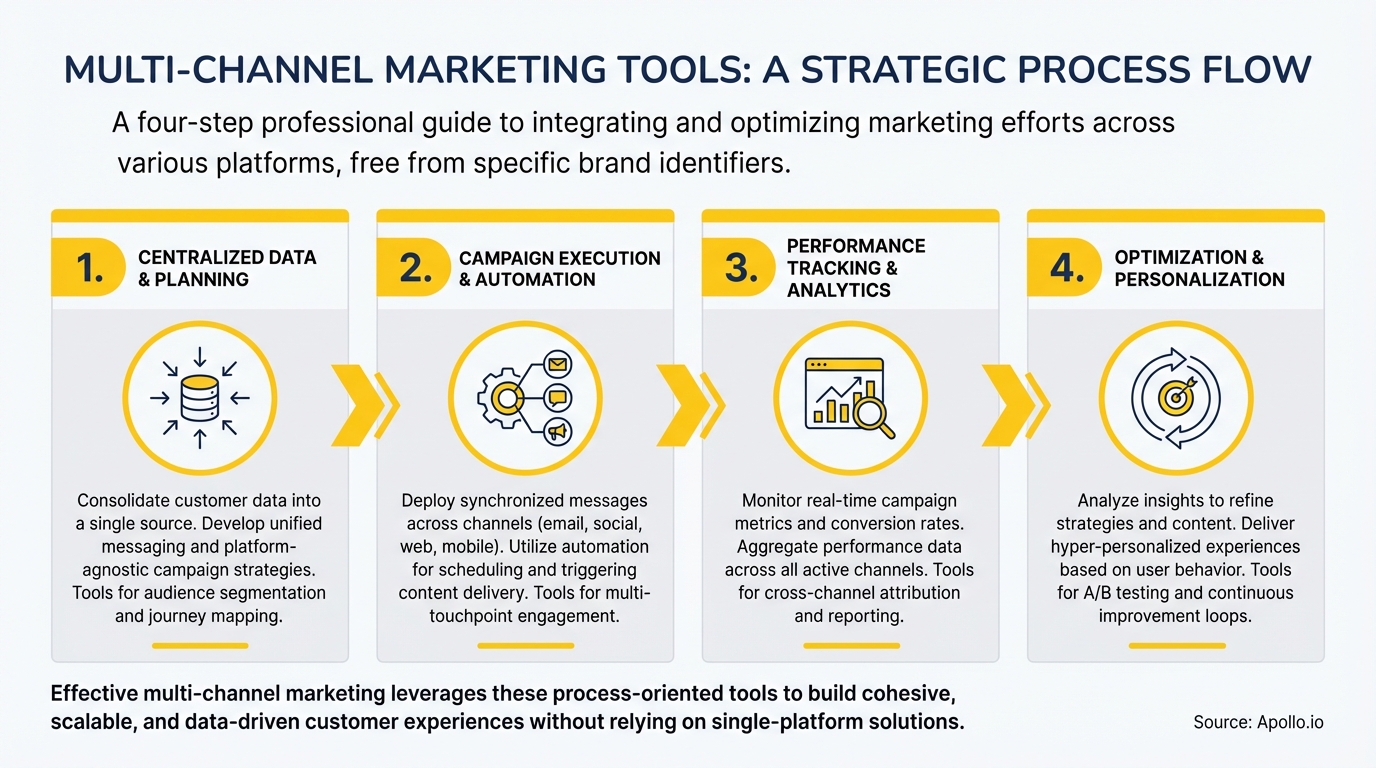
Multi-channel marketing tools are platforms that enable teams to plan, execute, and measure campaigns across email, social, phone, video, and messaging channels from a unified workspace. The best solutions eliminate data silos, reduce manual handoffs, and provide signal-driven orchestration that responds to buyer behavior in real time.

Get Verified Contacts Instantly With Apollo
Tired of spending 4+ hours daily hunting for contact info? Apollo delivers 224M verified contacts with 96% email accuracy. Join 550K+ companies closing deals faster.
Start Free with Apollo →Key Takeaways
- Multi-channel marketing tools orchestrate campaigns across email, social, phone, and messaging from one platform, eliminating tool sprawl and data silos
- Signal-driven orchestration triggered by buyer behavior outperforms static cadences, with AI agents increasingly automating next-best-action decisions
- The multi-channel marketing market is projected to grow from $6.96 billion in 2023 to $28.6 billion by 2030, driven by personalization and automation demands
- Unified platforms reduce costs and complexity while improving attribution clarity and cross-channel consistency
- Integration-first architecture with governance frameworks prevents message inconsistency and attribution gaps
What Are Multi-Channel Marketing Tools and Why Do They Matter?
Multi-channel marketing tools are software platforms that enable revenue teams to coordinate outreach, content, and engagement across multiple channels (email, phone, social, video, messaging) from a single interface. These tools unify data, automate workflows, and provide visibility into which channels drive pipeline and revenue.
The shift to multi-channel isn't optional. Research shows 86% of marketers report that multi-channel marketing is becoming increasingly effective year over year. Buyers expect consistent, personalized experiences whether they're reading your blog, attending a webinar, or receiving a cold email.
Multi-channel tools solve three core problems:
- Tool Sprawl: Teams using separate platforms for email, social, and phone create data silos and attribution nightmares
- Message Inconsistency: Disconnected tools lead to conflicting information across channels, eroding buyer trust
- Manual Orchestration: Without automation, teams waste hours coordinating touches across channels
"We reduced the complexity of three tools into one. We're getting higher reply rates, open rates are doubled, meetings are up, and speed to booking a meeting is cut in half."
How Do You Choose the Right Multi-Channel Marketing Tools?
Choosing multi-channel tools requires evaluating four dimensions: data quality, channel coverage, automation depth, and integration architecture. The wrong choice locks you into rigid workflows or forces expensive custom integrations.
Core Evaluation Criteria
| Criterion | What to Assess | Why It Matters |
|---|---|---|
| Data Foundation | Contact accuracy, enrichment coverage, update frequency | Bad data kills campaigns before they launch |
| Channel Coverage | Email, phone, social, video, messaging support | Buyers expect touchpoints where they're already active |
| Automation & AI | Signal-triggered sequences, personalization at scale, predictive routing | Manual orchestration doesn't scale past small teams |
| Integration Architecture | Native CRM sync, bi-directional data flow, API extensibility | Disconnected tools create attribution gaps and duplicate work |
| Attribution & Reporting | Multi-touch attribution, channel-level ROI, pipeline tracking | You can't optimize what you can't measure |
Need a unified platform that handles prospecting, engagement, and deal tracking? Apollo unifies sales intelligence and multi-channel engagement in one workspace.
The Platform Consolidation Shift
Teams are moving away from point solutions toward unified platforms. According to beehiiv, the multi-channel marketing market is projected to grow from $6.96 billion in 2023 to $28.6 billion by 2030, driven by increased adoption of digital channels, personalization, marketing automation, and demand for analytics.
This growth reflects a fundamental shift: revenue leaders want fewer tools, not more. The best B2B marketing tools for 2026 consolidate prospecting, engagement, and analytics into one platform, reducing cost and complexity.
Turn Forecast Guesswork Into Revenue Certainty
Pipeline forecasting a guessing game? Apollo's real-time deal tracking and lead scoring give you accurate visibility into every stage. Built-In increased win rates 10% with Apollo's intelligence.
Start Free with Apollo →What Channel Mix Drives the Highest ROI?
Channel performance varies by buyer segment, deal size, and industry. However, data from Metadata customers shows varying ROI by channel count: 1 channel delivers 3.73x ROI, 2 channels jump to 7.79x, 3 channels drop to 3.54x, 4 channels return 4.86x, and 5 channels fall to 2.23x (based on $80M in paid spend).
The lesson: more channels don't guarantee better results. The key is choosing channels where your buyers are active and orchestrating them cohesively.
High-Performing Channel Combinations
| Channel Mix | Best For | Key Advantage |
|---|---|---|
| Email + Phone | High-value outbound, enterprise deals | Balances scale (email) with personalization (phone) |
| Email + Social + Video | Content-driven demand gen, thought leadership | Builds trust across awareness and consideration stages |
| Email + Messaging + Phone | Fast-moving sales cycles, SMB/mid-market | Meets buyers where they prefer quick, asynchronous communication |
| Email + Social + Retargeting | ABM campaigns, long sales cycles | Maintains visibility throughout extended buying journeys |
"Apollo allowed us to 3x our annual revenue without any decrease in efficiency."
How Do You Build an Integration-First Multi-Channel Stack?
Integration-first architecture means your tools share a common data layer, eliminating manual data entry and ensuring consistency across channels. This requires choosing platforms with native integrations or robust APIs.
Essential Integration Points
- CRM Sync: Bi-directional sync ensures sales and marketing see the same data in real time
- Data Enrichment: Automatically fill contact records with firmographics, technographics, and intent signals
- Analytics Layer: Unify campaign data, engagement metrics, and pipeline attribution in one dashboard
- Workflow Automation: Trigger sequences based on website visits, email opens, content downloads, or CRM stage changes
Teams using enterprise marketing automation with integrated data layers report faster campaign deployment and clearer attribution to revenue.

What Role Does AI Play in Multi-Channel Orchestration?
AI is shifting from experimental to operational. Agentic AI now automates campaign creation, next-best-action recommendations, and content personalization across channels.
Signal-driven orchestration responds to buyer behavior (site visits, engagement spikes, intent signals) instead of following static day-by-day cadences.
AI-Powered Capabilities to Prioritize
- Predictive Routing: AI identifies which prospects are most likely to convert and prioritizes them for high-touch outreach
- Dynamic Personalization: Generate tailored messaging for each contact based on role, industry, and engagement history
- Real-Time Optimization: Adjust send times, channel mix, and content based on performance data
- Intent Signal Detection: Trigger sequences when prospects visit your pricing page, view case studies, or engage with competitors
Struggling to personalize outreach at scale? Apollo's AI-powered sequences automate personalization across email, phone, and social.
How Do You Measure Multi-Channel Attribution and ROI?
Multi-channel attribution connects every touchpoint (email open, webinar attendance, demo request) to pipeline and revenue. Without clear attribution, you're guessing which channels work.
Attribution Model Selection
| Model | How It Works | Best For |
|---|---|---|
| First-Touch | Credits the first interaction | Demand gen teams measuring top-of-funnel performance |
| Last-Touch | Credits the final interaction before conversion | Sales teams focused on closing tactics |
| Multi-Touch | Distributes credit across all touchpoints | Complex B2B journeys with long sales cycles |
| Time-Decay | Weights recent interactions more heavily | Campaigns where late-stage engagement predicts close rates |
Teams using revenue-focused marketing metrics align channel spend to pipeline contribution, not vanity metrics like impressions or clicks.
What Implementation Playbook Ensures Multi-Channel Success?
Launching multi-channel campaigns without governance creates message inconsistency and attribution chaos. A phased rollout with clear milestones prevents these failures.
0-90 Day Implementation Roadmap
| Phase | Timeline | Key Actions |
|---|---|---|
| Foundation | Days 0-30 | Audit data quality, map buyer journeys, define channel roles, establish governance framework |
| Pilot Campaigns | Days 31-60 | Launch 2-3 channel test campaigns, validate attribution tracking, refine messaging based on early data |
| Scale & Optimize | Days 61-90 | Expand to full channel mix, automate workflows, implement AI-driven optimization, build reporting dashboards |
For teams managing complex lifecycle marketing strategies, a phased approach ensures each stage (awareness, consideration, decision, retention) has tailored channel strategies.
How Apollo Simplifies Multi-Channel Marketing Execution
Apollo consolidates sales intelligence, multi-channel engagement, and deal management into one platform. Instead of juggling separate tools for prospecting, email, phone, and analytics, revenue teams execute end-to-end campaigns in a single workspace.
Key capabilities include:
- 224M+ Verified Contacts: Build targeted lists with 65+ filters including technographics, intent signals, and job changes
- Multi-Channel Sequences: Orchestrate email, phone, and social touches with AI-powered personalization
- Conversation Intelligence: Automatically capture and analyze calls to refine messaging and coach reps
- Pipeline Attribution: Track every touchpoint from first contact to closed deal
Teams using Apollo report faster pipeline velocity, higher connect rates, and clearer ROI attribution compared to stitching together point solutions.

Start Building Your Multi-Channel Marketing Engine
Multi-channel marketing tools are essential for B2B teams competing in a buyer-driven market. The best platforms consolidate your tech stack, eliminate data silos, and provide signal-driven orchestration that responds to buyer behavior in real time.
Prioritize platforms with robust data foundations, native integrations, and AI-powered automation. Avoid tool sprawl by choosing unified solutions that handle prospecting, engagement, and attribution in one workspace.
Ready to consolidate your sales and marketing tech stack? Start free with Apollo and orchestrate multi-channel campaigns from a single platform.
Prove ROI In Weeks, Not Quarters With Apollo
Budget approval stuck on unclear metrics? Apollo delivers measurable pipeline impact from day one—quantifiable time savings, faster deal velocity, and real ROI. Customer. io achieved 50% YoY growth with Apollo's automation.
Start Free with Apollo →Don't miss these
Sales
Inbound vs Outbound Marketing: Which Strategy Wins?
Sales
What Is a Sales Funnel? The Non-Linear Revenue Framework for 2026
Sales
What Is a Go-to-Market Strategy? The 2026 GTM Playbook
See Apollo in action
We'd love to show how Apollo can help you sell better.
By submitting this form, you will receive information, tips, and promotions from Apollo. To learn more, see our Privacy Statement.
4.7/5 based on 9,690 reviews
