
What Are Lead Generation Tools and How Do They Drive ROI?
Lead generation tools automate the process of identifying, attracting, and converting potential customers into sales opportunities. In 2026, companies that embraced next-generation sales capabilities experienced revenue growth at twice the rate of GDP, proving that the right tooling directly impacts bottom-line results.
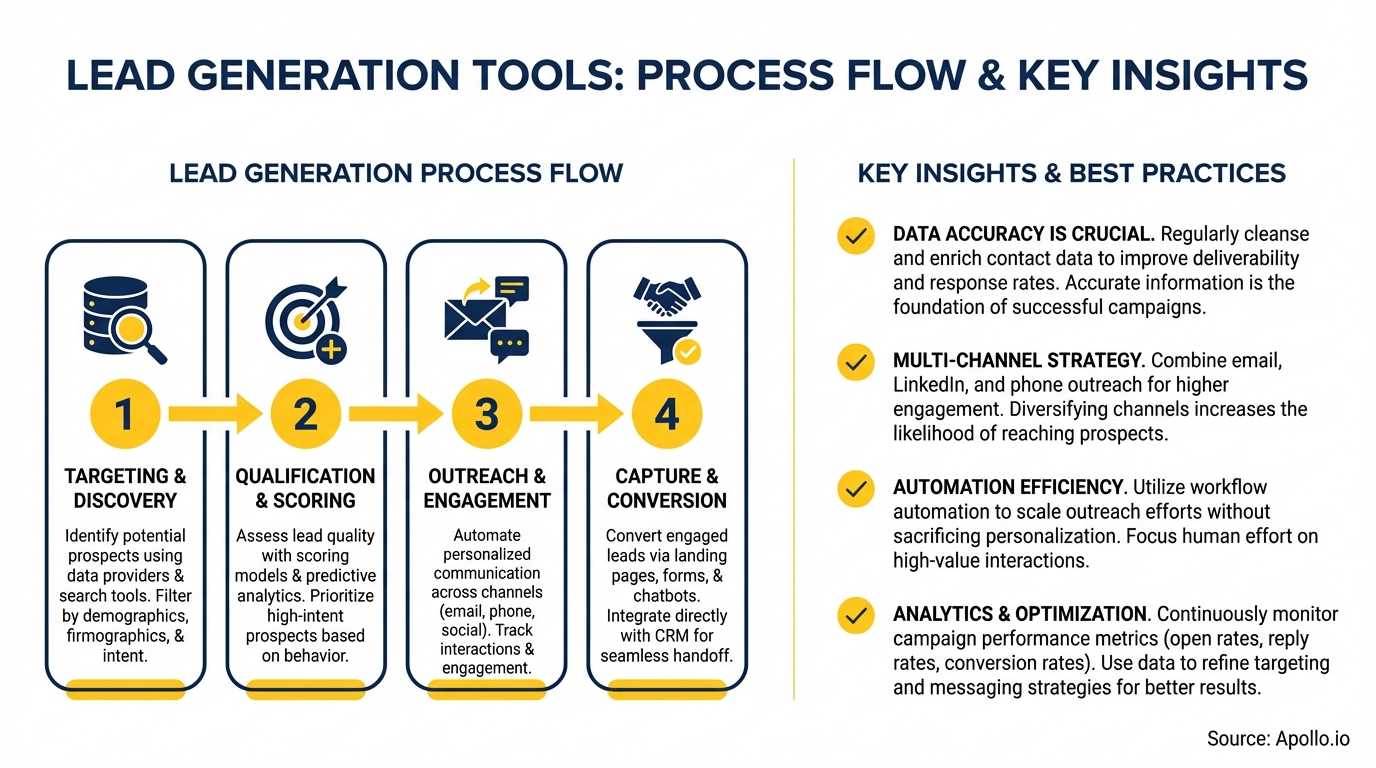
Modern lead generation tools combine database access, AI-powered research, automated outreach, and real-time enrichment in unified platforms. This consolidation cuts tech stack costs while delivering measurable improvements in pipeline velocity, connect rates, and conversion metrics.

Apollo Finds Verified Contacts In Seconds
Tired of spending 4+ hours daily hunting for contact info? Apollo delivers 224M+ contacts with 96% email accuracy—verified and ready to reach. Join 550K+ companies closing more deals.
Start Free with Apollo →Key Takeaways
- Lead generation tools automate prospecting, outreach, and qualification to accelerate pipeline growth
- Organic channels deliver lower cost per lead than paid channels, with strategic channel mix driving best ROI
- AI-driven tools increase personalization at scale, with companies seeing 46% more meetings and 35% higher booking rates
- Unified platforms consolidate multiple tools, reducing costs by 50% while improving efficiency
- Proper tool evaluation based on data quality, integration capabilities, and ROI metrics determines success
What Types of Lead Generation Tools Exist?
Lead generation tools fall into five core categories, each addressing specific stages of the buyer journey:
| Tool Category | Primary Function | Best Use Case |
|---|---|---|
| Database & Search Tools | Access verified B2B contacts with advanced filtering | Building targeted prospect lists |
| Enrichment Tools | Append missing contact and firmographic data | Cleaning and updating CRM records |
| Sales Engagement Platforms | Automate multi-channel outreach sequences | Scaling personalized outreach |
| Conversation Intelligence | Capture and analyze sales calls for insights | Improving messaging and objection handling |
| Intent & Signal Tools | Identify accounts showing buying behavior | Prioritizing high-intent prospects |
According to Gartner's 2023 Tech Marketing Benchmarks, technology marketers with annual revenues of $100 million or more utilized an average of 15 marketing channels. However, tool consolidation is becoming critical as teams realize that managing multiple disconnected systems creates inefficiency and data silos.
Struggling to find qualified leads? Search Apollo's 224M+ contacts with 65+ filters to build targeted lists in minutes, not hours.
How Do You Calculate Lead Generation ROI?
ROI calculation for lead generation tools requires tracking four key metrics: cost per lead (CPL), lead-to-opportunity conversion rate, opportunity-to-customer rate, and customer lifetime value (CLV).
Basic ROI Formula:
ROI = [(Revenue from Leads - Tool Cost) / Tool Cost] × 100
Data from Statista shows that between 2018-2022, organic channels delivered lower CPL than paid channels in B2B SaaS. This cost differential makes channel mix optimization critical for maximizing ROI.
| Channel Type | Average CPL | Conversion Quality |
|---|---|---|
| Organic (SEO, content) | Lower | Higher intent, longer nurture |
| Paid (PPC, display) | Higher | Faster velocity, varied intent |
| Outbound (cold email, calls) | Medium | Highly targeted, scalable |
| Referral/Partner | Lower | Highest conversion rates |
"Apollo could be a third of the cost if you look at the full price of what we were spending on ZoomInfo, Outreach, Salesforce, and admins to make it all work."
For detailed guidance on building cost-effective lead generation systems, see our guide on 15 Proven Free Lead Generation Strategies.

What Role Does AI Play in Modern Lead Generation?
AI transforms lead generation from manual research and generic messaging to intelligent automation and hyper-personalization. In 2026, AI capabilities include prospect research, message personalization, optimal send-time prediction, and conversation intelligence.
Proven AI Impact:
- 46% more meetings booked using AI research agents
- 35% increase in booking rates with AI-generated messaging
- 10x more personalized emails sent per rep with AI assistance
"With this kind of AI system, my BDRs can send 10x more personalized emails. Their productivity and growth has skyrocketed."
AI-powered tools analyze prospect data, company news, job changes, and intent signals to generate contextually relevant outreach. This eliminates hours of manual research while maintaining authenticity.
Research by McKinsey found that 64% of market share winners in B2B sectors adopted chatbots for customer interactions, compared to 42% of laggards. Automation and AI are no longer optional for competitive lead generation.
Learn more about implementing AI in your workflow: Apollo.io AI: Sales Automation Tools for B2B Prospecting Success.
How Should Sales and Marketing Align on Lead Generation?
Misalignment between sales and marketing causes revenue leakage. Effective alignment requires shared definitions, unified data, and collaborative processes.
Critical Alignment Elements:
- Shared Lead Definitions: Agree on MQL, SQL, and PQL criteria with specific scoring thresholds
- Unified Data Platform: Single source of truth for contact and account information
- Joint Campaign Planning: Collaborative content and outreach strategy development
- Closed-Loop Reporting: Sales provides feedback on lead quality to refine targeting
Companies using unified platforms report 50% cost reduction compared to managing separate marketing automation, sales engagement, and data enrichment tools. The key is eliminating data silos that create friction between teams.
For practical frameworks on improving lead quality, read: Lead Qualification: Find Better Prospects, Close More Deals.
Turn Unreliable Forecasts Into Revenue Certainty
Pipeline forecasting a guessing game? Apollo tracks real-time deal stages and buying signals so you can predict revenue with confidence. Built-In increased win rates 10% with Apollo's scoring and visibility.
Start Free with Apollo →What Features Should You Evaluate in Lead Generation Tools?
Selecting the right lead generation tool requires evaluating six critical dimensions:
| Evaluation Criteria | What to Assess | Why It Matters |
|---|---|---|
| Data Quality & Coverage | Contact accuracy, mobile numbers, email verification | Determines connect rates and deliverability |
| Search & Filtering | Available filters, Boolean logic, saved searches | Impacts precision of targeting |
| Enrichment Capabilities | Real-time updates, firmographics, technographics | Keeps CRM data current |
| Engagement Automation | Multi-channel sequences, A/B testing, personalization | Scales outreach without sacrificing quality |
| Integration Ecosystem | Native CRM sync, API access, workflow triggers | Eliminates manual data entry |
| Analytics & Reporting | Performance dashboards, attribution, forecasting | Enables data-driven optimization |
Spending hours on manual outreach? Automate your sequences with Apollo and focus your time on high-value conversations.
When evaluating tools, prioritize those offering trial periods or freemium tiers. Hands-on testing with your actual use cases reveals whether a tool fits your workflow better than vendor demos.
How Do Unified Platforms Compare to Point Solutions?
The build-versus-buy decision for lead generation tech stacks has evolved into unified platform versus point solution. Each approach has distinct trade-offs:
| Approach | Advantages | Disadvantages |
|---|---|---|
| Unified Platform | Lower total cost, seamless data flow, single login, consistent UX | Potential feature limitations in specialized areas |
| Best-of-Breed Stack | Deep functionality per category, flexibility to swap tools | Integration complexity, higher cost, data silos |
Modern unified platforms now match or exceed point solutions in core functionality while eliminating integration headaches. Apollo combines a database of 224M+ contacts, sales engagement automation, data enrichment, and conversation intelligence in one workspace.
Explore how consolidation accelerates pipeline: How to Build an Automated Lead Generation System.

What Are the Latest Trends in Lead Generation for 2026?
Lead generation continues evolving with buyer behavior and technology capabilities. Five trends are reshaping how B2B teams generate pipeline:
1. Self-Service Buying Dominance
According to McKinsey's B2B Pulse 2024, buyers increasingly prefer remote and self-service purchasing, with significant growth in e-commerce transactions for orders worth $500,000 or more. This requires content-rich websites and interactive tools.
2. Intent Signal Integration
Combining first-party signals (website behavior, content downloads) with third-party intent data identifies accounts actively researching solutions. This enables timely, relevant outreach.
3. Video Prospecting Adoption
Video messages in cold outreach increase reply rates by humanizing digital communication. Learn more: Video Prospecting: Connect, Engage, and Win More Sales.
4. Job Change Trigger Campaigns
Decision-makers changing roles present high-intent opportunities. Automated job change alerts enable timely outreach when prospects have fresh budget and authority. Read more: Job Change Alerts: Turn CRM Updates Into Pipeline Wins.
5. Privacy-First Data Strategies
Regulatory requirements and buyer preferences demand transparent data practices. Tools must provide business contact information gathered through compliant methods, with clear opt-out mechanisms.
Start Generating Higher-Quality Leads Today
Lead generation tools have evolved from simple contact databases to comprehensive platforms that automate research, personalize outreach, and optimize multi-channel engagement. The companies winning in 2026 consolidate their tech stacks, leverage AI for scale without sacrificing personalization, and align sales and marketing around unified data.
Success requires selecting tools based on data quality, integration capabilities, and measurable ROI rather than feature checklists. Start with clear definitions of your ideal customer profile, map your current lead generation process, and identify bottlenecks that automation can eliminate.
Apollo combines the database, enrichment, engagement, and intelligence capabilities you need in one platform. With 224M+ verified contacts, 96% email accuracy, and AI-powered personalization, you can build pipeline faster while cutting tool costs.
Start Your Free Trial and see how Apollo transforms your lead generation from scattered tools into a unified growth engine.
Prove Apollo's ROI In Your First 30 Days
Budget approval stuck on unclear metrics? Apollo tracks every touchpoint from prospect to closed deal—quantifying time saved, pipeline generated, and win rates improved. Built-In increased rates 10% and ACV 10% with Apollo's visibility.
Start Free with Apollo →Don't miss these
Sales
Inbound vs Outbound Marketing: Which Strategy Wins?
Sales
What Is a Sales Funnel? The Non-Linear Revenue Framework for 2026
Sales
What Is a Go-to-Market Strategy? The 2026 GTM Playbook
See Apollo in action
We'd love to show how Apollo can help you sell better.
By submitting this form, you will receive information, tips, and promotions from Apollo. To learn more, see our Privacy Statement.
4.7/5 based on 9,690 reviews
