
How To Become A GTM Engineer: A Complete Career Roadmap
The GTM Engineer role emerged in early 2023 as companies realized they needed someone who could translate revenue strategy into executable systems. This isn't a support role or a consultant who hands you a deck and disappears.
According to Flowla, the role was popularized in early 2023 and is recognized as foundational for modern scale. It sits at the intersection of revenue operations, sales engineering, and marketing automation.
This career path is part of our comprehensive guide on GTM Engineer. The role demands a unique blend of strategic thinking, technical execution, and deep understanding of buyer behavior.
Today's B2B buyers expect self-serve journeys, personalized outreach, and consistent messaging across every channel. The GTM Engineer builds the systems that deliver those experiences at scale.

Reclaim 4+ Hours Daily With Apollo
Tired of spending 4+ hours daily hunting for contact info? Apollo delivers 224M verified contacts with 96% email accuracy. Join 550K+ companies who've eliminated manual research.
Start Free with Apollo →Key Takeaways
- GTM Engineers are revenue strategists who build automated, scalable go-to-market systems, not tool integrators stitching together fragmented tech stacks.
- The role requires mastery across CRM configuration, AI workflow design, data enrichment, and omnichannel orchestration.
- Building a proof-of-work portfolio with measurable outcomes is now more valuable than traditional credentials.
- Industry salaries for GTM Engineers typically range from $132k to $241k based on experience and market positioning.
- Quick-start projects focused on scoring models, AI governance, and self-serve funnels create the fastest path to demonstrable expertise.
What Is A GTM Engineer?
A GTM Engineer is a technical expert who bridges the gap between sales, marketing, and technology to build automated, scalable revenue systems. MAccelerator defines them as GTM Systems Engineers or GTM Operations Engineers who create the infrastructure that turns strategy into execution.
This role is distinct from traditional RevOps or Sales Engineers. While RevOps maintains systems and Sales Engineers demonstrate products, GTM Engineers design and build the entire revenue engine from scratch.
The best GTM Engineers don't spend their time duct-taping 14 different tools together. They deploy elegant strategy at high velocity using consolidated platforms that eliminate integration overhead.
Understanding the gtm engineer job description helps clarify the technical and strategic requirements. The role demands both systems thinking and hands-on implementation skills.
What Core Competencies Do GTM Engineers Need?
GTM Engineers must master technical, analytical, and strategic capabilities simultaneously. Origami Agents emphasizes that CRM mastery and sales stack configuration are essential, including expertise in platforms like Salesforce, HubSpot, and Marketo for configuring custom fields, automations, lead routing, scoring, and maintaining data hygiene.
Data fluency separates competent GTM Engineers from exceptional ones. Research from TealHQ shows this includes comfort with data querying, writing SQL, and using BI tools to extract actionable insights from complex datasets.
AI and automation fluency have become non-negotiable. The rise of AI means GTM Engineers need to be adept at leveraging AI tools for tasks like lead qualification, personalized outreach, and automating complex sales workflows, as highlighted by industry analysis.
Strategic thinking completes the competency framework. The Velocity Factor notes that GTM Engineers need to analyze market trends, anticipate challenges, identify growth opportunities, and contribute to go-to-market, sales, and marketing strategies at the executive level.
How Do You Map Competencies To Buyer Requirements?
Modern B2B buyers have fundamentally changed how they want to purchase. Research by Gartner in 2024 found that 61% of B2B buyers prefer an overall rep-free buying experience, which directly impacts what GTM Engineers must build.
Bad targeting and irrelevant personalization now represent measurable revenue risk. The same Gartner research revealed that 73% of B2B buyers actively avoid suppliers who send irrelevant outreach, making precision targeting a core GTM Engineering mandate.
McKinsey's 2024 B2B Pulse survey of approximately 4,000 decision makers across 13 countries found that buyer preferences follow a "rule of thirds" at any stage: roughly one-third prefer in-person interactions, one-third prefer remote engagement, and one-third prefer digital self-serve options.
GTM Engineers must architect systems that support all three modalities simultaneously. This means building self-serve funnels with intelligent routing, enrichment layers that personalize every touchpoint, and testing frameworks that optimize across channels.
| Buyer Requirement | GTM Engineering Response | Key Competency |
|---|---|---|
| Self-serve journey for 61% of buyers | Automated lead scoring, intelligent content routing, progressive enrichment | CRM automation + AI workflow design |
| Zero tolerance for irrelevant outreach (73% avoid) | Signal-based prioritization, persona-specific messaging, multi-signal scoring | Data orchestration + strategic segmentation |
| Omnichannel preference (rule of thirds) | Unified engagement layer, channel-specific sequences, consistent messaging | Platform integration + governance frameworks |
| Consistency across touchpoints (69% see gaps) | Single source of truth, AI content systems, QA workflows | AI governance + content operations |
What Technical Skills Should You Prioritize First?
Start with CRM configuration mastery on one major platform. Choose Salesforce or HubSpot and learn custom objects, workflow automation, validation rules, and reporting dashboards until you can build complex routing logic without documentation.
Data enrichment and orchestration come next. Learn how to connect first-party data (CRM, website visitor tracking) with second-party sources (B2B databases) and third-party intent signals into unified scoring models.
Struggling to build unified data models across multiple sources? Start free with Apollo's 224M+ verified contacts and built-in enrichment workflows to see how modern platforms handle multi-source orchestration.
AI prompt engineering and workflow design represent the emerging frontier. Learn to design prompts that generate accurate, on-brand content, build evaluation frameworks to measure AI output quality, and create human-in-the-loop review processes.
Exploring the gtm tech stack reveals which platforms and integrations matter most. Focus on tools that consolidate capabilities rather than adding integration complexity.

How Do You Build Self-Serve And Omnichannel Systems?
Self-serve systems start with intelligent website visitor tracking. Capture anonymous traffic, enrich with firmographic data, score based on fit and intent signals, and route high-value visitors to targeted nurture sequences.
Omnichannel orchestration requires a unified engagement layer. Build sequences that coordinate email, phone, and social outreach based on prospect behavior and channel preferences, not arbitrary cadences.
Testing frameworks ensure continuous optimization. Implement A/B testing on messaging, timing, and channel mix, then feed results back into your scoring models to improve prioritization over time.
Data consistency across channels eliminates the 69% buyer complaint about information gaps. Maintain a single source of truth in your CRM and push updates to all downstream systems automatically.
| System Component | Implementation Approach | Success Metric |
|---|---|---|
| Website Visitor Tracking | Anonymous identification → Enrichment → Scoring → Automated routing | % of visitors identified and scored |
| Lead Scoring Model | Multi-signal inputs (fit + intent + engagement) → Weighted algorithm → Threshold-based routing | Correlation between score and conversion (r-value) |
| Omnichannel Sequences | Behavior-triggered steps → Channel preferences → Consistent messaging → AI personalization | Reply rate by channel and segment |
| AI Content Generation | Prompt templates → Account context → Human review → Quality scoring → Continuous training | Approval rate + time savings |
Fill Your Funnel With Qualified Leads Fast
Running out of fresh prospects while competitors lock in deals. Apollo delivers 224M verified contacts with buying signals that match your ICP. Top teams generate 3x more pipeline.
Start Free with Apollo →What AI Governance Framework Should You Implement?
AI governance starts with clear quality thresholds. Define what "good" looks like for AI-generated content: accuracy standards, brand voice consistency, personalization depth, and compliance requirements.
Human-in-the-loop workflows balance speed and quality. AI researches and drafts content for every account, humans review the top-scored opportunities, and feedback trains the system to improve over time.
Evaluation frameworks measure AI performance systematically. Track approval rates, edit depth, conversion outcomes, and time savings to quantify ROI and identify improvement opportunities.
Continuous optimization creates compounding returns. Use correlation analysis to identify which signals predict success, adjust scoring weights based on actual outcomes, and remove low-value signals that don't drive results.
Apollo's perspective is that the best GTM Engineer isn't a tool sommelier stitching together fragmented workflows. That's why Apollo's GTM Engineering (GTME) Program focuses on collapsing the typical Frankenstack into one unified workflow, helping teams move from strategy to execution without integration overhead through a structured seven-pillar framework.
How Do You Build A Portfolio That Demonstrates Impact?
Proof-of-work portfolios now matter more than credentials. Hiring managers want to see your Clay tables, scoring models, automation workflows, and most importantly, measurable outcomes.
Before-and-after metrics make your work tangible. Document baseline performance (conversion rates, response times, manual effort), implement your system, then measure the lift with specific numbers and timeframes.
Case study structure should follow a consistent format: business context, problem statement, your solution architecture, implementation approach, results with metrics, and lessons learned.
Public sharing accelerates career growth. Publish anonymized case studies on your personal site, share workflow screenshots on professional networks, and contribute to GTM engineering communities with tactical insights.
| Portfolio Component | What To Include | Impact Metrics |
|---|---|---|
| Scoring Model Case Study | Signal architecture, weighting methodology, implementation screenshots, correlation analysis | R-value improvement, conversion lift, false positive reduction |
| AI Workflow Implementation | Prompt templates, QA framework, human-in-the-loop process, training mechanisms | Approval rate, time savings, quality scores, personalization depth |
| Self-Serve Funnel Build | Visitor tracking setup, enrichment logic, routing rules, nurture sequences | Identification rate, conversion by segment, velocity improvements |
| Tech Stack Consolidation | Before state, integration challenges, unified platform architecture, migration approach | Tool count reduction, cost savings, team productivity gains |
What Are The Compensation And Career Growth Expectations?
Industry salaries for GTM Engineers typically range from $132k to $241k based on experience, geographic market, and company stage. The role sits at the intersection of technical execution and strategic impact, commanding compensation that reflects both dimensions.
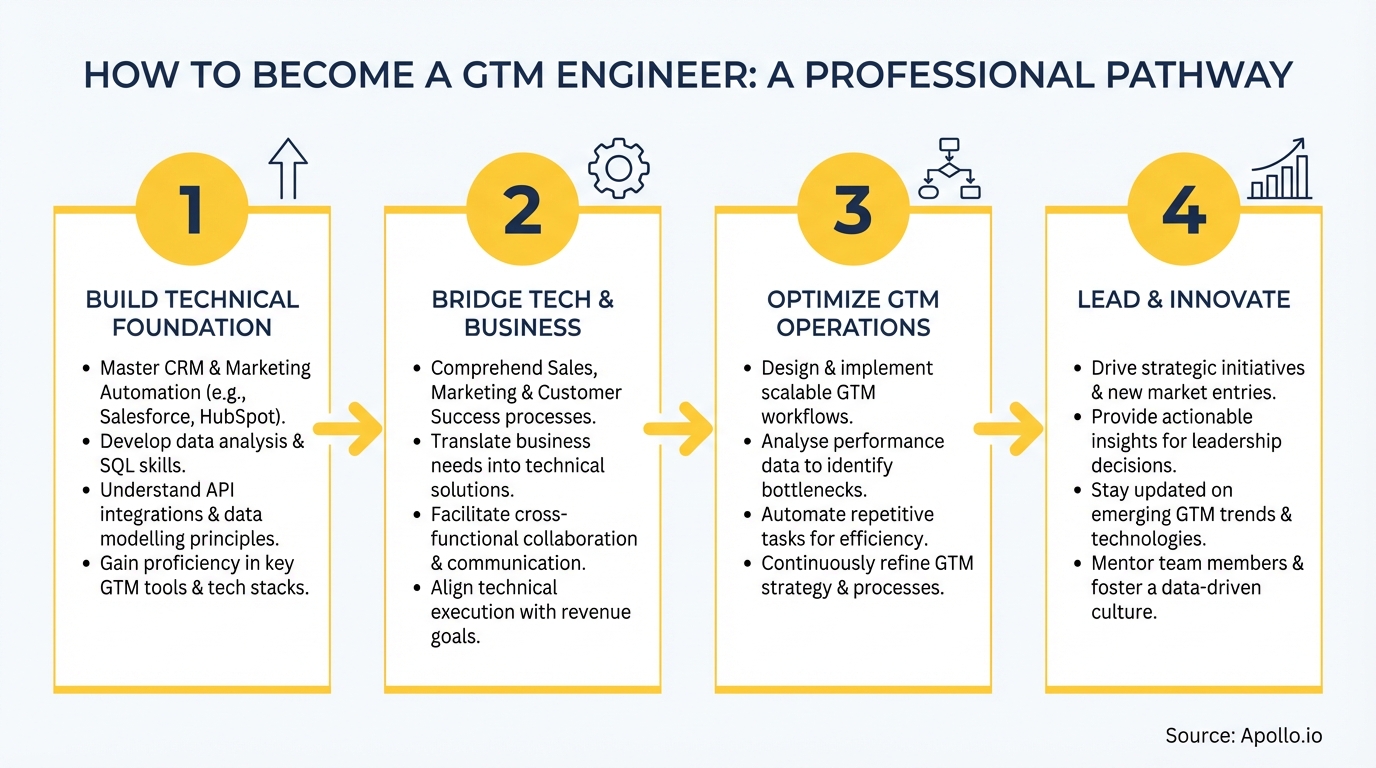
Career progression typically follows this path: GTM Associate or Junior Engineer → GTM Engineer → Senior GTM Engineer → Lead GTM Engineer → Head of GTM Engineering or Director of Revenue Operations.
For additional context on market rates, review our detailed analysis in gtm engineer salary. Compensation continues to rise as the role becomes more formalized across the B2B landscape.
The role is maturing from growth-hacker roots into a recognized revenue-systems discipline with clear leveling, interview processes, and career pathways. Public discussions about compensation and role definitions are accelerating this formalization.
What Quick-Start Projects Build Demonstrable Skills?
Six to eight week projects create the fastest path to a measurable portfolio. Choose projects that solve real business problems and generate quantifiable outcomes you can document.
Start with a scoring model rebuild if you have CRM access. Audit existing lead scoring, identify gaps in signal coverage, design a multi-dimensional model with weighted criteria, implement in your CRM, and measure correlation improvements.
AI content personalization projects demonstrate automation fluency.
Build prompt templates for different personas, create a human review workflow, implement quality scoring, and track approval rates plus time savings.
Self-serve funnel optimization shows omnichannel thinking. Implement website visitor tracking, build enrichment logic, create automated nurture sequences, and measure conversion improvements by segment.
Spending hours on manual prospect research and data entry? Automate your sequences with Apollo's AI-powered engagement platform to see how modern GTM systems eliminate repetitive work.
| Project Type | Timeline | Key Deliverables |
|---|---|---|
| Scoring Model Redesign | 6 weeks | Signal audit, weighted model, CRM implementation, correlation analysis, documentation |
| AI Content System | 8 weeks | Prompt library, QA workflow, approval dashboard, quality metrics, training process |
| Self-Serve Funnel Build | 7 weeks | Visitor tracking, enrichment rules, routing logic, nurture sequences, conversion reporting |
| Data Governance Framework | 6 weeks | Data quality SLAs, validation rules, cleanup workflows, monitoring dashboards, maintenance playbook |
How Do GTM Engineers Differ From RevOps Professionals?
GTM Engineers build new revenue systems from the ground up. RevOps professionals maintain, optimize, and scale existing operations once they're established.
The roles are complementary rather than competing. GTM Engineers design the architecture and implement the initial build, then hand off to RevOps teams for ongoing maintenance, reporting, and incremental improvements.
Understanding this distinction helps position your career trajectory. Many professionals start in RevOps, develop engineering skills, then transition into GTM Engineering roles that focus on greenfield builds.
Explore the detailed comparison in gtm engineer vs revops to understand how these roles work together in modern revenue organizations.
What Does The Future Of GTM Engineering Look Like?
Agentic GTM represents the evolution toward autonomous revenue systems. Most research, prioritization, personalization, and routing will run automatically without human intervention at every step.
The GTM Engineer's role shifts from building workflows to designing governance frameworks. You'll set strategic parameters, define quality thresholds, monitor system performance, and continuously train AI models.
Platform consolidation will accelerate as teams recognize the fragility of multi-tool architectures. The differentiator becomes proprietary signals and workflow IP, not access to the same tools as competitors.
Building effective gtm playbook frameworks becomes essential as autonomous systems require clear strategic direction and measurable success criteria.
Ready to build your GTM engineering career on a unified platform? Try Apollo Free and experience how modern GTM Engineers deploy revenue strategy without integration overhead, starting with 224M+ verified contacts, AI-powered workflows, and end-to-end engagement capabilities in one workspace.

Prove Apollo's Value In Your First 30 Days
Budget approval stuck on unclear metrics? Apollo delivers measurable pipeline impact from day one—track every dollar from prospect to close. Built-In increased win rates 10% and ACV 10% with clear attribution.
Start Free with Apollo →Don't miss these
Sales
Inbound vs Outbound Marketing: Which Strategy Wins?
Sales
What Is a Sales Funnel? The Non-Linear Revenue Framework for 2026
Sales
What Is a Go-to-Market Strategy? The 2026 GTM Playbook
See Apollo in action
We'd love to show how Apollo can help you sell better.
By submitting this form, you will receive information, tips, and promotions from Apollo. To learn more, see our Privacy Statement.
4.7/5 based on 9,690 reviews
