
What Is A GTM Playbook?
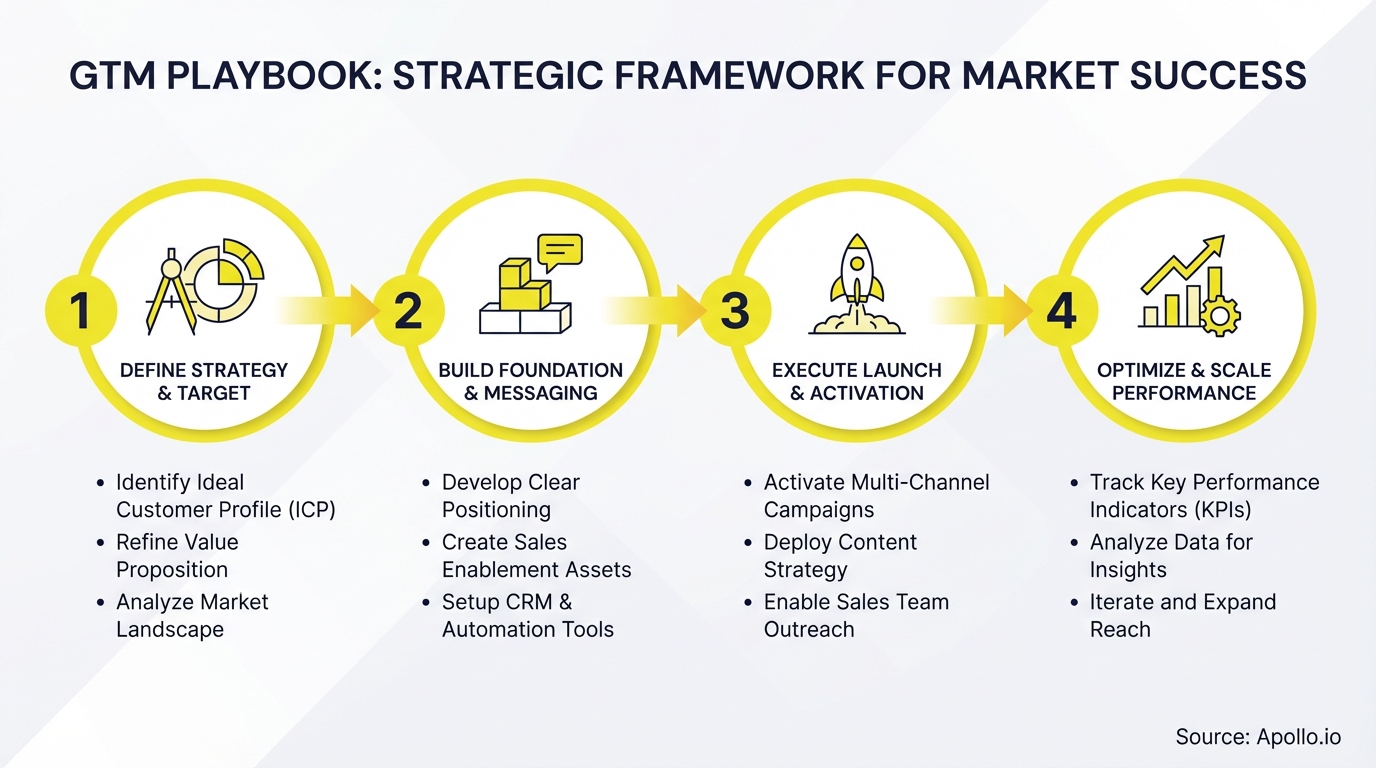
A GTM playbook is the operational blueprint that connects your go-to-market strategy to repeatable execution across sales, marketing, and revenue operations.
This comprehensive framework is essential for any GTM Engineer building scalable revenue systems that align cross-functional teams around shared targets and processes.
Unlike a static strategy document, a functional GTM playbook defines specific workflows, messaging frameworks, scoring models, and measurement systems that turn strategic intent into consistent daily actions.
Research by Go-to-Market Alliance shows companies with a well-structured GTM strategy are 33% more likely to achieve their revenue targets.
The challenge is that according to Digital Bloom, the average software company currently manages five core GTM channels along with 5.5 experimental initiatives, totaling 10.5 simultaneous GTM efforts.

Reclaim 4+ Hours Daily With Apollo
Tired of reps spending half their day hunting for contact info? Apollo delivers 224M+ verified contacts instantly, so your team sells instead of searches. Join 550K+ companies closing more deals.
Start Free with Apollo →Key Takeaways
- A GTM playbook translates strategy into repeatable workflows that sales, marketing, and RevOps teams execute daily
- Effective playbooks include ICP definitions, messaging frameworks, scoring models, engagement sequences, and measurement systems
- Companies with structured GTM playbooks are significantly more likely to hit revenue targets and scale efficiently
- Modern playbooks must support omnichannel buyer journeys and enable self-directed purchasing experiences
- Weekly metric tracking and execution adjustments drive measurably faster growth than monthly reporting cycles
Why Do GTM Playbooks Matter For Revenue Teams?
GTM playbooks solve the execution gap between what leadership decides and what teams actually do in the field.
Without documented processes, every rep interprets strategy differently, creating inconsistent buyer experiences and unpredictable results.
Data from Share Direct Tech reveals aligned sales and marketing teams generate 209% more revenue and a 20% annual growth rate.
Yet according to Directive Consulting, typically only 3 out of 15 common commercial activities include both sales and marketing teams.
This misalignment creates fragmented buyer experiences and wasted effort across teams pursuing different interpretations of the same strategy.
A comprehensive playbook establishes shared definitions, processes, and success metrics that keep everyone moving in the same direction.
What Are The Core Components Of A GTM Playbook?
A complete GTM playbook contains seven interconnected systems that work together to drive predictable revenue growth.
Each component serves a specific purpose in the buyer journey while feeding data to optimize the entire system.
What Is The Total Addressable Market Framework?
The TAM framework defines every company that could potentially buy from you, qualified and segmented by fit criteria.
This goes beyond simple list building to create a comprehensive view of your entire market universe with clear prioritization rules.
Your TAM list should include firmographic data, technographic signals, and engagement history that enable intelligent account selection.
Teams operating from a unified TAM eliminate duplicate outreach, maintain consistent messaging, and ensure no high-value accounts slip through coverage gaps.
How Does ICP-To-Messaging Mapping Work?
ICP-to-messaging mapping connects your ideal customer profiles to specific value propositions, pain points, and communication approaches.
This matrix ensures every buyer persona receives contextually relevant content across every channel they engage with.
Effective mapping includes persona definitions, key challenges, value drivers, objection handling frameworks, and channel preferences for each segment.
The result is personalized outreach at scale without sacrificing relevance or forcing reps to reinvent messaging for every conversation.
What Are Scoring And Prioritization Models?
Scoring models turn your strategic priorities into mathematical formulas that rank accounts and contacts by likelihood to convert.
These models combine fit signals (company size, industry, technology stack) with intent signals (website visits, content downloads, job changes) and engagement signals (email opens, meeting attendance, champion advocacy).
Companies with $3M-$75M ARR that track GTM metrics weekly and adjust execution based on trends grow significantly faster than competitors relying on monthly reporting, according to GTM Consult.
Your scoring system should assign point values to each signal category and automatically surface the highest-priority opportunities for human review.
What Is The Engagement Sequence Architecture?
Engagement sequences define the specific touchpoints, timing, and messaging cadences that move prospects through your pipeline stages.
Modern sequences integrate email, phone, social outreach, and direct mail into coordinated campaigns triggered by specific account behaviors or scores.
Your playbook should document sequence templates for each buyer stage, persona type, and campaign objective with clear success metrics and optimization triggers.
Struggling to coordinate multi-channel outreach at scale? Apollo's engagement platform unifies email, phone, and social sequences so your team executes consistent campaigns without toggling between tools.
How Do You Build The Measurement And Attribution System?
The measurement system defines exactly how you track performance, attribute revenue, and make data-driven optimization decisions.
This includes dashboard specifications, metric definitions, data governance rules, and regular review cadences that turn insights into action.
B2B organizations utilizing RevOps were 1.4 times more likely to exceed their revenue goals by 10% or more compared to those not using RevOps, according to Deloitte Digital.
Your measurement spine should include leading indicators (activity metrics, pipeline velocity) and lagging indicators (revenue, retention) with clear ownership and accountability.
How Do GTM Engineers Implement Playbooks?
GTM Engineers translate strategic playbooks into automated systems that execute consistently without constant human intervention.
This operational focus separates effective gtm engineer job description implementations from theoretical frameworks that never drive actual behavior change.
The implementation process follows a structured 12-week cadence that builds each component in the correct sequence while maintaining current operations.
| Phase | Weeks | Core Deliverables |
|---|---|---|
| Foundation | 1-3 | Complete TAM build, deliverability infrastructure, data architecture |
| Intelligence | 4-6 | Scoring model configuration, persona definitions, messaging frameworks |
| Automation | 7-9 | Sequence builds, workflow automation, signal integration |
| Enablement | 10-11 | Team training, review processes, handoff protocols |
| Optimization | 12 | Performance dashboards, correlation analysis, continuous improvement rituals |
Apollo Finds Your Exact Buyers Instantly
Struggling to keep your funnel full with qualified leads? Apollo delivers 224M+ verified contacts matched to your ICP, so your team spends time selling, not searching. Join 550K+ companies building predictable pipeline.
Start Free with Apollo →For teams looking to operationalize this framework, Apollo's GTM Engineering (GTME) Program provides a 12-week engagement where a dedicated Go-to-Market Engineer builds, implements, and optimizes a complete GTM system around your strategy.
The GTME approach focuses on collapsing fragmented tool stacks into unified workflows that execute strategy at velocity without integration overhead.
What Is The Role Of Data Orchestration In GTM Playbooks?
Data orchestration connects first-party signals (CRM, website behavior), second-party data (Apollo's B2B database), and third-party intent signals into a unified system of record.
This integration enables real-time account prioritization and automated workflow triggers based on comprehensive buyer signal analysis.
Modern GTM playbooks replace campaign-based execution with evergreen systems where scoring weight adjustments automatically shift focus across your entire TAM.
Instead of launching separate campaigns for different segments, you increase weight values for specific signals and let the system re-prioritize accounts accordingly.
Need verified contact data to power your scoring models? Apollo's database provides 224M+ verified contacts with 96% email accuracy to ensure your playbook operates on reliable intelligence.
How Do You Optimize GTM Playbooks Over Time?
Playbook optimization follows a continuous improvement cycle driven by correlation analysis between signals and actual revenue outcomes.
Monthly tactical reviews examine which scoring signals correlate with conversion, which messaging variants drive response, and which sequence timing produces meetings.
Quarterly strategic reviews adjust ICP definitions, re-weight scoring models, and refine persona frameworks based on closed-won analysis and market feedback.
The key is tracking signal-level performance rather than just campaign results so you build institutional knowledge that compounds over time.
Signals with correlation coefficients above 0.7 should receive increased weight, while signals below 0.5 should be decreased or removed entirely from scoring models.

What Are Common GTM Playbook Implementation Mistakes?
The most common mistake is building playbooks as static documents rather than dynamic systems that evolve with real performance data.
Teams often create comprehensive strategy decks that sit unused because they lack the operational specificity required for daily execution.
Another frequent error is optimizing individual channels in isolation rather than orchestrating integrated buyer journeys across touchpoints.
According to Arise GTM, 71% of CMOs report insufficient budgets and 75% are compelled to do more with less, making fragmented execution particularly costly.
Teams also commonly underinvest in measurement infrastructure, treating analytics as an afterthought rather than a foundational component.
Without clear data contracts, attribution rules, and governance rituals, even well-designed playbooks lack the feedback loops required for continuous improvement.
How Do GTM Playbooks Support Different Buyer Journeys?
Modern playbooks must accommodate three distinct buyer journey modes that prospects toggle between based on context and preference.
Digital self-serve journeys require content that functions as a rep-free enablement layer with decision briefs, ROI calculators, and comparison frameworks.
Remote engagement journeys need video demos, virtual workshops, and collaborative documents that maintain momentum without in-person meetings.
In-person journeys benefit from executive briefings, on-site workshops, and relationship-building activities that deepen trust and alignment.
Your playbook should define asset libraries, messaging frameworks, and handoff protocols for each mode rather than forcing buyers into a single prescribed path.
What Is The Relationship Between GTM Playbooks And RevOps?
GTM Engineers build the systems and playbooks while RevOps teams maintain them through ongoing optimization and governance.
This complementary relationship ensures playbooks remain living documents that evolve with market conditions rather than becoming outdated artifacts.
The gtm engineer vs revops distinction matters because each role brings different skills to playbook success.
GTM Engineers focus on architecture, automation, and initial configuration while RevOps owns data quality, metric reporting, and continuous improvement rituals.
According to Forrester, investments in revenue operations are considered investments in growth, with sales and marketing leaders expecting increases in operations investments to be among the largest areas of budget growth.
How Do You Measure GTM Playbook Success?
Playbook success is measured through three categories of metrics that track system health, performance outcomes, and efficiency gains.
System health metrics include TAM coverage percentage, data freshness, deliverability rates, and scoring model accuracy.
Performance metrics track reply rates by segment, meeting conversion by account score, pipeline contribution, and revenue attribution.
Efficiency metrics measure time spent on data gathering versus selling activities, research automation rates, and speed of strategy pivots.
Teams should track these metrics weekly at the tactical level and monthly at the strategic level to maintain tight feedback loops.

What Tools Enable Effective GTM Playbook Execution?
The most effective playbook execution happens on unified platforms that eliminate the integration overhead of managing multiple disconnected tools.
Your gtm tech stack should provide integrated data, engagement, and analytics capabilities rather than forcing teams to stitch together separate solutions.
Key capabilities include comprehensive B2B databases, multi-channel sequence orchestration, AI-powered research and personalization, real-time scoring and prioritization, and unified performance dashboards.
The goal is one elegant workflow that executes strategy at high velocity rather than a Frankenstack requiring constant API maintenance and data synchronization.
How Do GTM Playbooks Address Modern Buyer Expectations?
Modern GTM playbooks must acknowledge that buyers increasingly prefer self-directed purchasing experiences with minimal sales rep involvement.
This shift demands content that serves as comprehensive enablement resources buyers can share internally with procurement, security, finance, and IT stakeholders.
Your playbook should include templates for decision briefs, ROI memos, procurement packs, and risk assessment documents designed for internal forwarding.
These internal-forwardable assets help champions sell your solution within their organizations without requiring your team to join every conversation.
The emphasis on self-serve doesn't eliminate human touchpoints but rather ensures reps engage at high-value moments when their expertise genuinely advances deals.
What Is The Future Of GTM Playbooks?
The trajectory points toward Agentic GTM systems where most execution runs autonomously based on real-time signal analysis and automated decision-making.
Future playbooks will define the strategic guardrails and approval workflows while AI agents handle research, personalization, sequence execution, and optimization.
The GTM Engineer's role evolves from building manual workflows to architecting intelligent systems that learn from outcomes and self-optimize over time.
This shift requires teams to invest in measurement infrastructure, data quality, and strategic frameworks that provide clear direction for autonomous execution.
Companies building toward Agentic GTM today position themselves to scale revenue without proportionally scaling headcount or operational complexity.
Ready To Build Your GTM Playbook?
A comprehensive GTM playbook transforms strategic intent into repeatable execution systems that align cross-functional teams and drive predictable revenue growth.
The difference between high-performing revenue organizations and those struggling to hit targets often comes down to playbook discipline and systematic optimization.
Prove Apollo's ROI In Your First 30 Days
Budget approval stuck on unclear metrics? Apollo delivers measurable pipeline impact from day one—Built-In increased win rates 10% and ACV 10%. Join 90K paying customers who justified their investment fast.
Start Free with Apollo →Ready to transform your go-to-market execution with a unified platform that eliminates tool fragmentation? Try Apollo Free and experience how integrated prospecting, engagement, and analytics accelerate playbook implementation and revenue growth.
Don't miss these
Sales
Inbound vs Outbound Marketing: Which Strategy Wins?
Sales
What Is a Sales Funnel? The Non-Linear Revenue Framework for 2026
Sales
What Is a Go-to-Market Strategy? The 2026 GTM Playbook
See Apollo in action
We'd love to show how Apollo can help you sell better.
By submitting this form, you will receive information, tips, and promotions from Apollo. To learn more, see our Privacy Statement.
4.7/5 based on 9,690 reviews
