
GTM Engineer vs RevOps: What Is The Difference Between Build And Run?
The modern go-to-market organization faces a critical choice: hire someone to build your revenue systems or hire someone to run them.
These are two distinct skill sets, two different operating models, and two complementary roles that high-growth companies are now structuring deliberately. Understanding the boundary between GTM Engineer and Revenue Operations (RevOps) is the first step toward fixing misaligned planning, poor data quality, and underperforming analytics.
Research from Grand View Research shows the global revenue operations market size was estimated at USD 4.39 billion in 2024 and is projected to reach USD 16.98 billion by 2033, growing at a CAGR of 16.6%. This explosive growth reflects a fundamental shift in how companies architect their go-to-market infrastructure.
The demand for both roles is accelerating because the traditional approach—one generalist trying to do everything—breaks at scale.

Reclaim 4+ Hours Daily With Apollo's Data
Tired of reps spending half their day hunting for contact info? Apollo delivers 224M+ verified contacts instantly so your team can focus on selling. Join 550K+ companies closing more deals.
Start Free with Apollo →Key Takeaways
- GTM Engineers build systems, automation, and data products; RevOps teams govern, maintain, and optimize what's been built.
- Organizations with established RevOps functions were 1.4 times more likely to exceed revenue goals by 10% or more.
- The boundary between roles maps to a "build vs run" operating model with clear ownership and decision rights.
- Companies aligning people, processes, and technology in their demand engine achieve 36% more revenue growth.
- Defining explicit SLAs, RACI frameworks, and handoff protocols prevents the common failure modes of misalignment and poor collaboration.
What Is A GTM Engineer?
A GTM Engineer is a revenue strategist who designs, builds, and deploys technical systems that operationalize go-to-market strategy.
This role owns the architecture of your GTM data infrastructure—integrations, automation workflows, scoring models, AI orchestration, and experimentation pipelines. GTM Engineers translate business requirements (target this segment, prioritize these signals, personalize this message) into executable technical systems.
The core deliverable is a working system: a Total Addressable Market (TAM) list with real-time scoring, AI-powered research integrated into sequences, multi-channel workflows that adapt based on engagement signals, and reporting dashboards that surface what's working.
GTM Engineers are builders, not maintainers. They write SQL queries, configure APIs, design data models, and orchestrate AI agents to automate research and personalization at scale.
What Is Revenue Operations (RevOps)?
Revenue Operations is the function responsible for governing, maintaining, and optimizing the systems that drive predictable revenue growth.
RevOps owns the operating cadence: definitions (what counts as a qualified lead?), metrics hierarchy (which KPIs matter?), SLAs (how fast should leads get routed?), process documentation, and cross-functional alignment across marketing, sales, and customer success. This team ensures the GTM engine runs reliably, data stays clean, and strategy translates into consistent execution.
According to Deloitte Digital, organizations with established RevOps functions were 1.4 times more likely to exceed their 2023 revenue goals by 10% or more compared to those without RevOps.
RevOps is the operational backbone that prevents chaos as teams scale. They don't build the new scoring model—they define what "good fit" means, monitor model performance, and adjust weights based on conversion data.
How Do GTM Engineer And RevOps Roles Differ?
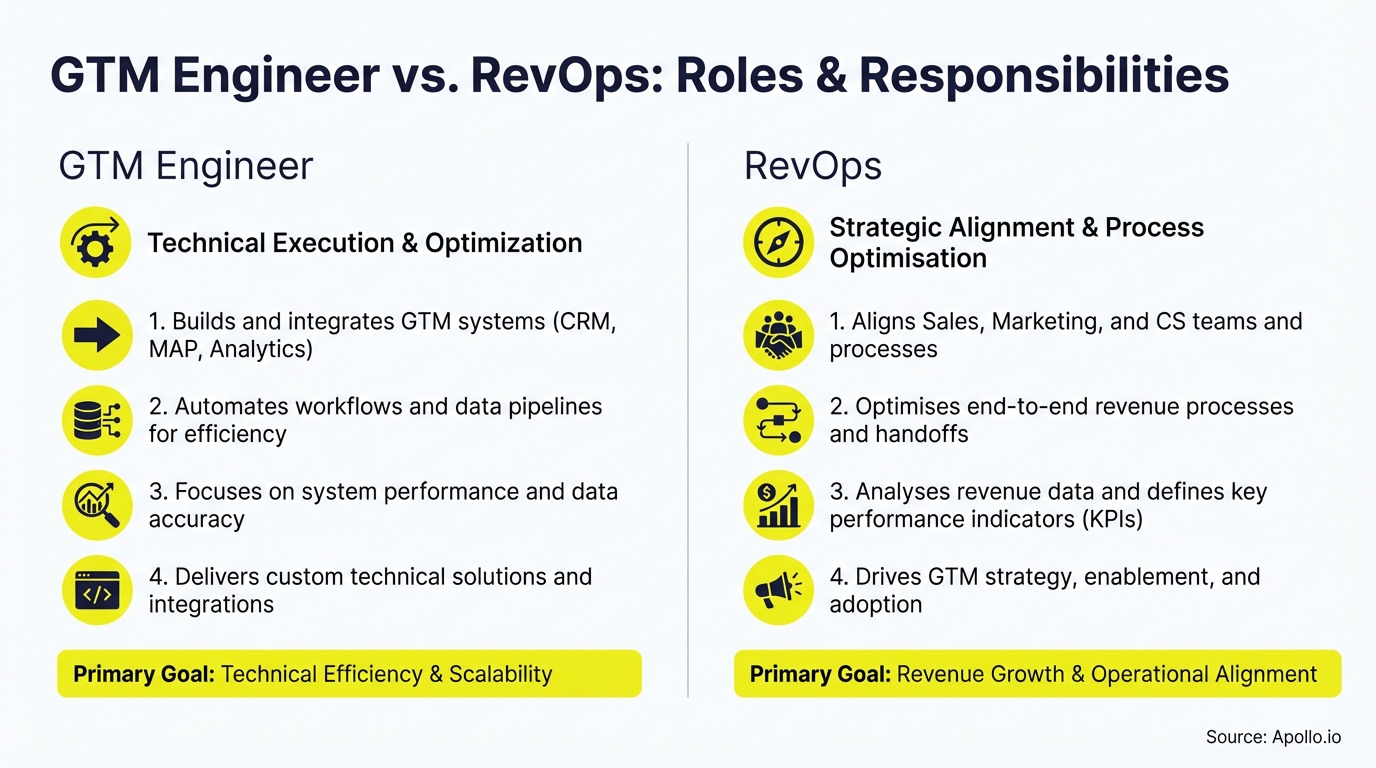
The distinction maps cleanly to a "build vs run" operating model. GTM Engineers architect and implement; RevOps governs and optimizes.
When a company decides to implement AI-powered lead scoring, the GTM Engineer designs the data pipeline, configures the scoring algorithm, and integrates it into the CRM. RevOps defines the scoring criteria, monitors accuracy, trains the sales team on how to use scores, and adjusts weights quarterly based on conversion analysis.
| Dimension | GTM Engineer | RevOps |
|---|---|---|
| Primary Focus | Build systems, automate workflows, integrate tools | Govern processes, maintain data quality, align teams |
| Core Deliverables | Data models, API integrations, automation scripts, AI workflows | SLAs, process documentation, KPI dashboards, training materials |
| Technical Skills | SQL, Python, API design, data architecture, prompt engineering | CRM administration, analytics, process design, change management |
| Decision Rights | How to build, what technologies to use, architecture patterns | What to measure, when to intervene, who owns which process |
| Time Horizon | Project-based (build, deploy, hand off) | Ongoing (monitor, optimize, maintain) |
| Success Metrics | System uptime, automation coverage, data freshness | Process adherence, forecast accuracy, cross-functional alignment |
This division of labor prevents two common failure modes: the builder who creates systems nobody can maintain, and the operator who manually compensates for missing automation.

Why Do Companies Need Both GTM Engineers And RevOps?
The modern GTM stack has evolved from simple SaaS applications into technical infrastructure requiring both engineering skill and operational discipline.
AI adoption is accelerating this shift. Platforms now ship agents that require orchestration, governance, and continuous optimization—work that demands both technical implementation and process rigor.
Data from QuotaPath shows that companies aligning people, processes, and technology in their demand engine achieve 36% more revenue growth and up to 28% more profitability. This alignment requires clear ownership: someone builds the technical foundation, someone else ensures it operates reliably.
The GTM Engineer solves the "how" problem—how to integrate intent signals, how to automate personalization, how to instrument attribution. RevOps solves the "what" and "why" problems—what should we measure, why did this campaign underperform, what processes need adjustment.
Without GTM Engineering, RevOps teams spend their time on manual workarounds instead of strategic optimization. Without RevOps, GTM Engineers build systems that don't align with business priorities or can't be maintained after deployment.
What Are The Common Failure Modes Each Role Prevents?
Every go-to-market organization faces predictable breakdowns. GTM Engineers and RevOps each address specific failure modes that erode revenue performance.
Poor data quality and limited cross-functional collaboration consistently rank as top barriers to analytics success. When sales leaders report that analytics underdeliver, the root cause is usually a combination of technical debt (systems that don't talk to each other) and process gaps (no ownership of data definitions).
| Failure Mode | Symptoms | GTM Engineer Solution | RevOps Solution |
|---|---|---|---|
| Misaligned Planning | Functional teams execute different strategies | Build unified data model connecting all teams | Define shared metrics and quarterly planning cadence |
| Data Quality Issues | Duplicate records, stale contacts, missing fields | Implement enrichment workflows and deduplication logic | Establish data governance policies and audit schedules |
| Analytics Underperformance | Reports don't drive decisions | Build attribution models and telemetry instrumentation | Define what good looks like and enforce usage SLAs |
| Manual Busywork | Teams spend time on research and data entry | Automate research, scoring, and personalization | Document standard operating procedures and train teams |
| Tool Sprawl | 14 disconnected systems requiring manual handoffs | Consolidate into integrated platform with unified data | Rationalize tool stack and negotiate vendor contracts |
The GTM Engineer fixes the technical barriers; RevOps fixes the organizational barriers. Both are required to move from firefighting to predictable execution.
How Should Companies Structure The GTM Engineer And RevOps Partnership?
The most effective operating model defines clear decision rights, handoff protocols, and recurring cadences that keep both teams aligned.
A RACI framework (Responsible, Accountable, Consulted, Informed) prevents ambiguity. When implementing a new lead scoring model, the GTM Engineer is Responsible for building it, RevOps is Accountable for defining criteria and monitoring performance, Sales Leadership is Consulted on scoring dimensions, and the broader sales team is Informed when it goes live.
| Activity | GTM Engineer (R/A/C/I) | RevOps (R/A/C/I) | Cadence |
|---|---|---|---|
| Define Scoring Criteria | Consulted | Accountable | Quarterly |
| Build Scoring Model | Responsible | Consulted | Project-based |
| Monitor Model Performance | Informed | Responsible | Monthly |
| Adjust Scoring Weights | Responsible | Accountable | Quarterly |
| Train Sales Team | Informed | Responsible | As needed |
| Data Quality Audits | Consulted | Accountable | Monthly |
Apollo Turns Weak Funnels Into Pipeline Power
Running out of qualified leads while competitors fill their pipeline. Apollo delivers 224M+ verified contacts so you never hit a prospect drought again. Join 90K paying customers closing more deals.
Start Free with Apollo →SLA examples create accountability. GTM Engineers commit to 99.5% uptime for critical data pipelines and <4-hour response time for integration failures. RevOps commits to monthly data quality audits and quarterly process documentation updates.
For teams looking to operationalize this partnership at scale, Apollo's GTM Engineering (GTME) Program provides a structured 12-week engagement where a dedicated GTM Engineer builds the technical foundation while training internal RevOps teams to govern and optimize the system long-term—eliminating the need to stitch together multiple tools and creating one unified workflow from strategy to execution.
What Does The GTM Data Architecture Look Like?
A well-designed GTM data architecture connects three layers: first-party data (CRM, website, product usage), second-party data (sales intelligence platforms), and third-party data (intent signals, technographic data).
The GTM Engineer owns the technical implementation—API connections, data transformation logic, storage architecture, and orchestration workflows. RevOps owns the business logic—what fields are required, how leads get scored, which signals trigger which actions.
Struggling with fragmented data across multiple tools? Apollo's data enrichment platform unifies 224M+ verified contacts with real-time signals, eliminating the need for complex integrations and giving both GTM Engineers and RevOps teams a single source of truth.
Data governance controls prevent the common failure mode where nobody knows which dataset is authoritative. The GTM Engineer implements version control for data models, lineage tracking for all transformations, and audit logs for changes.
RevOps defines data ownership, access policies, and retention schedules.
The modern architecture is stack-agnostic but integration-heavy. Most companies operate inside or around Salesforce, but the real value comes from connecting external signals—website visitor tracking, email engagement, competitive intelligence—into a unified scoring and routing engine.
How Do You Measure ROI For GTM Engineer And RevOps Investments?
Both roles deliver measurable business outcomes, but the metrics differ based on whether you're measuring build efficiency or operational performance.
For GTM Engineers, ROI comes from automation coverage (percentage of manual tasks eliminated), time-to-deployment (how fast new capabilities ship), and system reliability (uptime, data freshness). If a GTM Engineer automates account research that previously took SDRs 30 minutes per account, and your team touches 200 accounts weekly, that's 100 hours reclaimed monthly.
For RevOps, ROI comes from forecast accuracy (predicted vs actual revenue), process adherence (percentage of reps following playbooks), and cross-functional alignment (reduction in planning cycles). When RevOps tightens lead routing SLAs from 24 hours to 2 hours, conversion rates typically improve measurably.
| Investment Area | GTM Engineer ROI Metric | RevOps ROI Metric |
|---|---|---|
| Lead Scoring Implementation | % of leads auto-scored, model refresh frequency | Increase in qualified lead conversion rate |
| AI Research Automation | Hours saved per account researched | Improvement in personalization quality scores |
| Multi-Channel Sequences | % of outreach automated, deployment time | Reply rate improvement, meeting booking rate |
| Data Quality Program | % of records enriched, enrichment API uptime | Reduction in bounce rates, duplicate record % |
| Attribution Modeling | Data pipeline coverage, query performance | Marketing spend efficiency, CAC reduction |
The combined impact is where the real value emerges. According to The B2B Mix, as of May 2025, 48% of companies have a dedicated RevOps function, marking a 15% increase from the previous year—evidence that organizations are investing in this operating model because it delivers measurable results.
What Skills Do GTM Engineers And RevOps Professionals Need?
The skill profiles for these roles overlap in business acumen but diverge sharply in technical depth and operational focus.
GTM Engineers need strong technical foundations: SQL for data analysis, Python or JavaScript for automation, API design for integrations, and increasingly, prompt engineering for AI orchestration. They understand data architecture patterns, can debug integration failures, and think in systems and workflows.
RevOps professionals need deep operational expertise: CRM administration, analytics and reporting, process design, change management, and cross-functional communication. They excel at translating business requirements into clear specifications, training teams on new processes, and identifying bottlenecks in existing workflows.
Both roles require strategic thinking—the ability to connect technical implementation or process changes to revenue outcomes. A GTM Engineer who builds elegant automation that nobody uses has failed.
A RevOps leader who defines perfect processes that teams ignore has failed.
The best partnerships happen when GTM Engineers ask "what business problem are we solving?" before writing code, and RevOps professionals ask "what technical constraints exist?" before designing processes.
For professionals looking to build these skills systematically, understanding the GTM engineer job description provides a clear roadmap of technical and strategic capabilities that differentiate high-performing practitioners.
How Is AI Changing The GTM Engineer And RevOps Dynamic?
AI is fundamentally reshaping the boundary between these roles by shifting work from "configure tools" to "orchestrate agents."
GTM Engineers now spend less time on manual integrations and more time on AI workflow design—training models, refining prompts, building feedback loops, and ensuring AI-generated content aligns with brand voice. The technical skill set is evolving from "API plumber" to "AI systems architect."
RevOps teams face new governance challenges: how to QA AI-generated research, when humans should review AI recommendations, how to measure AI contribution to pipeline, and how to prevent AI from perpetuating biases in scoring or messaging.
The operating model remains the same—GTM Engineers build the AI infrastructure, RevOps governs its use—but the pace of change accelerates. AI enables weekly experimentation instead of quarterly campaigns, which requires tighter collaboration and faster decision cycles.
Need to automate outreach without losing the human touch? Apollo's AI sales automation lets GTM Engineers deploy intelligent sequences at scale while giving RevOps teams full visibility and governance controls over AI-driven engagement.
The endgame is Agentic GTM—autonomous systems that prospect, research, personalize, and even qualify leads with minimal human intervention. Achieving this requires both the technical capability to build reliable AI agents (GTM Engineer) and the operational discipline to ensure those agents behave consistently with business strategy (RevOps).

What Are The Implementation Steps For Building This Operating Model?
Organizations moving from generalist "marketing ops" or "sales ops" roles to a structured GTM Engineer + RevOps model should follow a phased approach.
Start by mapping current responsibilities to the build vs run framework. Identify who owns system architecture, who owns process governance, and where gaps exist.
Most companies discover they have strong operational capability but weak technical build capacity—or vice versa.
| Phase | Timeframe | GTM Engineer Focus | RevOps Focus |
|---|---|---|---|
| Foundation | 0-3 months | Audit tech stack, document data flows, identify quick wins | Define core metrics, establish reporting cadence, baseline current state |
| Build | 3-6 months | Implement priority integrations, build scoring model, automate key workflows | Document processes, train teams, establish governance policies |
| Scale | 6-12 months | Expand automation coverage, implement AI workflows, optimize performance | Refine SLAs, improve forecast accuracy, drive cross-functional alignment |
| Optimize | 12+ months | Continuous improvement, experimentation framework, system modernization | Strategic planning, change management, ROI measurement |
Define explicit handoff protocols. When does a project transition from GTM Engineer ownership to RevOps ownership?
Typically when the system moves from "build and test" to "deploy and maintain"—but this needs to be codified in writing.
Create recurring touchpoints: weekly tactical syncs (what's broken, what's launching), monthly performance reviews (what's working, what needs adjustment), and quarterly strategic planning (what capabilities do we need next).
The goal is not to create organizational silos but to establish clear accountability while maintaining tight collaboration. The GTM Engineer attends RevOps planning sessions to understand requirements.
RevOps attends technical design reviews to ensure business logic is correctly implemented.
Ready To Build A High-Performance GTM Engine?
The GTM Engineer vs RevOps distinction isn't about choosing one over the other—it's about structuring both roles to work in concert, with clear ownership, decision rights, and operational cadence.
Companies that define this boundary explicitly, invest in both technical build capacity and operational governance, and create structured handoff protocols consistently outperform competitors still operating with generalist ops teams trying to do everything.
Prove Apollo's ROI In Your First Quarter
Budget approval stuck on unclear metrics? Apollo delivers measurable pipeline impact from day one—96% email accuracy drives real conversations. Built-In increased win rates 10% and ACV 10% using Apollo's verified data.
Start Free with Apollo →Start a Trial with Apollo to experience how an integrated platform eliminates the complexity of managing multiple tools, giving both your GTM Engineers and RevOps teams a unified workspace to build, govern, and optimize your entire go-to-market engine in one place.
Don't miss these
Sales
Inbound vs Outbound Marketing: Which Strategy Wins?
Sales
What Is a Sales Funnel? The Non-Linear Revenue Framework for 2026
Sales
What Is a Go-to-Market Strategy? The 2026 GTM Playbook
See Apollo in action
We'd love to show how Apollo can help you sell better.
By submitting this form, you will receive information, tips, and promotions from Apollo. To learn more, see our Privacy Statement.
4.7/5 based on 9,690 reviews
