
GTM Engineer Salary: Comprehensive 2026 Compensation Guide
The GTM Engineer role is rapidly professionalizing, and compensation is evolving to reflect its strategic value. Yet most salary data conflates this emerging role with traditional sales operations or generic engineering positions, creating confusion for both job seekers and hiring managers.
This guide provides evidence-based salary benchmarks grounded in government data, industry research, and real-world job postings. Understanding GTM Engineer compensation requires examining related roles, industry context, and the business value these professionals deliver—topics covered in our comprehensive guide on GTM Engineer.

Stop Research Busywork—Apollo Finds Leads Fast
Tired of spending 4+ hours daily hunting for contact info? Apollo delivers 224M verified contacts instantly so your team can focus on closing. Join 550K+ companies accelerating pipeline.
Start Free with Apollo →Key Takeaways
- Industry salaries for GTM Engineers typically range from $132,000 to $241,000, with significant variation based on experience, location, and company type.
- The role bridges engineering rigor with revenue strategy, commanding compensation similar to Sales Engineers and senior RevOps professionals.
- AI/automation capabilities and tech stack consolidation skills are becoming primary salary differentiators in 2026.
- Compensation structure varies significantly: SaaS companies typically offer higher base salaries plus equity, while traditional enterprises lean toward OTE models.
What Is GTM Engineer Compensation?
GTM Engineer compensation refers to the total pay package for professionals who build, maintain, and optimize go-to-market systems and workflows. This includes base salary, variable compensation, equity, and benefits.
The role sits at the intersection of technical execution and revenue strategy. Because "GTM Engineer" is still formalizing as a job title, compensation data often appears under related roles like Sales Engineer, RevOps Engineer, or Forward Deployed Engineer.
How Do GTM Engineer Salaries Compare to Related Roles?
GTM Engineer salaries align closely with Sales Engineer benchmarks, since both require technical expertise applied to revenue-generating activities. The Bureau of Labor Statistics reported a median annual wage of $121,520 for Sales Engineers in May 2024.
However, GTM Engineers working in software and SaaS environments typically earn significantly more. Sales Engineers at software publishers earned a median of $137,650 in 2024, compared to $101,940 in manufacturing—a $35,710 premium for technology-focused roles.
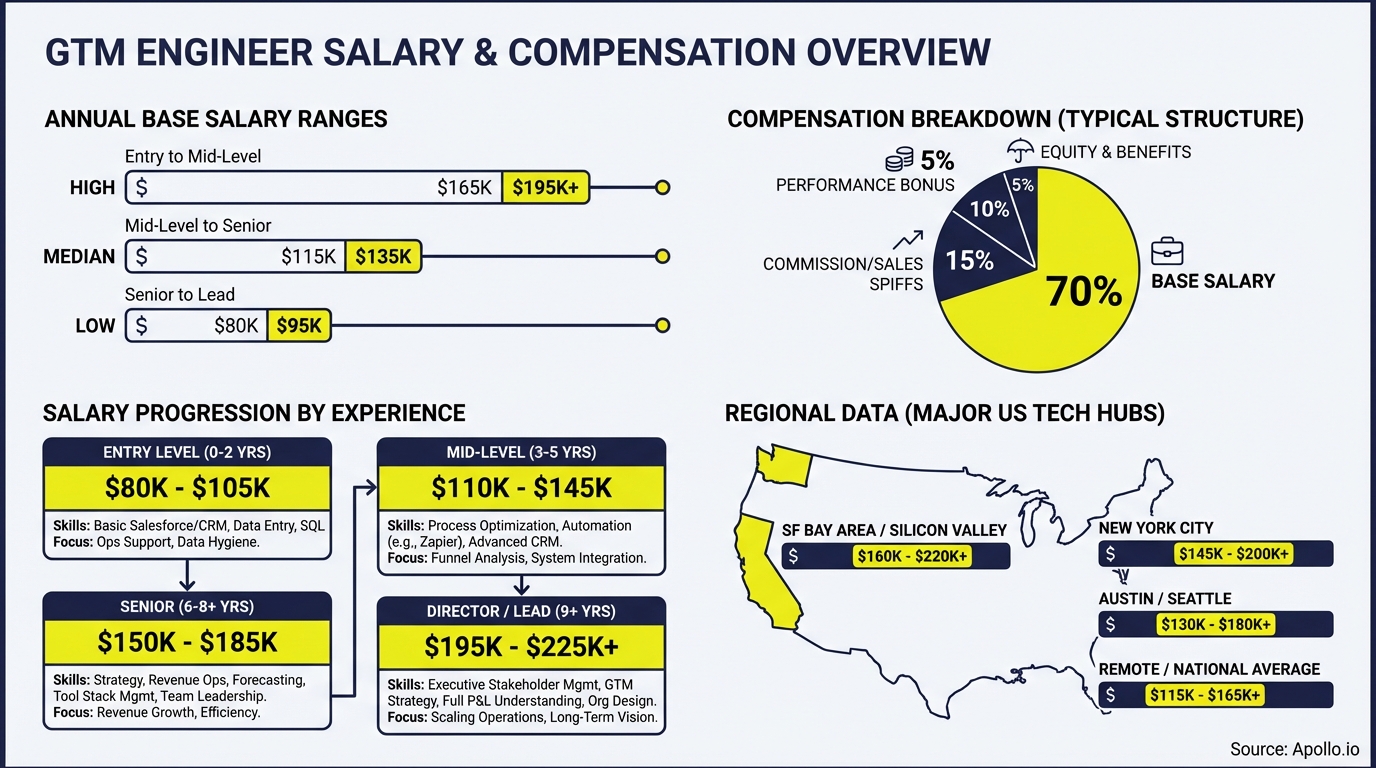
Most job aggregators show a range of $132,000 to $241,000 for GTM Engineer salaries in 2025. A study analyzing 1,000 GTM Engineering jobs in October 2025 found the median salary to be $127,500 per year, though this varies widely based on seniority and scope.
For comparison, Revenue Operations professionals—a closely related function—show different compensation patterns. As of February 2026, the average annual pay for Revenue Operations in the United States is $108,998.
The distinction matters: GTM Engineers who build and automate systems typically command engineering-grade base salaries, while RevOps professionals who maintain those systems often work within sales operations compensation bands. Learn more about this distinction in our guide on gtm engineer vs revops.
What Factors Influence GTM Engineer Salary Ranges?
Industry context drives significant compensation variation. Software publishers and AI-native companies consistently pay premium rates for GTM engineering talent, reflecting both the technical complexity of their products and the strategic importance of revenue operations.
Company size creates measurable salary differentials across the revenue operations function. Research from 2025 showed that RevOps professionals at companies with 0–50 employees earn a median OTE of $100,000, while those at companies with over 1,000 employees earn $162,000.
Geographic location remains a factor, though remote work is compressing regional spreads for top performers. Major tech hubs command higher base salaries, but companies increasingly pay closer to market rates for proven operators regardless of location.
Technical skill depth matters more than ever in 2026. GTM Engineers with demonstrated expertise in AI-powered workflows, CRM automation, data orchestration, and modern GTM tooling command significant premiums over those with only basic Salesforce administration experience.
Struggling to build GTM systems that justify engineering-level compensation? Apollo's unified platform eliminates the Frankenstack, letting GTM Engineers focus on strategy instead of integration maintenance.

How Is GTM Engineer Compensation Structured?
Compensation structure varies significantly by company type and role scope. Understanding these models helps both candidates negotiate effectively and employers design competitive offers.
| Component | SaaS/Tech Companies | Traditional Enterprise |
|---|---|---|
| Base Salary | 70-85% of total comp | 60-75% of total comp |
| Variable/Bonus | 10-20% (performance-based) | 15-25% (often OTE model) |
| Equity | 15-25% (RSUs or options) | 5-10% (limited to senior roles) |
| Benefits | Comprehensive (health, 401k match, learning stipends) | Standard (health, retirement) |
The shift toward engineering-style compensation reflects the role's technical nature. Unlike traditional sales operations roles with heavy variable compensation, GTM Engineers typically receive higher base salaries with smaller bonus components.
Equity participation is becoming standard at growth-stage companies. Startups and scale-ups use equity grants to compete with larger companies' cash compensation, particularly for senior GTM Engineers who can materially impact revenue outcomes.
What Do GTM Engineer Salaries Look Like by Experience Level?
Experience and scope drive significant compensation tiers in the GTM engineering function. Entry-level roles increasingly require technical capabilities that would have been considered mid-level just two years ago.
| Experience Level | Typical Salary Range | Key Responsibilities |
|---|---|---|
| Junior (0-2 years) | $100,000 - $130,000 | Build workflows, maintain integrations, support automation projects |
| Mid-Level (2-5 years) | $130,000 - $180,000 | Own GTM systems, design automations, implement AI tools |
| Senior (5+ years) | $180,000 - $250,000+ | Architect GTM infrastructure, drive revenue strategy, lead technical GTM initiatives |
| Principal/Staff | $250,000 - $350,000+ | Define GTM operating model, build platform capabilities, executive partnership |
Apollo Finds Buyers Ready To Engage Now
Running out of qualified leads to fill your pipeline. Apollo delivers buying signals and intent data so you reach prospects at the perfect moment. Built-In boosted win rates 10% with Apollo's scoring.
Start Free with Apollo →Recent job postings confirm these tiers are formalizing. A Junior Go-To-Market Engineer role posted in February 2026 offered $106,000 to $125,000 plus equity for hybrid work in San Francisco and New York.
At the senior end, Forward Deployed Engineer roles focused on commercial outcomes command premium compensation. One AI company posted a commercial FDE position at $176,000 to $220,000 base plus equity in January 2026.
The highest compensation bands appear at major AI vendors building technical GTM functions. H-1B filings from a leading AI company showed "Member of Go To Market Staff" roles at $180,000 to $290,000 base, with specialized Forward Deployed Engineer positions reaching $220,000 to $235,000.
Why Are Companies Paying Engineering Rates for GTM Roles?
The compensation premium reflects a fundamental shift in how companies think about revenue operations. GTM Engineers aren't coordinators managing spreadsheets—they're technical operators building systems that directly impact pipeline generation and revenue outcomes.
Research from Gartner's 2024 Seller Skills Survey revealed that 70% of sellers feel overwhelmed by the number of technologies required for their work, and 72% are overwhelmed by the number of skills required. This tech stack overload creates demand for specialists who can consolidate tools and automate workflows.
The business case is straightforward: one skilled GTM Engineer can replace multiple SDR-equivalents by building systems that automate research, personalization, and outreach at scale. Companies justify higher compensation because the role functions as a leverage multiplier, not a cost center.
AI capabilities are accelerating this trend. McKinsey research from 2023 (still heavily referenced in 2024-2025 GTM planning) estimates that generative AI could increase sales productivity by approximately 3-5% of current global sales expenditures, and boost marketing function productivity by 5-15% of total marketing spending.
For teams looking to operationalize this role effectively, Apollo's GTM Engineering (GTME) Program provides a proven framework—a 12-week engagement where a dedicated Go-to-Market Engineer builds, implements, and optimizes a complete GTM system around your strategy, eliminating the need to stitch together multiple disconnected tools.
How Do Location and Remote Work Affect GTM Engineer Salaries?
Geographic arbitrage is weakening for proven GTM Engineers, particularly those with demonstrable AI/automation expertise. While location-based pay bands still exist, companies increasingly pay closer to major market rates for high-performing remote operators.
Major tech hubs maintain premium compensation levels. San Francisco, New York, Seattle, and Boston GTM Engineers typically earn 15-25% more than the national median, reflecting both cost of living and concentrated demand from well-funded technology companies.
Remote-first companies are adopting hybrid models. Many now use 3-4 tier systems: Tier 1 (major tech hubs), Tier 2 (secondary markets), Tier 3 (lower cost-of-living areas), and Tier 4 (international remote).
Tier 1 commands full market rates, while other tiers see 10-30% adjustments.
The trend favors skilled practitioners. As GTM engineering professionalizes and demand outpaces supply, companies that rigidly enforce geographic pay bands struggle to hire top talent who can command competitive rates from remote-friendly employers.
What Should GTM Engineers Know About Negotiating Compensation?
Effective negotiation starts with understanding your leverage. GTM Engineers who can demonstrate quantifiable business impact—pipeline generated, tools consolidated, time saved—command significantly higher compensation than those positioning themselves as technical coordinators.
Research comparable roles beyond the "GTM Engineer" title. Look at Sales Engineer, Revenue Operations Engineer, Forward Deployed Engineer, and Marketing Operations Engineer postings to understand the full compensation landscape for your skill set and experience level.
Focus on total compensation, not just base salary. Equity can represent 20-30% of total comp at growth-stage companies, and the difference between standard and senior-level equity grants often exceeds $50,000 in annual value.
Emphasize strategic capabilities over tactical execution. Frame your work around business outcomes: "I built systems that automated 60% of our SDR research, allowing the team to focus on high-value conversations" resonates more than "I'm proficient in Salesforce and Clay."
Understanding the full scope of responsibilities is critical—explore our detailed breakdown in the gtm engineer job description guide.
What Is the Future Outlook for GTM Engineer Salaries?
Compensation trajectories point upward as the role continues professionalizing. The Bureau of Labor Statistics projects 5% employment growth for Sales Engineers from 2024-2034, with approximately 5,000 openings per year—a proxy indicator for technical revenue roles remaining resilient.
AI adoption is reshaping compensation expectations. Companies investing heavily in AI-powered GTM operations need engineers who can implement, optimize, and measure these systems.
This specialized expertise commands premium pay.
The role is converging toward clearer job families. As more companies formalize "GTM Engineer" or "Revenue Systems Engineer" titles with standardized responsibilities, compensation bands will stabilize around engineering-grade base salaries rather than sales operations models.
Market signals suggest rising floor expectations. Industry commentary from late 2025 indicated that founders were under-budgeting for GTM engineering talent, particularly for operators with demonstrated Clay, enrichment, and automation expertise—a gap that typically corrects upward over 12-18 months.
How Can GTM Engineers Maximize Their Earning Potential?
Technical depth in modern GTM tooling creates immediate salary differentiation. Mastery of AI-powered workflows, data orchestration platforms, and CRM automation frameworks separates mid-level operators from senior engineers commanding top-tier compensation.
Develop expertise in gtm tech stack consolidation. Companies value engineers who can replace 5-7 disparate tools with unified platforms, reducing vendor costs and integration overhead while improving team productivity.
Build measurable business acumen. GTM Engineers who speak fluently about pipeline metrics, conversion rates, CAC payback, and revenue per rep position themselves as strategic partners rather than technical support—a distinction worth $30,000-$50,000 in annual compensation.
Document and quantify your impact. Maintain a portfolio of projects with clear business outcomes: "Built scoring system that increased MQL-to-SQL conversion by 23%" or "Automated research workflows, saving team 15 hours per week."
If you're ready to build those high-impact GTM systems, explore Apollo's AI-powered automation capabilities that enable GTM Engineers to deploy sophisticated workflows without stitching together multiple vendors.
What Questions Should You Ask About GTM Engineer Compensation?
Candidates should clarify the role's strategic scope during interviews. Ask: "Does this role own GTM architecture and strategy, or primarily maintain existing systems?" The answer determines whether you're being hired as an engineer or a coordinator—a distinction that impacts both compensation and career trajectory.
Understanding the full gtm playbook the company operates helps assess role impact and growth potential.
Understand the tech stack philosophy. Companies betting on unified platforms versus those maintaining 10+ specialized tools create different working environments and skill development paths.
The former typically offers clearer career progression and higher long-term earning potential.
Ask about performance metrics and compensation review cycles. How does the company measure GTM engineering success?
Are there clear paths from junior to senior to staff levels with defined compensation bands?
Inquire about professional development support. Does the company provide learning budgets, conference attendance, or certification programs?
GTM engineering evolves rapidly, and employers investing in continuous learning signal they're building the function strategically.
Ready to Build High-Impact GTM Systems?
GTM Engineer compensation reflects the role's strategic value in modern revenue organizations. As companies recognize that effective GTM systems drive measurable business outcomes, they're investing in technical talent who can build, optimize, and scale those systems.
Whether you're a candidate evaluating offers or an employer designing compensation packages, grounding decisions in evidence-based benchmarks, industry context, and business value ensures fair, competitive outcomes.
Prove Apollo's ROI In Your First 30 Days
Budget approval stuck on unclear metrics? Apollo delivers measurable pipeline impact from day one—track every dollar spent to revenue generated. Built-In increased win rates 10% and ACV 10% with Apollo's scoring.
Start Free with Apollo →For those looking to develop GTM engineering expertise or build world-class revenue systems, Start Your Free Trial with Apollo's unified GTM platform and experience how consolidating your tech stack enables GTM Engineers to focus on strategy and execution instead of integration maintenance.
Don't miss these
Sales
Inbound vs Outbound Marketing: Which Strategy Wins?
Sales
What Is a Sales Funnel? The Non-Linear Revenue Framework for 2026
Sales
What Is a Go-to-Market Strategy? The 2026 GTM Playbook
See Apollo in action
We'd love to show how Apollo can help you sell better.
By submitting this form, you will receive information, tips, and promotions from Apollo. To learn more, see our Privacy Statement.
4.7/5 based on 9,690 reviews
