
GTM Engineer Job Description: Building Revenue Systems That Scale
The GTM Engineer role is no longer an experimental position. According to Corridor Careers, hiring for GTM engineering roles has doubled year over year for the last two years.
Companies now recognize that bridging strategy and execution demands a specialized operator who builds revenue systems, not just maintains them. For a comprehensive overview of this emerging discipline, explore our guide on GTM Engineer.
Modern job descriptions for GTM Engineers reflect a fundamental shift in how companies approach go-to-market operations. These roles combine technical implementation, revenue strategy, and workflow automation in ways that traditional RevOps or Sales Ops roles never required.
This article breaks down what organizations actually need in a GTM Engineer job description, the responsibilities that drive measurable outcomes, and the 90-day plan successful candidates follow to deliver early wins.

Apollo Eliminates 4+ Hours Of Daily Research
Tired of spending 4+ hours daily hunting for contact info? Apollo delivers 224M verified contacts with 96% email accuracy. Join 550K+ companies who turned manual research into instant prospecting.
Start Free with Apollo →Key Takeaways
- GTM Engineers build automated revenue systems, not just maintain CRM configurations
- The role sits at the intersection of technical implementation, data orchestration, and revenue strategy
- Modern GTM Engineer job descriptions emphasize AI governance, workflow automation, and outcome ownership
- A structured 90-day plan focusing on scoring, routing, and enrichment workflows delivers the fastest ROI
- Demand for GTM Engineers continues accelerating as companies shift to self-serve and AI-enabled buying journeys
What Is A GTM Engineer?
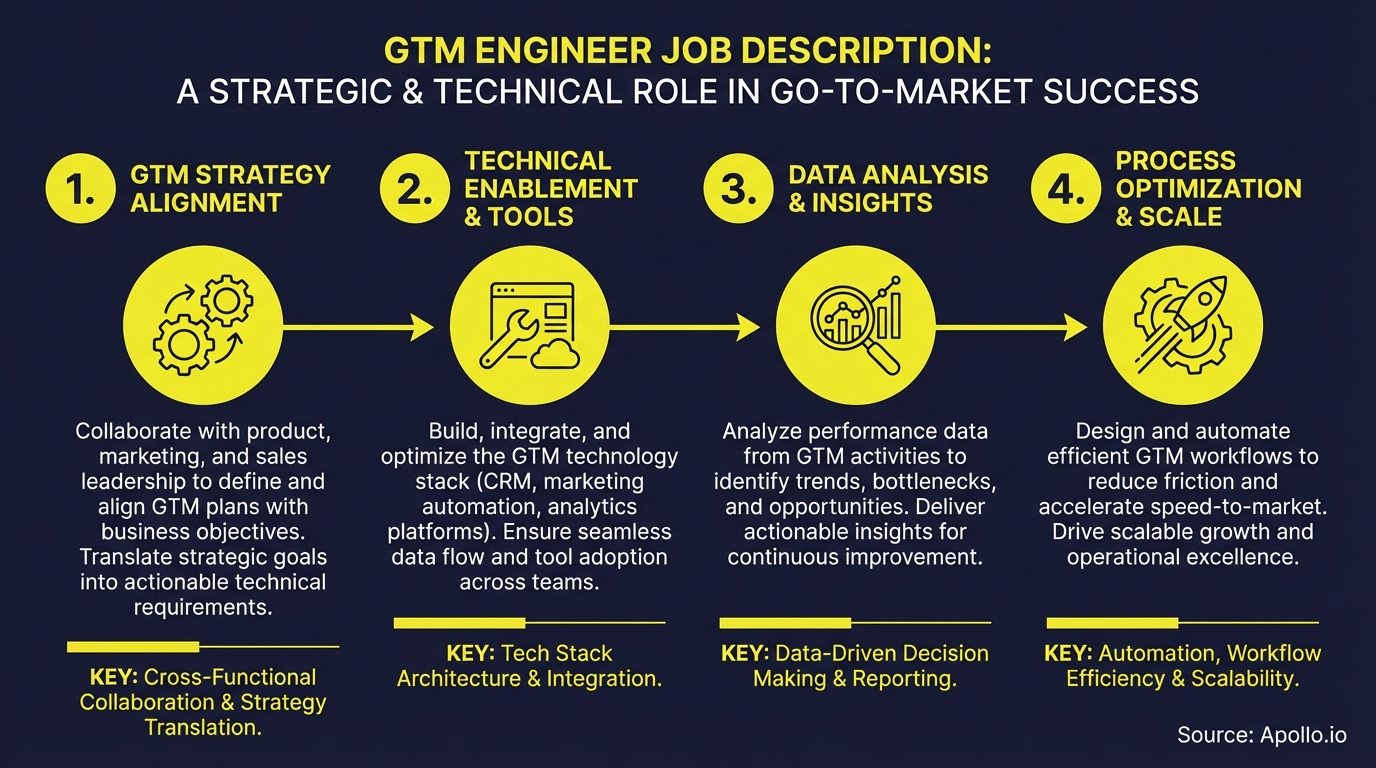
A GTM Engineer is a revenue systems architect who designs, builds, and maintains the technical infrastructure that powers go-to-market motions at scale.
Unlike traditional sales operations roles that focus on CRM administration and reporting, GTM Engineers write SQL queries, build API integrations, configure workflow automation platforms, and implement AI-powered systems that reduce manual work across sales, marketing, and customer success teams.
The role emerged from a fundamental market shift. RevOps Coop reports that 75% of B2B buyers prefer a rep-free experience, creating demand for self-serve buyer journeys and automated qualification systems that GTM Engineers design and implement.
These professionals translate business requirements into technical workflows. They don't just connect tools — they architect end-to-end systems where data flows automatically, scoring models prioritize accounts in real-time, and AI handles research while humans focus on judgment and relationship-building.
What Does A GTM Engineer Do Day-To-Day?
GTM Engineers spend their time building systems that operationalize revenue strategy. Their work focuses on reducing friction, automating repetitive tasks, and creating visibility into what's actually working.
A typical day includes configuring data enrichment workflows that append firmographic and technographic signals to lead records automatically. They build scoring models that rank accounts based on fit, intent, and engagement, then create routing logic that assigns high-priority accounts to the right sellers within minutes.
They implement AI-powered content generation systems that research accounts and draft personalized outreach at scale. According to Revenue Operations Alliance, automating marketing and sales workflows is a core function, enabling teams to maintain personalization without sacrificing speed.
GTM Engineers also maintain data integrity by building validation rules, deduplication processes, and hygiene automation. They create dashboards that surface actionable insights, run experiments to optimize conversion rates, and document systems so teams can operate workflows independently.
How Does A GTM Engineer Differ From RevOps?
GTM Engineers build new systems. RevOps professionals maintain and optimize existing ones.
The distinction matters because organizations often confuse these complementary roles. RevOps teams focus on process design, cross-functional alignment, forecasting accuracy, and strategic planning.
They define what should happen. GTM Engineers make it happen by writing the code, configuring the platforms, and implementing the technical workflows.
For a detailed comparison of these roles, see our analysis of gtm engineer vs revops.
RevOps owns the strategy layer — territory design, comp plans, funnel definitions, and go-to-market planning. GTM Engineers own the execution layer — data pipelines, integration architecture, automation workflows, and technical implementation.
The relationship is symbiotic. RevOps identifies the business problem (misaligned lead scoring reduces conversion rates by 40%).
GTM Engineers build the technical solution (a multi-signal scoring model that updates in real-time and triggers automated routing).
What Are The Core Responsibilities In A GTM Engineer Job Description?
Modern GTM Engineer job descriptions organize responsibilities around five pillars that directly impact revenue outcomes.
| Responsibility Area | Key Deliverables | Business Impact |
|---|---|---|
| Data Architecture & Enrichment | Build automated enrichment workflows, maintain data quality standards, implement validation rules | Clean, complete records that enable accurate segmentation and personalization |
| Scoring & Prioritization Systems | Configure multi-signal scoring models, implement real-time updates, correlate scores with outcomes | Sales teams focus on accounts most likely to convert, increasing win rates and pipeline velocity |
| Workflow Automation | Design and implement lead routing, sequence triggers, task creation, and stakeholder notifications | Faster response times, consistent follow-up, reduced manual work |
| AI System Implementation | Configure AI research agents, prompt engineering, content generation, human review workflows | Scalable personalization without proportional headcount increases |
| Analytics & Optimization | Build performance dashboards, run conversion experiments, document learnings | Data-driven decision making and continuous improvement of GTM systems |
These responsibilities require technical skills that traditional sales operations roles never demanded. GTM Engineers write SQL to query data warehouses, use APIs to connect systems, configure no-code/low-code platforms to automate workflows, and implement AI tools that require prompt engineering and governance frameworks.
What Technical Skills Should GTM Engineer Job Descriptions Require?
Effective GTM Engineer job descriptions specify both technical capabilities and business acumen. The role demands fluency in tools, languages, and platforms that power modern revenue operations.
Core technical requirements include SQL for data analysis and segmentation, JavaScript or Python for custom integrations and scripts, and API literacy to connect disparate systems. GTM Engineers work with workflow automation platforms, CRM configuration, data enrichment tools, and increasingly, AI orchestration platforms that require prompt engineering and governance design.
Struggling to build the technical infrastructure your GTM Engineer needs to succeed? Start with Apollo's data enrichment and automation platform to create the foundation for scalable revenue systems.
Business skills matter equally. GTM Engineers must understand sales methodologies, buyer journey mapping, funnel economics, and conversion optimization.
They translate business requirements into technical specifications, which demands the ability to ask clarifying questions, document requirements, and communicate trade-offs to non-technical stakeholders.
The strongest candidates demonstrate systems thinking — the ability to see how changes in one part of the GTM motion affect other components. They anticipate unintended consequences, design for scale from day one, and build maintainable systems that teams can operate without constant engineering support.
What Does A 90-Day GTM Engineer Onboarding Plan Look Like?
The fastest path to value follows a structured implementation plan that delivers measurable wins in each 30-day increment. This phased approach balances quick wins with foundational systems that compound over time.
| Phase | Timeline | Focus Areas | Key Deliverables |
|---|---|---|---|
| Foundation | Days 1-30 | Audit existing systems, identify data gaps, document current workflows | Complete system inventory, prioritized project roadmap, quick-win implementations (basic enrichment, simple routing rules) |
| Intelligence | Days 31-60 | Implement scoring models, build AI research workflows, create review processes | Multi-signal account scoring, automated research agents, human-in-the-loop approval workflows |
| Automation | Days 61-90 | Scale workflows, optimize performance, train teams on systems | End-to-end automation of high-volume workflows, performance dashboards, team training documentation |
Turn Stale Leads Into Revenue With Apollo
Running out of fresh, qualified leads while your pipeline stays empty. Apollo delivers 224M verified contacts with 96% email accuracy—so you can fill your funnel with buyers who actually convert. Join 550K+ companies building predictable pipeline.
Start Free with Apollo →The foundation phase establishes credibility through small wins while building deep system knowledge. GTM Engineers audit data quality, identify the highest-impact gaps, and implement targeted fixes that improve day-to-day operations immediately.
The intelligence phase introduces systems that change how teams prioritize and personalize. Scoring models rank the entire addressable market based on fit and intent.
AI research agents gather account intelligence automatically. Review workflows let humans focus on high-value accounts while automation handles the long tail.
The automation phase connects these components into cohesive systems. Scoring triggers routing.
Routing triggers research. Research feeds content generation.
Content enters sequences. Outcomes update scoring weights.
The system learns and improves continuously.
For teams looking to accelerate this timeline, Apollo's GTM Engineering (GTME) Program provides a 12-week engagement where a dedicated Go-to-Market Engineer implements these systems in parallel with your current operations, eliminating the opportunity cost of trial-and-error implementation.

How Should GTM Engineer Job Descriptions Define Success Metrics?
Outcome-oriented GTM Engineer job descriptions specify measurable KPIs that tie technical implementation directly to revenue impact.
Leading indicators track system health and adoption. These include data completeness percentages (target: 95%+ of records with required fields populated), workflow automation rates (target: 80%+ of routine tasks automated), and team adoption metrics (target: 90%+ of sellers using prioritized account lists).
Lagging indicators measure business outcomes. Successful GTM Engineers improve conversion rates at each funnel stage, reduce time-to-first-touch after lead creation, increase the percentage of accounts contacted within ideal timing windows, and demonstrate measurable pipeline contribution from implemented systems.
The strongest job descriptions quantify expectations. They specify targets like "implement scoring models that correlate r > 0.7 with closed-won outcomes" or "reduce manual research time by 60%+ through automated enrichment workflows" or "increase qualified meeting rate by 25%+ through improved targeting and personalization."
These metrics create accountability and align GTM Engineers with revenue goals rather than activity metrics. The role succeeds when systems drive measurable improvements in pipeline generation, conversion rates, and sales cycle length.
What AI Governance Should GTM Engineer Job Descriptions Include?
AI implementation without governance creates risk. Modern GTM Engineer job descriptions specify responsibilities for designing and maintaining AI systems that balance automation with oversight.

Governance frameworks address four critical areas. First, data quality standards that ensure AI systems train on accurate, complete information.
Second, prompt engineering guidelines that create consistent, on-brand outputs across use cases. Third, human review workflows that catch errors before they reach prospects.
Fourth, performance monitoring that tracks AI accuracy and continuously improves outputs.
GTM Engineers implement human-in-the-loop systems where AI handles research and drafting while humans review high-priority accounts, approve content before it sends, provide feedback that improves accuracy, and maintain the judgment that AI cannot replicate.
Documentation matters as much as implementation.
GTM Engineers create runbooks that specify when to use AI versus manual processes, define approval thresholds for different content types, document prompt templates and expected outputs, and establish escalation paths when systems produce unexpected results.
For detailed implementation frameworks, explore our comprehensive gtm playbook that covers AI governance, workflow design, and system optimization strategies.
How Are GTM Engineer Job Descriptions Evolving In 2026?
Job descriptions increasingly split into two distinct tracks. Internal GTM Engineers focus on building revenue systems, pipeline generation workflows, and operational automation.
Customer-facing GTM Engineers work with enterprise customers on implementation, enablement, and solutions engineering.
AI responsibilities moved from "nice-to-have" to core requirements. Job descriptions now specify experience with agentic AI workflows, prompt engineering, and semi-autonomous systems that operate with minimal human intervention.
Data engineering expectations rose significantly. Companies now require SQL fluency, API integration experience, and comfort working with data warehouses and event-based automation platforms — not just point-and-click CRM configuration.
Outcome ownership entered the job description. GTM Engineers face accountability for pipeline creation, conversion rate improvements, and cycle time reduction — measured like growth roles rather than support functions.
Tooling consolidation became an explicit responsibility. As companies combat stack bloat, GTM Engineers must evaluate, implement, and maintain integrated platforms that reduce the complexity of managing dozens of disconnected tools.
What Should Compensation Look Like In GTM Engineer Job Descriptions?
Industry salaries for GTM Engineers typically range from $132,000 to $241,000, reflecting the specialized technical and strategic skills the role demands. For a detailed breakdown of compensation structures, see our analysis of gtm engineer salary trends.
Compensation structures often include base salary plus variable components tied to system performance and business outcomes. Some organizations structure GTM Engineer roles with quota attainment bonuses linked to pipeline contribution from implemented systems, while others use project-based incentives for delivering specific technical milestones.
Equity participation varies by company stage and role scope. Early-stage companies often offer meaningful equity stakes to GTM Engineers who build foundational revenue systems.
Later-stage organizations typically offer smaller equity packages but higher base salaries and more predictable variable compensation.
What Resources Help GTM Engineers Succeed After Hiring?
Successful organizations provide GTM Engineers with technical infrastructure, strategic context, and cross-functional access that enable independent execution.
Technical infrastructure includes consolidated platforms that reduce integration complexity. Apollo's perspective is that the best GTM Engineer isn't a tool sommelier stitching together disparate systems — they're a revenue strategist who deploys elegant solutions at high velocity using unified platforms.
Strategic context comes from documented go-to-market strategy, ideal customer profiles, buyer journey maps, and historical performance data. GTM Engineers build better systems when they understand business context, not just technical requirements.
Cross-functional access matters because GTM systems touch every revenue function. Effective GTM Engineers maintain regular touchpoints with sales leadership (strategy and priorities), marketing teams (campaign execution and lead generation), customer success (expansion and retention workflows), and product teams (usage data and feature adoption signals).
Looking to scale your GTM systems without the complexity of managing multiple vendors? Explore Apollo's unified GTM platform that consolidates prospecting, engagement, and analytics in one workflow.
How Can Companies Attract Top GTM Engineer Candidates?
The strongest GTM Engineer job descriptions emphasize three elements that differentiate opportunities.
First, they articulate the business problem being solved. Generic descriptions that list tools and responsibilities fail to attract strategic candidates.
The best job descriptions explain the revenue challenge (we're expanding into enterprise and need systems that scale without proportional headcount increases) and the opportunity (build foundational systems that will power a 3x revenue growth trajectory).
Second, they specify the technology stack and technical environment. Candidates want to know whether they'll spend time duct-taping legacy systems or building modern workflows on integrated platforms.
Transparency about current state and future vision helps candidates self-select.
Third, they demonstrate organizational commitment to GTM systems. Candidates assess whether the role reports to revenue leadership (signal of strategic importance) or gets buried in IT (signal of tactical execution).
They evaluate whether the company allocates budget for modern tooling or expects GTM Engineers to make do with outdated systems.
Organizations serious about GTM Engineering invest in the role's success. They provide access to leadership, allocate meaningful budgets for tooling and infrastructure, and measure success based on business outcomes rather than completed tickets.
Prove Apollo's ROI In Your First 90 Days
Budget approval stuck on unclear metrics? Apollo delivers measurable pipeline impact from day one—so you can justify expansion with real revenue data. Built-In increased win rates 10% and ACV 10% using Apollo's signals and guidance.
Start Free with Apollo →Ready to build GTM systems that actually scale? Start Prospecting with Apollo's all-in-one platform and experience how unified data, intelligent automation, and AI-powered workflows eliminate the integration overhead that slows most GTM teams down.
Don't miss these
Sales
Inbound vs Outbound Marketing: Which Strategy Wins?
Sales
What Is a Sales Funnel? The Non-Linear Revenue Framework for 2026
Sales
What Is a Go-to-Market Strategy? The 2026 GTM Playbook
See Apollo in action
We'd love to show how Apollo can help you sell better.
By submitting this form, you will receive information, tips, and promotions from Apollo. To learn more, see our Privacy Statement.
4.7/5 based on 9,690 reviews
