What Is Founder Led Sales? The 2026 Buyer Enablement Framework
Founder led sales is a go-to-market strategy where company founders personally drive early sales conversations, customer discovery, and revenue generation. This approach leverages the founder's unique credibility, product knowledge, and vision to close initial deals and validate product-market fit before scaling a dedicated sales team.
In 2026, founder led sales has evolved beyond transactional outreach. According to Embryo, 96% of decision-makers conduct their own research before engaging with a salesperson. This shift demands that founders create self-serve buyer enablement assets, not just send cold emails.

Stop Manual Research—Apollo Finds Contacts Fast
Tired of spending 4+ hours daily hunting for contact info? Apollo delivers 224M verified contacts with 96% email accuracy. Join 550K+ companies who turned research time into selling time.
Start Free with Apollo →Key Takeaways
- Founder led sales combines direct outreach with thought leadership to educate buying groups and accelerate consensus
- Tech founder-led companies demonstrate a significant 30% growth rate, according to Ramp&D
- Modern buyers prefer rep-free experiences, requiring founders to build omnichannel distribution models (in-person, remote, digital self-serve)
- Success metrics include pipeline velocity, buying-group alignment, and transition readiness benchmarks
- AI tools and unified platforms enable founders to scale outreach without expanding headcount prematurely
Why Founder Led Sales Drives Higher Growth in 2026
Founder led sales is NOT about founders doing everything forever. It's about leveraging founder credibility to validate assumptions, build repeatable processes, and de-risk the transition to a scalable sales organization.
Research from Ramp&D shows tech founder-led companies have demonstrated a significant 30% growth rate, substantially outpacing other businesses that experienced a 6.7% growth. This performance gap stems from three advantages:
| Founder Advantage | Impact on Sales | Buyer Benefit |
|---|---|---|
| Product Vision Authority | Can commit to roadmap changes in real-time | Faster deal cycles, custom solutions |
| Market Credibility | Thought leadership creates inbound demand | Pre-educated buyers, stronger trust signals |
| Customer Discovery Access | Direct feedback loop to product development | Better product-market fit, fewer pivots |
"Apollo gets us the people we need to speak to. Without that, there's no business."
Turn Forecast Chaos Into Revenue Confidence
Pipeline forecasting a guessing game? Apollo reveals deal stage visibility and buying signals in real-time. Built-In increased win rates 10% with Apollo's intelligence.
Start Free with Apollo →The 2026 Buyer Enablement Framework for Founders
Traditional founder-led sales focused on high-touch outreach. The 2026 model recognizes that buyers want optionality. You need assets that work across three channels:
Omnichannel Distribution Model
In-Person (33% of buyers): Executive roundtables, industry events, customer advisory boards. Use these for enterprise deals and relationship-building.
Remote (33% of buyers): Product demos, consultative calls, video presentations. Most founder time should go here for efficiency.
Digital Self-Serve (33% of buyers): Pricing pages, demo libraries, comparison guides, internal alignment kits. These assets do the heavy lifting before the first call.
Need to identify and prioritize your ideal prospects? Apollo's search filters help founders focus on accounts most likely to convert.

Buyer Enablement Asset Suite
Modern B2B buying involves 6-10 stakeholders. Your job is to arm champions with assets that prevent internal stalls:
- One-Pagers: Problem-solution fit for each persona (technical, financial, security)
- Objection Memos: Pre-written responses to common blockers (pricing, integration, compliance)
- ROI Calculators: Quantified business case templates champions can customize
- Security/Compliance FAQs: Answers to procurement and legal questions
- Competitive Comparisons: Neutral feature matrices that highlight differentiation
These assets reduce time-to-close because buyers can self-educate and build internal consensus without waiting for your next meeting.
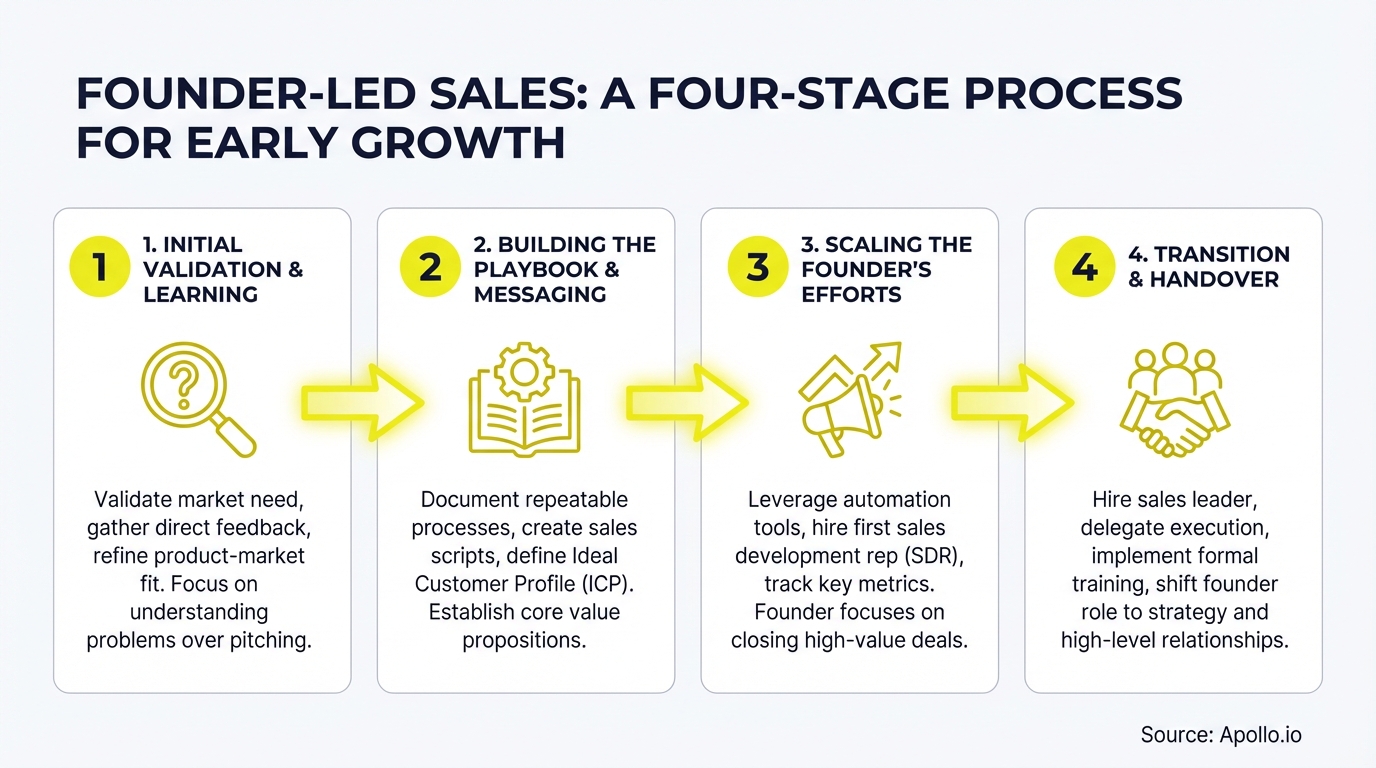
How to Implement Founder Led Sales in 4 Phases
Phase 1: Foundation (Weeks 1-4)
Define your Ideal Customer Profile (ICP) using firmographic and behavioral data. Document your value proposition for each buyer persona.
Set up a lightweight CRM to track conversations and pipeline velocity.
Build your initial prospect list using verified B2B contact data to ensure you're reaching decision-makers, not gatekeepers.
Phase 2: Outreach (Weeks 5-12)
Launch multi-channel sequences combining email, phone, and social outreach. Test 3-5 messaging angles to identify what resonates. Track open rates, reply rates, and meeting conversion.
"I love the fact that everything is in there together. It's all streamlined and connected."
Use sales automation to scale personalized outreach without sacrificing quality.
Phase 3: Process Documentation (Weeks 13-20)
Record successful discovery calls and demo flows. Create battle cards for common objections. Build a sales playbook documenting what works (messaging, qualification criteria, demo structure).
This documentation becomes the training manual for your first sales hire. Without it, you'll lose institutional knowledge during the transition.
Phase 4: Transition Readiness (Months 6-12)
Hire your first Account Executive when you have 10-15 closed deals and repeatable process documentation. Maintain founder involvement in enterprise deals and strategic accounts.
Shift founder time to thought leadership and product development.
For guidance on scaling beyond founder-led sales, explore revenue operations frameworks that align sales, marketing, and customer success.
Metrics That Matter for Founder Led Sales
Track these KPIs to measure progress and identify bottlenecks:
| Metric Category | Key Metrics | Target Benchmarks |
|---|---|---|
| Activity | Outreach volume, meetings booked | 20-30 new conversations/week |
| Conversion | Meeting-to-opportunity, opportunity-to-close | 30% meeting-to-opp, 20% opp-to-close |
| Velocity | Average sales cycle length | 30-90 days (varies by ACV) |
| Efficiency | Time per deal, deals per month | 10-15 hours per closed deal |
Use sales analytics to identify which activities correlate with closed revenue, then double down on what works.

Common Mistakes Founders Make in Sales
Mistake 1: Over-engineering the process too early. You don't need a complex CRM workflow for your first 10 deals. Use spreadsheets and simple tools until patterns emerge.
Mistake 2: Skipping process documentation.
If it's only in your head, you can't scale it.
Record calls, document objections, and create templates as you go.
Mistake 3: Hiring sales too early. Reps can't sell what you haven't validated. Wait until you have 10-15 closed deals and a repeatable playbook.
Mistake 4: Treating all channels equally. Most founders waste time on low-ROI activities. Test, measure, and reallocate time to what converts.
Tools That Multiply Founder Productivity
The right tech stack prevents founders from getting buried in manual work. Prioritize tools that consolidate multiple functions:
- Prospecting: Verified contact databases with filtering for ICP targeting
- Engagement: Multi-channel sequences (email, phone, social) with AI personalization
- Meetings: Calendar automation and AI-powered call summaries
- Pipeline: Visual deal tracking and forecasting dashboards
For a comprehensive breakdown, see our guide on building a sales tech stack that scales revenue.
When and How to Transition Beyond Founder Led Sales
The transition point varies by business model, but watch for these signals:
- You've closed 10-15 deals with repeatable messaging and process
- Sales cycles are predictable (you can forecast close dates within 2 weeks)
- Your time is better spent on product, fundraising, or strategic partnerships
- Inbound demand exceeds your capacity to handle conversations
When you hire your first sales rep, maintain founder involvement in enterprise deals and customer advisory boards. Your credibility remains an asset even after you've scaled the team.
Conclusion: Founder Led Sales as a Competitive Advantage
Founder led sales isn't a temporary phase to survive until you can afford real salespeople. It's a strategic advantage that validates your market, builds your brand, and creates the foundation for scalable growth.
The founders who win in 2026 combine direct outreach with thought leadership, buyer enablement assets, and AI-powered productivity tools. They don't just sell—they educate buying groups, reduce friction, and build repeatable systems.
Ready to scale your founder-led sales motion? Request a Demo to see how Apollo consolidates prospecting, engagement, and pipeline management into one workspace.
Prove Apollo's ROI In Your First 30 Days
Budget approval stuck on unclear metrics? Apollo tracks every touchpoint from prospect to closed deal—quantifying time saved, pipeline generated, and win rates improved. Customer. io achieved 50% YoY growth with measurable Apollo impact.
Start Free with Apollo →Don't miss these
Sales
Inbound vs Outbound Marketing: Which Strategy Wins?
Sales
What Is a Sales Funnel? The Non-Linear Revenue Framework for 2026
Sales
What Is a Go-to-Market Strategy? The 2026 GTM Playbook
See Apollo in action
We'd love to show how Apollo can help you sell better.
By submitting this form, you will receive information, tips, and promotions from Apollo. To learn more, see our Privacy Statement.
4.7/5 based on 9,690 reviews
