
Digital Sales Rooms: What They Are and Why B2B Teams Need Them
B2B buyers now expect seamless digital experiences throughout their entire purchase journey. According to Gartner, 80% of B2B sales interactions occur in digital channels. Digital sales rooms meet this demand by creating centralized, personalized spaces where buyers access proposals, contracts, product demos, and resources on their own timeline. For enterprise sales teams managing complex deals, this shift from scattered email threads to organized digital hubs accelerates decision-making and improves win rates.

Apollo Eliminates 4+ Hours Of Daily Research
Tired of spending 4+ hours daily hunting for contact info? Apollo delivers 224M verified contacts with 96% email accuracy instantly. Join 550K+ companies who stopped manual prospecting.
Start Free with Apollo →Key Takeaways
- Digital sales rooms centralize all deal content in one buyer-accessible space, reducing friction and accelerating sales cycles by 20-30%
- Account Executives using DSRs gain real-time visibility into buyer engagement, enabling data-driven follow-ups that increase close rates
- Proper CRM integration and tech stack consolidation eliminate duplicate data entry and ensure seamless handoffs from SDRs to AEs to CS teams
- ROI measurement requires tracking metrics like time-to-close, content engagement rates, and multi-threading effectiveness across buying committees
- Implementation success depends on change management, with 60% of DSR failures stemming from poor sales team adoption rather than technology limitations
What Are Digital Sales Rooms?
A digital sales room is a secure, personalized online workspace where sellers and buyers collaborate throughout the sales process. Unlike generic file-sharing tools, DSRs provide structured deal progression with mutual action plans, stakeholder tracking, and engagement analytics.
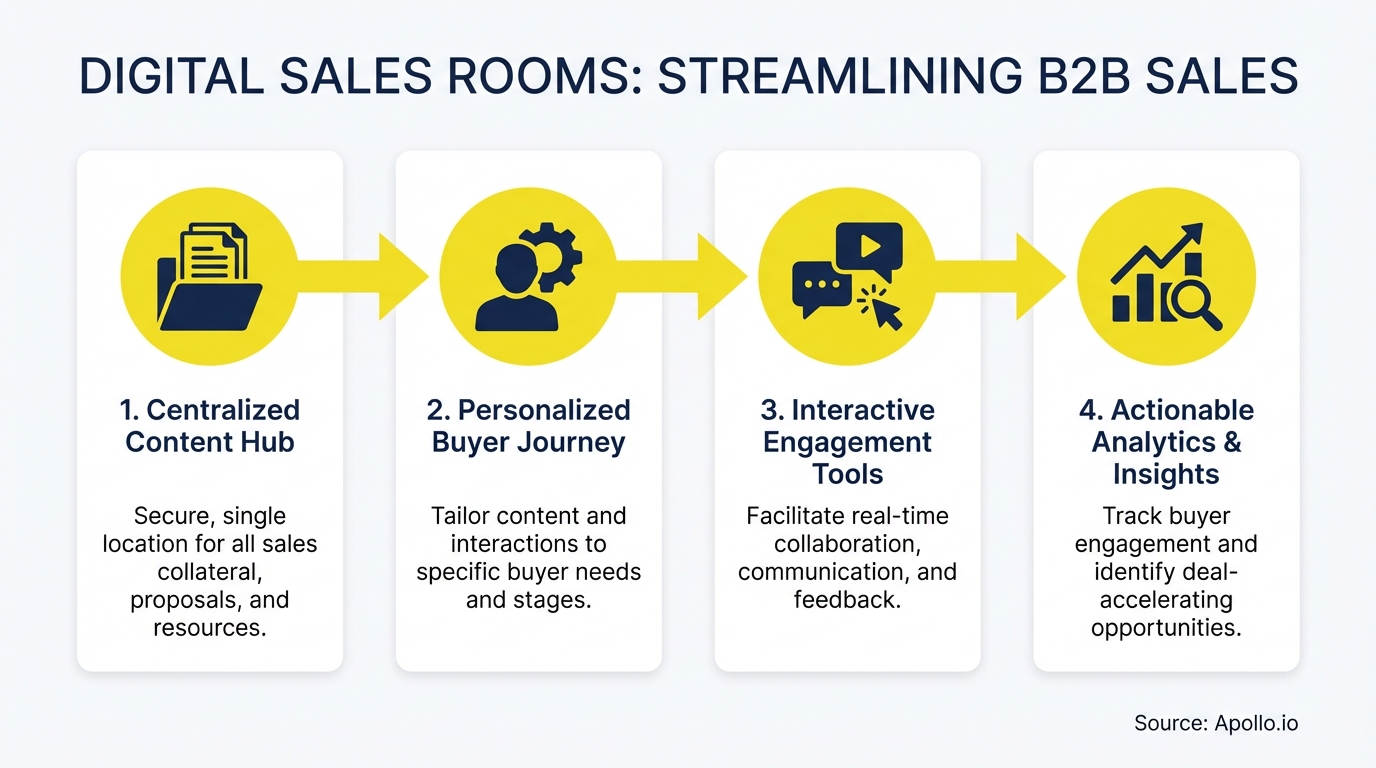
Key components include:
- Content library: Proposals, case studies, product documentation, pricing, and contracts organized by deal stage
- Mutual action plans: Shared timelines with tasks, owners, and deadlines visible to both seller and buyer
- Engagement tracking: Real-time visibility into which stakeholders viewed what content and for how long
- Communication hub: Threaded discussions, Q&A, and asynchronous collaboration tools
Research by McKinsey shows 35% of B2B decision-makers will spend $500,000+ through remote or self-service channels. DSRs enable this high-value digital buying behavior by providing structure and transparency.
How Do Account Executives Use Digital Sales Rooms to Close More Deals?
Account Executives leverage DSRs to orchestrate complex, multi-stakeholder deals with full visibility into buyer engagement. Instead of guessing who's reviewing proposals, AEs see exactly which executives accessed pricing, which technical leads downloaded security documentation, and which champions shared content internally.

Practical AE workflows include:
- Multi-threading: Create stakeholder-specific content sections (CFO sees ROI calculators, IT sees integration guides, end-users see product demos)
- Objection handling: Upload competitive battle cards, compliance documentation, and customer testimonials proactively based on engagement patterns
- Deal momentum: Track days since last buyer activity, automatically triggering follow-up sequences when deals go cold
- Internal alignment: Give SEs, RevOps, and leadership real-time deal room access without forwarding endless email chains
Struggling to track deal progress across scattered emails and meetings? Centralize your pipeline with Apollo's deal management platform.

What Are the Core Technical Components of a Digital Sales Room?
Effective DSR architecture requires integration across your entire go-to-market tech stack. The core technical foundation includes CRM synchronization, content management, identity/access control, and analytics infrastructure.
| Component | Function | Integration Requirements |
|---|---|---|
| CRM Sync | Bi-directional data flow for contacts, activities, deal stages | Salesforce/HubSpot API, webhook triggers, field mappings |
| Content Repository | Centralized asset library with version control and permissions | Google Drive/SharePoint/Dropbox connectors, SSO authentication |
| Analytics Engine | Engagement tracking, attribution modeling, predictive scoring | Event tracking pixels, data warehouse integration, BI tool exports |
| Communication Layer | Email notifications, in-app messaging, calendar integration | SMTP configuration, calendar API (Google/Outlook), Slack webhooks |
For RevOps teams, the integration architecture determines whether DSRs eliminate manual work or create another data silo. Proper implementation routes engagement data back to your CRM, enriches contact records with buying signals, and triggers automated workflows based on buyer behavior.
Turn Forecast Guesswork Into Revenue Certainty
Pipeline forecasting a guessing game? Apollo's real-time deal intelligence reveals exactly where opportunities stand. Built-In boosted win rates 10% with Apollo's scoring and signals.
Start Free with Apollo →How Do You Implement a Digital Sales Room Strategy Step-by-Step?
Successful DSR implementation follows a phased approach starting with pilot programs before full rollout. Organizations that skip pilot testing face 60% higher failure rates due to poor change management and misaligned content strategies.
Phase 1: Foundation (Weeks 1-4)
- Define use cases by deal type (enterprise vs mid-market, new business vs expansion)
- Audit existing sales content and identify gaps in buyer journey coverage
- Select pilot team of 5-10 top performers across different segments
- Configure CRM integration and establish data governance policies
Phase 2: Pilot Program (Weeks 5-12)
- Create templates for common deal scenarios with pre-loaded content libraries
- Train pilot users on engagement tracking interpretation and follow-up best practices
- Establish weekly feedback loops to refine templates and workflows
- Track baseline metrics: time-to-close, win rate, buyer engagement scores
Phase 3: Scale and Optimize (Weeks 13+)
- Roll out to broader sales organization with role-specific training (SDRs, AEs, SEs)
- Implement governance model for content updates and template management
- Build analytics dashboards tracking DSR impact on pipeline velocity and conversion
- Integrate AI-powered sales tools for automated content recommendations and buyer intent signals
How Do You Measure ROI and Effectiveness of Digital Sales Rooms?
ROI measurement requires both leading indicators (engagement metrics) and lagging indicators (revenue outcomes). Sales leaders should track a balanced scorecard rather than single metrics to understand true DSR impact.
| Metric Category | Key Indicators | Target Benchmarks (2026) |
|---|---|---|
| Velocity | Average sales cycle length, time in each stage, stalled deal rate | 20-30% reduction in time-to-close |
| Conversion | Win rate by deal size, stage-to-stage progression, champion identification rate | 15-25% increase in overall win rate |
| Engagement | Stakeholder participation rate, content consumption depth, sharing frequency | 60%+ buying committee engagement |
| Efficiency | Content reuse rate, time spent on admin tasks, rep ramp time | 40% reduction in content creation time |
Calculate financial ROI using this formula: [(Incremental revenue from improved win rate + Time savings from efficiency gains) - (DSR platform costs + implementation costs)] / Total investment. Most B2B organizations see 3-5x ROI within 12 months when factoring in faster ramp times and increased deal sizes.
Need better visibility into your sales pipeline and deal progression? Apollo's AI-powered platform provides real-time deal insights and automated next-best-action recommendations.
What Security and Compliance Considerations Matter for Digital Sales Rooms?
For enterprise sales teams handling sensitive buyer information, security architecture determines whether DSRs pass procurement scrutiny. Common blockers include inadequate access controls, unclear data residency policies, and missing compliance certifications.
Critical security requirements:
- Access control: Role-based permissions, time-limited sharing links, watermarked documents, and activity audit logs
- Data protection: Encryption at rest and in transit (AES-256), SOC 2 Type II compliance, GDPR/CCPA data processing agreements
- Identity management: SSO integration (SAML/OAuth), multi-factor authentication, automatic session timeouts
- Content governance: Version control, expiration policies for outdated materials, approval workflows for regulated industries
For heavily regulated industries (healthcare, financial services, government), additional requirements include data residency controls, advanced threat protection, and detailed compliance reporting for audits. RevOps teams should involve InfoSec and Legal early in vendor selection to avoid procurement delays.
How Can Sales Leaders Drive Adoption and Change Management?
Technology implementation fails without user adoption. The primary barrier isn't feature complexity but rather changing ingrained seller behaviors and demonstrating clear value over existing workflows.
Proven adoption strategies for sales leaders:
- Executive sponsorship: CRO or VP Sales must use DSRs in their own deal reviews, making adoption a visible priority
- Incentive alignment: Tie DSR usage to quarterly bonuses or SPIFs for early adopters who achieve target engagement metrics
- Just-in-time training: Replace lengthy onboarding sessions with short videos and practical sales development playbooks embedded in workflow
- Champion network: Identify power users who achieve quick wins, then leverage them as peer coaches and template creators
- Data-driven coaching: Use engagement analytics in 1-on-1s to coach reps on content effectiveness and follow-up timing
Track adoption through activity metrics (percentage of deals with active DSRs, average content items per room, buyer engagement rates) rather than just login frequency. Sustainable adoption requires demonstrating ROI at the individual rep level through faster quota attainment and larger deal sizes.
Why Digital Sales Rooms Matter More in 2026
The shift to digital-first B2B buying is permanent and accelerating. Sales teams that master digital sales rooms gain competitive advantage through better buyer experiences, faster deal cycles, and more predictable revenue.
The integration of AI, improved analytics, and seamless tech stack consolidation makes DSRs essential infrastructure rather than optional tools.
For SDRs, BDRs, and Account Executives, DSRs eliminate the friction of scattered communications and provide the structure needed to manage complex, multi-stakeholder deals. RevOps leaders benefit from unified data and clearer attribution.
Sales Leaders gain the visibility required to forecast accurately and coach effectively.
Organizations that implement DSRs strategically with proper integration, governance, and change management see measurable improvements in win rates, sales cycle length, and team efficiency. The key is treating DSRs as a strategic go-to-market initiative rather than just another software purchase.
Ready to consolidate your sales tech stack and accelerate deal velocity? Get leads now with Apollo's all-in-one GTM platform.
Prove Apollo's Value In Your First Week
Budget approvals stuck on unclear pipeline metrics? Apollo tracks every touchpoint from first contact to closed deal. Built-In increased win rates 10% and ACV 10% with Apollo's deal intelligence.
Start Free with Apollo →Don't miss these
Sales
Inbound vs Outbound Marketing: Which Strategy Wins?
Sales
What Is a Sales Funnel? The Non-Linear Revenue Framework for 2026
Sales
What Is a Go-to-Market Strategy? The 2026 GTM Playbook
See Apollo in action
We'd love to show how Apollo can help you sell better.
By submitting this form, you will receive information, tips, and promotions from Apollo. To learn more, see our Privacy Statement.
4.7/5 based on 9,690 reviews
