InsightsSalesWhat Is a Cross Functional Team and How to Build One That Drives Revenue
What Is a Cross Functional Team and How to Build One That Drives Revenue
February 26, 2026
Written by The Apollo Team
What Is a Cross Functional Team and How to Build One That Drives Revenue
Cross functional teams bring together people from sales, marketing, product, and operations to solve complex business problems. When done right, they accelerate revenue growth and improve customer outcomes.
When done poorly, they create coordination overhead and slow decision-making.
The difference comes down to operating discipline: shared goals, clear decision rights, and systems that prevent misalignment. According to Revenue Memo, companies that achieve sales and marketing alignment grow 19% faster and are 15% more profitable than their misaligned peers. Yet most organizations struggle to operationalize cross-functional collaboration beyond occasional alignment meetings.
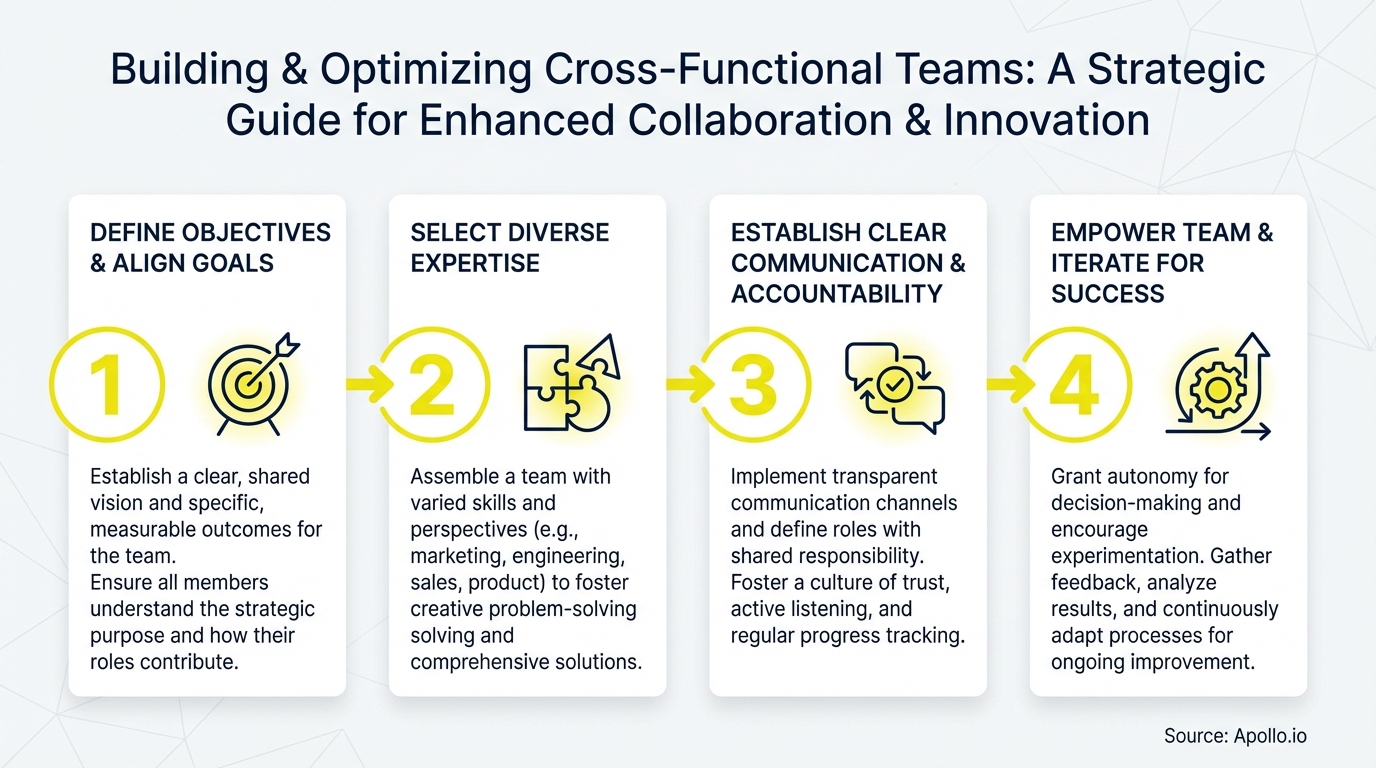
A four-step process diagram illustrates building and optimizing cross-functional teams with icons and descriptions.
MANUAL LEAD RESEARCH TIME WASTE
Apollo Eliminates 4+ Hours Of Daily Research
Tired of spending 4+ hours daily hunting for contact info? Apollo delivers 224M verified contacts with 96% email accuracy—instantly. Join 550K+ companies who stopped manual prospecting and started closing deals.
Cross functional teams unite sales, marketing, product, and operations around shared revenue goals and buyer journey metrics
Organizations with aligned teams experience measurably higher revenue growth, but 84% of marketers report high collaboration drag without proper operating models
Success requires explicit governance: DACI/RACI frameworks, intake processes, SLAs, and shared data systems
RevOps is emerging as the default operating system for cross-functional GTM teams in 2026
AI adoption increases both productivity and risk, making cross-functional governance more critical than ever
What Is a Cross Functional Team?
A cross functional team is a group of people from different departments working together toward a shared objective. In B2B organizations, this typically means sales, marketing, product marketing, customer success, and revenue operations collaborating on initiatives like product launches, account-based strategies, or content programs.
Cross functional teams are NOT ad hoc collaboration. They require formal structure: defined roles, decision rights, workflows, and accountability metrics.
Without these elements, teams default to consensus-driven processes that create coordination overhead rather than velocity.
Core characteristics of high-performing cross functional teams:
Shared outcome metrics (pipeline, revenue, retention) rather than functional KPIs
Clear decision-making authority using frameworks like DACI or RACI
Unified data systems that eliminate version-control conflicts and manual handoffs
Defined SLAs for requests, reviews, and escalations
Regular operating cadences with pre-defined agendas and decision points
Why Cross Functional Teams Matter in 2026
Three forces are making cross-functional collaboration a competitive requirement: budget pressure, AI adoption, and buyer complexity.
Budget constraints are forcing tool consolidation and process efficiency. Marketing budgets fell to 7.7% of company revenue in 2024, down from 9.1% in 2023.
Organizations are rationalizing tech stacks and eliminating redundant workflows. Cross-functional teams enable shared tooling and content reuse across marketing, sales, and customer teams.
Struggling with disconnected data across your revenue stack? Apollo's unified platform eliminates manual handoffs between prospecting, engagement, and deal execution.
AI is increasing output volume while raising quality and compliance risk. 81% of B2B marketers now use generative AI tools, but without cross-functional governance, teams create brand inconsistencies, legal exposure, and factual errors at scale. Research from Gartner shows 84% of marketing leaders and employees report experiencing high levels of "collaboration drag" when working with other functions.
B2B buying committees are larger and harder to align. Gartner reports 74% of buyer teams demonstrate unhealthy conflict during decision processes.
Winning deals requires coordinated stakeholder plays across sales, marketing, and product teams to create consensus rather than just generating leads.
"We reduced the complexity of three tools into one. We're getting higher reply rates, open rates are doubled, meetings are up, and speed to booking a meeting is cut in half."
The ROI of Cross Functional Alignment
Cross-functional alignment delivers measurable business outcomes. According to We Are All Connected, organizations with well-aligned sales and marketing teams typically experience 39% higher revenue growth compared to those with poor alignment.
The revenue impact comes from three operational improvements:
Operational Improvement
Revenue Impact
How to Measure
Shared buyer journey insights
2.3x higher conversion rates
Stage-to-stage conversion metrics across marketing and sales
Unified GTM data and processes
3x revenue growth vs. misaligned peers
Year-over-year revenue growth rate
Sales-marketing collaboration on commercial activities
15% increase in success rate
Win rate on qualified opportunities
Need a unified system for prospecting, engagement, and pipeline management? Apollo consolidates your GTM stack so cross-functional teams work from the same data and workflows.
How to Structure Cross Functional Teams for Revenue
High-performing cross functional teams require explicit operating models. Here's a blueprint based on revenue operations best practices:
Use DACI or RACI to Clarify Decision Rights
DACI defines who is the Driver (owns execution), Approver (final decision), Contributor (provides input), and Informed (stays updated). RACI uses similar logic: Responsible, Accountable, Consulted, Informed.
Example DACI for a product launch content program:
Without clear decision rights, teams default to consensus-driven processes that slow execution. McKinsey research shows 3 in 4 cross-functional teams underperform on key metrics without operating discipline.
Define Intake Processes and SLAs
Cross-functional requests need structured intake to prevent ad hoc Slack escalations. Define submission forms, approval criteria, and response SLAs.
Sample SLA framework:
Request Type
Intake Method
Response SLA
Owner
Sales content request
Shared form with context fields
2 business days
Content ops lead
Legal review for external content
Pre-publish checklist submission
3 business days
Legal counsel
Product messaging input
Scheduled PMM review sessions
Weekly cadence
Product marketing
Establish Shared Metrics and Dashboards
Cross functional teams need shared definitions for lifecycle stages, lead quality, and pipeline metrics. Revenue operations typically owns this taxonomy and ensures data consistency across systems.
Critical shared metrics:
MQL-to-SQL conversion rate (marketing and sales both accountable)
Sales cycle length by segment (product, sales, customer success)
Content influence on pipeline (marketing, sales enablement)
Customer health scores (customer success, product, sales)
Looking to align your marketing team structure with revenue goals? Learn how modern teams organize around customer outcomes.
"Having Apollo and having everything be in one system was a game changer — for BDRs specifically."
Four diverse professionals discussing documents at a modern office table.
PIPELINE VISIBILITY GAPS
Turn Forecast Chaos Into Revenue Confidence
Pipeline forecasting a guessing game? Apollo delivers real-time deal intelligence and buyer signals that make your numbers predictable. Built-In boosted win rates 10% with Apollo's scoring.
Generative AI adoption is accelerating content production, but it's also creating new risks: factual errors, brand inconsistencies, copyright exposure, and compliance violations. Cross-functional teams need explicit AI governance.
Common Cross Functional Team Challenges and Solutions
Challenge: Conflicting Priorities Across Functions
Gartner's survey found 90% of marketing and sales executives said their functional priorities conflict. Sales optimizes for short-term pipeline, marketing for long-term brand and demand generation.
Solution: Shared OKRs with joint accountability. Example: "Generate $2M in sales-qualified pipeline from target accounts" (both teams measured on the same number).
Challenge: Data Silos and Version Control Conflicts
Marketing works in one system, sales in another, product in a third. Teams waste time reconciling conflicting data and manually transferring information.
Solution: Unified GTM platform with shared contact, account, and activity data. Need to consolidate your sales tech stack? Apollo eliminates data silos across prospecting, engagement, and pipeline execution.
Challenge: Unclear Decision-Making Authority
Teams default to consensus-driven processes that require everyone's approval, creating bottlenecks and slow execution.
Solution: DACI or RACI frameworks with explicit Approver and Driver roles. Document who makes final decisions and communicate it clearly.
Three colleagues discuss in a modern office, a woman with a tablet and a man with a notebook.
RevOps as the Operating System for Cross Functional Teams
Revenue Operations (RevOps) is emerging as the default operating model for cross-functional GTM teams in 2026. RevOps unifies sales operations, marketing operations, and customer success operations under one function with shared systems, data, and processes.
According to Deloitte Digital, B2B organizations using RevOps were 1.4 times more likely to exceed their 2023 revenue goals by 10% or more, compared to those not using RevOps.
RevOps owns three critical cross-functional capabilities:
Unified data architecture: Single source of truth for contacts, accounts, pipeline, and customer health
Process orchestration: Lead routing, territory assignment, handoff workflows between marketing, sales, and CS
Performance analytics: Shared dashboards, funnel metrics, and revenue forecasting across functions
Want to see how modern sales operations teams are structuring for cross-functional collaboration? Explore operational frameworks that scale.
Implementation: Building Your Cross Functional Team
Phase 1: Define Shared Outcomes (Week 1-2)
Identify the revenue goal or customer outcome the team will own
Draft shared OKRs with input from all functions
Assign executive sponsor with cross-functional authority
Phase 2: Establish Operating Model (Week 3-4)
Document DACI or RACI for key decisions
Create intake forms and SLA commitments
Set up shared Slack channel, project tracker, and meeting cadence
Phase 3: Align Systems and Data (Week 5-8)
Audit current tech stack for redundancies and gaps
Define shared lifecycle stages and field definitions
Implement unified platform or data integration layer
Phase 4: Launch and Iterate (Week 9+)
Run pilot program with defined scope and metrics
Conduct bi-weekly retrospectives to surface blockers
Refine workflows based on actual usage patterns
Conclusion: Cross Functional Teams Drive Revenue When Structure Supports Strategy
Cross functional teams are not a nice-to-have collaboration model. They are a competitive requirement in 2026 as budgets tighten, AI adoption accelerates, and buyer committees become more complex.
The organizations that win are those that operationalize cross-functional collaboration with explicit governance: shared metrics, clear decision rights, unified data systems, and RevOps-driven process orchestration. Companies that achieve this alignment grow 19% faster and are 15% more profitable than their peers.
Start by defining shared outcomes, establishing operating discipline with DACI/RACI frameworks, and consolidating your GTM tech stack to eliminate data silos and manual handoffs.
Ready to unify your cross-functional revenue team on one platform? Start Free with Apollo and eliminate the coordination overhead holding your team back.
REVENUE GROWTH
Prove Apollo's ROI In Your First 30 Days
Budget approval stuck on unclear metrics? Apollo delivers measurable pipeline impact from day one—quantifiable time savings, faster deal velocity, and real revenue growth. Customer. io achieved 50% YoY growth with Apollo's automation.